
BuddhistCatholicContemplativeEvangelicalGeneral ChristianHinduJewishLatter-day SaintMuslimNew VisionsProgressive Christian
Beliefs
- Buddhist
- Catholic
- Contemplative
- Evangelical
- General Christian
- Hindu
- Jewish
- Latter-day Saint
- More Voices
- Muslim
- New Visions
- Pagan
- Progressive Christian
Topics
- Religion News
- Food and Religion
- Sports and Religion
- Religious Art
- Religious Music and Entertainment
- Religious Events
- History and Religion
- Style and Religion
- Politics and Religion
- Women in Religion
- Recreation Outdoors and Religion
- Business Finance and Religion
- Careers Workplace and Religion
- Education and Religion
- Family Parenting and Religion
- Health Fitness and Religion
- Home and Religion
- Relationships and Religion
- Technology and Religion
- Travel and Religion
Columnists
- Buddhist Columnists
- Business Finance and Religion Columnists
- Careers Workplace and Religion Columnists
- Catholic Columnists
- Contemplative Columnists
- Education and Religion Columnists
- Evangelists Columnists
- Family Parenting and Religion Columnists
- General Christian Columnists
- Health Fitness and Religion Columnists
- Hindu Columnists
- History and Religion Columnists
- Home and Religion Columnists
- Jewish Columnists
- More Voices Columnists
- Latter Day Columnists
- Muslim Columnists
- New Visions Columnists
- Nonreligious Columnists
- Pagan Columnists
- Politics and Religion Columnists
- Progressive Columnists
- Recreation Outdoors and Religion Columnists
- Relationships and Religion Columnists
- Religion News Columnists
- Religious Art Columnists
- Religious Events Columnists
- Religious Music and Entertainment Columnists
- Sports and Religion Columnists
- Style and Religion Columnists
- Technology and Religion Columnists
- Travel and Religion Columnists
- Women in Religion Columnists
Resource Library
- 2026 Calendar
- Library of World Religions
- The 100 Most Holy Places on Earth
- Patheos Answers
- Podcasts
- Videos
- Faith Leaders Database
- Anglican Episcopalian
- Bahai
- Baptist
- Buddhism
- Christianity
- Confucianism
- Eastern Orthodoxy
- Hinduism
- Holiness and Pentecostal
- ISKCON
- Islam
- Judaism
- Lutheran
- Methodist
- The Church of Jesus Christ of Latter-day Saints
- New Age
- Paganism
- Presbytarian and Reformed
- Protestantism
- Religion Behind the Scenes
- Roman Catholic
- Scientology
- Shia Islam
- Sikhism
- Sufism
- Sunni Islam
- Taoism
- Zen
- See all religions
Research Tools
 Ad-Free & Subscriber Log-In Subscription Support
Ad-Free & Subscriber Log-In Subscription Support
Follow Patheos 

- Trending:
- Forgiveness
- |
- Marriage
- |
- Consciousness
- |
- Death Penalty
- |
- Election
- |
- Halloween
 Cultivare
- Home
- Evangelical
- Why do Artists Cry?
Why do Artists Cry?
Last updated on: July 19, 2012 at 5:03 pm by Kyle Roberts
Why do Artists Cry? 2012-07-19T17:03:29-04:00 Kyle Roberts
Patheos Explore the world's faith through different perspectives on religion and spirituality! Patheos has the views of the prevalent religions and spiritualities of the world.
This is a guest post by Steph Roberts, an artist and art professor in Chicago. She also happens to be my sister. For more information on her and her work (with samples) go here
Why do Artists Cry?
It’s a bit awkward losing one’s composure in an art museum. The hushed, reserved, brightly lit galleries of the Minneapolis Institute of Arts may seem an unlikely place to see someone wiping away tears in a gush of emotion. It was opening day at the  Rembrandt in America exhibition, and I had been looking at his Self-Portrait of 1659 for a while. As an artist, I tend to edge my way up close to paintings and make the guards nervous as I squint at the surface of the work. I was eyeing the small blob of warm white highlight skimmed over the nose, and peering into the gray hollows that created cool tones in the skin. I am never more in awe of technique than when I look closely at a Rembrandt, but this virtuosic use of paint touched me because of something greater than the sum of its parts. How a work of art is made can set the stage for its impact, but the real meaning of art comes through how it shakes us, lingers in our minds, gives us the tingles. What is it about art that can speak to us so mysteriously, so that we are at once struck, pierced, and yet unable to articulate exactly what it has done to us?
The emotional moment I had in Minneapolis came just as my brother approached to exchange comments in front of the self-portrait. I think I muffled something to him like, “This one kills me. It just kills me,” and then I immediately went searching for a less crowded section of the gallery to collect myself, dry my face, and return my breathing to normal. The notion of a painting “killing” or “slaying” a viewer, in a manner of speaking, certainly is weird in today’s culture, but turns out is not unique to me, as recounted in James Elkins compelling book Pictures and Tears. He writes in eloquent terms about viewers’ accounts of breaking down while looking at art and the elusive meaning of these encounters.
The encounters I have described …are responses to painting’s plenitude. They are recoils from painting’s pressure, its insistent presence. We can no longer have blazing, shattering religious encounters with paintings. We can’t be crippled, or receive the stigmata. But we can be winded, and even knocked down. We can feel an uncanny residue, an inexplicable supplement, an aura, a presence that is indisputably there even if no one can see it. In saying so we link hands back to a distant past when that thing had the single name God.
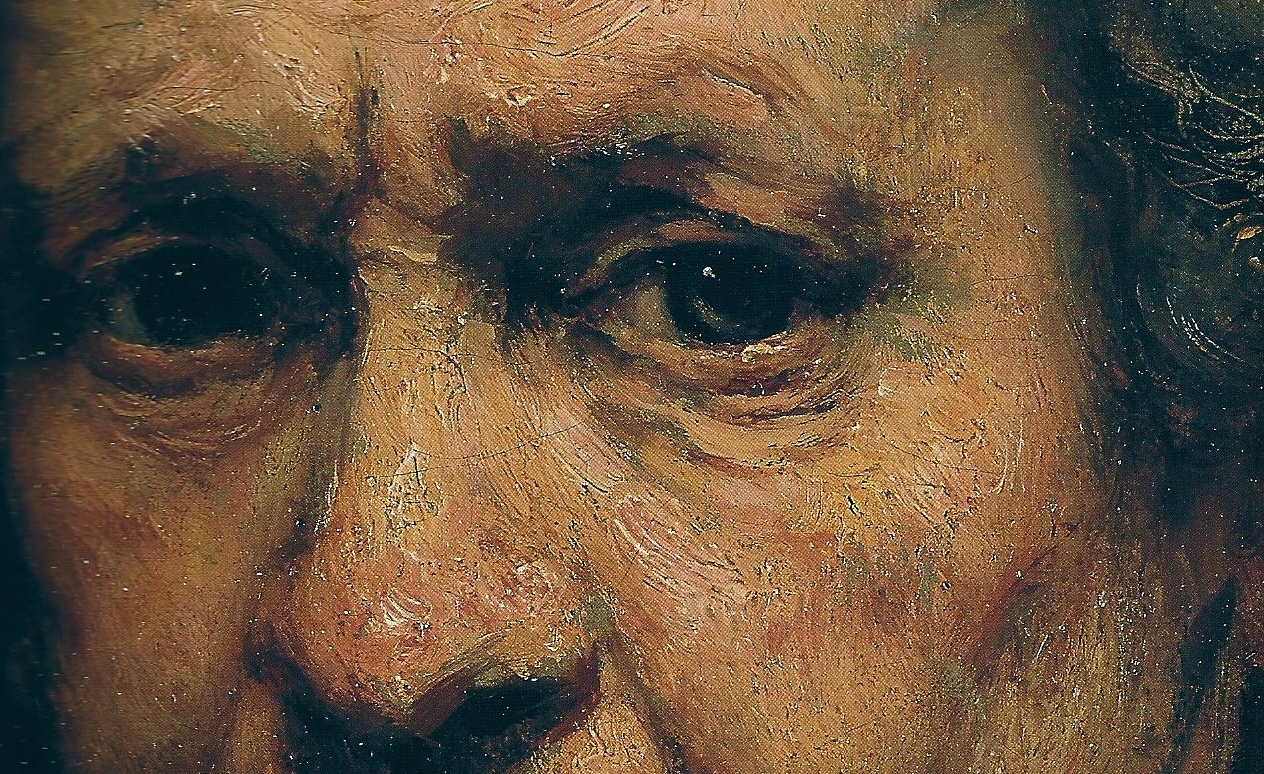
It would figure that this connection could be felt strongly across the disciplines – a reader of a work of literature with a lump in her throat from a sense of hearing the author speak directly to her, an intent listener to a Chopin sonata experiencing moments of euphoria that feel like transport through time to the mind of the composer. I should not have been caught off guard to the extent I was in Minneapolis because this happened to me before years ago at the Metropolitan Museum of Art, in front of another Rembrandt Self-Portrait. There is an undeniable directness unique to self-portraits (they are looking at you, after all), and a slightly unnerving effect that we as viewers are seeing the artist through the two-way mirror of the painting. As Rembrandt studies his face for nuances of form to record with his brush, one might imagine he may also be rehearsing his regrets, his scars of loss, or considering his own vanity. At the risk of sounding like a romantic, I will say that I felt as I stood in front of his painting like I was seeing him, that he was suddenly in the room, his gaze both formidable and vulnerable. Yes, Rembrandt was a successful artist with throngs of imitators, a long list of important commissions, but here in these mature self-portraits he showed himself to be very human, saggy-cheeked, and wounded by life. Familiarity with his story gained during my visit to his house and studio in Amsterdam (Rembrandthuis museum), instills a good deal of empathy for him, knowing that he lost his first love, his fortune, and would lose all his children before his death. Yet, there’s something more, or more significant than sadness that broke me down.
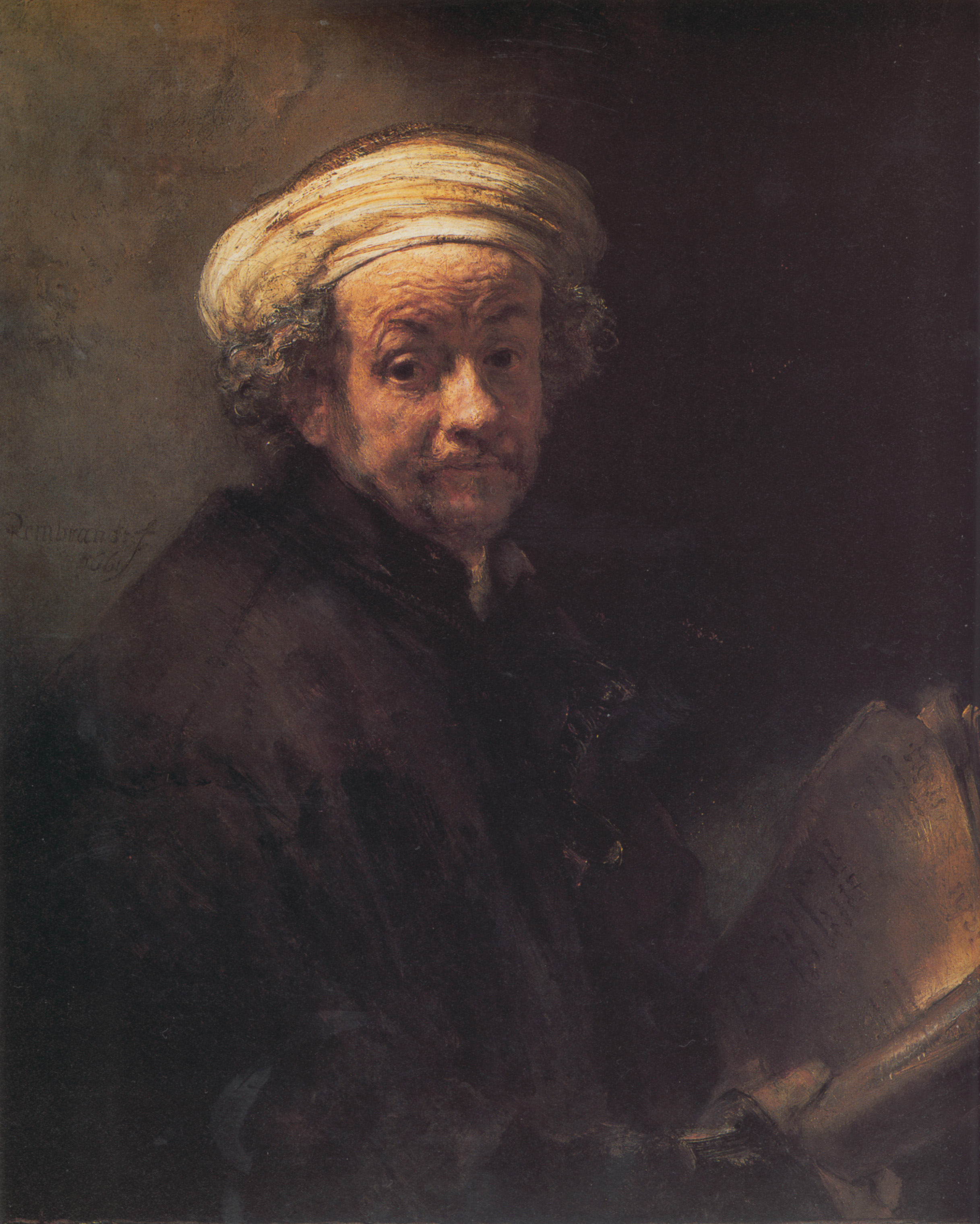 I remember when I was a young teenager looking in the mirror and having the odd sensation of saying to myself, “That’s me. That’s really me.” as though my psyche and my physical body were somehow at odds, or hadn’t quite married together fully. Rembrandt’s self-portraits touch on this peculiarity of being a stranger to the physical vessel of your own body. In others of his self-portraits, he actually portrays himself as someone else in exploration of his religious identity. In one (see image on left), he depicted himself as Paul the Apostle -not as a powerful leader of the early church, but an unassuming, ordinary, almost melancholic man. Rembrandt painted his face with incredible looseness, facility and concreteness, and through that brushwork, a soul ekes out. Perhaps it is this God factor that made me cry — that the same God who gave Rembrandt his eternal soul is at the end of our search for meaning. Perhaps looking into Rembrandt’s eyes gave way to seeing the Creator behind them. Perhaps that presence I felt was not only palpably human, but also mysteriously divine.
Previous Post

July 18, 2012
Summer Reading
Next Post
July 20, 2012 Zombies, Gnosticism, and the Departure of Hope
Browse Our Archives
Select a Category Alex Blondeau Authors Daniel Harrell Daniel Siedell Dawn Duncan Harrell Kyle Roberts Uncategorized Wyndy Corbin
Select a Month November 2014 October 2014 September 2014 August 2014 July 2014 June 2014 May 2014 April 2014 March 2014 February 2014 January 2014 December 2013 November 2013 October 2013 September 2013 August 2013 July 2013 June 2013 May 2013 April 2013 March 2013 February 2013 January 2013 December 2012 November 2012 October 2012 September 2012 August 2012 July 2012 June 2012 May 2012
TAKE THE
Religious Wisdom Quiz
What does Hebrews say Jesus learned through what he suffered?
Select your answer to see how you score.
Mercy Humility Compassion Obedience
Related posts from Cultivare


Young Evangelicals and the "Nones": Jumping Ship


Calling For Public Theology (A Brief Convocation Address)
TRENDING AT PATHEOS Evangelical

The REST of Your Life: A Creative Wrestles...
This week I had a conversation with a good friend from church....

How the author of the world's best hymn...
I've been working with John Newton for a while now. This makes...

Long before this Lectio Divina, Psalm 130 - the song - started...

What About the Trees? Another Living Parable
After I finished writing the last article about falling leaves as a...

Why Classical Education Is a Conversation, Not a...
Come and Read: Joy in Classical Education When I was a little...

Cornell University has received a great deal of negative publicity and intense...
view all Evangelical blogs
Ad-Free & Subscriber Log-In Subscription Support
- About Us
- 2026 Calendar
- Videos
- Podcasts
- Library of World Religions
- Faith In Media Tracker
- Advertise With Us
- Write for Us
- Privacy Policy
- Terms of Service
- Do Not Sell My Data
- Contact Us
- Radiant Digital
- Manage Newsletter Subscriptions
- Unsubscribe From Notifications
- Sitemap
Copyright 2008-2026, Patheos. All rights reserved.
Subscription Support Ad-Free & Subscriber Log-In
Follow Patheos