
BuddhistCatholicContemplativeEvangelicalGeneral ChristianHinduJewishLatter-day SaintMuslimNew VisionsProgressive Christian
Beliefs
- Buddhist
- Catholic
- Contemplative
- Evangelical
- General Christian
- Hindu
- Jewish
- Latter-day Saint
- More Voices
- Muslim
- New Visions
- Pagan
- Progressive Christian
Topics
- Religion News
- Food and Religion
- Sports and Religion
- Religious Art
- Religious Music and Entertainment
- Religious Events
- History and Religion
- Style and Religion
- Politics and Religion
- Women in Religion
- Recreation Outdoors and Religion
- Business Finance and Religion
- Careers Workplace and Religion
- Education and Religion
- Family Parenting and Religion
- Health Fitness and Religion
- Home and Religion
- Relationships and Religion
- Technology and Religion
- Travel and Religion
Columnists
- Buddhist Columnists
- Business Finance and Religion Columnists
- Careers Workplace and Religion Columnists
- Catholic Columnists
- Contemplative Columnists
- Education and Religion Columnists
- Evangelists Columnists
- Family Parenting and Religion Columnists
- General Christian Columnists
- Health Fitness and Religion Columnists
- Hindu Columnists
- History and Religion Columnists
- Home and Religion Columnists
- Jewish Columnists
- More Voices Columnists
- Latter Day Columnists
- Muslim Columnists
- New Visions Columnists
- Nonreligious Columnists
- Pagan Columnists
- Politics and Religion Columnists
- Progressive Columnists
- Recreation Outdoors and Religion Columnists
- Relationships and Religion Columnists
- Religion News Columnists
- Religious Art Columnists
- Religious Events Columnists
- Religious Music and Entertainment Columnists
- Sports and Religion Columnists
- Style and Religion Columnists
- Technology and Religion Columnists
- Travel and Religion Columnists
- Women in Religion Columnists
Resource Library
- 2026 Calendar
- Library of World Religions
- The 100 Most Holy Places on Earth
- Patheos Answers
- Podcasts
- Videos
- Faith Leaders Database
- Anglican Episcopalian
- Bahai
- Baptist
- Buddhism
- Christianity
- Confucianism
- Eastern Orthodoxy
- Hinduism
- Holiness and Pentecostal
- ISKCON
- Islam
- Judaism
- Lutheran
- Methodist
- The Church of Jesus Christ of Latter-day Saints
- New Age
- Paganism
- Presbytarian and Reformed
- Protestantism
- Religion Behind the Scenes
- Roman Catholic
- Scientology
- Shia Islam
- Sikhism
- Sufism
- Sunni Islam
- Taoism
- Zen
- See all religions
Research Tools
 Ad-Free & Subscriber Log-In Subscription Support
Ad-Free & Subscriber Log-In Subscription Support
Follow Patheos 

- Trending:
- Forgiveness
- |
- Marriage
- |
- Consciousness
- |
- Death Penalty
- |
- Election
- |
- Halloween
 Cultivare
- Home
- Evangelical
- Art and Karma: A Report from India
Art and Karma: A Report from India
Last updated on: July 18, 2012 at 6:35 pm by Daniel A. Siedell
Art and Karma: A Report from India 2012-07-18T18:35:44-04:00 Daniel A. Siedell
Patheos Explore the world's faith through different perspectives on religion and spirituality! Patheos has the views of the prevalent religions and spiritualities of the world.
 I spent last week in Hyderabad, India leading an arts in ministry track at the fourth annual India YCL Conference sponsored in part by One Hope, one of the more exciting and intellectually dynamic missions organizations in North America. Founded by Bob Hoskins in 1987 and located in Pompano Beach, Florida, the mission of the organization is simple yet ambitious—get the Word of God to children around the world. Its reach is aggressively global, working in over 140 countries and with close partnerships with local churches and organizations in every country. It is also emerging as a leader in global evangelism in the twenty-first century with its outcomes-based research, creative means to deliver Scripture to the world’s youth, and innovative partnerships. In addition, it makes its missions research and experience available to local churches in North America as a means to help them reach their local communities with the gospel.
The YCL conference in India is one of the means by which One Hope grows and cultivates young leaders in the Indian church, equipping them to develop ways to impact children and young people, in partnership with a local community development foundation and the New Life Assemblies of God. The fourth annual YCL conference attracted over two hundred and fifty young people to the two-day conference to participate in one of four tracks: business development, led by Hope Foundation director George Hoskins; technology and social media, led by Brian Boyd of Media Connect Partners in New York City; film and storytelling, with Phil and Kathleen Cooke of Cooke Pictures, based in Southern California; and the arts track, led by me. Rob Hoskins, President of One Hope, led an adjacent track for pastors, with Keith Boyer and Jurie Kriel, to help pastors encourage and disciple these young people in their congregations.
An important part of the conference was offering the opportunity for attendees to work together to design and develop practical ministry projects. Some of the attendees will be selected to continue work on their ministry projects as part of a four-month Creative Lab initiative, giving these young men and women support and resources to help them realize their ministry vision.
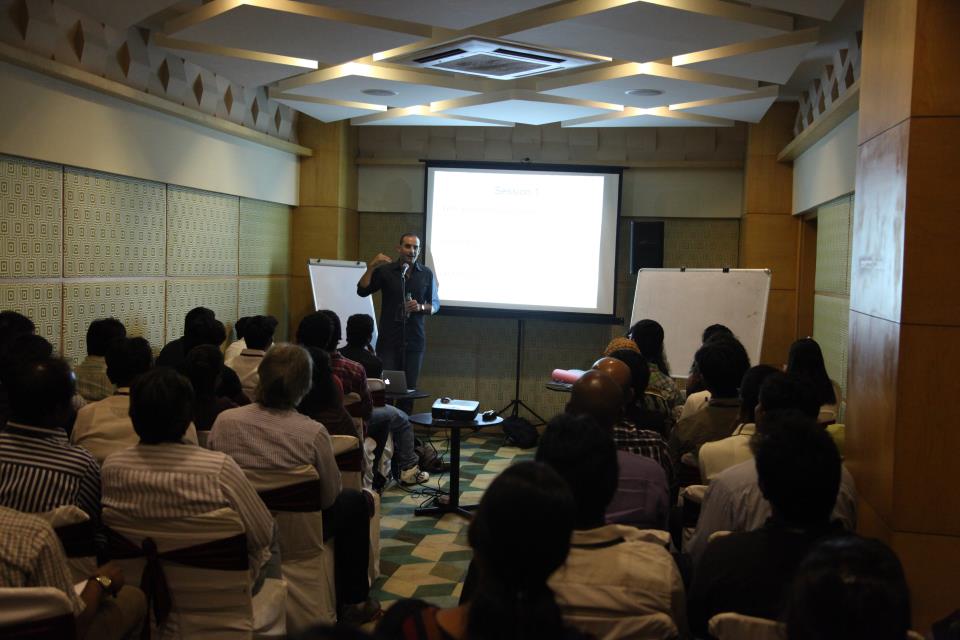 The Arts Workshop at YCL Conference, Hyderabad, India
My approach to the arts track was two-fold, to develop a robust Reformational theological foundation for the importance and necessity of the arts in the church and to create a safe space for artists to meet others who share their interests as well as face the challenges they experience in the church, which, like the evangelical church in North America, is often threatened by them. The keynote address by Rob Hoskins offered a passionate and informed declaration of the importance for the arts and creativity in the contemporary church and thus served as an important introduction to the work I intended to do.
My theological foundation offered a theology of creation: God continues to call his creation very good, coming to us through our senses. I then explored a theology of culture: that God has given us the responsibility and desire to cultivate his creation. As Andy Crouch observed in his book, Culture Making: “culture is what we make of the world…to take the world as it’s given to us and make something else.” And finally I presented a theology of vocation, of calling, offering a biblical basis for the use of their talents and passions to edify the church, serve as a witness in their particular part of culture, and to serve their neighbor.
I also discussed the importance of the wonderful “uselessness” of art as a witness to the operation of grace, which undermines and overthrows the transactional, law-based regime of this world, testifying to an alien presence that is not of this world. Art distinguishes itself from advertising, propaganda, and other art-related practices because it is not a means but an end in itself. It exists as a gift from the artist to the viewer, listener, reader, to be enjoyed in itself. In this way art destroys the concept of Karma, revealing, if only for a moment, that we ultimately do not get what we deserve and that the foundation of the world is a gift—one-way, unconditional love. The very existence of art testifies to a promise (grace) that will overwhelm the powers of this world (law). This idea is especially difficult in Indian culture, which is predicated on an intricate transactional and highly leveraged economy of gift and hospitality that obligates and binds the recipient. In the course of our discussions, we talked about the challenges of producing explicitly “Christian art,” given the fact that most art in Indian culture is made within and for a specific religious tradition, of which there are many. And so we discussed the possibility that a powerful “Christian art” may be an art that resists that temptation to narrow its audience, choosing rather to expand and not restrict art’s scope to one’s own religious community, confident that the Lord is the Lord and Savior of all peoples, and offering to their audience an experience that is expansively human, and not merely “Hindu,” “Muslim,” or “Christian” (or “Western”).
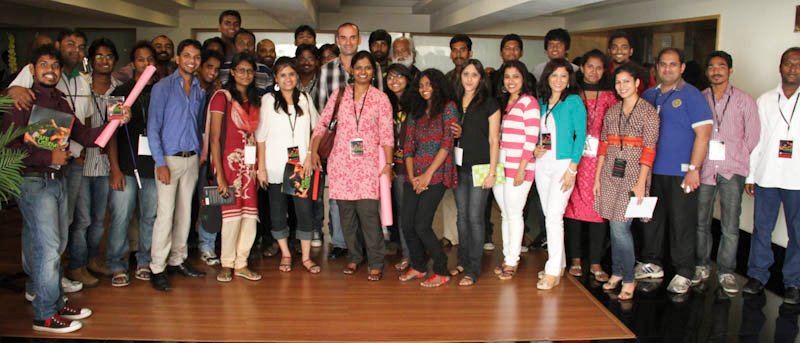 Participants in the Arts Track
Perhaps the most important part of the two-day conference was the opportunity for artists to meet others and develop relationships that support their work and their walk with Christ. Most artists in the church experience isolation, are looked at with suspicion, both by their families, who want them to do something more practical, and their church leaders, who are worried that their creativity will compromise doctrinal stability and disturb traditional practices. Far from accommodating art, the Gospel demands it. Art is not a marginal practice on the fringe of both contemporary culture and the church, but is at the heart of God’s work in both. Therefore, I urged them not to remain isolated and on the margins. Many of these young artists are planning to meet together for bible studies, reading groups, and informal critiques, in which they share their work. And I will look forward to offering guidance and resources as well as initiating and facilitating on-line discussions. Artists in the church, however, don’t often make life easy for their pastors and church leadership. And so I emphasized the importance of using their gifts to serve their pastor and their leadership, to think creatively about ways that they can use their talents to strengthen the local church and its witness to the community. This will help them create a space of trust within the church that will allow them to work productively as artists in the church for the culture.
Previous Post

July 2, 2012
The Moral Vacuum of the Health Care Debates
Next Post
July 4, 2012 Justice for All
Browse Our Archives
Select a Category Alex Blondeau Authors Daniel Harrell Daniel Siedell Dawn Duncan Harrell Kyle Roberts Uncategorized Wyndy Corbin
Select a Month November 2014 October 2014 September 2014 August 2014 July 2014 June 2014 May 2014 April 2014 March 2014 February 2014 January 2014 December 2013 November 2013 October 2013 September 2013 August 2013 July 2013 June 2013 May 2013 April 2013 March 2013 February 2013 January 2013 December 2012 November 2012 October 2012 September 2012 August 2012 July 2012 June 2012 May 2012
TAKE THE
Religious Wisdom Quiz
Proverbs warns against what kind of woman as a symbol of temptation?
Select your answer to see how you score.
Widow Mother-in-law Queen Adulterous woman
Related posts from Cultivare



TRENDING AT PATHEOS Evangelical

The REST of Your Life: A Creative Wrestles...
This week I had a conversation with a good friend from church....

How the author of the world's best hymn...
I've been working with John Newton for a while now. This makes...

Long before this Lectio Divina, Psalm 130 - the song - started...

What About the Trees? Another Living Parable
After I finished writing the last article about falling leaves as a...

Why Classical Education Is a Conversation, Not a...
Come and Read: Joy in Classical Education When I was a little...

Cornell University has received a great deal of negative publicity and intense...
view all Evangelical blogs
Ad-Free & Subscriber Log-In Subscription Support
- About Us
- 2026 Calendar
- Videos
- Podcasts
- Library of World Religions
- Faith In Media Tracker
- Advertise With Us
- Write for Us
- Privacy Policy
- Terms of Service
- Do Not Sell My Data
- Contact Us
- Radiant Digital
- Manage Newsletter Subscriptions
- Unsubscribe From Notifications
- Sitemap
Copyright 2008-2026, Patheos. All rights reserved.
Subscription Support Ad-Free & Subscriber Log-In
Follow Patheos