
BuddhistCatholicContemplativeEvangelicalGeneral ChristianHinduJewishLatter-day SaintMuslimNew VisionsProgressive Christian
Beliefs
- Buddhist
- Catholic
- Contemplative
- Evangelical
- General Christian
- Hindu
- Jewish
- Latter-day Saint
- More Voices
- Muslim
- New Visions
- Pagan
- Progressive Christian
Topics
- Religion News
- Food and Religion
- Sports and Religion
- Religious Art
- Religious Music and Entertainment
- Religious Events
- History and Religion
- Style and Religion
- Politics and Religion
- Women in Religion
- Recreation Outdoors and Religion
- Business Finance and Religion
- Careers Workplace and Religion
- Education and Religion
- Family Parenting and Religion
- Health Fitness and Religion
- Home and Religion
- Relationships and Religion
- Technology and Religion
- Travel and Religion
Columnists
- Buddhist Columnists
- Business Finance and Religion Columnists
- Careers Workplace and Religion Columnists
- Catholic Columnists
- Contemplative Columnists
- Education and Religion Columnists
- Evangelists Columnists
- Family Parenting and Religion Columnists
- General Christian Columnists
- Health Fitness and Religion Columnists
- Hindu Columnists
- History and Religion Columnists
- Home and Religion Columnists
- Jewish Columnists
- More Voices Columnists
- Latter Day Columnists
- Muslim Columnists
- New Visions Columnists
- Nonreligious Columnists
- Pagan Columnists
- Politics and Religion Columnists
- Progressive Columnists
- Recreation Outdoors and Religion Columnists
- Relationships and Religion Columnists
- Religion News Columnists
- Religious Art Columnists
- Religious Events Columnists
- Religious Music and Entertainment Columnists
- Sports and Religion Columnists
- Style and Religion Columnists
- Technology and Religion Columnists
- Travel and Religion Columnists
- Women in Religion Columnists
Resource Library
- 2026 Calendar
- Library of World Religions
- The 100 Most Holy Places on Earth
- Patheos Answers
- Podcasts
- Videos
- Faith Leaders Database
- Anglican Episcopalian
- Bahai
- Baptist
- Buddhism
- Christianity
- Confucianism
- Eastern Orthodoxy
- Hinduism
- Holiness and Pentecostal
- ISKCON
- Islam
- Judaism
- Lutheran
- Methodist
- The Church of Jesus Christ of Latter-day Saints
- New Age
- Paganism
- Presbytarian and Reformed
- Protestantism
- Religion Behind the Scenes
- Roman Catholic
- Scientology
- Shia Islam
- Sikhism
- Sufism
- Sunni Islam
- Taoism
- Zen
- See all religions
Research Tools
 Ad-Free & Subscriber Log-In Subscription Support
Ad-Free & Subscriber Log-In Subscription Support
Follow Patheos 

- Trending:
- Forgiveness
- |
- Marriage
- |
- Consciousness
- |
- Death Penalty
- |
- Election
- |
- Halloween
 Cry 'Woof'
-
Series
- Home
- Catholic
- Today’s Aquinas: An Opportunity to Make Merry
Today’s Aquinas: An Opportunity to Make Merry
Last updated on: December 21, 2015 at 12:33 pm by willduquette
Today’s Aquinas: An Opportunity to Make Merry 2015-12-21T12:33:26-05:00 willduquette
Patheos Explore the world's faith through different perspectives on religion and spirituality! Patheos has the views of the prevalent religions and spiritualities of the world.
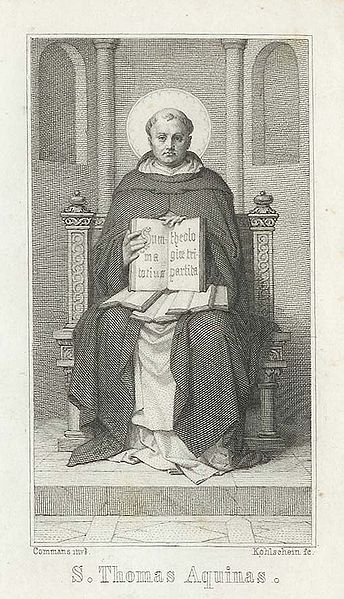 We’re blogging through St. Thomas Aquinas’ Compendium Theologiae, sometimes called his Shorter Summa. Find the previous posts here.
Today’s post is from Chapter 60, “The Number of Relations and the Number of Persons”.
My intent is to blog through the entire Compendium Theologiae, but some chapters I really wish I could skip, and this is one of them. In the past few chapters, Thomas has identified three subsisting persons in God, as defined by five properties or notions: innascibility, paternity, filiation, spiration, and procession. So, someone (not me!) might ask, there are five properties! Why are there not five persons? And Thomas is concerned to reassure them on this point. If you are untroubled by this, you might take this opportunity to finish your Christmas shopping or make merry with your loved ones.
So, once more into the breach, dear friends!
We must realize that, although the relations subsisting in the Godhead are the divine persons themselves, as was stated above, we are not to conclude that there are five or four persons corresponding to the number of relations.
The three divine persons are three subsistent relations in God, and yet there are five notions distinguishing them. Why are there not five persons? The short answer is that the notions are with respect to different persons or pairs of persons. Paternity and filiation—that is, fatherhood and sonship—are opposite ways of looking at the same relation. For the long answer, carry on.
For number follows distinction of some sort. Just as unity is indivisible or undivided, so plurality is divisible or divided. For a plurality of persons requires that relations have power to distinguish by reason of opposition, since formal distinction necessarily entails opposition. If, then, the relations in question are closely examined, paternity and filiation will be seen to have relative opposition to each other; hence they are incompatible in the same suppositum. Consequently paternity and filiation in God must be two subsistent persons.
In other words, a son can’t be his own father or a father his own son, time travel stories notwithstanding. As I said above, these two properties imply exactly two persons. (In this context, a suppositum is a substance, a thing that exists of itself, as opposed to a quality of a thing. Remember, an apple is a substance, its redness is an accident that exists only as a quality of the apple.)
Innascibility, on the other hand, although opposed to filiation, is not opposed to paternity. Hence paternity and innascibility can pertain to one and the same person.
Innascibility is the property of not proceeding from any other person; it’s one of the distinctions of the Father. So the Father can be the Father of the Son, and also be “innascible”.
Similarly, common spiration is not opposed either to paternity or to filiation, nor to innascibility. Thus nothing prevents common spiration from being in both the person of the Father and the person of the Son. Accordingly common spiration is not a subsisting person distinct from the persons of the Father and the Son.
Common spiration is a distinction between the Father and the Son on one hand and the Holy Spirit on the other. The Holy Spirit proceeds from the Father and the Son, as the Creed tells us; and Thomas calls this the common spiration of the Father and the Son. But common spiration is not in anyway opposed to fatherhood or sonship, but to the procession of the Spirit:
But procession has a relation of opposition to common spiration. Therefore, since common spiration pertains to the Father and the Son, procession must be a person distinct from the persons of the Father and the Son.
Thus, we have three subsisting relations: innascibility, to which nothing is opposed; paternity/filiation; and common spiration/procession. But where multiple properties pertain to a person, one is primary:
Accordingly the reason is clear why God is not called “quiune,” quinus, on account of the notions, which are five in number, but is called triune, on account of the Trinity of persons. The five notions are not five subsisting things, but the three persons are three subsisting things. Although several notions or properties may pertain to a single person, only one of them constitutes the person. For a divine person is constituted by the properties, not in the sense that He is constituted by several of them, but in the sense that the relative, subsisting property itself is a person. If several properties were understood as subsisting in themselves apart, they would be several persons, and not one person. Hence we must understand that, of the several properties or notions belonging to a single person, the one that precedes according to the order of nature constitutes the person; the others are understood as inhering in the person already constituted.
But which ones? For the Father, paternity must be primary:
Thus it is evident that innascibility cannot be the first notion of the Father, constituting His person, because nothing is constituted by a negation, and also because affirmation naturally precedes negation. Further, common spiration presupposes paternity and filiation in the order of nature, just as the procession of love presupposes the procession of the Word.
And for the Son, filiation must be primary, and for the Spirit, procession must be primary:
Hence common spiration cannot be the first notion of the Father, or of the Son either. The first notion of the Father is paternity and the first notion of the Son is filiation, whereas procession alone is the notion of the Holy Spirit.
Thus, though we have five notions, only three of them are properties in the proper sense:
Accordingly the notions constituting persons are three in number: paternity, filiation, and procession. And these notions must be strict properties. For that which constitutes a person must pertain to that person alone; individuating principles cannot belong to several individuals. For this reason the three notions in question are called personal properties, in the sense that they constitute the three persons in the manner described. The remaining notions are called properties or notions of the persons, but not personal properties or notions, because they do not constitute a person.
I’m glad that’s all settled.
____
photo credit: Public Domain; source Wikimedia Commons

Previous Post

December 15, 2015
Straw vs. the Symphony of God
Next Post

December 28, 2015 Today's Aquinas: The Missing Chapter 59
Browse Our Archives
Select a Category Admin App o' the Morning Ask the Dogmat Believing Thomas Bits of Fiction Blasts from the Past Bootstrapping the Interior Life Catholic Mom Christian Living Deep Thoughts from the Doghouse Dominicana Evangelii Gaudium Interviews It Was A Dark and Stormy Night Links to This and That Lumen Fidei Meme Watch On Writing Operation Gratitude Pedant Errant Photography Quill Random Barkings S'Mary's World Shakers of Salt Software Development The Dog Whistler The Dogmat Sez Third Orders Thomas Aquinas Uncategorized Vikings at Dinos Woof Guide to Cinema Woof Guide to History Woof Guide to Literature Woof Guide to Obscure Catholic Music Woof Guide to Philosophy Woof Guide to Popular Music Woof Guide to Technology Woof Guide to Theology Words I Wish I'd Written Works For Me
Select a Month September 2016 August 2016 June 2016 May 2016 April 2016 March 2016 February 2016 January 2016 December 2015 November 2015 October 2015 September 2015 August 2015 July 2015 June 2015 May 2015 April 2015 March 2015 February 2015 January 2015 December 2014 November 2014 October 2014 September 2014 August 2014 July 2014 June 2014 May 2014 April 2014 March 2014 February 2014 January 2014 December 2013 November 2013 October 2013
Follow Us!
TAKE THE
Religious Wisdom Quiz
In the Parable of the Pearl of Great Price, what does the merchant do?
Select your answer to see how you score.
Builds a bigger barn Sells all to buy the pearl Finds a lost coin Buys many pearls
Related posts from Cry 'Woof'
Today's Aquinas: Form Over Matter
Today's Aquinas: Only God can Create
Today's Aquinas: Something from Nothing
Today's Aquinas: The Chicken or the Egg
TRENDING AT PATHEOS Catholic

Rejecting Doom: Christian Hope And Human Action
Christianity is a religion of hope. We are to have hope and...

It’s What Comes From Within Which Matters
One of the most difficult things for us to understand is why...

Why I Choose the Eucharist Over the Sermon
Choose the Eucharist, Not the Sermon What are we supposed to get...

5 Design Elements Found in Spiritually Rooted Homes
Putting Spirituality Into Home Decor Our homes are more than our living...

Credo: A Story of God Told with the...
About 10 years ago, I began to imagine a personal "Credo" that...

The Anatomy of Divine Revelation in Catholic Thought
The claim that God has made Himself known to human beings is...
view all Catholic blogs
Ad-Free & Subscriber Log-In Subscription Support
- About Us
- 2026 Calendar
- Videos
- Podcasts
- Library of World Religions
- Faith In Media Tracker
- Advertise With Us
- Write for Us
- Privacy Policy
- Terms of Service
- Do Not Sell My Data
- Contact Us
- Radiant Digital
- Manage Newsletter Subscriptions
- Unsubscribe From Notifications
- Sitemap
Copyright 2008-2026, Patheos. All rights reserved.
Subscription Support Ad-Free & Subscriber Log-In
Follow Patheos