
BuddhistCatholicContemplativeEvangelicalGeneral ChristianHinduJewishLatter-day SaintMuslimNew VisionsProgressive Christian
Beliefs
- Buddhist
- Catholic
- Contemplative
- Evangelical
- General Christian
- Hindu
- Jewish
- Latter-day Saint
- More Voices
- Muslim
- New Visions
- Pagan
- Progressive Christian
Topics
- Religion News
- Food and Religion
- Sports and Religion
- Religious Art
- Religious Music and Entertainment
- Religious Events
- History and Religion
- Style and Religion
- Politics and Religion
- Women in Religion
- Recreation Outdoors and Religion
- Business Finance and Religion
- Careers Workplace and Religion
- Education and Religion
- Family Parenting and Religion
- Health Fitness and Religion
- Home and Religion
- Relationships and Religion
- Technology and Religion
- Travel and Religion
Columnists
- Buddhist Columnists
- Business Finance and Religion Columnists
- Careers Workplace and Religion Columnists
- Catholic Columnists
- Contemplative Columnists
- Education and Religion Columnists
- Evangelists Columnists
- Family Parenting and Religion Columnists
- General Christian Columnists
- Health Fitness and Religion Columnists
- Hindu Columnists
- History and Religion Columnists
- Home and Religion Columnists
- Jewish Columnists
- More Voices Columnists
- Latter Day Columnists
- Muslim Columnists
- New Visions Columnists
- Nonreligious Columnists
- Pagan Columnists
- Politics and Religion Columnists
- Progressive Columnists
- Recreation Outdoors and Religion Columnists
- Relationships and Religion Columnists
- Religion News Columnists
- Religious Art Columnists
- Religious Events Columnists
- Religious Music and Entertainment Columnists
- Sports and Religion Columnists
- Style and Religion Columnists
- Technology and Religion Columnists
- Travel and Religion Columnists
- Women in Religion Columnists
Resource Library
- 2026 Calendar
- Library of World Religions
- The 100 Most Holy Places on Earth
- Patheos Answers
- Podcasts
- Videos
- Faith Leaders Database
- Anglican Episcopalian
- Bahai
- Baptist
- Buddhism
- Christianity
- Confucianism
- Eastern Orthodoxy
- Hinduism
- Holiness and Pentecostal
- ISKCON
- Islam
- Judaism
- Lutheran
- Methodist
- The Church of Jesus Christ of Latter-day Saints
- New Age
- Paganism
- Presbytarian and Reformed
- Protestantism
- Religion Behind the Scenes
- Roman Catholic
- Scientology
- Shia Islam
- Sikhism
- Sufism
- Sunni Islam
- Taoism
- Zen
- See all religions
Research Tools
 Ad-Free & Subscriber Log-In Subscription Support
Ad-Free & Subscriber Log-In Subscription Support
Follow Patheos 

- Trending:
- Forgiveness
- |
- Marriage
- |
- Consciousness
- |
- Death Penalty
- |
- Election
- |
- Halloween
 Cry 'Woof'
-
Series
- Home
- Catholic
- Today’s Aquinas: Why a Trinity? Why not a Quaternity?
Today’s Aquinas: Why a Trinity? Why not a Quaternity?
Last updated on: November 23, 2015 at 6:00 am by willduquette
Today’s Aquinas: Why a Trinity? Why not a Quaternity? 2015-11-22T11:20:11-05:00 willduquette
Patheos Explore the world's faith through different perspectives on religion and spirituality! Patheos has the views of the prevalent religions and spiritualities of the world.
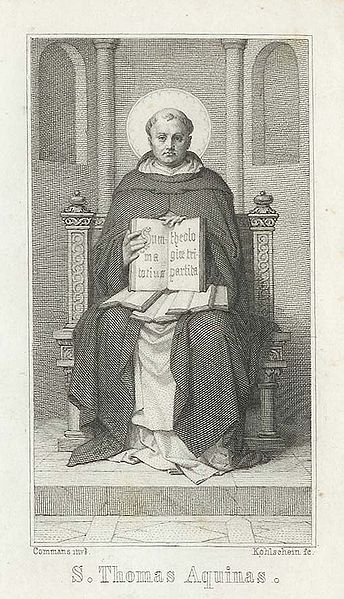 We’re blogging through St. Thomas Aquinas’ Compendium Theologiae, sometimes called his Shorter Summa. Find the previous posts here.
Today’s post is from Chapter 56, “Impossibility of More Than Three Persons in God”.
To some, the doctrine of the Trinity might reasonably seem like a magic trick: given a single God, we pull three persons out of our theological hat. So if three, why not four? Why not ten? Why not a whole pantheon?
In fact, Thomas has carefully ruled this out by his arguments so far; and now he makes that explicit—at great length.
First, the usual way you get multiple things from one thing is by cutting it into pieces, as you might produce a temple's worth of marble pillars from a single slab of marble. But that's not how we get the three Divine persons: we aren't cut God into pieces. God is a single substance, and by His essence has no pieces; that was determined by Thomas' initial argument for the existence of God. So how do we get multiple persons? Here's Thomas' summary:
There cannot be more than three persons in God. For the divine persons cannot be multiplied by a division of their substance, but solely by the relation of some procession; and not by any sort of procession, but only by such as does not have its term in something outside of God.
There's something that God does, by his nature, some action, that both begins and ends with Himself. As He is unchanging, it's something He has therefore done eternally; and since it both begins and ends in Him, it is wholly divine. Thomas has told us about two of these processions: God's knowledge of Himself, and God's love of His own perfect goodness.
God also loves his Creation, but this love isn't a procession in the required sense: Creation is distinct from God, and so God's love of His Creation begins with Him but doesn't end with Him:
If the relation had something external as its term, this would not possess the divine nature, and so could not be a divine person or hypostasis.
The only two processions in God that terminate in God are His knowledge (the operation of His intellect) and his love, the operation of his will:
But procession in God that does not terminate outside of God must be either according to the operation of the intellect, whereby the Word proceeds, or according to the operation of the will, whereby love proceeds, as is clear from our exposition. Therefore no divine person can proceed unless He proceeds as the Word, whom we call the Son, or as love, whom we call the Holy Spirit.
Thus, there are only three: there's only one way there could be a fourth, and there's no matching operation of God terminating in Himself that would give rise to a fourth person in God. (One might ask, how do we know that? We know of only two such processions; perhaps there are more that have not been revealed to us. Perhaps there are an infinite number. If you're interested, see the Summa Theologiae, First Part, Question 30, Article 2, for Thomas' answer.)
OK, so there are only two processions, two actions of God, by which we might get additional persons in God. But what if God takes those actions multiple times? We might get multiple Sons, multiple spirits. No, says Thomas, because truly God acts only once:
Moreover, since God comprehends everything in His intellect by a single act of intuition, and similarly loves everything by a single act of His will, there cannot be several words or several loves in God. If, then, the Son proceeds as Word, and if the Holy Spirit proceeds as love, there cannot be several Sons or several Holy Spirits in God.
Thomas now makes an argument from perfection: a thing is perfect of its kind if it lacks nothing that would make it more itself. Half-an-apple is half an apple; part of it is missing. And if a thing's nature is perfect, then there can't be more than one of it: the one thing of that kind must perfectly express its nature. This is true of the Son and the Spirit, so we can't have more than one of each.
Again: the perfect is that beyond which there is nothing. Hence a being that would tolerate anything of its own class to be outside itself, would fall short of absolute perfection. This is why things that are simply perfect in their natures are not numerically multiplied; thus God, the sun, the moon, and so on. But both the Son and the Holy Spirit must be simply perfect, since each of them is God, as we have shown. Therefore several Sons or several Holy Spirits are impossible.
Note Thomas' observation about the Sun and the Moon. They were thought to be unique, each the perfect singular instance of its kind, perfectly spherical, moving but changing in no other way. (Until the invention of the telescope, the heavenly bodies were thought to be a completely different kind of thing from the matter we have down here.) We now know this to be untrue; moons are a dime-a-dozen in our Solar System, and our Sun is one of many many peers just in our own galaxy. But note that this doesn't contradict Thomas' principle. When we found that the Sun was one star among many, we also found that it wasn't simply perfect in its nature.
And then, identity (as we would say, and identity theft not withstanding) simply isn't something that can be multiplied. That which makes you a unique individual, distinct from other individuals, is naturally something that can't be shared. The Son is identified by the nature of His procession from the Father; the Spirit by the nature of His procession from the Father and the Son. To say that there might be two Sons is to say that there are two persons with the same identity:
Besides, that whereby a subsistent thing is this particular thing, distinct from other things, cannot be numerically multiplied, for the reason that an individual cannot be predicated of many. But the Son is this divine person, subsisting in Himself and distinct from the other divine persons by sonship; just as Socrates is constituted this human person by individuating principles. Accordingly, as the individuating principles whereby Socrates is this man cannot pertain to more than one man, so sonship in the Godhead cannot pertain to more than one divine person. Similar is the case with the relation of the Father and the Holy Spirit. Hence there cannot be several Fathers in God or several Sons or several Holy Spirits.
And then, finally and at last, we get back to form and matter. Remember that physical objects, like stones and apples and dogs and humans, are a composite of form and matter. You and I are both human beings; we share the form of Humanity. We are distinguished by our matter: my matter is right here, whereas yours is over there. Matter multiplies the one form of Humanity into multiple people. But if a thing is immaterial (e.g., mathematical concepts, angels, and God) there is no matter in it, and no way to multiply the form into multiple beings. Thus, you can't have multiple Sons or multiple Spirits in God, since God is immaterial:
Lastly, whatever is one by reason of its form, is not numerically multiplied except through matter; thus whiteness is multiplied by existing in many subjects. But there is no matter in God. Consequently whatever is one in species and form in the Godhead, cannot be multiplied numerically. Such are paternity and filiation and the procession of the Holy Spirit. And thus there cannot be several Fathers or Sons or Holy Spirits in God.
____
photo credit: Public Domain; source Wikimedia Commons

Previous Post

November 16, 2015
Today's Aquinas: One God in Three Persons
Next Post
November 30, 2015 Today's Aquinas: Properties of the Father
Browse Our Archives
Select a Category Admin App o' the Morning Ask the Dogmat Believing Thomas Bits of Fiction Blasts from the Past Bootstrapping the Interior Life Catholic Mom Christian Living Deep Thoughts from the Doghouse Dominicana Evangelii Gaudium Interviews It Was A Dark and Stormy Night Links to This and That Lumen Fidei Meme Watch On Writing Operation Gratitude Pedant Errant Photography Quill Random Barkings S'Mary's World Shakers of Salt Software Development The Dog Whistler The Dogmat Sez Third Orders Thomas Aquinas Uncategorized Vikings at Dinos Woof Guide to Cinema Woof Guide to History Woof Guide to Literature Woof Guide to Obscure Catholic Music Woof Guide to Philosophy Woof Guide to Popular Music Woof Guide to Technology Woof Guide to Theology Words I Wish I'd Written Works For Me
Select a Month September 2016 August 2016 June 2016 May 2016 April 2016 March 2016 February 2016 January 2016 December 2015 November 2015 October 2015 September 2015 August 2015 July 2015 June 2015 May 2015 April 2015 March 2015 February 2015 January 2015 December 2014 November 2014 October 2014 September 2014 August 2014 July 2014 June 2014 May 2014 April 2014 March 2014 February 2014 January 2014 December 2013 November 2013 October 2013
Follow Us!
TAKE THE
Religious Wisdom Quiz
What nation captured Jerusalem and took Daniel captive?
Select your answer to see how you score.
Egypt Assyria Persia Babylonia
Related posts from Cry 'Woof'
Today's Aquinas: Form Over Matter
Today's Aquinas: Only God can Create
Today's Aquinas: Something from Nothing
Today's Aquinas: The Chicken or the Egg
TRENDING AT PATHEOS Catholic

Rejecting Doom: Christian Hope And Human Action
Christianity is a religion of hope. We are to have hope and...

It’s What Comes From Within Which Matters
One of the most difficult things for us to understand is why...

Why I Choose the Eucharist Over the Sermon
Choose the Eucharist, Not the Sermon What are we supposed to get...

5 Design Elements Found in Spiritually Rooted Homes
Putting Spirituality Into Home Decor Our homes are more than our living...

Credo: A Story of God Told with the...
About 10 years ago, I began to imagine a personal "Credo" that...

The Anatomy of Divine Revelation in Catholic Thought
The claim that God has made Himself known to human beings is...
view all Catholic blogs
Ad-Free & Subscriber Log-In Subscription Support
- About Us
- 2026 Calendar
- Videos
- Podcasts
- Library of World Religions
- Faith In Media Tracker
- Advertise With Us
- Write for Us
- Privacy Policy
- Terms of Service
- Do Not Sell My Data
- Contact Us
- Radiant Digital
- Manage Newsletter Subscriptions
- Unsubscribe From Notifications
- Sitemap
Copyright 2008-2026, Patheos. All rights reserved.
Subscription Support Ad-Free & Subscriber Log-In
Follow Patheos