
BuddhistCatholicContemplativeEvangelicalGeneral ChristianHinduJewishLatter-day SaintMuslimNew VisionsProgressive Christian
Beliefs
- Buddhist
- Catholic
- Contemplative
- Evangelical
- General Christian
- Hindu
- Jewish
- Latter-day Saint
- More Voices
- Muslim
- New Visions
- Pagan
- Progressive Christian
Topics
- Religion News
- Food and Religion
- Sports and Religion
- Religious Art
- Religious Music and Entertainment
- Religious Events
- History and Religion
- Style and Religion
- Politics and Religion
- Women in Religion
- Recreation Outdoors and Religion
- Business Finance and Religion
- Careers Workplace and Religion
- Education and Religion
- Family Parenting and Religion
- Health Fitness and Religion
- Home and Religion
- Relationships and Religion
- Technology and Religion
- Travel and Religion
Columnists
- Buddhist Columnists
- Business Finance and Religion Columnists
- Careers Workplace and Religion Columnists
- Catholic Columnists
- Contemplative Columnists
- Education and Religion Columnists
- Evangelists Columnists
- Family Parenting and Religion Columnists
- General Christian Columnists
- Health Fitness and Religion Columnists
- Hindu Columnists
- History and Religion Columnists
- Home and Religion Columnists
- Jewish Columnists
- More Voices Columnists
- Latter Day Columnists
- Muslim Columnists
- New Visions Columnists
- Nonreligious Columnists
- Pagan Columnists
- Politics and Religion Columnists
- Progressive Columnists
- Recreation Outdoors and Religion Columnists
- Relationships and Religion Columnists
- Religion News Columnists
- Religious Art Columnists
- Religious Events Columnists
- Religious Music and Entertainment Columnists
- Sports and Religion Columnists
- Style and Religion Columnists
- Technology and Religion Columnists
- Travel and Religion Columnists
- Women in Religion Columnists
Resource Library
- 2026 Calendar
- Library of World Religions
- The 100 Most Holy Places on Earth
- Patheos Answers
- Podcasts
- Videos
- Faith Leaders Database
- Anglican Episcopalian
- Bahai
- Baptist
- Buddhism
- Christianity
- Confucianism
- Eastern Orthodoxy
- Hinduism
- Holiness and Pentecostal
- ISKCON
- Islam
- Judaism
- Lutheran
- Methodist
- The Church of Jesus Christ of Latter-day Saints
- New Age
- Paganism
- Presbytarian and Reformed
- Protestantism
- Religion Behind the Scenes
- Roman Catholic
- Scientology
- Shia Islam
- Sikhism
- Sufism
- Sunni Islam
- Taoism
- Zen
- See all religions
Research Tools
 Ad-Free & Subscriber Log-In Subscription Support
Ad-Free & Subscriber Log-In Subscription Support
Follow Patheos 

- Trending:
- Forgiveness
- |
- Marriage
- |
- Consciousness
- |
- Death Penalty
- |
- Election
- |
- Halloween
 Cry 'Woof'
-
Series
- Home
- Catholic
- Today’s Aquinas: What is the Word of God?
Today’s Aquinas: What is the Word of God?
Last updated on: June 15, 2015 at 6:00 am by willduquette
Today’s Aquinas: What is the Word of God? 2015-06-13T13:42:49-05:00 willduquette
Patheos Explore the world's faith through different perspectives on religion and spirituality! Patheos has the views of the prevalent religions and spiritualities of the world.
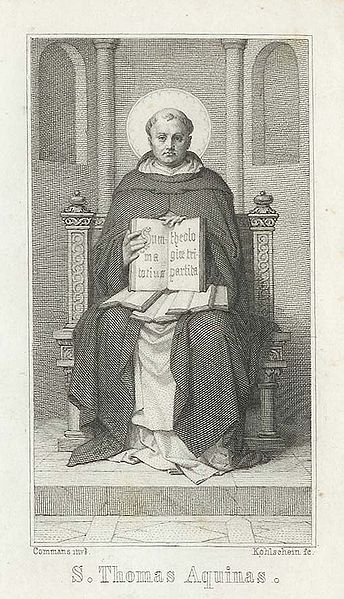 We’re blogging through St. Thomas Aquinas’ Compendium Theologiae, sometimes called his Shorter Summa. Find the previous posts here.
In the last chapter, Thomas concluded the purely philosophical part of his discussion of God; now we move on to the Trinity, and specifically to the Second Person of the Trinity, the Word of God. As we’ll find, Thomas doesn’t regard that title, “Word”, as purely symbolic, but as reflecting a deep truth about the nature of the Trinity.
The Trinity is a murky subject, and our doctrine consists of a number of truths held in tension: God is One in substance, there is only one Godhead. God is Three in person, Father, Son, and Holy Spirit. And yet, according to what Thomas has shown so far, God is metaphysically simple, and cannot be decomposed into separate parts. It’s all very confusing, and my Catholic readers might pray for me that I approach the topic with all due humility.
Now, I’ve said that Thomas is moving from philosophy to theology in this chapter; but that doesn’t mean that we’re leaving philosophy behind. Thomas is going to make extensive use of Aristotelian concepts; the following chapters are deceptively short. Let’s get started.
We take from the doctrine previously laid down that God understands and loves Himself; likewise, that understanding and willing in Him are not something distinct from His essence.
God is person, and persons have intellect and will; and the first thing He understands and loves is Himself. That sounds odd, almost narcissistic, to our ears. The first thing to remember is that love, properly understand, is an act of the will: choosing the thing loved as opposed to something else. And if the intellect and will are in proper working order, the will chooses in accord with understanding, or in other words loves each thing in proportion to its true goodness. And as Thomas has shown, as the First Cause God necessarily and perfectly contains all that is good, and hence all that is lovable. So indeed, God must understand Himself perfectly (for understanding is a good, and so God is perfect in understanding) and understanding Himself perfectly must understand Himself as the perfect good and hence the perfectly lovable. And having will, for will is a good, God must love Himself perfectly.
And since there are no accidents in God, nothing but His pure essence, His intellect and will are part of that essence, not separate from it.
Thomas continues,
Since God understands Himself, and since all that is understood is in the person who understands, God must be in Himself as the object understood is in the person understanding.
“…all that is understood is in the person who understands…” That’s an odd assertion; it sounds somehow mystical. To explain it, we must delve into the Aristotelian view of the soul.
Suppose I see a dog running down the street. I perceive a dog: in my “sense”, I have an image of the dog (a golden retriever, let’s say), and the sound of its bark. “Sense” is a faculty shared by all animals, including humans; it’s the ability to take in sensory impressions and remember them. At the moment, since I’m sitting at my desk, I’m imagining the dog running down the street; I have images of the dog in my head, images that are based on dogs and streets I have known.
From these images, my intellect apprehends or, in plain English, seizes the essence or form of Dogginess, a form shared by all dogs. For Plato, this form would exist eternally in some other reality, the Plane of Forms; for Aristotle, form of Dogginess exists in two places: metaphysically, as the substantial form of every dog, and within the intellect of a person contemplating a dog. He goes so far as to say that when I contemplate a dog my intellect literally takes on the form of Dogginess, and this allows me to reason abstractly about what it is to be a dog. This is what Aristotle means by understanding, this apprehension of the essence of other things, and it is in this sense that the thing understood is in the person who understands.
Let me digress for a moment. To apprehend is to seize; to comprehend is to grasp, to understand fully and completely. To see that I apprehend the essence of Dogginess is not to say that I understand fully and completely what it is to be a Dog; it merely means that I can distinguish dogs from non-dogs. Comprehension comes to human beings slowly and painfully, through careful reasoning, and is limited; Thomas famously said that we have never fully comprehended even the essence of a house fly.
So when I understand something, that thing’s essence or form is in my intellect.
But the object understood, so far as it is in the one who understands, is a certain word of the intellect; we signify by an exterior word what we comprehend interiorly in our intellect. For words, according to the Philosopher, are signs of intellectual concepts [De interpretatione, I, 1, 16 a 3].
This essence of Dogginess that I understand intellectually, we would more usually refer to as a concept: I have a concept of what a Dog is. And if I want to express that concept to another person, I would use a word: “Dog” (as I have in fact been doing throughout this explanation). The concept in my head is not the same as the word I speak; there are many words for “Dog” in many languages, but they all relate to the same concept. Nevertheless, by analogy, we may refer to that concept as Thomas does, as a word of the intellect which we signify by the exterior word “Dog”.
In short, when I speak a word, the concept associated with that word is in my intellect. Thomas then goes on to say,
Hence we must acknowledge in God the existence of His Word.
God understands Himself, that is, God has a concept of Himself; and that concept we’ve agreed to call a word of the intellect. And since the first and most import thing God understands is Himself, we can call this word of the intellect, this understanding of Himself, as the Word, the Word of God. And since His understanding is one with His essence, the Word of God must be in God Himself.
____
photo credit: Public Domain; source Wikimedia Commons

Previous Post

June 12, 2015
Topics of Interest
Next Post
June 16, 2015 Dominicans Everywhere! Or, Is It Time for a New Level to the Hierarchy?
Browse Our Archives
Select a Category Admin App o' the Morning Ask the Dogmat Believing Thomas Bits of Fiction Blasts from the Past Bootstrapping the Interior Life Catholic Mom Christian Living Deep Thoughts from the Doghouse Dominicana Evangelii Gaudium Interviews It Was A Dark and Stormy Night Links to This and That Lumen Fidei Meme Watch On Writing Operation Gratitude Pedant Errant Photography Quill Random Barkings S'Mary's World Shakers of Salt Software Development The Dog Whistler The Dogmat Sez Third Orders Thomas Aquinas Uncategorized Vikings at Dinos Woof Guide to Cinema Woof Guide to History Woof Guide to Literature Woof Guide to Obscure Catholic Music Woof Guide to Philosophy Woof Guide to Popular Music Woof Guide to Technology Woof Guide to Theology Words I Wish I'd Written Works For Me
Select a Month September 2016 August 2016 June 2016 May 2016 April 2016 March 2016 February 2016 January 2016 December 2015 November 2015 October 2015 September 2015 August 2015 July 2015 June 2015 May 2015 April 2015 March 2015 February 2015 January 2015 December 2014 November 2014 October 2014 September 2014 August 2014 July 2014 June 2014 May 2014 April 2014 March 2014 February 2014 January 2014 December 2013 November 2013 October 2013
Follow Us!
TAKE THE
Religious Wisdom Quiz
What happened when Peter tried to walk on water?
Select your answer to see how you score.
He led other disciples out The Spirit descended upon him He ran ahead of Jesus He sank when he doubted
Related posts from Cry 'Woof'

Today's Aquinas: Form Over Matter
Today's Aquinas: Only God can Create
Today's Aquinas: Something from Nothing
Today's Aquinas: The Chicken or the Egg
TRENDING AT PATHEOS Catholic

Creation, Preservation, and Teleology in Catholic Theology
As I write this, it is very early Monday morning. Like millions...

The Parable Of The Sower And The Word...
One of Christ’s most famous parables is that of the sower who...

Rejecting Doom: Christian Hope And Human Action
Christianity is a religion of hope. We are to have hope and...

Why I Choose the Eucharist Over the Sermon
Choose the Eucharist, Not the Sermon What are we supposed to get...

5 Design Elements Found in Spiritually Rooted Homes
Putting Spirituality Into Home Decor Our homes are more than our living...

Credo: A Story of God Told with the...
About 10 years ago, I began to imagine a personal "Credo" that...
view all Catholic blogs
Ad-Free & Subscriber Log-In Subscription Support
- About Us
- 2026 Calendar
- Videos
- Podcasts
- Library of World Religions
- Faith In Media Tracker
- Advertise With Us
- Write for Us
- Privacy Policy
- Terms of Service
- Do Not Sell My Data
- Contact Us
- Radiant Digital
- Manage Newsletter Subscriptions
- Unsubscribe From Notifications
- Sitemap
Copyright 2008-2026, Patheos. All rights reserved.
Subscription Support Ad-Free & Subscriber Log-In
Follow Patheos