
BuddhistCatholicContemplativeEvangelicalGeneral ChristianHinduJewishLatter-day SaintMuslimNew VisionsProgressive Christian
Beliefs
- Buddhist
- Catholic
- Contemplative
- Evangelical
- General Christian
- Hindu
- Jewish
- Latter-day Saint
- More Voices
- Muslim
- New Visions
- Pagan
- Progressive Christian
Topics
- Religion News
- Food and Religion
- Sports and Religion
- Religious Art
- Religious Music and Entertainment
- Religious Events
- History and Religion
- Style and Religion
- Politics and Religion
- Women in Religion
- Recreation Outdoors and Religion
- Business Finance and Religion
- Careers Workplace and Religion
- Education and Religion
- Family Parenting and Religion
- Health Fitness and Religion
- Home and Religion
- Relationships and Religion
- Technology and Religion
- Travel and Religion
Columnists
- Buddhist Columnists
- Business Finance and Religion Columnists
- Careers Workplace and Religion Columnists
- Catholic Columnists
- Contemplative Columnists
- Education and Religion Columnists
- Evangelists Columnists
- Family Parenting and Religion Columnists
- General Christian Columnists
- Health Fitness and Religion Columnists
- Hindu Columnists
- History and Religion Columnists
- Home and Religion Columnists
- Jewish Columnists
- More Voices Columnists
- Latter Day Columnists
- Muslim Columnists
- New Visions Columnists
- Nonreligious Columnists
- Pagan Columnists
- Politics and Religion Columnists
- Progressive Columnists
- Recreation Outdoors and Religion Columnists
- Relationships and Religion Columnists
- Religion News Columnists
- Religious Art Columnists
- Religious Events Columnists
- Religious Music and Entertainment Columnists
- Sports and Religion Columnists
- Style and Religion Columnists
- Technology and Religion Columnists
- Travel and Religion Columnists
- Women in Religion Columnists
Resource Library
- 2026 Calendar
- Library of World Religions
- The 100 Most Holy Places on Earth
- Patheos Answers
- Podcasts
- Videos
- Faith Leaders Database
- Anglican Episcopalian
- Bahai
- Baptist
- Buddhism
- Christianity
- Confucianism
- Eastern Orthodoxy
- Hinduism
- Holiness and Pentecostal
- ISKCON
- Islam
- Judaism
- Lutheran
- Methodist
- The Church of Jesus Christ of Latter-day Saints
- New Age
- Paganism
- Presbytarian and Reformed
- Protestantism
- Religion Behind the Scenes
- Roman Catholic
- Scientology
- Shia Islam
- Sikhism
- Sufism
- Sunni Islam
- Taoism
- Zen
- See all religions
Research Tools
 Ad-Free & Subscriber Log-In Subscription Support
Ad-Free & Subscriber Log-In Subscription Support
Follow Patheos 

- Trending:
- Forgiveness
- |
- Marriage
- |
- Consciousness
- |
- Death Penalty
- |
- Election
- |
- Halloween
 Cry 'Woof'
-
Series
- Home
- Catholic
- Julian May: The Saga of the Pliocene Exile
Julian May: The Saga of the Pliocene Exile
Last updated on: May 5, 2015 at 8:36 am by willduquette
Julian May: The Saga of the Pliocene Exile 2015-05-05T08:36:26-05:00 willduquette
Patheos Explore the world's faith through different perspectives on religion and spirituality! Patheos has the views of the prevalent religions and spiritualities of the world.
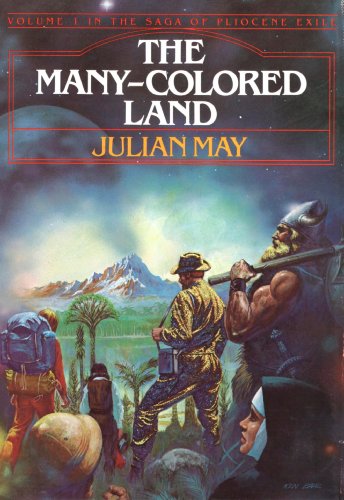 Julian May’s Saga of the Pliocene Exile is a collection of four books: The Many Colored Land, The Golden Torc, The Non-Born King, and The Adversary. It was first published back in the 1980’s; I remember reading positive reviews of it in Analog Science Fiction and thinking it sounded rather uninteresting. The reviews, as I remember them, conveyed something like this to me: A hundred years or so in our future, a French physicist named Guderian has invented a time machine that only works one way: it will transport a small volume to the precise same spot in the valley of the Rhone some time during the Pliocene era. Certain individuals who find themselves unsuited to life in the modern era for one reason or another choose to seek exile in the distant past by means of this time gate. Once there they have to deal with the primitive surroundings.
Oh, I thought, another dinosaur book. How thrilling.
But eventually, being short of reading material (I was in college; I was dependent on stock turn-over in the local bookstores for new fantasy and science-fiction books to read) I picked up The Many Colored Land and discovered that it was something quite different than I had thought.
Yes, there’s a time gate; yes, there are exiles. But both the future and the past worlds were more interesting than I had guessed. The future world is a time when Earth has been drawn into a galactic civilization based on “metapsychic” powers, telepathy and so forth, which have just begun to blossom in the human race; and the past world is found to have already have been settled by the Tanu and the Firvulag, a pair of exotic races from a far distant galaxy. The Firvulag have genuine but limited metapsychic powers, mostly in the area of creating illusions, and the Tanu, though having only latent metapsychic abilities have learned to awaken those powers by the use of special electronics which are worn around the neck in the form of golden torcs (natch).
If you’re at all acquainted with the folklore of the British Isles those names will seem reminiscent of the Tuatha de Danaan and the Fir-Bolg, and for good reason.
As the book begins, every party of exiles that has come through the gate for the past several decades has been scooped up the Tanu, who have been eager to have them for the tech gear and knowledge they possess, knowledge that has given the Tanu near dominance over the Firvulag, but also for their reproductive abilities. Tanu reproduce slowly if at all, and it develops that humans and Tanu are interfertile….
In short, our exiles are due for a wild ride, and the presence of several wild cards among them kick off a storm of intrigue, warfare, and disaster that easily fills the four books. There are numerous interesting and memorable characters, and it’s all wrapped up quite satisfyingly in the end.
I re-read the four books recently after having not looked at them for about fifteen years, and was pleased to see that they held up pretty well. I was also fascinated by the Catholic themes, and how they played with the details of May’s world.
The theosphere of May’s world is one of evolving consciousness à la Teilhard de Chardin (who is referred to as St. Teilhard in the books). The metapsychic union (or “coadunation”) of the races of the Galactic Milieu is the next step in this evolving consciousness. It’s never made clear (that I could see) whether the Catholics in the novel worshipped the transcendent God of orthodox theism or whether the evolving consciousness of the universe was in fact supposed to be God coming to know Himself over time; though as one of the priests in the series is named Sister Amerie one can assume that strict orthodoxy wasn’t intended. In any event it was interesting to watch.
Previous Post

May 4, 2015
Today's Aquinas: The Will is in the Willing
Next Post

May 6, 2015 What's Religion Good For?
Browse Our Archives
Select a Category Admin App o' the Morning Ask the Dogmat Believing Thomas Bits of Fiction Blasts from the Past Bootstrapping the Interior Life Catholic Mom Christian Living Deep Thoughts from the Doghouse Dominicana Evangelii Gaudium Interviews It Was A Dark and Stormy Night Links to This and That Lumen Fidei Meme Watch On Writing Operation Gratitude Pedant Errant Photography Quill Random Barkings S'Mary's World Shakers of Salt Software Development The Dog Whistler The Dogmat Sez Third Orders Thomas Aquinas Uncategorized Vikings at Dinos Woof Guide to Cinema Woof Guide to History Woof Guide to Literature Woof Guide to Obscure Catholic Music Woof Guide to Philosophy Woof Guide to Popular Music Woof Guide to Technology Woof Guide to Theology Words I Wish I'd Written Works For Me
Select a Month September 2016 August 2016 June 2016 May 2016 April 2016 March 2016 February 2016 January 2016 December 2015 November 2015 October 2015 September 2015 August 2015 July 2015 June 2015 May 2015 April 2015 March 2015 February 2015 January 2015 December 2014 November 2014 October 2014 September 2014 August 2014 July 2014 June 2014 May 2014 April 2014 March 2014 February 2014 January 2014 December 2013 November 2013 October 2013
Follow Us!
TAKE THE
Religious Wisdom Quiz
To which country was Joseph taken as a slave?
Select your answer to see how you score.
Babylon Midian Canaan Egypt
Related posts from Cry 'Woof'

In which the Blogger is Very Truly Run...

The Daughter of Time, by Josephine Tey
Book Review: Catholic Commentary on Sacred Scripture, The...

Steven Pressfield: The Lion's Gate
TRENDING AT PATHEOS Catholic

Creation, Preservation, and Teleology in Catholic Theology
As I write this, it is very early Monday morning. Like millions...

The Parable Of The Sower And The Word...
One of Christ’s most famous parables is that of the sower who...

Rejecting Doom: Christian Hope And Human Action
Christianity is a religion of hope. We are to have hope and...

Why I Choose the Eucharist Over the Sermon
Choose the Eucharist, Not the Sermon What are we supposed to get...

5 Design Elements Found in Spiritually Rooted Homes
Putting Spirituality Into Home Decor Our homes are more than our living...

Credo: A Story of God Told with the...
About 10 years ago, I began to imagine a personal "Credo" that...
view all Catholic blogs
Ad-Free & Subscriber Log-In Subscription Support
- About Us
- 2026 Calendar
- Videos
- Podcasts
- Library of World Religions
- Faith In Media Tracker
- Advertise With Us
- Write for Us
- Privacy Policy
- Terms of Service
- Do Not Sell My Data
- Contact Us
- Radiant Digital
- Manage Newsletter Subscriptions
- Unsubscribe From Notifications
- Sitemap
Copyright 2008-2026, Patheos. All rights reserved.
Subscription Support Ad-Free & Subscriber Log-In
Follow Patheos