
BuddhistCatholicContemplativeEvangelicalGeneral ChristianHinduJewishLatter-day SaintMuslimNew VisionsProgressive Christian
Beliefs
- Buddhist
- Catholic
- Contemplative
- Evangelical
- General Christian
- Hindu
- Jewish
- Latter-day Saint
- More Voices
- Muslim
- New Visions
- Pagan
- Progressive Christian
Topics
- Religion News
- Food and Religion
- Sports and Religion
- Religious Art
- Religious Music and Entertainment
- Religious Events
- History and Religion
- Style and Religion
- Politics and Religion
- Women in Religion
- Recreation Outdoors and Religion
- Business Finance and Religion
- Careers Workplace and Religion
- Education and Religion
- Family Parenting and Religion
- Health Fitness and Religion
- Home and Religion
- Relationships and Religion
- Technology and Religion
- Travel and Religion
Columnists
- Buddhist Columnists
- Business Finance and Religion Columnists
- Careers Workplace and Religion Columnists
- Catholic Columnists
- Contemplative Columnists
- Education and Religion Columnists
- Evangelists Columnists
- Family Parenting and Religion Columnists
- General Christian Columnists
- Health Fitness and Religion Columnists
- Hindu Columnists
- History and Religion Columnists
- Home and Religion Columnists
- Jewish Columnists
- More Voices Columnists
- Latter Day Columnists
- Muslim Columnists
- New Visions Columnists
- Nonreligious Columnists
- Pagan Columnists
- Politics and Religion Columnists
- Progressive Columnists
- Recreation Outdoors and Religion Columnists
- Relationships and Religion Columnists
- Religion News Columnists
- Religious Art Columnists
- Religious Events Columnists
- Religious Music and Entertainment Columnists
- Sports and Religion Columnists
- Style and Religion Columnists
- Technology and Religion Columnists
- Travel and Religion Columnists
- Women in Religion Columnists
Resource Library
- 2026 Calendar
- Library of World Religions
- The 100 Most Holy Places on Earth
- Patheos Answers
- Podcasts
- Videos
- Faith Leaders Database
- Anglican Episcopalian
- Bahai
- Baptist
- Buddhism
- Christianity
- Confucianism
- Eastern Orthodoxy
- Hinduism
- Holiness and Pentecostal
- ISKCON
- Islam
- Judaism
- Lutheran
- Methodist
- The Church of Jesus Christ of Latter-day Saints
- New Age
- Paganism
- Presbytarian and Reformed
- Protestantism
- Religion Behind the Scenes
- Roman Catholic
- Scientology
- Shia Islam
- Sikhism
- Sufism
- Sunni Islam
- Taoism
- Zen
- See all religions
Research Tools
 Ad-Free & Subscriber Log-In Subscription Support
Ad-Free & Subscriber Log-In Subscription Support
Follow Patheos 

- Trending:
- Forgiveness
- |
- Marriage
- |
- Consciousness
- |
- Death Penalty
- |
- Election
- |
- Halloween
 Cry 'Woof'
-
Series
- Home
- Catholic
- Book Review: Catholic Commentary on Sacred Scripture, The Gospel of John
Book Review: Catholic Commentary on Sacred Scripture, The Gospel of John
Last updated on: May 26, 2015 at 6:00 am by willduquette
Book Review: Catholic Commentary on Sacred Scripture, The Gospel of John 2015-05-25T10:36:12-05:00 willduquette
Patheos Explore the world's faith through different perspectives on religion and spirituality! Patheos has the views of the prevalent religions and spiritualities of the world.
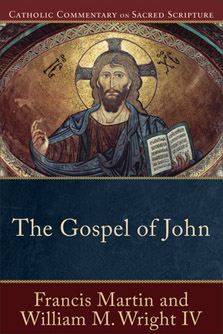 I recently received a review copy of The Gospel of John, by Francis Martin and William M. Wright IV, from the series Catholic Commentary on Sacred Scripture, and I’ve been perusing it. I’m not accepting review copies very often these days, because I found most of the ones I’ve received tend to languish unread, which isn’t fair to the publisher; but I’d heard good things about this series, and I love the Gospel of John, so I said, “OK, why not.”
And so far, I’m impressed; it looks like exactly the sort of thing I would want.
First, the approach is deeply Catholic, in line with Dei Verbum and Pope Benedict’s words in Verbum Domini and other works. From the Editor’s Preface:
These volumes seek to offer scholarship illumined by faith, in the conviction that the ultimate aim of biblical interpretation is to discover what God has revealed and is still speaking through the sacred text. Central to our approach are the principles taught by Vatican II: first, the use of historical and literary methods to discern what the authors intended to express; second, prayerful theological reflection to understand the sacred text “in accord with the same Spirit by whom it was written”—that is, in light of the content and unity of the whole Scripture, the living tradition of the Church, and the analogy of faith.
In short, it’s intended to build up faith in the Catholic reader, not tear it down or deconstruct it.
One of my touchstones is the authorship question, and I turned eagerly to the book’s introduction to see how they would handle it; and again I was pleased.
First, they note that the majority opinion from the second century to a couple of hundred years ago attributed it to John the Apostle. Chief among second century sources is St. Irenaeus, who was a disciple of St. Polycarp, who was a disciple of John.
Authorship by John the Apostle is now disputed, for a variety of reasons, with opinions ranging from authorship by John’s immediate disciples to authorship by an unnamed disciple who was not an apostle at all. The text gently notes that modern scholarship doesn’t give much weight in these matters to second century authorities (which is laughable, honestly, given how scanty the commonly accepted historical record is in many places outside of biblical scholarship), but does highlight some of their arguments, notably that the Gospel of John shows signs of having been assembled by multiple hands. This part of the introduction ends with the acknowledgement that the waters are murky but suggests that it’s not unreasonable to believe that the Beloved Disciple is John the Apostle and that John’s Gospel was assembled and put into its final form by John’s disciples. In short, the discussion ends on a note that honors ancient tradition while accepting that sausage-making is messy. More I cannot ask.
So I like the approach it takes; what about the content? I am not a scripture scholar, but I know my way around the New Testament. Is there enough new here to warrant my spending time with this particular volume?* And does it lend itself to reflection and meditation?
I can hardly pretend to give a comprehensive answer after a quick once-over and a few spot checks, but the answer certainly seems to be yes on both counts. As an example of something I’d not heard before, the Introduction suggests that the Gospel of John shouldn’t be considered a history, an account of everything important that happened; rather, it’s a “Life” (bios in Greek), in the same genre as Plutarch’s Lives. Plutarch’s goal wasn’t to tell everything about the man whose life he was writing, but to bring out the man’s character specifically as an aid to moral formation. John himself tells us that this is his goal in writing his gospel, but it hadn’t occurred to me to relate the two. This matters, because while I’ve heard a lot of talk about how the gospels aren’t history, per se, I’ve heard very little of interest as to what they really are.
In addition to the text of the gospel (NABRE, unsurprisingly) and the direct commentary (which is voluminous) there are also numerous sidebars on the historical setting and on post-biblical tradition, and all of the usual cross-references (which I’m usually too lazy to follow).
In short, I like what I’ve seen; and I plan to spend more time with the volume over the coming weeks and months.
* I am not a scripture scholar. The answer is going to be “Yes”.
catholic commentary on sacred scripture
Previous Post

May 24, 2015
Memorial Day
Next Post

May 27, 2015 How the Mind Ascends to God
Browse Our Archives
Select a Category Admin App o' the Morning Ask the Dogmat Believing Thomas Bits of Fiction Blasts from the Past Bootstrapping the Interior Life Catholic Mom Christian Living Deep Thoughts from the Doghouse Dominicana Evangelii Gaudium Interviews It Was A Dark and Stormy Night Links to This and That Lumen Fidei Meme Watch On Writing Operation Gratitude Pedant Errant Photography Quill Random Barkings S'Mary's World Shakers of Salt Software Development The Dog Whistler The Dogmat Sez Third Orders Thomas Aquinas Uncategorized Vikings at Dinos Woof Guide to Cinema Woof Guide to History Woof Guide to Literature Woof Guide to Obscure Catholic Music Woof Guide to Philosophy Woof Guide to Popular Music Woof Guide to Technology Woof Guide to Theology Words I Wish I'd Written Works For Me
Select a Month September 2016 August 2016 June 2016 May 2016 April 2016 March 2016 February 2016 January 2016 December 2015 November 2015 October 2015 September 2015 August 2015 July 2015 June 2015 May 2015 April 2015 March 2015 February 2015 January 2015 December 2014 November 2014 October 2014 September 2014 August 2014 July 2014 June 2014 May 2014 April 2014 March 2014 February 2014 January 2014 December 2013 November 2013 October 2013
Follow Us!
TAKE THE
Religious Wisdom Quiz
I asked for wisdom above all else, and God granted me riches and honor as well. Who am I?
Select your answer to see how you score.
Hezekiah Josiah Solomon David
Related posts from Cry 'Woof'

In which the Blogger is Very Truly Run...

The Daughter of Time, by Josephine Tey

Steven Pressfield: The Lion's Gate
TRENDING AT PATHEOS Catholic

Rejecting Doom: Christian Hope And Human Action
Christianity is a religion of hope. We are to have hope and...

It’s What Comes From Within Which Matters
One of the most difficult things for us to understand is why...

Why I Choose the Eucharist Over the Sermon
Choose the Eucharist, Not the Sermon What are we supposed to get...

5 Design Elements Found in Spiritually Rooted Homes
Putting Spirituality Into Home Decor Our homes are more than our living...

Credo: A Story of God Told with the...
About 10 years ago, I began to imagine a personal "Credo" that...

The Anatomy of Divine Revelation in Catholic Thought
The claim that God has made Himself known to human beings is...
view all Catholic blogs
Ad-Free & Subscriber Log-In Subscription Support
- About Us
- 2026 Calendar
- Videos
- Podcasts
- Library of World Religions
- Faith In Media Tracker
- Advertise With Us
- Write for Us
- Privacy Policy
- Terms of Service
- Do Not Sell My Data
- Contact Us
- Radiant Digital
- Manage Newsletter Subscriptions
- Unsubscribe From Notifications
- Sitemap
Copyright 2008-2026, Patheos. All rights reserved.
Subscription Support Ad-Free & Subscriber Log-In
Follow Patheos