
BuddhistCatholicContemplativeEvangelicalGeneral ChristianHinduJewishLatter-day SaintMuslimNew VisionsProgressive Christian
Beliefs
- Buddhist
- Catholic
- Contemplative
- Evangelical
- General Christian
- Hindu
- Jewish
- Latter-day Saint
- More Voices
- Muslim
- New Visions
- Pagan
- Progressive Christian
Topics
- Religion News
- Food and Religion
- Sports and Religion
- Religious Art
- Religious Music and Entertainment
- Religious Events
- History and Religion
- Style and Religion
- Politics and Religion
- Women in Religion
- Recreation Outdoors and Religion
- Business Finance and Religion
- Careers Workplace and Religion
- Education and Religion
- Family Parenting and Religion
- Health Fitness and Religion
- Home and Religion
- Relationships and Religion
- Technology and Religion
- Travel and Religion
Columnists
- Buddhist Columnists
- Business Finance and Religion Columnists
- Careers Workplace and Religion Columnists
- Catholic Columnists
- Contemplative Columnists
- Education and Religion Columnists
- Evangelists Columnists
- Family Parenting and Religion Columnists
- General Christian Columnists
- Health Fitness and Religion Columnists
- Hindu Columnists
- History and Religion Columnists
- Home and Religion Columnists
- Jewish Columnists
- More Voices Columnists
- Latter Day Columnists
- Muslim Columnists
- New Visions Columnists
- Nonreligious Columnists
- Pagan Columnists
- Politics and Religion Columnists
- Progressive Columnists
- Recreation Outdoors and Religion Columnists
- Relationships and Religion Columnists
- Religion News Columnists
- Religious Art Columnists
- Religious Events Columnists
- Religious Music and Entertainment Columnists
- Sports and Religion Columnists
- Style and Religion Columnists
- Technology and Religion Columnists
- Travel and Religion Columnists
- Women in Religion Columnists
Resource Library
- 2026 Calendar
- Library of World Religions
- The 100 Most Holy Places on Earth
- Patheos Answers
- Podcasts
- Videos
- Faith Leaders Database
- Anglican Episcopalian
- Bahai
- Baptist
- Buddhism
- Christianity
- Confucianism
- Eastern Orthodoxy
- Hinduism
- Holiness and Pentecostal
- ISKCON
- Islam
- Judaism
- Lutheran
- Methodist
- The Church of Jesus Christ of Latter-day Saints
- New Age
- Paganism
- Presbytarian and Reformed
- Protestantism
- Religion Behind the Scenes
- Roman Catholic
- Scientology
- Shia Islam
- Sikhism
- Sufism
- Sunni Islam
- Taoism
- Zen
- See all religions
Research Tools
 Ad-Free & Subscriber Log-In Subscription Support
Ad-Free & Subscriber Log-In Subscription Support
Follow Patheos 

- Trending:
- Forgiveness
- |
- Marriage
- |
- Consciousness
- |
- Death Penalty
- |
- Election
- |
- Halloween
 Cry 'Woof'
-
Series
- Home
- Catholic
- Today’s Aquinas: Do Humans and Animals Think in the Same Way?
Today’s Aquinas: Do Humans and Animals Think in the Same Way?
Last updated on: April 27, 2015 at 8:00 am by willduquette
Today’s Aquinas: Do Humans and Animals Think in the Same Way? 2015-04-25T14:36:26-05:00 willduquette
Patheos Explore the world's faith through different perspectives on religion and spirituality! Patheos has the views of the prevalent religions and spiritualities of the world.
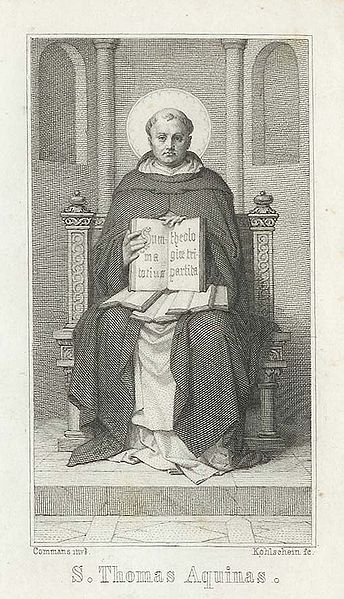 Last week’s discussion of “nobler beings” predictably started a comment thread about the nature of intelligence and the intelligence of animals, with excursions on language and tool use. Thomas believed (as did Aristotle before him) that human intelligence is qualitatively different than animal intelligence—that human beings are defined as being the kind of animal that reasons. I might add that reason, to Thomas, encompassed more than logical argumentation. Human reason encompasses three things, the Three Acts of the Mind.
First, given a sensory impression of a thing, a human being can abstract from it the essence of the thing: can recognize it at as a dog, or a tree, or a triangle, that is, as a member of a class having things in common with other members of that class. As an example, I might see a triangular “Yield” sign, and recognize it as a triangle with rounded corners, where a triangle is a closed plane figure with three sides and three angles adding to 180 degrees. I might further recognize it as an isosceles triangle, one with two sides and two angles the same.
The thing to note about this definition is that it applies to all triangles, regardless of the length of the sides or how it is drawn or what the angles are. You can’t draw a picture of all triangles at once, but you can define them all at once. Thomas and Aristotle would claim that this is a uniquely human ability.
Second, human beings can consider a proposition and judge it as true or false.
Third, human beings can reason from premises to a conclusion in a logical fashion.
One might jest that they’ve met people who don’t seem able to do these three things, but in fact we all do them constantly. If you tell me it’s raining, and I’m standing bone dry under a clear blue sky, I’ll surely tell you you’re mistaken, and so would anyone else. If that last slice of cake is missing, and I didn’t eat it, I know that someone else must have. This isn’t rocket science; it’s basic human equipment.
Thomas and Aristotle would make a further claim: that human reasoning cannot be explained in purely materialistic terms. There must be a component to the human being that is immaterial: that exists, and operates, but is not explainable in terms of the body (though it will certainly need to work with the body). This is how human beings have immortal souls: the material is naturally corruptible, but the immaterial is not. (I do not intend to try to prove this statement here; the go-to writeup is James Ross’ 1992 paper “Immaterial Aspects of Thought”).
This understanding of human reason is no longer as common as it once was; most people more or less assume that animal intelligence is on a spectrum with snails, say, at one end, and human beings on the other. Some animals rank highly (dolphins, apes, crows, some parrots) and others do not. From the scientific point of view (and science has nothing to say to the immateriality of thought, which is not susceptible to experiment), this seems a reasonable assumption, although I believe it to be wrong on philosophical grounds.
Even if you disagree with me, let’s assume for the moment that the above statements are all true: that human reason is as I’ve described, and that human reason has immaterial aspects.
The question, then, is this: are humans in fact alone as “rational animals”?
If there is intelligent life on other planets, life capable of the three acts of the mind, I would infer that they too are “rational animals” with an immortal soul.
But what about the various smarter animals on our planet? Do chimpanzees reason? Do dolphins reason? No one knows for sure. The experiments with Koko the Gorilla are suggestive but inconclusive. Is there a form of animal intelligence that is qualitatively or quantitatively less than human but still has immaterial aspects? I don’t know if that’s even possible.
In any event, for Thomas et al, the mark of intelligence is the three acts of the mind, not simply the ability to use speech or tools.
____
photo credit: Public Domain; source Wikimedia Commons

Previous Post

April 24, 2015
Gopher Tuna!
Next Post
April 28, 2015 Ngaio Marsh: Death in a White Tie
Browse Our Archives
Select a Category Admin App o' the Morning Ask the Dogmat Believing Thomas Bits of Fiction Blasts from the Past Bootstrapping the Interior Life Catholic Mom Christian Living Deep Thoughts from the Doghouse Dominicana Evangelii Gaudium Interviews It Was A Dark and Stormy Night Links to This and That Lumen Fidei Meme Watch On Writing Operation Gratitude Pedant Errant Photography Quill Random Barkings S'Mary's World Shakers of Salt Software Development The Dog Whistler The Dogmat Sez Third Orders Thomas Aquinas Uncategorized Vikings at Dinos Woof Guide to Cinema Woof Guide to History Woof Guide to Literature Woof Guide to Obscure Catholic Music Woof Guide to Philosophy Woof Guide to Popular Music Woof Guide to Technology Woof Guide to Theology Words I Wish I'd Written Works For Me
Select a Month September 2016 August 2016 June 2016 May 2016 April 2016 March 2016 February 2016 January 2016 December 2015 November 2015 October 2015 September 2015 August 2015 July 2015 June 2015 May 2015 April 2015 March 2015 February 2015 January 2015 December 2014 November 2014 October 2014 September 2014 August 2014 July 2014 June 2014 May 2014 April 2014 March 2014 February 2014 January 2014 December 2013 November 2013 October 2013
Follow Us!
TAKE THE
Religious Wisdom Quiz
Which prophet predicted the Babylonian captivity would last 70 years?
Select your answer to see how you score.
Haggai Jeremiah Isaiah Ezekiel
Related posts from Cry 'Woof'

Today's Aquinas: Form Over Matter
Today's Aquinas: Only God can Create
Today's Aquinas: Something from Nothing
Today's Aquinas: The Chicken or the Egg
TRENDING AT PATHEOS Catholic

Rejecting Doom: Christian Hope And Human Action
Christianity is a religion of hope. We are to have hope and...

It’s What Comes From Within Which Matters
One of the most difficult things for us to understand is why...

Why I Choose the Eucharist Over the Sermon
Choose the Eucharist, Not the Sermon What are we supposed to get...

5 Design Elements Found in Spiritually Rooted Homes
Putting Spirituality Into Home Decor Our homes are more than our living...

Credo: A Story of God Told with the...
About 10 years ago, I began to imagine a personal "Credo" that...

The Anatomy of Divine Revelation in Catholic Thought
The claim that God has made Himself known to human beings is...
view all Catholic blogs
Ad-Free & Subscriber Log-In Subscription Support
- About Us
- 2026 Calendar
- Videos
- Podcasts
- Library of World Religions
- Faith In Media Tracker
- Advertise With Us
- Write for Us
- Privacy Policy
- Terms of Service
- Do Not Sell My Data
- Contact Us
- Radiant Digital
- Manage Newsletter Subscriptions
- Unsubscribe From Notifications
- Sitemap
Copyright 2008-2026, Patheos. All rights reserved.
Subscription Support Ad-Free & Subscriber Log-In
Follow Patheos