
BuddhistCatholicContemplativeEvangelicalGeneral ChristianHinduJewishLatter-day SaintMuslimNew VisionsProgressive Christian
Beliefs
- Buddhist
- Catholic
- Contemplative
- Evangelical
- General Christian
- Hindu
- Jewish
- Latter-day Saint
- More Voices
- Muslim
- New Visions
- Pagan
- Progressive Christian
Topics
- Religion News
- Food and Religion
- Sports and Religion
- Religious Art
- Religious Music and Entertainment
- Religious Events
- History and Religion
- Style and Religion
- Politics and Religion
- Women in Religion
- Recreation Outdoors and Religion
- Business Finance and Religion
- Careers Workplace and Religion
- Education and Religion
- Family Parenting and Religion
- Health Fitness and Religion
- Home and Religion
- Relationships and Religion
- Technology and Religion
- Travel and Religion
Columnists
- Buddhist Columnists
- Business Finance and Religion Columnists
- Careers Workplace and Religion Columnists
- Catholic Columnists
- Contemplative Columnists
- Education and Religion Columnists
- Evangelists Columnists
- Family Parenting and Religion Columnists
- General Christian Columnists
- Health Fitness and Religion Columnists
- Hindu Columnists
- History and Religion Columnists
- Home and Religion Columnists
- Jewish Columnists
- More Voices Columnists
- Latter Day Columnists
- Muslim Columnists
- New Visions Columnists
- Nonreligious Columnists
- Pagan Columnists
- Politics and Religion Columnists
- Progressive Columnists
- Recreation Outdoors and Religion Columnists
- Relationships and Religion Columnists
- Religion News Columnists
- Religious Art Columnists
- Religious Events Columnists
- Religious Music and Entertainment Columnists
- Sports and Religion Columnists
- Style and Religion Columnists
- Technology and Religion Columnists
- Travel and Religion Columnists
- Women in Religion Columnists
Resource Library
- 2026 Calendar
- Library of World Religions
- The 100 Most Holy Places on Earth
- Patheos Answers
- Podcasts
- Videos
- Faith Leaders Database
- Anglican Episcopalian
- Bahai
- Baptist
- Buddhism
- Christianity
- Confucianism
- Eastern Orthodoxy
- Hinduism
- Holiness and Pentecostal
- ISKCON
- Islam
- Judaism
- Lutheran
- Methodist
- The Church of Jesus Christ of Latter-day Saints
- New Age
- Paganism
- Presbytarian and Reformed
- Protestantism
- Religion Behind the Scenes
- Roman Catholic
- Scientology
- Shia Islam
- Sikhism
- Sufism
- Sunni Islam
- Taoism
- Zen
- See all religions
Research Tools
 Ad-Free & Subscriber Log-In Subscription Support
Ad-Free & Subscriber Log-In Subscription Support
Follow Patheos 

- Trending:
- Forgiveness
- |
- Marriage
- |
- Consciousness
- |
- Death Penalty
- |
- Election
- |
- Halloween
 Cry 'Woof'
-
Series
- Home
- Catholic
- Today’s Aquinas: Intelligence is Immaterial
Today’s Aquinas: Intelligence is Immaterial
Last updated on: March 2, 2015 at 8:00 am by willduquette
Today’s Aquinas: Intelligence is Immaterial 2015-03-01T10:48:47-05:00 willduquette
Patheos Explore the world's faith through different perspectives on religion and spirituality! Patheos has the views of the prevalent religions and spiritualities of the world.
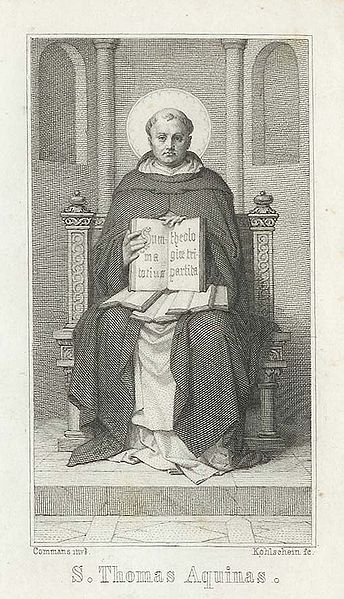 We’re blogging through St. Thomas Aquinas’ Compendium Theologiae, sometimes called his Shorter Summa. Find the previous posts here.
So far, Thomas has shown that God, the First Mover, must be One, infinite in power and goodness, and the source of all that is good in creation. The next step is to show that God is Person (or, ultimately, Persons); and for Thomas, a person is that which possesses intellect and will: someone, you might say, with whom you could have a conversation.
Thomas divides human reason in two, sense and imagination on one side and intellect on the other. Sense is what allows is to see and remember a triangular shape, and to picture it in our heads. It begins with our sensory perceptions, but also includes the faculties of memory and imagination, which is the ability to assemble images from the bits and pieces of things we’ve seen: a golden apple, for instance, or a unicorn. Intellect is what allows us to abstract from that triangle the essence of triangularity: to say, a triangle (species) is a plane figure (genus) with three straight sides and three angles (specific difference); or that a unicorn (species) is a horse (genus) with a horn (specific difference); or, alternatively, to recognize that chihuahuas and great danes are both the same kind of thing despite all evidence to the contrary. Among the animals here on Earth, we alone possess intellect. And so, because God possesses all good things in an eminent way, so therefore, must God:
We must go on to demonstrate that God is intelligent. We have already proved that all perfections of all beings whatsoever pre-exist in God superabundantly. Among all the perfections found in beings, intelligence is deemed to possess a special pre-eminence, for the reason that intellectual beings are more powerful than all others. Therefore God must be intelligent.
You might dispute that intellectual beings are more powerful than all others. Elephants are stronger than men, tigers are fiercer perhaps; but no animal other than man has ever worried about destroying all life on Earth—or needed to.
Next, Thomas makes an argument at which my mind boggled the first time I read it:
Moreover, we pointed out above that God is pure act without any admixture of potentiality. On the other hand, matter is being in potency. Consequently God must be utterly free from matter. But freedom from matter is the cause of intellectuality. An indication of this is that material forms are rendered intelligible in act by being abstracted from matter and from material conditions. Therefore God is intelligent.
By now the notion that God is pure act, unchanging, should be a familiar one; and since matter, in Thomistic philosophy, is that which supports change, God is necessarily immaterial. So far, so good. The problem comes with the bolded statement. How can freedom from matter be the cause of intellectuality?
This is at the root of the best argument I’ve seen for the immortality of the human soul: that the ability to look under the surface of things and abstract from them their essential forms, to understand them as you and I understand that a triangle is a shape with three sides or a unicorn is a horse with a horn, is something that mere matter cannot do. The human intellect, in a sense, becomes the thing understood in the moment of understanding. That is how it is able to turn the thing around, investigate it, and ponder its properties. But the intellect can, in that sense, become anything at all: a mouse, a mountain, a galaxy, without taking on the matter of the thing pondered.
This is a deep topic, too deep to fully address here, and I am surely not doing it justice. But consider the words you are reading: not their meanings, but their shapes in pixels on the screen, or in ink on a page. Such markings have no inherent meaning; they are simply a way for one intellect to pass meaning to another intellect by means of agreement about chicken scratches. (That’s what learning to read and building vocabulary is all about: learning what chicken scratches go with which meanings.)
Now, our memories are surely “written down” as chemical or electrical changes in our brains. And as with physical marks on a page, so with the physical marks of memory in our brains. They are meaningless unless interpreted by the intellect that “wrote them down”.
And for Thomas, for a being to be immaterial it must necessarily be intellectual; there’s nothing else left. Immaterial being isn’t some kind of ectoplasm, matter by another name; an immaterial being can only operate in those ways that do not require matter. A purely immaterial created being—which is to say, an angel—cannot be green or blue or red or white: because color is a property of the material world. An angel might still appear to us as green or blue or red or white because if it is to appear to us it has to manifest itself in the material world in some way, and any visible way implies color. But that’s no more the angel we’re seeing than it’s Van Gogh we’re seeing when we look at his self-portrait.
Finally, Thomas provides a third observation:
We proved, further, that God is the first mover. This very perfection appears to be a property of intellect, for the intellect, we observe, uses all other things as instruments, so to speak, in producing movement. Thus man, through his intellect, uses animals and plants and inanimate objects as instruments, of a sort, to cause motion. Consequently God, the first mover, must be intelligent.
God works through other things; He uses them as instruments, which is to say as tools, as intermediate causes, so as to achieve His ends. We do the same, and it is our intellects that drive the process.
Here’s how it works: I perceive the things about me, and that I’m hungry (sense). Looking at the things around me, I understand that the coffee is good to drink, that the eggs are good to eat, and that the dishwashing liquid is not for internal use. To no longer be hungry, I reason, I should eat the eggs and drink the coffee. But, I also know that I’m about to go to get blood drawn and have to be fasting for the tests to be accurate, and so I choose to remain hungry, and then eat after the blood test. And in that way, my intellect, directing my sense and my will, uses them to achieve its goal of not having to go back and get blood drawn a second time on another day.
This differs from animals. A dog will sense its food and its hunger and go eat the food; that’s what dogs do, unless they are prevented. It would never be able to say, “I’m about to go to the vet for an operation which will make me feel much better in a week or to, and if I eat now my master will have to put it off; I’d better wait and eat later.”
In short, we (through our intelligence) possess a greater capability to use other beings instrumentally than the animals do; and given that God is the instrument-player par excellence, He must also be intelligent.
___
photo credit: Public Domain; source Wikimedia Commons

Previous Post

February 27, 2015
Harry Belafonte: A Hole in the Bucket
Next Post
March 3, 2015 A Tour of Tim Powers: The Anubis Gates
Browse Our Archives
Select a Category Admin App o' the Morning Ask the Dogmat Believing Thomas Bits of Fiction Blasts from the Past Bootstrapping the Interior Life Catholic Mom Christian Living Deep Thoughts from the Doghouse Dominicana Evangelii Gaudium Interviews It Was A Dark and Stormy Night Links to This and That Lumen Fidei Meme Watch On Writing Operation Gratitude Pedant Errant Photography Quill Random Barkings S'Mary's World Shakers of Salt Software Development The Dog Whistler The Dogmat Sez Third Orders Thomas Aquinas Uncategorized Vikings at Dinos Woof Guide to Cinema Woof Guide to History Woof Guide to Literature Woof Guide to Obscure Catholic Music Woof Guide to Philosophy Woof Guide to Popular Music Woof Guide to Technology Woof Guide to Theology Words I Wish I'd Written Works For Me
Select a Month September 2016 August 2016 June 2016 May 2016 April 2016 March 2016 February 2016 January 2016 December 2015 November 2015 October 2015 September 2015 August 2015 July 2015 June 2015 May 2015 April 2015 March 2015 February 2015 January 2015 December 2014 November 2014 October 2014 September 2014 August 2014 July 2014 June 2014 May 2014 April 2014 March 2014 February 2014 January 2014 December 2013 November 2013 October 2013
Follow Us!
TAKE THE
Religious Wisdom Quiz
"Let your ________ before men, that they may see your good deeds and praise your Father in heaven."
Select your answer to see how you score.
Light So Shine Face Shine Voice Be Raised Conscience Be Clear
Related posts from Cry 'Woof'

Today's Aquinas: Form Over Matter
Today's Aquinas: Only God can Create
Today's Aquinas: Something from Nothing
Today's Aquinas: The Chicken or the Egg
TRENDING AT PATHEOS Catholic

Rejecting Doom: Christian Hope And Human Action
Christianity is a religion of hope. We are to have hope and...

It’s What Comes From Within Which Matters
One of the most difficult things for us to understand is why...

Why I Choose the Eucharist Over the Sermon
Choose the Eucharist, Not the Sermon What are we supposed to get...

5 Design Elements Found in Spiritually Rooted Homes
Putting Spirituality Into Home Decor Our homes are more than our living...

Credo: A Story of God Told with the...
About 10 years ago, I began to imagine a personal "Credo" that...

The Anatomy of Divine Revelation in Catholic Thought
The claim that God has made Himself known to human beings is...
view all Catholic blogs
Ad-Free & Subscriber Log-In Subscription Support
- About Us
- 2026 Calendar
- Videos
- Podcasts
- Library of World Religions
- Faith In Media Tracker
- Advertise With Us
- Write for Us
- Privacy Policy
- Terms of Service
- Do Not Sell My Data
- Contact Us
- Radiant Digital
- Manage Newsletter Subscriptions
- Unsubscribe From Notifications
- Sitemap
Copyright 2008-2026, Patheos. All rights reserved.
Subscription Support Ad-Free & Subscriber Log-In
Follow Patheos