
BuddhistCatholicContemplativeEvangelicalGeneral ChristianHinduJewishLatter-day SaintMuslimNew VisionsProgressive Christian
Beliefs
- Buddhist
- Catholic
- Contemplative
- Evangelical
- General Christian
- Hindu
- Jewish
- Latter-day Saint
- More Voices
- Muslim
- New Visions
- Pagan
- Progressive Christian
Topics
- Religion News
- Food and Religion
- Sports and Religion
- Religious Art
- Religious Music and Entertainment
- Religious Events
- History and Religion
- Style and Religion
- Politics and Religion
- Women in Religion
- Recreation Outdoors and Religion
- Business Finance and Religion
- Careers Workplace and Religion
- Education and Religion
- Family Parenting and Religion
- Health Fitness and Religion
- Home and Religion
- Relationships and Religion
- Technology and Religion
- Travel and Religion
Columnists
- Buddhist Columnists
- Business Finance and Religion Columnists
- Careers Workplace and Religion Columnists
- Catholic Columnists
- Contemplative Columnists
- Education and Religion Columnists
- Evangelists Columnists
- Family Parenting and Religion Columnists
- General Christian Columnists
- Health Fitness and Religion Columnists
- Hindu Columnists
- History and Religion Columnists
- Home and Religion Columnists
- Jewish Columnists
- More Voices Columnists
- Latter Day Columnists
- Muslim Columnists
- New Visions Columnists
- Nonreligious Columnists
- Pagan Columnists
- Politics and Religion Columnists
- Progressive Columnists
- Recreation Outdoors and Religion Columnists
- Relationships and Religion Columnists
- Religion News Columnists
- Religious Art Columnists
- Religious Events Columnists
- Religious Music and Entertainment Columnists
- Sports and Religion Columnists
- Style and Religion Columnists
- Technology and Religion Columnists
- Travel and Religion Columnists
- Women in Religion Columnists
Resource Library
- 2026 Calendar
- Library of World Religions
- The 100 Most Holy Places on Earth
- Patheos Answers
- Podcasts
- Videos
- Faith Leaders Database
- Anglican Episcopalian
- Bahai
- Baptist
- Buddhism
- Christianity
- Confucianism
- Eastern Orthodoxy
- Hinduism
- Holiness and Pentecostal
- ISKCON
- Islam
- Judaism
- Lutheran
- Methodist
- The Church of Jesus Christ of Latter-day Saints
- New Age
- Paganism
- Presbytarian and Reformed
- Protestantism
- Religion Behind the Scenes
- Roman Catholic
- Scientology
- Shia Islam
- Sikhism
- Sufism
- Sunni Islam
- Taoism
- Zen
- See all religions
Research Tools
 Ad-Free & Subscriber Log-In Subscription Support
Ad-Free & Subscriber Log-In Subscription Support
Follow Patheos 

- Trending:
- Forgiveness
- |
- Marriage
- |
- Consciousness
- |
- Death Penalty
- |
- Election
- |
- Halloween
 Cry 'Woof'
-
Series
- Home
- Catholic
- Review: Between Silk and Cyanide
Review: Between Silk and Cyanide
Last updated on: February 24, 2015 at 8:00 am by willduquette
Review: Between Silk and Cyanide 2015-02-21T16:05:54-05:00 willduquette
Patheos Explore the world's faith through different perspectives on religion and spirituality! Patheos has the views of the prevalent religions and spiritualities of the world.
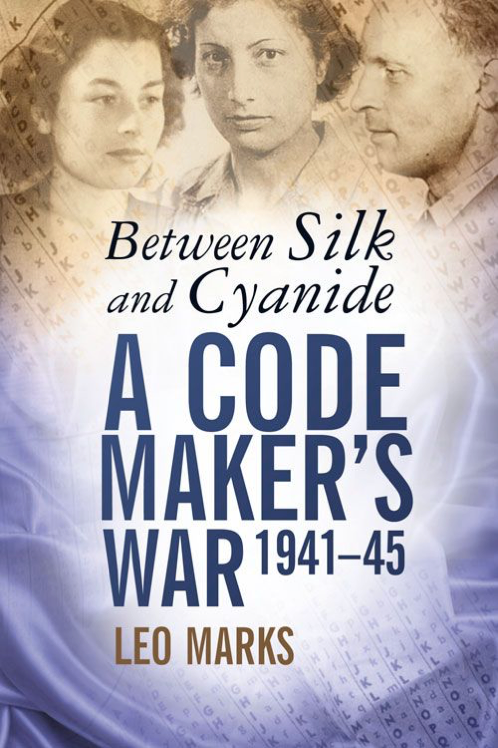 I’m taking a break from the Tim Powers tour this week to review a book recommended to me by Leah Libresco a couple of weeks ago. I’d just finished Tim Powers’ Declare, a supernatural spy thriller, and Leah posted about a book about real spies: Leo Marks’ Between Silk and Cyanide: A Codemaker’s War, 1941-1945
And then I opened it up—and was enchanted. Leo Marks is an excellent story-teller, with a dry, self-deprecating wit; and he’s writing about a real time and place, and his own actions in that time and place, actions that had a real effect on the life and death of hundreds of agents in occupied Europe. The book is over 600 pages long, and I devoured it.
It begins,
In January 1942 I was escorted to the war by my parents in case I couldn’t find it or met with an accident on the way.
Which is to say, they took him to the railway station to travel to his brand new wartime job, working on codes for the British SOE—the Special Operations Executive, which was responsible for running and supporting Britain’s agents in the occupied countries.
The SOE was not the big noise in codes in WWII Britain; that would be Bletchley Park, where Alan Turing and others built one of the first computers to defeat the German Enigma machine. Bletchley Park belonged to the Secret Intelligence Service (SIS), a rival of the SOE’s. When Marks went to coding school, he was hoping to work with John Tiltman at Bletchley Park; but the instructor decided that he was the least promising student he’d seen. His twenty-four fellow students went to Bletchley, and Marks barely squeaked into the SOE.
The SOE was not primarily interested in codes, but codes were essential to the SOE’s work. The organization communicated with agents in the field by means of wireless telegraphy, with scheduled sessions (“skeds”) set up at particular times. And of course every message had to be sent in code, for the protection of the agent and his mission.
When Marks began his work, all SOE agents were using “poem codes”. Each agent had a memorized poem he (or she!) used as the basis for his code. When coding, he’d pick five words from the poem, and use them to generate a double transposition key, which he would then use to code his message. The code groups would begin with an indicator group: an indicator of which five words were used.
Marks was aghast.
The advantage of the poem codes was that the key was memorized; the agent had nothing to carry, and nothing to be found if he were stopped and searched. But the disadvantages, immediately obvious to Marks, were many:
- What’s memorized can’t be found, but it can be beaten out of you if you’re caught: and then all of your message traffic is compromised. Worse, the enemy can keep you active, with or without your help.
- If a message is broken the hard way, the words used to generate the key become known. All too often the words from just one or two messages can be used to identify the poem if it’s a well-known one…and then all of that agent’s past and future traffic is compromised without the agent or the SOE being any the wiser. As most agents used a favorite poem they’d learned in school, this was all too likely.
- It’s easy to make mistakes when generating the double-transposition key from the five words, especially when under stress (as all agents were); and this makes the message “indecipherable”.
Indecipherables were especially bad because such messages had to be resent. Now, every minute an agent spent transmitting was another minute in which he was visible to the German DF (direction-finding) trucks: another minute in which they could triangulate on his location. Each indecipherable brought that agent another minute closer to being captured and killed.
One of Marks’ jobs, consequently, was to “break” the indecipherable messages before the agent’s next sked, so that they wouldn’t need to be resent. He had the advantage of knowing the poem the agent was trying to use, and he devised a list of common mistakes the agent might have made and how to fix them. When he began, only about 3% of the indecipherables were decoded in time.
The remainder of the book concerns Marks’ one-man crusade to reduce the number of indecipherables and thus increase the expected life span of Britain’s agents. He taught his code breaking skills to the young women (FANYs in the parlance of the day) who manned the coding room. When an indecipherable came in, the women on duty (usually about thirty) would drop everything and begin trying to break it using all of Marks’ tricks, and dividing the labor so as to avoid duplication. They’d sometimes try many thousands of different approaches, but after a time as many as 90% of the indecipherables were decoded by the FANYs, leaving only the worst for Marks.
But that was only one side of his work. The other, in which he often faced stiff opposition, was devising newer, safer codes: codes that would be harder for the Germans to break and safer for the agents to use.
Although the codes are at the heart of the story this is not a technical work. Rather, the focus is equally on all of the people involved: Marks’ superiors, of course, but even more on the FANYs, and on the agents he was trying to keep alive, and on the many people he worked with to persuade them of the need for better codes.
There’s no way to collapse a 600-plus page book into a few words; you’ll have to read it. But Marks was ultimately successful; his new codes were used by agents all of the world, and in particular were used by all of the forces invading Europe on D-Day. Take that, Bletchley Park! John Tiltman came to call Marks “the one that got away.”
A bit of related literary trivia: Marks’ father owned a bookshop, Marks & Co; which is to say that he grew up on the premises of 84 Charing Cross Road, immortalized by Helene Hanff in the book of the same name. The bookshop figures largely in Marks’ tale; it’s where he learned to love codes, and it’s where he went when he had a problem to figure out and the solution wasn’t quite ready to emerge.
Anyway…read this book. It’s funny, fascinating, and ultimately quite moving, and I expect to be relating anecdotes from it to people for the rest of my life.
Previous Post

February 23, 2015
Today's Aquinas: the Good vs. the good
Next Post

February 25, 2015 Lent, Weight Watchers, and Aristotle
Browse Our Archives
Select a Category Admin App o' the Morning Ask the Dogmat Believing Thomas Bits of Fiction Blasts from the Past Bootstrapping the Interior Life Catholic Mom Christian Living Deep Thoughts from the Doghouse Dominicana Evangelii Gaudium Interviews It Was A Dark and Stormy Night Links to This and That Lumen Fidei Meme Watch On Writing Operation Gratitude Pedant Errant Photography Quill Random Barkings S'Mary's World Shakers of Salt Software Development The Dog Whistler The Dogmat Sez Third Orders Thomas Aquinas Uncategorized Vikings at Dinos Woof Guide to Cinema Woof Guide to History Woof Guide to Literature Woof Guide to Obscure Catholic Music Woof Guide to Philosophy Woof Guide to Popular Music Woof Guide to Technology Woof Guide to Theology Words I Wish I'd Written Works For Me
Select a Month September 2016 August 2016 June 2016 May 2016 April 2016 March 2016 February 2016 January 2016 December 2015 November 2015 October 2015 September 2015 August 2015 July 2015 June 2015 May 2015 April 2015 March 2015 February 2015 January 2015 December 2014 November 2014 October 2014 September 2014 August 2014 July 2014 June 2014 May 2014 April 2014 March 2014 February 2014 January 2014 December 2013 November 2013 October 2013
Follow Us!
TAKE THE
Religious Wisdom Quiz
What miraculous event saved Daniel's friends from execution by fire?
Select your answer to see how you score.
They were hidden in a cave They were unharmed in a fiery furnace They turned invisible They outran horses
Related posts from Cry 'Woof'

In which the Blogger is Very Truly Run...

The Daughter of Time, by Josephine Tey
Book Review: Catholic Commentary on Sacred Scripture, The...

Steven Pressfield: The Lion's Gate
TRENDING AT PATHEOS Catholic

The Parable Of The Sower And The Word...
One of Christ’s most famous parables is that of the sower who...

Rejecting Doom: Christian Hope And Human Action
Christianity is a religion of hope. We are to have hope and...

Why I Choose the Eucharist Over the Sermon
Choose the Eucharist, Not the Sermon What are we supposed to get...

5 Design Elements Found in Spiritually Rooted Homes
Putting Spirituality Into Home Decor Our homes are more than our living...

Credo: A Story of God Told with the...
About 10 years ago, I began to imagine a personal "Credo" that...

The Anatomy of Divine Revelation in Catholic Thought
The claim that God has made Himself known to human beings is...
view all Catholic blogs
Ad-Free & Subscriber Log-In Subscription Support
- About Us
- 2026 Calendar
- Videos
- Podcasts
- Library of World Religions
- Faith In Media Tracker
- Advertise With Us
- Write for Us
- Privacy Policy
- Terms of Service
- Do Not Sell My Data
- Contact Us
- Radiant Digital
- Manage Newsletter Subscriptions
- Unsubscribe From Notifications
- Sitemap
Copyright 2008-2026, Patheos. All rights reserved.
Subscription Support Ad-Free & Subscriber Log-In
Follow Patheos