
BuddhistCatholicContemplativeEvangelicalGeneral ChristianHinduJewishLatter-day SaintMuslimNew VisionsProgressive Christian
Beliefs
- Buddhist
- Catholic
- Contemplative
- Evangelical
- General Christian
- Hindu
- Jewish
- Latter-day Saint
- More Voices
- Muslim
- New Visions
- Pagan
- Progressive Christian
Topics
- Religion News
- Food and Religion
- Sports and Religion
- Religious Art
- Religious Music and Entertainment
- Religious Events
- History and Religion
- Style and Religion
- Politics and Religion
- Women in Religion
- Recreation Outdoors and Religion
- Business Finance and Religion
- Careers Workplace and Religion
- Education and Religion
- Family Parenting and Religion
- Health Fitness and Religion
- Home and Religion
- Relationships and Religion
- Technology and Religion
- Travel and Religion
Columnists
- Buddhist Columnists
- Business Finance and Religion Columnists
- Careers Workplace and Religion Columnists
- Catholic Columnists
- Contemplative Columnists
- Education and Religion Columnists
- Evangelists Columnists
- Family Parenting and Religion Columnists
- General Christian Columnists
- Health Fitness and Religion Columnists
- Hindu Columnists
- History and Religion Columnists
- Home and Religion Columnists
- Jewish Columnists
- More Voices Columnists
- Latter Day Columnists
- Muslim Columnists
- New Visions Columnists
- Nonreligious Columnists
- Pagan Columnists
- Politics and Religion Columnists
- Progressive Columnists
- Recreation Outdoors and Religion Columnists
- Relationships and Religion Columnists
- Religion News Columnists
- Religious Art Columnists
- Religious Events Columnists
- Religious Music and Entertainment Columnists
- Sports and Religion Columnists
- Style and Religion Columnists
- Technology and Religion Columnists
- Travel and Religion Columnists
- Women in Religion Columnists
Resource Library
- 2026 Calendar
- Library of World Religions
- The 100 Most Holy Places on Earth
- Patheos Answers
- Podcasts
- Videos
- Faith Leaders Database
- Anglican Episcopalian
- Bahai
- Baptist
- Buddhism
- Christianity
- Confucianism
- Eastern Orthodoxy
- Hinduism
- Holiness and Pentecostal
- ISKCON
- Islam
- Judaism
- Lutheran
- Methodist
- The Church of Jesus Christ of Latter-day Saints
- New Age
- Paganism
- Presbytarian and Reformed
- Protestantism
- Religion Behind the Scenes
- Roman Catholic
- Scientology
- Shia Islam
- Sikhism
- Sufism
- Sunni Islam
- Taoism
- Zen
- See all religions
Research Tools
 Ad-Free & Subscriber Log-In Subscription Support
Ad-Free & Subscriber Log-In Subscription Support
Follow Patheos 

- Trending:
- Forgiveness
- |
- Marriage
- |
- Consciousness
- |
- Death Penalty
- |
- Election
- |
- Halloween
 Cry 'Woof'
-
Series
- Home
- Catholic
- Review: Master and Commander, by Patrick O’Brian
Review: Master and Commander, by Patrick O’Brian
Last updated on: September 9, 2014 at 6:47 pm by willduquette
Review: Master and Commander, by Patrick O’Brian 2014-09-09T18:47:42-05:00 willduquette
Patheos Explore the world's faith through different perspectives on religion and spirituality! Patheos has the views of the prevalent religions and spiritualities of the world.
 J.R.R. Tolkien was the first great literary discovery of my life, and the author of the book that I’ve returned to more often than any other. I fell in love with his work when I was nine, and have never fallen out of it.
Patrick O’Brian is the second great literary discovery of my life; I first made his (literary) acquaintance sometime in the mid-90’s, and have loved his work ever since.
Some of you are now nodding your heads, some of you are shaking them, and some of you are wondering what the ruckus is all about. Those of you in the first group, you’re on your own; I’m not going to preach to the choir. No, this review is for those of you in the second and third groups. I have hopes that some of you in the second group, who have tried O’Brian and found him lacking, will with persistence move into the first group; and that some of you in the third group who might otherwise have gotten stuck will be able to move to the first group as well.
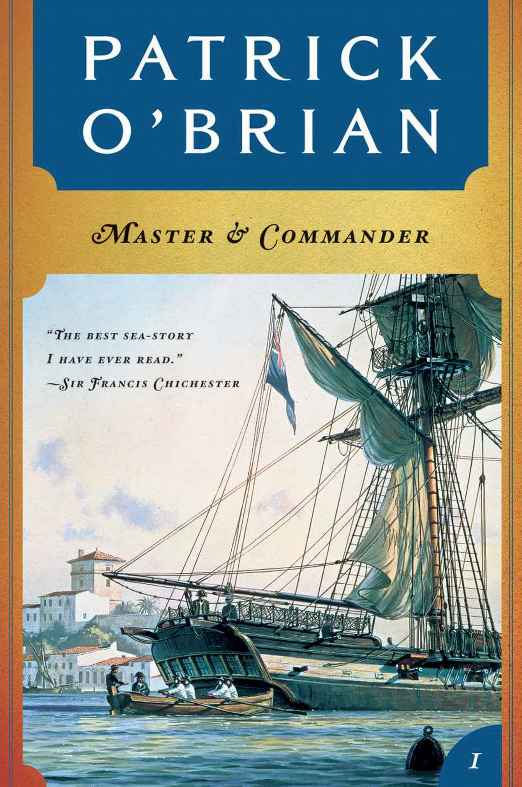
Here’s the background: Master and Commander
The series is often compared with C.S. Forester’s tales of Horatio Hornblower, and this I think is a mistake. Both are set at sea, both take place during the Napoleonic wars, both involve the career of an officer in the Royal Navy—but while Hornblower is pure nautical adventure, O’Brian’s series is anything but. Mind you, there is nautical adventure aplenty, and I enjoy that thoroughly. But Aubrey and Maturin have a depth that Hornblower lacks. The Hornblower tales are romances in the classic sense: tales in which the action is primarily external. Master and Commander isn’t a romance (though it has romantic aspects) but a novel, a book in which the important action is internal rather than external. It’s possible to read the Aubrey/Maturin series purely as adventure novel (I did my first time through) but it can be an awfully puzzling endeavor: books sometimes stop where the logic of the novel dictates, leaving the adventure hanging. In those days, when I couldn’t just download the next e-book, I found it useful to buy the novels in threes, so that I could keep reading.
In the case of Master and Commander, though, I think the problem is more a bit of inexperience on O’Brian’s part. Time and again I hear people say, “Oh, I tried that book, but I kept getting lost in all of the nautical terminology, and so I gave up.” And usually I can pinpoint the spot at which they did it.
Jack Aubrey has just taken command of His Majesty’s Sloop Sophie, and Stephen Maturin has just come aboard. Jack’s rather busy, and suggests that Mowett, one of the senior midshipmen, might give Stephen a tour of the sloop. Mowett’s trying to pass the lieutenant’s exam, and is just full of all of sorts of helpful details; and O’Brian gives us all of it, from the height of the masts to the names of various odd bits of hardware; the futtock shrouds, for example. It’s all rather confusing, to both Stephen and the reader, and goes on rather too long.
It’s possible to pay attention to every word Mowett says, and work out just what he’s talking about, if you work at it—I’ve done that—but I find that it’s best to let Mowett’s words flow over you for their nautical flavor, and not pay too much attention to them. After all, Stephen isn’t paying any more attention to Mowett than he can manage; he’s just discovered that the sloop’s lieutenant is one James Dillon, a man he’d known well in earlier life, in circumstances that are now dangerous—truly dangerous—to remember, and wondering what he’s going to do about it. So he goes along into the tops with Mowett, pausing only to be scared to death, and responds with anything that will keep Mowett talking as his mind and heart race.
O’Brian took the lesson from this book; in later interviews, he often said, “You must include the crosscatharpins; but you must not explain the crosscatharpins.” In this passage he tried a little too hard to explain, and he loses many readers. For those of you who had this problem, I assure you: if you keep on, it gets better.
And now I want to give a few examples of why I love this book so much: it’s O’Brian’s prose, his amazing ability to pack a picture into ten words instead of a thousand.
First, here’s an example where O’Brian overdoes it with the terminology; but it’s worth it for the image at the tale end, of Aubrey surfacing like a majestic whale and frightening the topsman:
Jack stepped over to the weather-rail, swung himself into the shrouds and ran up the ratlines. ‘This may not look quite dignified, in a captain,’ he reflected, pausing under the loom of the top to see just how much more clearance well-bowsed cross-catharpings might give the yard. ‘Perhaps I had better go up through the lubber’s hole .’ Ever since the invention of those platforms some way up the mast called tops, sailors have made it a point of honour to get into them by an odd, devious route – by clinging to the futtock-shrouds, which run from the catharpings near the top of the mast to the futtock-plates at the outer edge of the top: they cling to them and creep like flies, hanging backward about twenty-five degrees from the vertical, until they reach the rim of the top and so climb upon it, quite ignoring the convenient square hole next to the mast itself, to which the shrouds lead directly as their natural culmination – a straight, safe path with easy steps from the deck to the top. This hole, this lubber’s hole, is as who should say never used, except by those who have never been to sea or persons of great dignity, and when Jack came up through it he gave Jan Jackruski, ordinary seaman, so disagreeable a fright that he uttered a thin scream.
Stephen makes his first cruise with Jack as Jack’s guest; and as the second begins he and Jack are dining in the gunroom, which is to say in the officer’s mess. (The captain usually eats in his cabin, with any guests he might choose to invite.)
‘Well, gentlemen,’ [Jack] said, after they had drunk the King’s health, ‘I have news that will please you, I believe; though I must ask Mr Dillon’s indulgence for speaking of a service matter at this table. The admiral gives us a cruise on our own down to Cape Nao. And I have prevailed upon Dr Maturin to stay aboard, to sew us up when the violence of the King’s enemies happens to tear us apart.’
‘Huzzay – well done – hear, hear – topping news – good – hear him,’ they cried, all more or less together, and they looked so pleased – there was so much candid friendliness on their faces that Stephen was intensely moved.
‘Lord Keith was delighted when I told him,’ Jack went on. ‘Said he envied us extremely – had no physician in the flag-ship – was amazed when I told him of the gunner’s brains – called for his spy-glass to look at Mr Day taking the sun on deck – and wrote out the Doctor’s order in his own hand, which is something I have never heard of in the service before.’
Nor had anyone there present – the order had to be wetted – three bottles of port, there Killick – bumpers all round – and while Stephen sat looking modestly down at the table, they all stood up, crouching their heads under the beams, and sang.
I love that last line: “they all stood up, crouching their heads under the beams, and sang.” I can just see them, all crowded around the narrow table, in the cramped space of the gunroom, bending over like passengers in the window seat of an airplane who are waiting for those ahead of them to deplane but insist on standing up anyway.
Anyway—O’Brian is really good stuff, and comes with my highest recommendation, and it’s really truly worth your time to make the effort, and not let a little Mowett put you off.
Mind you, then you need to plow through Post-Captain, which is a whole ‘nuther kettle of fish. But more of that anon.
Previous Post

September 8, 2014
CT 11: Identity of Essence and Existence in God
Next Post
September 10, 2014 Nom Nom Nominalism
Browse Our Archives
Select a Category Admin App o' the Morning Ask the Dogmat Believing Thomas Bits of Fiction Blasts from the Past Bootstrapping the Interior Life Catholic Mom Christian Living Deep Thoughts from the Doghouse Dominicana Evangelii Gaudium Interviews It Was A Dark and Stormy Night Links to This and That Lumen Fidei Meme Watch On Writing Operation Gratitude Pedant Errant Photography Quill Random Barkings S'Mary's World Shakers of Salt Software Development The Dog Whistler The Dogmat Sez Third Orders Thomas Aquinas Uncategorized Vikings at Dinos Woof Guide to Cinema Woof Guide to History Woof Guide to Literature Woof Guide to Obscure Catholic Music Woof Guide to Philosophy Woof Guide to Popular Music Woof Guide to Technology Woof Guide to Theology Words I Wish I'd Written Works For Me
Select a Month September 2016 August 2016 June 2016 May 2016 April 2016 March 2016 February 2016 January 2016 December 2015 November 2015 October 2015 September 2015 August 2015 July 2015 June 2015 May 2015 April 2015 March 2015 February 2015 January 2015 December 2014 November 2014 October 2014 September 2014 August 2014 July 2014 June 2014 May 2014 April 2014 March 2014 February 2014 January 2014 December 2013 November 2013 October 2013
Follow Us!
TAKE THE
Religious Wisdom Quiz
I worked with a trowel in one hand and a weapon in the other, ready to build and fight. Who am I?
Select your answer to see how you score.
The Tribe of Judah The servants The Priests The builders
Related posts from Cry 'Woof'

In which the Blogger is Very Truly Run...

The Daughter of Time, by Josephine Tey

Book Review: Catholic Commentary on Sacred Scripture, The...

Steven Pressfield: The Lion's Gate
TRENDING AT PATHEOS Catholic

Rejecting Doom: Christian Hope And Human Action
Christianity is a religion of hope. We are to have hope and...

It’s What Comes From Within Which Matters
One of the most difficult things for us to understand is why...

Why I Choose the Eucharist Over the Sermon
Choose the Eucharist, Not the Sermon What are we supposed to get...

5 Design Elements Found in Spiritually Rooted Homes
Putting Spirituality Into Home Decor Our homes are more than our living...

Credo: A Story of God Told with the...
About 10 years ago, I began to imagine a personal "Credo" that...

The Anatomy of Divine Revelation in Catholic Thought
The claim that God has made Himself known to human beings is...
view all Catholic blogs
Ad-Free & Subscriber Log-In Subscription Support
- About Us
- 2026 Calendar
- Videos
- Podcasts
- Library of World Religions
- Faith In Media Tracker
- Advertise With Us
- Write for Us
- Privacy Policy
- Terms of Service
- Do Not Sell My Data
- Contact Us
- Radiant Digital
- Manage Newsletter Subscriptions
- Unsubscribe From Notifications
- Sitemap
Copyright 2008-2026, Patheos. All rights reserved.
Subscription Support Ad-Free & Subscriber Log-In
Follow Patheos