
BuddhistCatholicContemplativeEvangelicalGeneral ChristianHinduJewishLatter-day SaintMuslimNew VisionsProgressive Christian
Beliefs
- Buddhist
- Catholic
- Contemplative
- Evangelical
- General Christian
- Hindu
- Jewish
- Latter-day Saint
- More Voices
- Muslim
- New Visions
- Pagan
- Progressive Christian
Topics
- Religion News
- Food and Religion
- Sports and Religion
- Religious Art
- Religious Music and Entertainment
- Religious Events
- History and Religion
- Style and Religion
- Politics and Religion
- Women in Religion
- Recreation Outdoors and Religion
- Business Finance and Religion
- Careers Workplace and Religion
- Education and Religion
- Family Parenting and Religion
- Health Fitness and Religion
- Home and Religion
- Relationships and Religion
- Technology and Religion
- Travel and Religion
Columnists
- Buddhist Columnists
- Business Finance and Religion Columnists
- Careers Workplace and Religion Columnists
- Catholic Columnists
- Contemplative Columnists
- Education and Religion Columnists
- Evangelists Columnists
- Family Parenting and Religion Columnists
- General Christian Columnists
- Health Fitness and Religion Columnists
- Hindu Columnists
- History and Religion Columnists
- Home and Religion Columnists
- Jewish Columnists
- More Voices Columnists
- Latter Day Columnists
- Muslim Columnists
- New Visions Columnists
- Nonreligious Columnists
- Pagan Columnists
- Politics and Religion Columnists
- Progressive Columnists
- Recreation Outdoors and Religion Columnists
- Relationships and Religion Columnists
- Religion News Columnists
- Religious Art Columnists
- Religious Events Columnists
- Religious Music and Entertainment Columnists
- Sports and Religion Columnists
- Style and Religion Columnists
- Technology and Religion Columnists
- Travel and Religion Columnists
- Women in Religion Columnists
Resource Library
- 2026 Calendar
- Library of World Religions
- The 100 Most Holy Places on Earth
- Patheos Answers
- Podcasts
- Videos
- Faith Leaders Database
- Anglican Episcopalian
- Bahai
- Baptist
- Buddhism
- Christianity
- Confucianism
- Eastern Orthodoxy
- Hinduism
- Holiness and Pentecostal
- ISKCON
- Islam
- Judaism
- Lutheran
- Methodist
- The Church of Jesus Christ of Latter-day Saints
- New Age
- Paganism
- Presbytarian and Reformed
- Protestantism
- Religion Behind the Scenes
- Roman Catholic
- Scientology
- Shia Islam
- Sikhism
- Sufism
- Sunni Islam
- Taoism
- Zen
- See all religions
Research Tools
 Ad-Free & Subscriber Log-In Subscription Support
Ad-Free & Subscriber Log-In Subscription Support
Follow Patheos 

- Trending:
- Forgiveness
- |
- Marriage
- |
- Consciousness
- |
- Death Penalty
- |
- Election
- |
- Halloween
 Cry 'Woof'
-
Series
- Home
- Catholic
- A Tale of Two Financial Collapses: More BS?
A Tale of Two Financial Collapses: More BS?
Last updated on: August 20, 2014 at 8:00 am by willduquette
A Tale of Two Financial Collapses: More BS? 2014-08-19T19:09:52-05:00 willduquette
Patheos Explore the world's faith through different perspectives on religion and spirituality! Patheos has the views of the prevalent religions and spiritualities of the world.
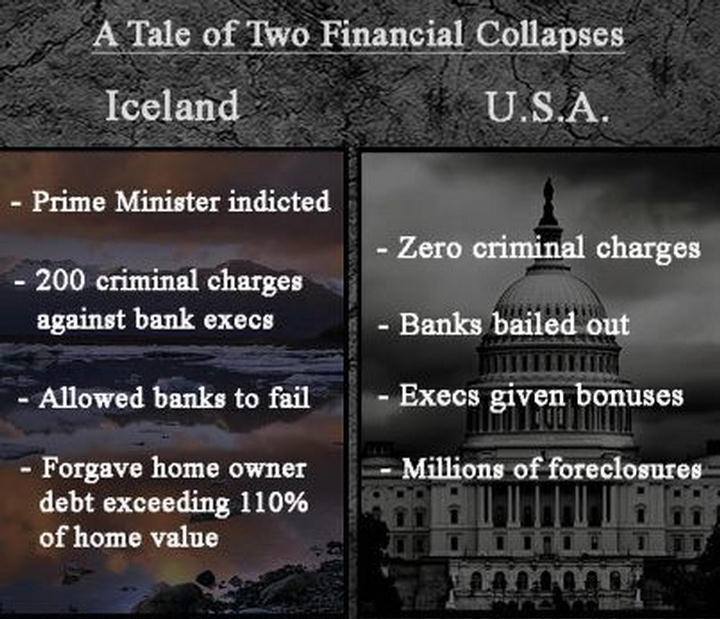
Here we have another economic meme, somewhat similar to the meme I examined recently and accused of being BS.*
- It’s comparing two disparate regions, Iceland and the United States.
- It’s discussing economic actions and results.
- It’s trying to make an implicit point.
So what is it claiming?
Both Iceland and the United States suffered financial collapses. I don’t follow the news from Iceland, but I’ll take it as read that Iceland has indeed had difficulties. The events here in the United States I remember quite well.
In Iceland, we learn,
- The Prime Minister was indicted. I gather there was some reason to think he was responsible. Was he convicted?
- Bank executives were charged with crimes. Two-hundred charges were made; how many were brought to trial? How many were convicted?
- Banks were allowed to fail. OK.
- Mortgagees were forgiven debt in significant excess of the value of their homes. But by who? The government? The banks? Both? More importantly, how many home owners were in this position, and what was the total debt that was forgiven?
For the purposes of analysis, I’ll assume that these assertions about Iceland are true and not misleading.
In the United States, we had a scheme where the U.S. government was seeking equality of outcome by encouraging banks, through FNMA, to give inexpensive, dangerously structured loans to first-time buyers without due concern for their ability to repay—a classic example of seeking short-term gains at the expense of long-term viability. When the collapse came, according to this meme,
- No one was charged. I think this is a slight exaggeration; there were a few lawsuits that were at least tangentially involved. (I’m thinking of Countrywide Funding here.) But in general, this is true.
- Banks were bailed out. They certainly weren’t allowed to fail.
- Execs given bonuses. Perhaps they were; it wouldn’t surprise me. Execs of large corporations are always given bonuses. I find it interesting that all of the blame seems to be put on the bankers; in fact, the government was in it with both feet and a shovel.
- Millions of homes were foreclosed on. Well, yes; that’s what happens when you give home loans without due regard for risk. I’d be curious to know what the total unpaid debt has been.
Now for the implicit claims, which are much more modest, I think, than in that other meme.
The responsible parties in the U.S. collapse should have been held accountable; they were in Iceland. So it seems, and we agree.
The responsible parties in the U.S. collapse could have been held accountable. I’d certainly like to think so. But given the degree of cooperation between the government and the banking industry, it wasn’t likely. This wasn’t a matter of one or two individuals agreeing to do the dirty; it was the result of a major policy decision that impacted many, many workers on both sides. In America, we far too often reward failed policies by re-doubling our efforts in the same direction.
And then here’s the kicker:
Foreclosures were avoided in Iceland; maybe those millions of foreclosures could have been avoided. The best way to have avoided them would have been to have not made the loans to begin with. But given that we did, could we have forgiven the excess debt?
The first thing to note, here, is that the sums of money involved in Iceland were necessarily much, much lower than here in the United States. One of the commenters on this meme on Facebook noted that she lived in a U.S. county with twice the population of Iceland. That means that the issues were combinatorially simpler, easier to understand, easier to manage, and (apparently) easier to solve.
Were the loans in Iceland held by the individual banks? In the United States, these kinds of loans are generally repackaged and sold to investors as junk bonds. The banks don’t own them, they just service them; and when a mortgagee can’t pay, it isn’t the bank that suffers, but the investors who were foolish enough to invest in junk bonds. And many of those investors were probably mutual funds representing many small investors.
Forgiving all of that debt would have helped the home owners but would have adversely impacted many other everyday Americans, many of whom were in no way responsible. It was a difficult situation.
To conclude, there’s much to criticize on this meme; but on reflection I find it much less guilty of indulging in BS than its predecessor.
- It’s much more muted, using quiet colors and a less strident font. It doesn’t appear to be going for emotional effect.
- It seems directed toward spurring reflection rather than reaction.
- It encourages responsibility and accountability, which I’m certainly in favor of.
- It encourages the reader to assume that two disparate situations are directly comparable when a moment’s reflection shows that they can’t be.
- It takes an overly simplistic view of the nature of the collapse here in the United States. But then, it’s a meme.
In short, it’s pointing out a real problem with how we handled home loans in past decades, and encouraging us to do better in the future, rather than manipulating us to jump to conclusions to support a particular taxation policy. There’s maybe a slight whiff of BS here, but it isn’t overpowering;** I’d be much more likely to accuse it of wishful thinking.
_____
* I’ll use this abbreviation out of deference to the reader who assumed I was using bad language to try to be edgy and such. A casual glance at my previous posts will reveal that I’m not inclined to do that.
** Always assuming that the statements about Iceland are true and not misleading.
Previous Post
August 19, 2014
Review: The Citadel of God, by Louis de Wohl
Next Post

August 21, 2014 Terry Pratchett on Family Feuds
Browse Our Archives
Select a Category Admin App o' the Morning Ask the Dogmat Believing Thomas Bits of Fiction Blasts from the Past Bootstrapping the Interior Life Catholic Mom Christian Living Deep Thoughts from the Doghouse Dominicana Evangelii Gaudium Interviews It Was A Dark and Stormy Night Links to This and That Lumen Fidei Meme Watch On Writing Operation Gratitude Pedant Errant Photography Quill Random Barkings S'Mary's World Shakers of Salt Software Development The Dog Whistler The Dogmat Sez Third Orders Thomas Aquinas Uncategorized Vikings at Dinos Woof Guide to Cinema Woof Guide to History Woof Guide to Literature Woof Guide to Obscure Catholic Music Woof Guide to Philosophy Woof Guide to Popular Music Woof Guide to Technology Woof Guide to Theology Words I Wish I'd Written Works For Me
Select a Month September 2016 August 2016 June 2016 May 2016 April 2016 March 2016 February 2016 January 2016 December 2015 November 2015 October 2015 September 2015 August 2015 July 2015 June 2015 May 2015 April 2015 March 2015 February 2015 January 2015 December 2014 November 2014 October 2014 September 2014 August 2014 July 2014 June 2014 May 2014 April 2014 March 2014 February 2014 January 2014 December 2013 November 2013 October 2013
Follow Us!
TAKE THE
Religious Wisdom Quiz
What famous prayer did Jesus teach His followers?
Select your answer to see how you score.
The Prayer of Jabez The Lord’s Prayer The Shema Psalm 23
Related posts from Cry 'Woof'
Meme Watch: The Fruit was Good for Food
What's a Meme? Let me count the ways....

Aphorism Watch: Do What You Love, Love What...
TRENDING AT PATHEOS Catholic

The Parable Of The Sower And The Word...
One of Christ’s most famous parables is that of the sower who...

Rejecting Doom: Christian Hope And Human Action
Christianity is a religion of hope. We are to have hope and...

Why I Choose the Eucharist Over the Sermon
Choose the Eucharist, Not the Sermon What are we supposed to get...

5 Design Elements Found in Spiritually Rooted Homes
Putting Spirituality Into Home Decor Our homes are more than our living...

Credo: A Story of God Told with the...
About 10 years ago, I began to imagine a personal "Credo" that...

The Anatomy of Divine Revelation in Catholic Thought
The claim that God has made Himself known to human beings is...
view all Catholic blogs
Ad-Free & Subscriber Log-In Subscription Support
- About Us
- 2026 Calendar
- Videos
- Podcasts
- Library of World Religions
- Faith In Media Tracker
- Advertise With Us
- Write for Us
- Privacy Policy
- Terms of Service
- Do Not Sell My Data
- Contact Us
- Radiant Digital
- Manage Newsletter Subscriptions
- Unsubscribe From Notifications
- Sitemap
Copyright 2008-2026, Patheos. All rights reserved.
Subscription Support Ad-Free & Subscriber Log-In
Follow Patheos