
BuddhistCatholicContemplativeEvangelicalGeneral ChristianHinduJewishLatter-day SaintMuslimNew VisionsProgressive Christian
Beliefs
- Buddhist
- Catholic
- Contemplative
- Evangelical
- General Christian
- Hindu
- Jewish
- Latter-day Saint
- More Voices
- Muslim
- New Visions
- Pagan
- Progressive Christian
Topics
- Religion News
- Food and Religion
- Sports and Religion
- Religious Art
- Religious Music and Entertainment
- Religious Events
- History and Religion
- Style and Religion
- Politics and Religion
- Women in Religion
- Recreation Outdoors and Religion
- Business Finance and Religion
- Careers Workplace and Religion
- Education and Religion
- Family Parenting and Religion
- Health Fitness and Religion
- Home and Religion
- Relationships and Religion
- Technology and Religion
- Travel and Religion
Columnists
- Buddhist Columnists
- Business Finance and Religion Columnists
- Careers Workplace and Religion Columnists
- Catholic Columnists
- Contemplative Columnists
- Education and Religion Columnists
- Evangelists Columnists
- Family Parenting and Religion Columnists
- General Christian Columnists
- Health Fitness and Religion Columnists
- Hindu Columnists
- History and Religion Columnists
- Home and Religion Columnists
- Jewish Columnists
- More Voices Columnists
- Latter Day Columnists
- Muslim Columnists
- New Visions Columnists
- Nonreligious Columnists
- Pagan Columnists
- Politics and Religion Columnists
- Progressive Columnists
- Recreation Outdoors and Religion Columnists
- Relationships and Religion Columnists
- Religion News Columnists
- Religious Art Columnists
- Religious Events Columnists
- Religious Music and Entertainment Columnists
- Sports and Religion Columnists
- Style and Religion Columnists
- Technology and Religion Columnists
- Travel and Religion Columnists
- Women in Religion Columnists
Resource Library
- 2026 Calendar
- Library of World Religions
- The 100 Most Holy Places on Earth
- Patheos Answers
- Podcasts
- Videos
- Faith Leaders Database
- Anglican Episcopalian
- Bahai
- Baptist
- Buddhism
- Christianity
- Confucianism
- Eastern Orthodoxy
- Hinduism
- Holiness and Pentecostal
- ISKCON
- Islam
- Judaism
- Lutheran
- Methodist
- The Church of Jesus Christ of Latter-day Saints
- New Age
- Paganism
- Presbytarian and Reformed
- Protestantism
- Religion Behind the Scenes
- Roman Catholic
- Scientology
- Shia Islam
- Sikhism
- Sufism
- Sunni Islam
- Taoism
- Zen
- See all religions
Research Tools
 Ad-Free & Subscriber Log-In Subscription Support
Ad-Free & Subscriber Log-In Subscription Support
Follow Patheos 

- Trending:
- Forgiveness
- |
- Marriage
- |
- Consciousness
- |
- Death Penalty
- |
- Election
- |
- Halloween
 Cry 'Woof'
-
Series
- Home
- Catholic
- Review: The Complete Peanuts, 1950 to 1952
Review: The Complete Peanuts, 1950 to 1952
Last updated on: March 22, 2014 at 3:13 am by willduquette
Review: The Complete Peanuts, 1950 to 1952 2014-03-21T18:14:54-05:00 willduquette
Patheos Explore the world's faith through different perspectives on religion and spirituality! Patheos has the views of the prevalent religions and spiritualities of the world.
This review was first posted in May of 2004.
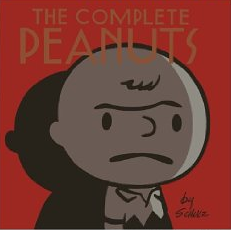 The Complete Peanuts 1950-1952 (Vol. 1) (The Complete Peanuts)
The first is purely nostalgic. During most of my life, the only Peanuts cartoons I read in the newspaper were the Sunday strips. The daily strips weren’t on the usual comics page; instead, they were just inside the front page, which I seldom looked at. Thus, my knowledge of Charlie Brown et al came from a handful of Peanuts collections, most of which I inherited from my siblings, and all of which were from the first ten years of the strip’s existence. I read them over and over. And many of the ones I remember best are from the time period covered by this current collection.
The other reason is that I’m a comic strip junkie, and I especially like watching comic strips evolve. There’s always a period of time during which the cartoonist is figuring out how his characters are drawn, and what personalities they have, and I find it fascinating to watch. In this case, I also found it fascinating to re-read the same cartoons I’d loved as a kid, and see things that had gone completely over my head.
Here are a number of things I noticed as I was reading it.
As the strip begins, there are only four major characters: Shermy, Patty (who is not the Peppermint Patty of the later years), Charlie Brown, and Snoopy. Shermy and Patty are the big kids—they both go to school (though it might only be kindergarten). Charlie Brown is the little kid in the neighborhood; he doesn’t go to school yet. And the kind of problems Charlie Brown has with Patty and Shermy (though mostly with Patty) are the kind of problems any little kid has with the Big Kids. Interestingly, there’s a clear scent of on-again/off-again romance between Patty and Shermy. Snoopy, meanwhile, is just a dog. He has moods, and opinions, but they are non-verbal. His big thing is that he can always tell when Charlie Brown has anything to eat, especially ice cream or candy.
Over the course of the first year, Charlie Brown gets a little older, and a new cast member is added: Violet, a pretty girl of Charlie Brown’s own age, with two straight pigtails in back (though she’s usually drawn in profile, so you can only see one). One gathers that she was added to give Charlie Brown a love interest of his own. Violet, interestingly, is the first girl to hold a football for Charlie Brown; and though she takes it away at the last minute, it doesn’t appear to be due to malice. Charlie Brown also shows up playing Beethoven (badly) on a violin during this period.
The next kid to arrive is Schroeder, the new baby in the neighborhood, and for the first month or so a baby is all he is—and then the piano shows up, and he takes off with Beethoven. By the end of the book he’s walking and talking and playing baseball with Charlie Brown—who at this point is always shown as the catcher, never the pitcher—though he’s definitely still younger than Charlie Brown.
Shortly after Schroeder makes the transformation from toddler to little boy and Charlie Brown’s frequent companion, Lucy shows up. As with Schroeder, she starts out more or less as a toddler, and though she has an independent streak she’s initially relatively guileless. Toward the end of the book, she does indeed hold the football for Charlie Brown in a Sunday strip in which he twice fails to kick the ball, and in neither case does she pull the ball away. The first time she’s afraid that he’ll kick her, and so she lets go of the ball so that it flops over just as he’s about to kick it. The second time Charlie Brown warns her to hold it absolutely still, and she holds it so tightly that he can’t kick it out of her grip. In neither case is she being mean; she’s trying her best, in fact.
After Lucy appears, Violet’s hairstyle begins to change, possibly because she and Lucy look too much alike. Over the course of several months it goes back and forth between her signature pigtails hanging straight down in back and a single proto-bun on the back of her head.
It’s about this time, or maybe a few months earlier, that Snoopy shows signs of becoming a Dog of Parts. Charlie Brown comments that everyone in town is getting a TV, and gives as evidence Snoopy’s doghouse, which has a TV aerial on top. (If I’m not mistaken, this marks the first time Snoopy’s doghouse appears in the strip.) A month or so later, angry at being left all alone by the kids at the end of the day of a long day of play, Snoopy stalks off to his dog house. If they don’t want to play anymore, that fine. He doesn’t need them. He can spend the evening watching TV.
And then, just at the end of the book, Linus makes his first appearances as Lucy’s baby brother.
As 1952 comes to a close, none of the characters yet look quite as we will know them for the better part of the strip’s life. Charlie Brown’s head is still noticeably oval when seen full-face. Snoopy hasn’t yet begun to walk on his hindlegs or sleep on top of his dog house—it’s not even completely clear yet that he’s Charlie Brown’s dog. Violet is clearly evolving toward her final form, but hasn’t gotten there yet. Schroeder is already a big Beethoven fan, but Lucy has not yet fallen in love with him. Lucy, who is still noticeably younger than Charlie Brown, has not yet opened her psychiatrist’s booth. Linus has not yet acquired his security blanket, nor can he talk. Charlie Brown plays baseball, but has not yet begun to pitch.
There’s good stuff in this first volume, but clearly, the best is yet to come.

Previous Post

March 21, 2014
Old Blind Dogs: Kincardine Lads
Next Post
March 23, 2014 Called from the Labyrinth
Browse Our Archives
Select a Category Admin App o' the Morning Ask the Dogmat Believing Thomas Bits of Fiction Blasts from the Past Bootstrapping the Interior Life Catholic Mom Christian Living Deep Thoughts from the Doghouse Dominicana Evangelii Gaudium Interviews It Was A Dark and Stormy Night Links to This and That Lumen Fidei Meme Watch On Writing Operation Gratitude Pedant Errant Photography Quill Random Barkings S'Mary's World Shakers of Salt Software Development The Dog Whistler The Dogmat Sez Third Orders Thomas Aquinas Uncategorized Vikings at Dinos Woof Guide to Cinema Woof Guide to History Woof Guide to Literature Woof Guide to Obscure Catholic Music Woof Guide to Philosophy Woof Guide to Popular Music Woof Guide to Technology Woof Guide to Theology Words I Wish I'd Written Works For Me
Select a Month September 2016 August 2016 June 2016 May 2016 April 2016 March 2016 February 2016 January 2016 December 2015 November 2015 October 2015 September 2015 August 2015 July 2015 June 2015 May 2015 April 2015 March 2015 February 2015 January 2015 December 2014 November 2014 October 2014 September 2014 August 2014 July 2014 June 2014 May 2014 April 2014 March 2014 February 2014 January 2014 December 2013 November 2013 October 2013
Follow Us!
TAKE THE
Religious Wisdom Quiz
Which of Job’s friends said, "Consider now: Who, being innocent, has ever perished?"
Select your answer to see how you score.
Bildad Eliphaz Elihu Zophar
Related posts from Cry 'Woof'

In which the Blogger is Very Truly Run...

The Daughter of Time, by Josephine Tey
Book Review: Catholic Commentary on Sacred Scripture, The...

Steven Pressfield: The Lion's Gate
TRENDING AT PATHEOS Catholic

Rejecting Doom: Christian Hope And Human Action
Christianity is a religion of hope. We are to have hope and...

It’s What Comes From Within Which Matters
One of the most difficult things for us to understand is why...

Why I Choose the Eucharist Over the Sermon
Choose the Eucharist, Not the Sermon What are we supposed to get...

5 Design Elements Found in Spiritually Rooted Homes
Putting Spirituality Into Home Decor Our homes are more than our living...

Credo: A Story of God Told with the...
About 10 years ago, I began to imagine a personal "Credo" that...

The Anatomy of Divine Revelation in Catholic Thought
The claim that God has made Himself known to human beings is...
view all Catholic blogs
Ad-Free & Subscriber Log-In Subscription Support
- About Us
- 2026 Calendar
- Videos
- Podcasts
- Library of World Religions
- Faith In Media Tracker
- Advertise With Us
- Write for Us
- Privacy Policy
- Terms of Service
- Do Not Sell My Data
- Contact Us
- Radiant Digital
- Manage Newsletter Subscriptions
- Unsubscribe From Notifications
- Sitemap
Copyright 2008-2026, Patheos. All rights reserved.
Subscription Support Ad-Free & Subscriber Log-In
Follow Patheos