
BuddhistCatholicContemplativeEvangelicalGeneral ChristianHinduJewishLatter-day SaintMuslimNew VisionsProgressive Christian
Beliefs
- Buddhist
- Catholic
- Contemplative
- Evangelical
- General Christian
- Hindu
- Jewish
- Latter-day Saint
- More Voices
- Muslim
- New Visions
- Pagan
- Progressive Christian
Topics
- Religion News
- Food and Religion
- Sports and Religion
- Religious Art
- Religious Music and Entertainment
- Religious Events
- History and Religion
- Style and Religion
- Politics and Religion
- Women in Religion
- Recreation Outdoors and Religion
- Business Finance and Religion
- Careers Workplace and Religion
- Education and Religion
- Family Parenting and Religion
- Health Fitness and Religion
- Home and Religion
- Relationships and Religion
- Technology and Religion
- Travel and Religion
Columnists
- Buddhist Columnists
- Business Finance and Religion Columnists
- Careers Workplace and Religion Columnists
- Catholic Columnists
- Contemplative Columnists
- Education and Religion Columnists
- Evangelists Columnists
- Family Parenting and Religion Columnists
- General Christian Columnists
- Health Fitness and Religion Columnists
- Hindu Columnists
- History and Religion Columnists
- Home and Religion Columnists
- Jewish Columnists
- More Voices Columnists
- Latter Day Columnists
- Muslim Columnists
- New Visions Columnists
- Nonreligious Columnists
- Pagan Columnists
- Politics and Religion Columnists
- Progressive Columnists
- Recreation Outdoors and Religion Columnists
- Relationships and Religion Columnists
- Religion News Columnists
- Religious Art Columnists
- Religious Events Columnists
- Religious Music and Entertainment Columnists
- Sports and Religion Columnists
- Style and Religion Columnists
- Technology and Religion Columnists
- Travel and Religion Columnists
- Women in Religion Columnists
Resource Library
- 2026 Calendar
- Library of World Religions
- The 100 Most Holy Places on Earth
- Patheos Answers
- Podcasts
- Videos
- Faith Leaders Database
- Anglican Episcopalian
- Bahai
- Baptist
- Buddhism
- Christianity
- Confucianism
- Eastern Orthodoxy
- Hinduism
- Holiness and Pentecostal
- ISKCON
- Islam
- Judaism
- Lutheran
- Methodist
- The Church of Jesus Christ of Latter-day Saints
- New Age
- Paganism
- Presbytarian and Reformed
- Protestantism
- Religion Behind the Scenes
- Roman Catholic
- Scientology
- Shia Islam
- Sikhism
- Sufism
- Sunni Islam
- Taoism
- Zen
- See all religions
Research Tools
 Ad-Free & Subscriber Log-In Subscription Support
Ad-Free & Subscriber Log-In Subscription Support
Follow Patheos 

- Trending:
- Forgiveness
- |
- Marriage
- |
- Consciousness
- |
- Death Penalty
- |
- Election
- |
- Halloween
 Cry 'Woof'
-
Series
- Home
- Catholic
- App o’ the Morning: LilyPond
App o’ the Morning: LilyPond
Last updated on: December 23, 2014 at 6:35 pm by willduquette
App o’ the Morning: LilyPond 2014-12-23T18:35:14-05:00 willduquette
Patheos Explore the world's faith through different perspectives on religion and spirituality! Patheos has the views of the prevalent religions and spiritualities of the world.
The tin whistle is a folk instrument; and the wonder and glory of folk music is that although it consists mostly of old standards, the old standards aren’t particularly standard. For any well-known tune there will be any number of versions extant, with different words, slightly different melodies, different arrangements, and so on. And then, when you learn to play the tune, you’re not expected to simply play it just like everyone else—instead, you’re expected to take it and make it your own, and play it the way you want to play it.
And that means that even if you can find sheet music for the song, you’re ultimately going to want to make changes to it. You might want to some ornamentation here, or repeat that phrase, or change that note there, or change the rhythm slightly. Or you might find it in the key of F, and you’d really rather have it in D.
Now, you could simply write it all out longhand on music paper; but given a tablet and applications like ForScore, you’re going to want it in electronic form. Now, as it happens there are many, many programs for music typesetting that will let you enter your score and save it as a PDF file. Some of them are extremely expensive; others are less so. And then there’s LilyPond, which is free and works quite well—if you don’t mind thinking like a programmer.
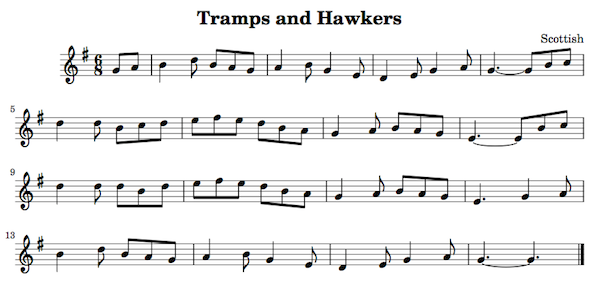
For example, I found some sheet music for a song called “Tramps and Hawkers”; but it wasn’t quite right. It was written as 3/4 time, when it plays more like 6/8 time; and one note sounded off to me. (That is to say, it sounded different than the recording I’m familiar with.) I wanted to fix it, so I re-arranged it in LilyPond.
When you start LilyPond, it gives you a text editor window to type the tune into, using its own notation language. Here’s what I ended up with for “Tramps and Hawkers”:
\relative c'' {
  \key g \major
  \time 6/8

  \partial 4
  g8 a | b4 d8 b a g | a4 b8 g4 e8 | d4 e8 g4 a8 | g4.~ g8 b c | \break
  d4 d8 b c d | e fis e d b a | g4 a8 b a g | e4.~ e8 b' c | \break
  d4 d8 d b d | e fis e d b a | g4 a8 b a g | e4. g4 a8 | \break
  b4 d8 b a g | a4 b8 g4 e8 | d4 e8 g4 a8 | g4.~ g4.

  \bar "|."
}
As you can see, it’s in G major and 6/8 time. The first measure (a pickup) is “g8 a“. “g8” means you want G as an 8th note, and “a” means A. Since the duration is not given, the A will also be an 8th note.
The vertical bar indicates the beginning of a new measure, which is “b4 d8 b a g“, or a B quarter note, followed by D, B, A, and G as eight notes.
Now, each of the notes A through G appears multiple times on the staff. How does LilyPond know which one you want? Essentially, it picks the one closest to the previous note. The code “\relative c''” means that the tune starts near C two octaves above middle C; and after that each note is relative to its predecessor.
Sometimes, of course, the nearest note is not what you want. In the last measure on the second line, you’ll see this: “e4.~ e8 b' c“. The apostrophe in “b'” means that the note is one octave up from what LilyPond expects. Similarly, you can move it down an octave by writing “b,“. (For the record, the “e4.~ e8” is an E as a dotted quarter note, with a tie to the subsequent eighth note.)
Here’s what it looks like all put together:
LilyPond is not for everyone. If the idea of writing and debugging code repels you, you’ll want to look for something else. Me, I’m a programmer; writing and debugging code is where I live. And then…many years ago, while I was learning the recorder, I bought a program called Noteworthy Composer. It was a nice piece of software, and I did a number of tunes with it. Then I switched from Windows to Macintosh…and Noteworthy Composer is Windows only. Instantly, the score files I’d created with Noteworthy Composer were worthless to me. But even if LilyPond went away tomorrow, I’d still have the input text for each tune, and I could still read it myself.
I don’t know whether I’ll stick with LilyPond long-term, but so far it’s been able to do everything I need; and I know it’s capable of many things (such as multi-part scores) that I don’t expect ever to need. There’s a reasonable tutorial at the LilyPond website, and lots of reference material as well.
Previous Post

January 31, 2014
The Weavers: Kisses Sweeter Than Wine
Next Post
February 1, 2014 The Old Man In the Hat Comes Back
Browse Our Archives
Select a Category Admin App o' the Morning Ask the Dogmat Believing Thomas Bits of Fiction Blasts from the Past Bootstrapping the Interior Life Catholic Mom Christian Living Deep Thoughts from the Doghouse Dominicana Evangelii Gaudium Interviews It Was A Dark and Stormy Night Links to This and That Lumen Fidei Meme Watch On Writing Operation Gratitude Pedant Errant Photography Quill Random Barkings S'Mary's World Shakers of Salt Software Development The Dog Whistler The Dogmat Sez Third Orders Thomas Aquinas Uncategorized Vikings at Dinos Woof Guide to Cinema Woof Guide to History Woof Guide to Literature Woof Guide to Obscure Catholic Music Woof Guide to Philosophy Woof Guide to Popular Music Woof Guide to Technology Woof Guide to Theology Words I Wish I'd Written Works For Me
Select a Month September 2016 August 2016 June 2016 May 2016 April 2016 March 2016 February 2016 January 2016 December 2015 November 2015 October 2015 September 2015 August 2015 July 2015 June 2015 May 2015 April 2015 March 2015 February 2015 January 2015 December 2014 November 2014 October 2014 September 2014 August 2014 July 2014 June 2014 May 2014 April 2014 March 2014 February 2014 January 2014 December 2013 November 2013 October 2013
Follow Us!
TAKE THE
Religious Wisdom Quiz
True or False: The entire city of Nineveh repented after Jonah preached to them.
Select your answer to see how you score.
FALSE TRUE
Related posts from Cry 'Woof'

Review: Something Other Than God, by Jennifer Fulwiler

The Desolation of the Draggin'


Animated Shorts of Irish Folk Songs
TRENDING AT PATHEOS Catholic

Rejecting Doom: Christian Hope And Human Action
Christianity is a religion of hope. We are to have hope and...

It’s What Comes From Within Which Matters
One of the most difficult things for us to understand is why...

Why I Choose the Eucharist Over the Sermon
Choose the Eucharist, Not the Sermon What are we supposed to get...

5 Design Elements Found in Spiritually Rooted Homes
Putting Spirituality Into Home Decor Our homes are more than our living...

Credo: A Story of God Told with the...
About 10 years ago, I began to imagine a personal "Credo" that...

The Anatomy of Divine Revelation in Catholic Thought
The claim that God has made Himself known to human beings is...
view all Catholic blogs
Ad-Free & Subscriber Log-In Subscription Support
- About Us
- 2026 Calendar
- Videos
- Podcasts
- Library of World Religions
- Faith In Media Tracker
- Advertise With Us
- Write for Us
- Privacy Policy
- Terms of Service
- Do Not Sell My Data
- Contact Us
- Radiant Digital
- Manage Newsletter Subscriptions
- Unsubscribe From Notifications
- Sitemap
Copyright 2008-2026, Patheos. All rights reserved.
Subscription Support Ad-Free & Subscriber Log-In
Follow Patheos