
BuddhistCatholicContemplativeEvangelicalGeneral ChristianHinduJewishLatter-day SaintMuslimNew VisionsProgressive Christian
Beliefs
- Buddhist
- Catholic
- Contemplative
- Evangelical
- General Christian
- Hindu
- Jewish
- Latter-day Saint
- More Voices
- Muslim
- New Visions
- Pagan
- Progressive Christian
Topics
- Religion News
- Food and Religion
- Sports and Religion
- Religious Art
- Religious Music and Entertainment
- Religious Events
- History and Religion
- Style and Religion
- Politics and Religion
- Women in Religion
- Recreation Outdoors and Religion
- Business Finance and Religion
- Careers Workplace and Religion
- Education and Religion
- Family Parenting and Religion
- Health Fitness and Religion
- Home and Religion
- Relationships and Religion
- Technology and Religion
- Travel and Religion
Columnists
- Buddhist Columnists
- Business Finance and Religion Columnists
- Careers Workplace and Religion Columnists
- Catholic Columnists
- Contemplative Columnists
- Education and Religion Columnists
- Evangelists Columnists
- Family Parenting and Religion Columnists
- General Christian Columnists
- Health Fitness and Religion Columnists
- Hindu Columnists
- History and Religion Columnists
- Home and Religion Columnists
- Jewish Columnists
- More Voices Columnists
- Latter Day Columnists
- Muslim Columnists
- New Visions Columnists
- Nonreligious Columnists
- Pagan Columnists
- Politics and Religion Columnists
- Progressive Columnists
- Recreation Outdoors and Religion Columnists
- Relationships and Religion Columnists
- Religion News Columnists
- Religious Art Columnists
- Religious Events Columnists
- Religious Music and Entertainment Columnists
- Sports and Religion Columnists
- Style and Religion Columnists
- Technology and Religion Columnists
- Travel and Religion Columnists
- Women in Religion Columnists
Resource Library
- 2026 Calendar
- Library of World Religions
- The 100 Most Holy Places on Earth
- Patheos Answers
- Podcasts
- Videos
- Faith Leaders Database
- Anglican Episcopalian
- Bahai
- Baptist
- Buddhism
- Christianity
- Confucianism
- Eastern Orthodoxy
- Hinduism
- Holiness and Pentecostal
- ISKCON
- Islam
- Judaism
- Lutheran
- Methodist
- The Church of Jesus Christ of Latter-day Saints
- New Age
- Paganism
- Presbytarian and Reformed
- Protestantism
- Religion Behind the Scenes
- Roman Catholic
- Scientology
- Shia Islam
- Sikhism
- Sufism
- Sunni Islam
- Taoism
- Zen
- See all religions
Research Tools
 Ad-Free & Subscriber Log-In Subscription Support
Ad-Free & Subscriber Log-In Subscription Support
Follow Patheos 

- Trending:
- Forgiveness
- |
- Marriage
- |
- Consciousness
- |
- Death Penalty
- |
- Election
- |
- Halloween
 Crux Sola: Formed by Scripture to Live like Christ
-
Blog Series
- Home
- Evangelical
- “Punch Drunk” Love: Beth Moore, Coldplay, and the Beautiful Scandal of Metaphor
“Punch Drunk” Love: Beth Moore, Coldplay, and the Beautiful Scandal of Metaphor
Last updated on: August 30, 2022 at 6:49 am by Nijay Gupta
“Punch Drunk” Love: Beth Moore, Coldplay, and the Beautiful Scandal of Metaphor 2022-08-30T06:49:26-08:00 Nijay Gupta
Patheos Explore the world's faith through different perspectives on religion and spirituality! Patheos has the views of the prevalent religions and spiritualities of the world.
“Punch Drunk” Love
Beth Moore, Coldplay, and the Beautiful Scandal of Metaphor
Nijay K. Gupta
 Most of the Bible is written in narrative or poetry. That means most of the biblical writers were verbal artists. And one of the key elements of literature is metaphor. Virtually all of the music, movies, and novels we love are loaded with symbolism and wordplay, verbal images splashed across pages or woven into lyrics and scripts. Truth be told, the Bible wasn’t written as a point-by-point systematic theology—and thank goodness. The Bible is far more interesting, exciting, emotionally-charged, character-driven, symbol-laden, and ripe for new reflection. But that also makes the Bible challenging to interpret. When a biblical writer uses a metaphor, we are left to wonder: what exactly did they mean? How far should the metaphor go? Think about Jesus’ parables and teachings. The shrewd manager that cuts bills to make friends. The persistent widow—is it appropriate to give in to nagging? Jesus’ teachings don’t have 1000 footnotes and qualifications. Sometimes he dropped a word bomb, preaching is dangerous.
We could spend hours talking about one word Jesus uses: Hades (yup, you read that right, Jesus draws religious language from pagan mythology). Remember when Jesus says, *On this rock I will build my church, and the gates of hell will not prevail…*well…the word for “hell” is the Greek word Hades. Surely Jesus wasn’t talking about that Hades. And yet he used an image from the Greek world to capture a Hebraic concept. Sometimes we might push the boundaries of “acceptable” speech by using words, images, and concepts that are meant to startle or arrest. Jesus accomplished that, and more.
Beth Moore was the focus of a dust-up on Twitter recently for commenting about developing a “crush” on Jesus. She posted a picture of her grapevine and wrote: “I’m growing grapes for reals. It’s like a miracle. In fifty jillion degree weather. If Jesus is trying to get me to have a crush on him, it’s working.” I hope anyone who spends time on social media knows that (1) this is casual speech (not a doctoral defense) and (2) she was probably playing off of the idea that grapes are sometimes “crushed.” In any case, self-appointed Twitter theology police stepped in to question the notion that believers might “crush” on Jesus. They accused Moore of going too far. That this was not appropriate Christian discourse. But…is it not? The Bible does use love and affection language a lot, and in Jesus’ own time it was uncommon to do so. In Roman religion, it was not appropriate to talk about personal affection for God, but Jews did view a relationship with the divine as like an intimate marriage (Hosea). Now, of course, they tried to avoid sexual connotations, but Jews and Christians could easily be accused by society of confusing human relationships of affection with religion—which should be professional, proper, and “leave room for the Holy Spirit.” Even in the New Testament, we see glimpses of Christians experiencing a kind of “punch drunk love” for God.
Coldplay’s Ode to the Mystery of Love
I was reminded of the idea that love is a mysterious feeling that takes us into dangerous territory when I was listening to a song by Coldplay called “Hymn for the Weekend.” I think this song is about the strange sensation of love, where we feel overwhelmed by emotion. Hence the chorus refrain “Got me feeling drunk and high.” “Life is a drink and love’s a drug/Oh, now I think I must be miles up/When I was a river, dried up/You came to rain a flood.” This could easily be about human love. But there appear to be biblical resonances in the song as well. First, it’s called a “hymn,” and second, the refrain “Drink from me/drink from me,” which echoes Jesus’ own call “If anyone thirsts, let them come to me and drink” (John 7). But surely it is wrong to compare human-divine love to our baser human urges of passion and drugs, right? That’s bad theology, isn’t it? Maybe not.
That sort of conundrum struck me as I was singing this song mindlessly in the car. “…[F]eeling drunk and high….” My kids yelled at me, “Daddy! You’re singing about being drunk and high!” (BUSTED.) In the moment, I tried to think of an excuse. Later I genuinely wondered, is this wrong? Is this immoral? Scandalous? Inappropriate?
Only days later did I remember Ephesians 5:18: “Do not get drunk with wine, for that is debauchery; but be filled with the Spirit” (NRSV). Now here Paul was saying not to get drunk, and that being filled with the Spirit is better, but is this a kind of Spirit-drunk—an overwhelming of our being by God? That is one way to interpret this statement, and Eugene Peterson’s The Message seems to reflect that approach: “Don’t drink too much wine. That cheapens your life. Drink the Spirit of God, huge draughts of him.” This likewise reminds me of when the believers are filled with the Spirit in Acts 2 and the onlookers think they are drunk (Acts 2:15): It’s too early to be drunk with wine, but never too early to be drunk on the Holy Ghost! (New Nijay Paraphrase).
The Scandal of Loving with the Affections of Jesus
Paul makes this statement in Philippians which is easy to miss, but tells us a lot about early Christianity: “I long for all of you with the affections of Christ Jesus” (Phil 1:8). It’s not enough for Paul to say, I miss you, he lives within the deep affections and passions of Christ. In some ways, Christ came to teach us how to love God more deeply. Some will find this scandalous, because they are not willing to sit and ponder the mystery of unrestrained affection in Christ Jesus. We aren’t talking sex here. We aren’t talking about the burning of loins, but it does carry some of the scandalous connotations of “punch drunk love.” Some Christians want to limit ambiguity and simplify complexity. But the goal of theology is not to resolve paradox and mystery, but to enjoy it. Personally, I loved Beth Moore’s tweets about both grapes and Jesus. And her clever and honest use of metaphors and candid reflections are no more improper than the teachings of Jesus and the apostles and living proof that she is one of modern society’s most faithful biblical theologians.
Previous Post

August 4, 2022
Preorder "Perks" for 15 New Testament Words of Life
Next Post

September 2, 2022 Big Eerdmans Ebook Sale (Sept 2022)
Browse Our Archives
Select a Category (Mis)Understanding Philippians 10 Things I Can't Live Without 2023 New Books 30 OT HB Scholars to Read and Follow 5 Books Series 50-2-Follow Academia Christian Theologians to Read and Follow Cruciform Scripture: Contributor Reflections Crux Sola TV Editors Behind Great Books in NT Studies Education Gendering the Holy Spirit Gupta FB Live Lectures In Faith and Doubt In Their Own Words Living the King Jesus Gospel My Top 6 OT Commentaries New Testament Resource Guide New Word Biblical Themes Nijay's A Very Library Christmas Shopping Guide Notes from an Editor Notes on New Books NTRG OT in the NT Paul Seminary Now The Bible in God's World The Word Felt Among Us SPENCER Translating Philippians Uncategorized Why I Use Accordance Women in Ministry
Select a Month March 2024 February 2024 January 2024 December 2023 November 2023 October 2023 September 2023 August 2023 May 2023 March 2023 February 2023 January 2023 December 2022 November 2022 October 2022 September 2022 August 2022 July 2022 June 2022 May 2022 March 2022 February 2022 January 2022 December 2021 November 2021 October 2021 September 2021 August 2021 July 2021 June 2021 May 2021 April 2021 March 2021 February 2021 January 2021 December 2020 November 2020 October 2020 September 2020 August 2020 July 2020 June 2020 May 2020 April 2020 March 2020 February 2020 January 2020 December 2019 November 2019 October 2019 September 2019 August 2019 July 2019 June 2019 May 2019 April 2019 March 2019 February 2019 January 2019 October 2018 September 2018 August 2018 July 2018 June 2018 April 2018 March 2018 February 2018 January 2018 December 2017 October 2017 September 2017 August 2017 July 2017 June 2017 May 2017 April 2017 March 2017 February 2017 January 2017 December 2016 November 2016 October 2016 September 2016 August 2016 July 2016 June 2016 May 2016 April 2016 March 2016 February 2016 January 2016 December 2015 November 2015 October 2015 September 2015 August 2015 July 2015 June 2015 May 2015 April 2015 March 2015 February 2015 January 2015 December 2014 November 2014 October 2014 September 2014 August 2014 July 2014 June 2014 May 2014 April 2014 March 2014 February 2014 January 2014 December 2013 November 2013 October 2013 September 2013 August 2013 July 2013 June 2013 May 2013 April 2013 March 2013 February 2013 January 2013 December 2012 November 2012 October 2012 September 2012 August 2012 July 2012 June 2012 May 2012 April 2012 March 2012 February 2012 January 2012 December 2011 November 2011 October 2011 September 2011 August 2011 July 2011 June 2011 May 2011 April 2011 March 2011 February 2011 January 2011 December 2010 November 2010 October 2010 September 2010 August 2010 July 2010 June 2010 May 2010 April 2010 March 2010 February 2010 January 2010 December 2009 November 2009 October 2009 September 2009 August 2009 July 2009 June 2009 May 2009 April 2009 March 2009 February 2009 January 2009 December 2008 November 2008 October 2008 September 2008 August 2008 July 2008 June 2008 May 2008 April 2008 March 2008 February 2008 January 2008 December 2007 November 2007 October 2007 September 2007 August 2007 July 2007 April 2007 March 2007 February 2007 January 2007
Follow Us!
TAKE THE
Religious Wisdom Quiz
True or False: Paul told the Thessalonians that those who are unwilling to work should not eat.
Select your answer to see how you score.
TRUE FALSE
Related posts from Crux Sola: Formed by Scripture to Live like Christ
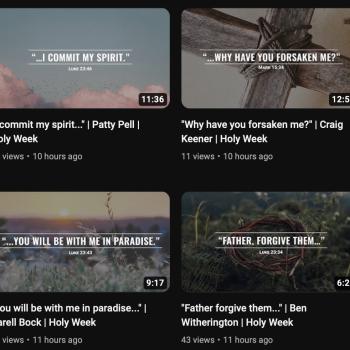
Check out the SeminaryNow Holy Week (2024) Video...
Crux Sola: Formed by Scripture to Live like Christ
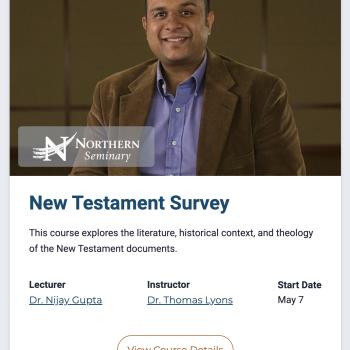
Get Seminary Credit through SeminaryNow Live Courses
Crux Sola: Formed by Scripture to Live like Christ
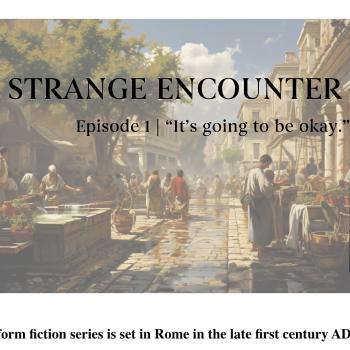
My New Fiction Series ("Strange Encounter")
Crux Sola: Formed by Scripture to Live like Christ

"Strange Religious Texts": Get the Bonus Essay FREE
Crux Sola: Formed by Scripture to Live like Christ
TRENDING AT PATHEOS Evangelical

Looking at the Largest Orthodox Cathedral on Earth
There is often a considerable amount of anger and, shall we...

The Problem with False Prophets
Miller’s Station UMC| 10/18/26| Anchor Verse: Jeremiah 23: 1, 9-23 I...

Emotion in Early Christianity by Andrew Crislip
Andrew Crislip’s Emotion in Early Christianity examines an often overlooked dimension of...

16 Spiritual Touchstones for a More Grounded Life
After decades of spiritual study, here are 16 principles I try...

Catholic Evangelization: Sharing Your Faith Every Day
Welcome back to the Graceful Awakening mini-series called, “From Faith to Mission.” ...

The Pillar of the Boatmen: the Ancient Monument...
The Pillar of the Boatmen is a Romano-Gaulish sculpture that dates from...
view all Evangelical blogs
Ad-Free & Subscriber Log-In Subscription Support
- About Us
- 2026 Calendar
- Videos
- Podcasts
- Library of World Religions
- Faith In Media Tracker
- Advertise With Us
- Write for Us
- Privacy Policy
- Terms of Service
- Do Not Sell My Data
- Contact Us
- Radiant Digital
- Manage Newsletter Subscriptions
- Unsubscribe From Notifications
- Sitemap
Copyright 2008-2026, Patheos. All rights reserved.
Subscription Support Ad-Free & Subscriber Log-In
Follow Patheos