
BuddhistCatholicContemplativeEvangelicalGeneral ChristianHinduJewishLatter-day SaintMuslimNew VisionsProgressive Christian
Beliefs
- Buddhist
- Catholic
- Contemplative
- Evangelical
- General Christian
- Hindu
- Jewish
- Latter-day Saint
- More Voices
- Muslim
- New Visions
- Pagan
- Progressive Christian
Topics
- Religion News
- Food and Religion
- Sports and Religion
- Religious Art
- Religious Music and Entertainment
- Religious Events
- History and Religion
- Style and Religion
- Politics and Religion
- Women in Religion
- Recreation Outdoors and Religion
- Business Finance and Religion
- Careers Workplace and Religion
- Education and Religion
- Family Parenting and Religion
- Health Fitness and Religion
- Home and Religion
- Relationships and Religion
- Technology and Religion
- Travel and Religion
Columnists
- Buddhist Columnists
- Business Finance and Religion Columnists
- Careers Workplace and Religion Columnists
- Catholic Columnists
- Contemplative Columnists
- Education and Religion Columnists
- Evangelists Columnists
- Family Parenting and Religion Columnists
- General Christian Columnists
- Health Fitness and Religion Columnists
- Hindu Columnists
- History and Religion Columnists
- Home and Religion Columnists
- Jewish Columnists
- More Voices Columnists
- Latter Day Columnists
- Muslim Columnists
- New Visions Columnists
- Nonreligious Columnists
- Pagan Columnists
- Politics and Religion Columnists
- Progressive Columnists
- Recreation Outdoors and Religion Columnists
- Relationships and Religion Columnists
- Religion News Columnists
- Religious Art Columnists
- Religious Events Columnists
- Religious Music and Entertainment Columnists
- Sports and Religion Columnists
- Style and Religion Columnists
- Technology and Religion Columnists
- Travel and Religion Columnists
- Women in Religion Columnists
Resource Library
- 2026 Calendar
- Library of World Religions
- The 100 Most Holy Places on Earth
- Patheos Answers
- Podcasts
- Videos
- Faith Leaders Database
- Anglican Episcopalian
- Bahai
- Baptist
- Buddhism
- Christianity
- Confucianism
- Eastern Orthodoxy
- Hinduism
- Holiness and Pentecostal
- ISKCON
- Islam
- Judaism
- Lutheran
- Methodist
- The Church of Jesus Christ of Latter-day Saints
- New Age
- Paganism
- Presbytarian and Reformed
- Protestantism
- Religion Behind the Scenes
- Roman Catholic
- Scientology
- Shia Islam
- Sikhism
- Sufism
- Sunni Islam
- Taoism
- Zen
- See all religions
Research Tools
 Ad-Free & Subscriber Log-In Subscription Support
Ad-Free & Subscriber Log-In Subscription Support
Follow Patheos 

- Trending:
- Forgiveness
- |
- Marriage
- |
- Consciousness
- |
- Death Penalty
- |
- Election
- |
- Halloween
 Crux Sola: Formed by Scripture to Live like Christ
-
Blog Series
- Home
- Evangelical
- “Salvation and the Good Life”: Julien C.H. Smith, Author of Paul and the Good Life
“Salvation and the Good Life”: Julien C.H. Smith, Author of Paul and the Good Life
Last updated on: December 27, 2020 at 7:48 am by Nijay Gupta
“Salvation and the Good Life”: Julien C.H. Smith, Author of Paul and the Good Life 2020-12-27T07:48:23-08:00 Nijay Gupta
Patheos Explore the world's faith through different perspectives on religion and spirituality! Patheos has the views of the prevalent religions and spiritualities of the world.
Blog Series: In Their Own Words. Here authors of new books offer a snippet of their research converted to a blog form. Julien C.H. Smith is author of Paul and the Good Life: Transformation and Citizenship in the Commonwealth of God.
Salvation and the Good Life: Putting the Pieces Back Together
What does it look like to be saved? We might liken it to being rescued from life-threatening peril, as in pulling a drowning child from a river. But we could also envision salvation as restoration to a life of genuine flourishing, such as when an alcoholic is restored to a life of sobriety and health. These are distinct images of being saved, to be sure, although not mutually exclusive. To restore an addict to health, for example, may well entail rescue from circumstances which enable the addiction.
These generic understandings of salvation map well onto two specific ways of understanding salvation found within the church. On the one hand, we hear of salvation from the consequences of sin, namely death, through the atoning death of Christ. On the other hand, we speak of being saved to a life of discipleship, following in the way of Jesus.
We might well insist that a full-orbed picture of salvation requires us to hold together the notion of rescue from peril and restoration to wholeness. However, in my experience as a Christian—in a variety of different denominational settings and parachurch organizations—I have often found these two understandings of salvation divorced from each other.
That is to say, depending on where we worship on a Sunday morning, we may hold a picture of salvation in which rescue from sin has been divorced from restoration to a life of flourishing. Indeed, in some churches these may be seen as antithetical understandings of salvation. Perhaps we find it difficult to hold together these two dimensions of salvation because the image of Jesus himself is fragmented in our minds. As an example of what I’m talking about, consider the following images of Jesus.
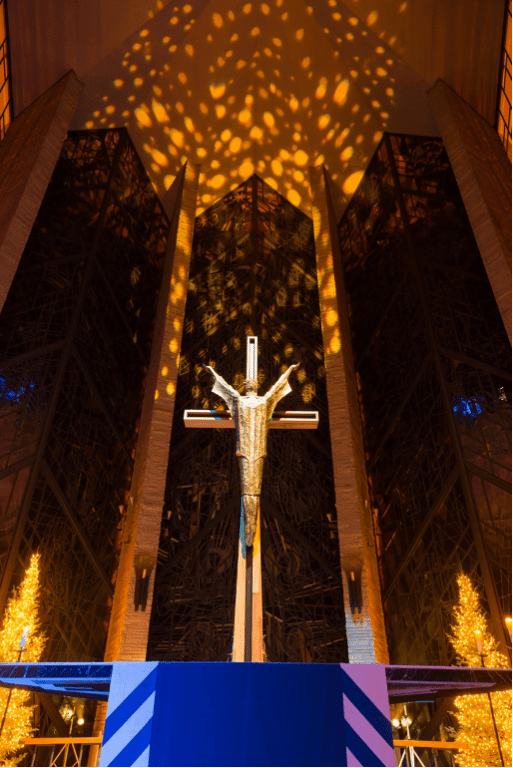 On the campus of Valparaiso University where I teach you will find two striking—and strikingly different—sculptures of Jesus. In the Chapel of the Resurrection, the glorious Christus Rex —Christ the King—soars upward from the ground, seemingly suspended in mid-air in front of the cross. Resplendent in glory, its gilded finish catching and reflecting the light, this majestic image captures the victorious hope of the resurrected Christ. Outside the chapel, on an unassuming park bench on the quad lies Homeless Jesus. His nail-scarred feet protrude from a meager blanket, scant protection against the winter cold. The unoccupied seat at the end of the bench invites passersby to share this space with Jesus, a fitting reminder of the way in which this Jesus has entered and shared our own space of suffering.

How can we hold in tension these two divergent portrayals of Jesus—the victorious king and the suffering servant? Like strong magnets of identical polarity, these two images of Jesus seem to resist our efforts to keep them together. Can we even imagine a figure possessing surpassing power and yet experiencing the fearful depths of human suffering? And out of this deficit in our imagination is borne both a fragmented picture of Jesus and a fragmented picture of salvation.
In my own efforts to hold these two images of Jesus together, I have experienced of late what philosopher James K. A. Smith (no relation) calls a “recalibration of the imagination” through studying Paul’s life and letters. My journey of discovery up to this point has resulted in my recent book, Paul and the Good Life: Transformation and Citizenship in the Commonwealth of God. The question at the heart of the book is how Paul works out the relationship between Jesus, suffering, victory, salvation, and the life of human flourishing. But for Paul this puzzle is no mere intellectual curiosity: our picture of Jesus has far-reaching practical implications for the way life is actually lived. The Apostle puts it this way: “I want to know Christ and the power of his resurrection and the sharing of his sufferings by becoming like him in his death” (Phil 3:10).
Knowing Christ’s power and sharing in his sufferings: Paul wrote those words from a prison cell facing the possibility of imminent execution. In that grim place, he not only discovered Jesus to be present in the midst of suffering; he came to imagine the life of flourishing in a profoundly new way—following in the way of Jesus the suffering king.
Why does it matter that we hold together in our minds an image of Jesus who is both victorious king and suffering servant? To answer this question we must ask another: What does Paul have in mind when he writes of being saved through faith in (and through the faithfulness of) Jesus?
Paul, I argue, understands salvation as both rescue from life-threatening peril and restoration to a life of wholeness. Through the death and resurrection of Jesus we are saved from the wages of sin, namely death, and we are restored to a life of genuine flourishing as we live under the present-and-coming reign of Jesus. These two dimensions of salvation are brought together in Paul’s understanding of Jesus as sōtēr, a Greek term normally translated as “savior” and often used as an epithet for a king in the Greco-Roman cultural milieu.
To be “saved” within this cultural context is not merely to be liberated from the rule of a tyrant, but to be made citizens of a new commonwealth, to be brought into a life of genuine flourishing under the reign of the savior-king. Paul has just such a holistic picture of salvation in mind when he writes that the Father “has rescued us from the power of darkness and transferred us into the kingdom of his beloved Son” (Col 1:13).
Having been rescued from the tyrannical power of sin, citizens of this new commonwealth must now endeavor to “live worthily as citizens (politeuesthe)” under the present-and-coming reign of Jesus (Phil 1:27), a life enabled by the Spirit as we are transformed into the image of the king. This is Paul’s Christocentric vision of the “good life”—we are saved from the deforming tyranny of sin and restored to a life of genuine flourishing.
Jesus, of course, is a king like no other. To follow such a king, it is crucial that we see Jesus whole—suffering and victorious. He is the king who did not exploit his own status and power, but emptied himself by entering into the human experience of suffering and death. But he is also the king who has been given the name that is above all names (Phil 2:5-11). Thus Paul desires both to know the power of Christ’s resurrection and to share in his suffering. It is only in putting these back together that we grasp Paul’s vision of salvation and the good life.
Check out Smith’s new book, Paul and the Good Life (Baylor University Press, 2020)

Next Post

December 28, 2020 Tom Greggs (Aberdeen): Christian Theologians to Read and Follow
Browse Our Archives
Select a Category (Mis)Understanding Philippians 10 Things I Can't Live Without 2023 New Books 30 OT HB Scholars to Read and Follow 5 Books Series 50-2-Follow Academia Christian Theologians to Read and Follow Cruciform Scripture: Contributor Reflections Crux Sola TV Editors Behind Great Books in NT Studies Education Gendering the Holy Spirit Gupta FB Live Lectures In Faith and Doubt In Their Own Words Living the King Jesus Gospel My Top 6 OT Commentaries New Testament Resource Guide New Word Biblical Themes Nijay's A Very Library Christmas Shopping Guide Notes from an Editor Notes on New Books NTRG OT in the NT Paul Seminary Now The Bible in God's World The Word Felt Among Us SPENCER Translating Philippians Uncategorized Why I Use Accordance Women in Ministry
Select a Month March 2024 February 2024 January 2024 December 2023 November 2023 October 2023 September 2023 August 2023 May 2023 March 2023 February 2023 January 2023 December 2022 November 2022 October 2022 September 2022 August 2022 July 2022 June 2022 May 2022 March 2022 February 2022 January 2022 December 2021 November 2021 October 2021 September 2021 August 2021 July 2021 June 2021 May 2021 April 2021 March 2021 February 2021 January 2021 December 2020 November 2020 October 2020 September 2020 August 2020 July 2020 June 2020 May 2020 April 2020 March 2020 February 2020 January 2020 December 2019 November 2019 October 2019 September 2019 August 2019 July 2019 June 2019 May 2019 April 2019 March 2019 February 2019 January 2019 October 2018 September 2018 August 2018 July 2018 June 2018 April 2018 March 2018 February 2018 January 2018 December 2017 October 2017 September 2017 August 2017 July 2017 June 2017 May 2017 April 2017 March 2017 February 2017 January 2017 December 2016 November 2016 October 2016 September 2016 August 2016 July 2016 June 2016 May 2016 April 2016 March 2016 February 2016 January 2016 December 2015 November 2015 October 2015 September 2015 August 2015 July 2015 June 2015 May 2015 April 2015 March 2015 February 2015 January 2015 December 2014 November 2014 October 2014 September 2014 August 2014 July 2014 June 2014 May 2014 April 2014 March 2014 February 2014 January 2014 December 2013 November 2013 October 2013 September 2013 August 2013 July 2013 June 2013 May 2013 April 2013 March 2013 February 2013 January 2013 December 2012 November 2012 October 2012 September 2012 August 2012 July 2012 June 2012 May 2012 April 2012 March 2012 February 2012 January 2012 December 2011 November 2011 October 2011 September 2011 August 2011 July 2011 June 2011 May 2011 April 2011 March 2011 February 2011 January 2011 December 2010 November 2010 October 2010 September 2010 August 2010 July 2010 June 2010 May 2010 April 2010 March 2010 February 2010 January 2010 December 2009 November 2009 October 2009 September 2009 August 2009 July 2009 June 2009 May 2009 April 2009 March 2009 February 2009 January 2009 December 2008 November 2008 October 2008 September 2008 August 2008 July 2008 June 2008 May 2008 April 2008 March 2008 February 2008 January 2008 December 2007 November 2007 October 2007 September 2007 August 2007 July 2007 April 2007 March 2007 February 2007 January 2007
Follow Us!
TAKE THE
Religious Wisdom Quiz
Where did Jacob and his family settle in Egypt?
Select your answer to see how you score.
Thebes Memphis Cairo Goshen
Related posts from Crux Sola: Formed by Scripture to Live like Christ
Demon Problems, the Bible, and Enchanted Eyewitnesses
Crux Sola: Formed by Scripture to Live like Christ
Darwin and the Bible, by Dru Johnson
Crux Sola: Formed by Scripture to Live like Christ
Let's Stop Celebrating Arrogance (by Dr. Dennis Edwards)
Crux Sola: Formed by Scripture to Live like Christ

Removing Evil's Mask (Ingrid Faro)
Crux Sola: Formed by Scripture to Live like Christ
TRENDING AT PATHEOS Evangelical

Archdiocese Hosts Military Marriage Retreat in Germany
RASTATT, Germany — The transient military lifestyle, with its frequent deployments and...

Nearly every morning, I make the drive to Detroit with my high-school-age...

The Real AI Story Is Adoption Without Trust
Artificial intelligence has crossed a political threshold. It is no longer a...

A new article, written by Jeff Lindsay and Gale L. Pooley,...

Swimfan: Forgotten Aughts Pleasures
This is a recovery effort. In 2002, My Big Fat Greek Wedding...

Top Three Anti-Catholic Lies About Catholicism
This is my initial transcript for the video, "THE 3 WORST...
view all Evangelical blogs
Ad-Free & Subscriber Log-In Subscription Support
- About Us
- 2026 Calendar
- Videos
- Podcasts
- Library of World Religions
- Faith In Media Tracker
- Advertise With Us
- Write for Us
- Privacy Policy
- Terms of Service
- Do Not Sell My Data
- Contact Us
- Radiant Digital
- Manage Newsletter Subscriptions
- Unsubscribe From Notifications
- Sitemap
Copyright 2008-2026, Patheos. All rights reserved.
Subscription Support Ad-Free & Subscriber Log-In
Follow Patheos