
BuddhistCatholicContemplativeEvangelicalGeneral ChristianHinduJewishLatter-day SaintMuslimNew VisionsProgressive Christian
Beliefs
- Buddhist
- Catholic
- Contemplative
- Evangelical
- General Christian
- Hindu
- Jewish
- Latter-day Saint
- More Voices
- Muslim
- New Visions
- Pagan
- Progressive Christian
Topics
- Religion News
- Food and Religion
- Sports and Religion
- Religious Art
- Religious Music and Entertainment
- Religious Events
- History and Religion
- Style and Religion
- Politics and Religion
- Women in Religion
- Recreation Outdoors and Religion
- Business Finance and Religion
- Careers Workplace and Religion
- Education and Religion
- Family Parenting and Religion
- Health Fitness and Religion
- Home and Religion
- Relationships and Religion
- Technology and Religion
- Travel and Religion
Columnists
- Buddhist Columnists
- Business Finance and Religion Columnists
- Careers Workplace and Religion Columnists
- Catholic Columnists
- Contemplative Columnists
- Education and Religion Columnists
- Evangelists Columnists
- Family Parenting and Religion Columnists
- General Christian Columnists
- Health Fitness and Religion Columnists
- Hindu Columnists
- History and Religion Columnists
- Home and Religion Columnists
- Jewish Columnists
- More Voices Columnists
- Latter Day Columnists
- Muslim Columnists
- New Visions Columnists
- Nonreligious Columnists
- Pagan Columnists
- Politics and Religion Columnists
- Progressive Columnists
- Recreation Outdoors and Religion Columnists
- Relationships and Religion Columnists
- Religion News Columnists
- Religious Art Columnists
- Religious Events Columnists
- Religious Music and Entertainment Columnists
- Sports and Religion Columnists
- Style and Religion Columnists
- Technology and Religion Columnists
- Travel and Religion Columnists
- Women in Religion Columnists
Resource Library
- 2026 Calendar
- Library of World Religions
- The 100 Most Holy Places on Earth
- Patheos Answers
- Podcasts
- Videos
- Faith Leaders Database
- Anglican Episcopalian
- Bahai
- Baptist
- Buddhism
- Christianity
- Confucianism
- Eastern Orthodoxy
- Hinduism
- Holiness and Pentecostal
- ISKCON
- Islam
- Judaism
- Lutheran
- Methodist
- The Church of Jesus Christ of Latter-day Saints
- New Age
- Paganism
- Presbytarian and Reformed
- Protestantism
- Religion Behind the Scenes
- Roman Catholic
- Scientology
- Shia Islam
- Sikhism
- Sufism
- Sunni Islam
- Taoism
- Zen
- See all religions
Research Tools
 Ad-Free & Subscriber Log-In Subscription Support
Ad-Free & Subscriber Log-In Subscription Support
Follow Patheos 

- Trending:
- Forgiveness
- |
- Marriage
- |
- Consciousness
- |
- Death Penalty
- |
- Election
- |
- Halloween
 Crux Sola: Formed by Scripture to Live like Christ
-
Blog Series
- Home
- Evangelical
- Book Notice: Studying the New Testament through Inscriptions (D. Clint Burnett)
Book Notice: Studying the New Testament through Inscriptions (D. Clint Burnett)
Last updated on: June 18, 2020 at 7:00 am by Nijay Gupta
Book Notice: Studying the New Testament through Inscriptions (D. Clint Burnett) 2020-06-18T07:00:17-08:00 Nijay Gupta
Patheos Explore the world's faith through different perspectives on religion and spirituality! Patheos has the views of the prevalent religions and spiritualities of the world.
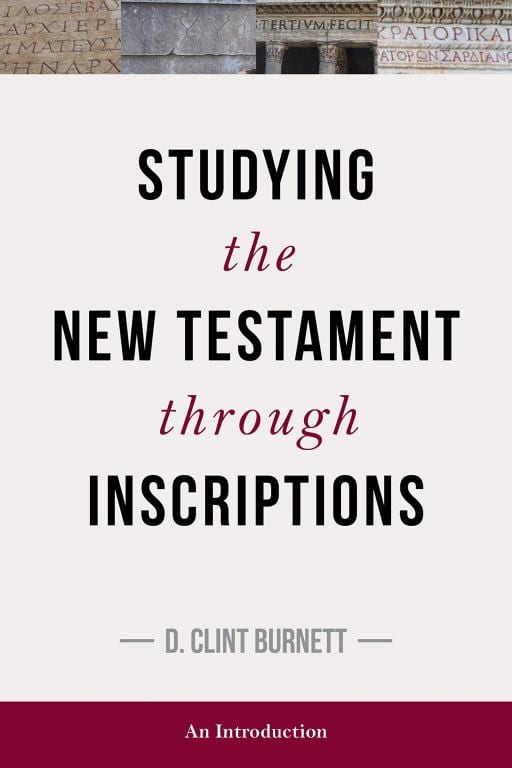
Studying the New Testament through Inscriptions is one of those resources I wish I had 15 years ago. Burnett has done the NT academy a huge service. We need more textbooks like this to aid students and researchers. If you want to do accurate and comprehensive investigation of real life in the ancient world, you need to be able to work competently and responsibly with relevant epigraphical remains; and this book is designed to help you do that.
What are “Inscriptions”?
An inscription is “a message written on a durable material” meant to be read by people that pass by (11). All of these kinds of signs can fall under the label “inscription”: civic decree, public honorific praise, dedications (to a patron of a building project, e.g.), sacred laws, graffiti, epitaphs/tombstones, curse tablets. According to Burnett, over 500,000 ancient inscriptions are at our disposal today, yet researchers in NT studies often don’t know where to find them, how to decipher the reference coding, and how to use them for research in a fair and accurate way.
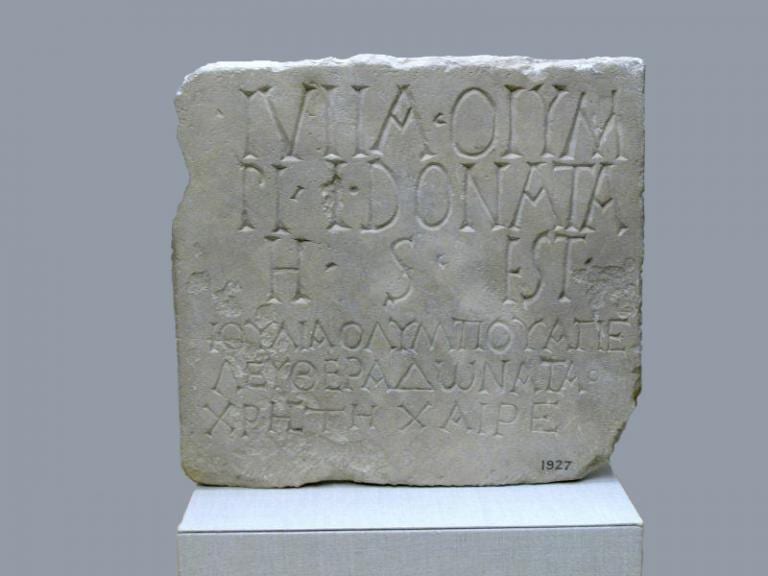
This funerary plaque is unusual in that it has inscriptions in both Latin and Greek, each of which follows conventions appropriate to the respective language. It reads in Latin above: “Julia Donata, the freedwoman of Olympus, lies here” and in Greek below: “Good Ioulia Donata, the freedwoman of Olympos, farewell.” (Met Museum)
In Burnett’s introduction, he offers a basic guide to the types of Greco-Roman inscriptions (when, where, what, why?) as well as information about where scholars can find databases and collections of inscriptions. Unfortunately, there is not really a “one-stop shop” online or in print for all inscriptions. One has to look in several places such as the set Corpus Inscriptionum Graecarum (CIG) and the Corpus Inscriptionum Latinarum (CIL)—and there are more collections with more acronyms (CIS, IGRR, ILS, OGIS, SIG3, TNSI). Burnett also offers a clear chart of the sigla (symbols) scholars use in their transcriptions and translations to give you information about the inscription (pg 56).
After the lengthy introduction (beautifully-illustrated with photos of inscriptions), Burnett showcases the value of epigraphical research for NT scholarship with several case studies. Think of them as a series of academic articles, where attention to epigraphical evidence sheds important light on the issue.
I found each of these case studies carefully researched, often adding crucial pieces to the discussion of topics like Christology, the Lord’s Supper/banquet, imperial loyalty oaths, and women in public.
Strengths
Burnett’s book has many strengths. First off, he really knows his stuff. He has a well-rounded understanding, not only of NT scholarship in general, but the epigraphy world as well. The case studies stand all on their own as excellent specimens of scholarship. As noted above, Burnett includes many, many photographs of inscriptions for illustration, and the visuals really help. In the appendix, Burnett helpfully includes information about printed collections of inscriptions (appendix 1), online databases (appendix 2), and his guide to abbreviations in inscriptions (appendix 3).
Weaknesses
I hesitate to call my comments here “weaknesses”; I enjoyed the book overall, but perhaps better “advice for the second edition.”
I found the introductory chapter (pp. 9-57) quite readable and clear for students (i.e., seminary students). The case studies are quite technical, geared more towards doctoral students or beyond. I would comfortably commend the introduction to my seminary students, but they might be overwhelmed by the case studies. So, I wish Burnett had included maybe a couple of short and simple case studies for the beginner student.
Another desire I had was that Burnett would maybe do a walkthrough of how he would go about using inscriptional information to shed light on an exegetical issue. The case studies are the final product, and they are fine. But I kept wondering—where did he go first? How did he know which databases to use and how many to consult? Did he need to log in? Does it cost money? Is any of this on Logos? Accordance?
There is a handy Greek lexicon that focuses on insight from inscriptions and letters (i.g., Vocabulary of the Greek Testament, aka, Moulton & Milligan, aka M-M). It is my impression that M-M is a great tool for utilizing inscriptional information in word studies. Unfortunately it is an older resource, so does not include knowledge from more recent discoveries. Still, I didn’t really see a discussion of M-M in Burnett. I use M-M a lot, so I wish Burnett had weighed in on its value. The same goes for BrillDAG—I wish Burnett had discussed whether the new BrillDAG includes and handles epigraphical information well.
Finally, I didn’t see Burnett talk about a very handy set of resources called New Documents Illustrating Early Christianity (I think there are ten volumes so far). These volumes summarize insight from several years of discoveries (batched in each volume) and study of inscriptions and letters. For a research project I did a few years ago, I read through almost all 10 volumes and it was a great “cheater’s guide” to inscriptions and what they teach us about the lives of ancient people. For the busy pastor or student, I find NDIEC useful, does Burnett agree?
Final thoughts
Studying the New Testament through Inscriptions is one of those resources I wish I had 15 years ago. Burnett has done the NT academy a huge service. We need more textbooks like this to aid students and researchers. If you want to do accurate and comprehensive investigation of real life in the ancient world, you need to be able to work competently and responsibly with relevant epigraphical remains; and this book is designed to help you do that.
Browse Our Archives
Select a Category (Mis)Understanding Philippians 10 Things I Can't Live Without 2023 New Books 30 OT HB Scholars to Read and Follow 5 Books Series 50-2-Follow Academia Christian Theologians to Read and Follow Cruciform Scripture: Contributor Reflections Crux Sola TV Editors Behind Great Books in NT Studies Education Gendering the Holy Spirit Gupta FB Live Lectures In Faith and Doubt In Their Own Words Living the King Jesus Gospel My Top 6 OT Commentaries New Testament Resource Guide New Word Biblical Themes Nijay's A Very Library Christmas Shopping Guide Notes from an Editor Notes on New Books NTRG OT in the NT Paul Seminary Now The Bible in God's World The Word Felt Among Us SPENCER Translating Philippians Uncategorized Why I Use Accordance Women in Ministry
Select a Month March 2024 February 2024 January 2024 December 2023 November 2023 October 2023 September 2023 August 2023 May 2023 March 2023 February 2023 January 2023 December 2022 November 2022 October 2022 September 2022 August 2022 July 2022 June 2022 May 2022 March 2022 February 2022 January 2022 December 2021 November 2021 October 2021 September 2021 August 2021 July 2021 June 2021 May 2021 April 2021 March 2021 February 2021 January 2021 December 2020 November 2020 October 2020 September 2020 August 2020 July 2020 June 2020 May 2020 April 2020 March 2020 February 2020 January 2020 December 2019 November 2019 October 2019 September 2019 August 2019 July 2019 June 2019 May 2019 April 2019 March 2019 February 2019 January 2019 October 2018 September 2018 August 2018 July 2018 June 2018 April 2018 March 2018 February 2018 January 2018 December 2017 October 2017 September 2017 August 2017 July 2017 June 2017 May 2017 April 2017 March 2017 February 2017 January 2017 December 2016 November 2016 October 2016 September 2016 August 2016 July 2016 June 2016 May 2016 April 2016 March 2016 February 2016 January 2016 December 2015 November 2015 October 2015 September 2015 August 2015 July 2015 June 2015 May 2015 April 2015 March 2015 February 2015 January 2015 December 2014 November 2014 October 2014 September 2014 August 2014 July 2014 June 2014 May 2014 April 2014 March 2014 February 2014 January 2014 December 2013 November 2013 October 2013 September 2013 August 2013 July 2013 June 2013 May 2013 April 2013 March 2013 February 2013 January 2013 December 2012 November 2012 October 2012 September 2012 August 2012 July 2012 June 2012 May 2012 April 2012 March 2012 February 2012 January 2012 December 2011 November 2011 October 2011 September 2011 August 2011 July 2011 June 2011 May 2011 April 2011 March 2011 February 2011 January 2011 December 2010 November 2010 October 2010 September 2010 August 2010 July 2010 June 2010 May 2010 April 2010 March 2010 February 2010 January 2010 December 2009 November 2009 October 2009 September 2009 August 2009 July 2009 June 2009 May 2009 April 2009 March 2009 February 2009 January 2009 December 2008 November 2008 October 2008 September 2008 August 2008 July 2008 June 2008 May 2008 April 2008 March 2008 February 2008 January 2008 December 2007 November 2007 October 2007 September 2007 August 2007 July 2007 April 2007 March 2007 February 2007 January 2007
Follow Us!
TAKE THE
Religious Wisdom Quiz
Peter was staying where when he saw the vision of the great sheet with all the animals?
Select your answer to see how you score.
Bethabara With Cornelius With Simon the Tanner Joppa
Related posts from Crux Sola: Formed by Scripture to Live like Christ
Check out the SeminaryNow Holy Week (2024) Video...
Crux Sola: Formed by Scripture to Live like Christ
Get Seminary Credit through SeminaryNow Live Courses
Crux Sola: Formed by Scripture to Live like Christ
My New Fiction Series ("Strange Encounter")
Crux Sola: Formed by Scripture to Live like Christ
"Strange Religious Texts": Get the Bonus Essay FREE
Crux Sola: Formed by Scripture to Live like Christ
TRENDING AT PATHEOS Evangelical

Looking at the Largest Orthodox Cathedral on Earth
There is often a considerable amount of anger and, shall we...

The Problem with False Prophets
Miller’s Station UMC| 10/18/26| Anchor Verse: Jeremiah 23: 1, 9-23 I...

Emotion in Early Christianity by Andrew Crislip
Andrew Crislip’s Emotion in Early Christianity examines an often overlooked dimension of...

16 Spiritual Touchstones for a More Grounded Life
After decades of spiritual study, here are 16 principles I try...

Catholic Evangelization: Sharing Your Faith Every Day
Welcome back to the Graceful Awakening mini-series called, “From Faith to Mission.” ...

The Pillar of the Boatmen: the Ancient Monument...
The Pillar of the Boatmen is a Romano-Gaulish sculpture that dates from...
view all Evangelical blogs
Ad-Free & Subscriber Log-In Subscription Support
- About Us
- 2026 Calendar
- Videos
- Podcasts
- Library of World Religions
- Faith In Media Tracker
- Advertise With Us
- Write for Us
- Privacy Policy
- Terms of Service
- Do Not Sell My Data
- Contact Us
- Radiant Digital
- Manage Newsletter Subscriptions
- Unsubscribe From Notifications
- Sitemap
Copyright 2008-2026, Patheos. All rights reserved.
Subscription Support Ad-Free & Subscriber Log-In
Follow Patheos