
BuddhistCatholicContemplativeEvangelicalGeneral ChristianHinduJewishLatter-day SaintMuslimNew VisionsProgressive Christian
Beliefs
- Buddhist
- Catholic
- Contemplative
- Evangelical
- General Christian
- Hindu
- Jewish
- Latter-day Saint
- More Voices
- Muslim
- New Visions
- Pagan
- Progressive Christian
Topics
- Religion News
- Food and Religion
- Sports and Religion
- Religious Art
- Religious Music and Entertainment
- Religious Events
- History and Religion
- Style and Religion
- Politics and Religion
- Women in Religion
- Recreation Outdoors and Religion
- Business Finance and Religion
- Careers Workplace and Religion
- Education and Religion
- Family Parenting and Religion
- Health Fitness and Religion
- Home and Religion
- Relationships and Religion
- Technology and Religion
- Travel and Religion
Columnists
- Buddhist Columnists
- Business Finance and Religion Columnists
- Careers Workplace and Religion Columnists
- Catholic Columnists
- Contemplative Columnists
- Education and Religion Columnists
- Evangelists Columnists
- Family Parenting and Religion Columnists
- General Christian Columnists
- Health Fitness and Religion Columnists
- Hindu Columnists
- History and Religion Columnists
- Home and Religion Columnists
- Jewish Columnists
- More Voices Columnists
- Latter Day Columnists
- Muslim Columnists
- New Visions Columnists
- Nonreligious Columnists
- Pagan Columnists
- Politics and Religion Columnists
- Progressive Columnists
- Recreation Outdoors and Religion Columnists
- Relationships and Religion Columnists
- Religion News Columnists
- Religious Art Columnists
- Religious Events Columnists
- Religious Music and Entertainment Columnists
- Sports and Religion Columnists
- Style and Religion Columnists
- Technology and Religion Columnists
- Travel and Religion Columnists
- Women in Religion Columnists
Resource Library
- 2026 Calendar
- Library of World Religions
- The 100 Most Holy Places on Earth
- Patheos Answers
- Podcasts
- Videos
- Faith Leaders Database
- Anglican Episcopalian
- Bahai
- Baptist
- Buddhism
- Christianity
- Confucianism
- Eastern Orthodoxy
- Hinduism
- Holiness and Pentecostal
- ISKCON
- Islam
- Judaism
- Lutheran
- Methodist
- The Church of Jesus Christ of Latter-day Saints
- New Age
- Paganism
- Presbytarian and Reformed
- Protestantism
- Religion Behind the Scenes
- Roman Catholic
- Scientology
- Shia Islam
- Sikhism
- Sufism
- Sunni Islam
- Taoism
- Zen
- See all religions
Research Tools
 Ad-Free & Subscriber Log-In Subscription Support
Ad-Free & Subscriber Log-In Subscription Support
Follow Patheos 

- Trending:
- Forgiveness
- |
- Marriage
- |
- Consciousness
- |
- Death Penalty
- |
- Election
- |
- Halloween
 Crux Sola: Formed by Scripture to Live like Christ
-
Blog Series
- Home
- Evangelical
- Interview with Luke Timothy Johnson, Constructing Paul (Part 2)
Interview with Luke Timothy Johnson, Constructing Paul (Part 2)
Last updated on: May 29, 2020 at 10:35 am by Nijay Gupta
Interview with Luke Timothy Johnson, Constructing Paul (Part 2) 2020-05-29T10:35:59-08:00 Nijay Gupta
Patheos Explore the world's faith through different perspectives on religion and spirituality! Patheos has the views of the prevalent religions and spiritualities of the world.
This is PART 2 of my interview with Luke Timothy Johnson, Robert W. Woodruff Professor Emeritus of New Testament and Christian Origins at Emory University’s Candler School of Theology. In this interview (part 2), Johnson talks more about his book Constructing Paul and some other projects as well.
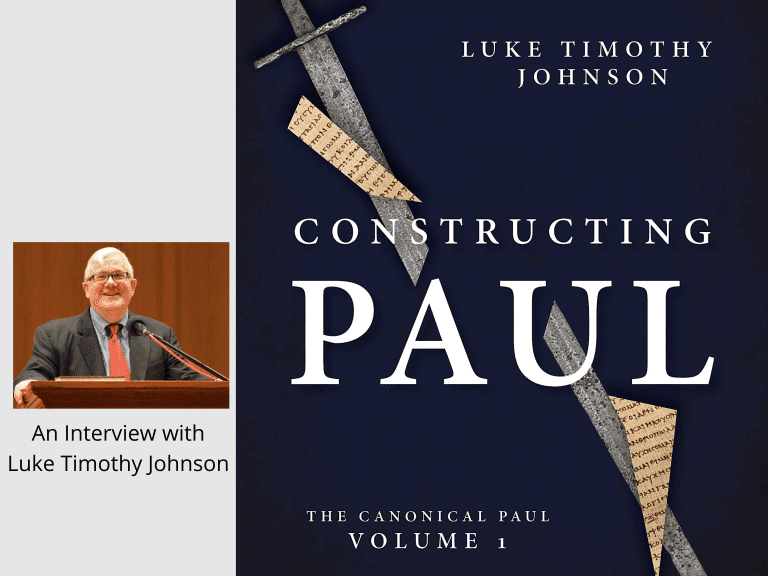
NKG: You offer one key case study for your approach to Paul in this volume: Philemon. (You cover Paul’s other letters in your next volume) Why did you decide to front load Philemon? How does this short letter demonstrate well the approach you take to studying Paul.
LTJ: Philemon is an inviting entry into Paul’s letters (as others before me have seen) first of all because it presents a “Paul” who escapes both the “old” and “new perspectives,” who writes in response to a pressing practical issue (the return of the slave Onesimus to his legal owner), and in the process shows himself charming, witty, and completely at home in the world of Greco-Roman diplomacy, playfully — yet seriously — tweaking the system of patronage and the culture of honor and shame in original and effective ways.
Yet Philemon also presses the question that New Testament scholarship seldom faces head-on: why should a personal note to an otherwise obscure personage be included — without debate and from the beginning — as part of the New Testament canon? Perhaps, I suggest, it is because Philemon was part of a three or four letter packet of letters delivered by Paul’s delegate Tychichus, a packet that included letters to the local churches at Colossae and Laodicea (not extant), with the letter to the Colossians being delivered and read aloud to the assembly at the same time as he returns Onesimus. Tychichus would also at each stop read the circular letter we know as Ephesians. In this reading, Philemon is a letter of personal commendation, Colossians a letter to the local church, and Ephesians a circular letter to the circle of Pauline communities in Asia and Phrygia.
I draw the analogy to the three Johannine letters delivered as a packet to the Elder: note of commendation for the delegate (3 John), cover missive tot the local church (2 John), and a sermon to be read aloud in the assembly (1 John).
The payoff of this construal is that it explains the intricate network of names among Colossians, Ephesians, and Philemon; it identifies the rhetorical function of each letter; it explains why a private note should find its way into the canon; and, best of all, it enriches the reading of all three canonical letters when they are read together (see especially my discussion of the passages dealing with slaves and masters in Colossians and Ephesians).
NKG: If you could have students of Paul read one other academic book about Paul (other than Constructing Paul), what would it be and why?
LTJ: Three continental scholars of the last generation especially deserve attention. The first is the Belgian scholar, Lucien Cerfaux, whose essays (many of them available in collected form) are marked by a combination of wide-ranging knowledge of ancient sources and a close exegesis of specific passages. The second is Johannes Munck, whose Paul and the Salvation of Mankind illustrates how a truly independent mind can reach conclusions that are consistently both sane and startling. The third is Nils Dahl, whose Studies in Paul remains seminal. I note that none of these scholars began or ended with a “big idea” or overarching theory. They were each servants of the text, following where it led them. They all wrote simply and to the point. When all the major theory entries fade, they continue to instruct and illuminate the writings of Paul.
NKG: If you could use your book Constructing Paul to change one thing about how scholars look at Paul, what would that be?
LTJ: My hope is to encourage scholars who profess to work in service of the church to take seriously the canonical status of all 13 Pauline letters, to open their inquiry to that larger field of evidence, and to discover, through engagement with all these letters on an equal footing, that they offer exciting new possibilities of insight. When viewed from the perspective of the canonical Paul, for example, both so-called “old” and “new” perspectives are revealed as dealing with a very small part of the Pauline evidence, and neither can support to claim to “explain” Paul when they ignore the largest part of the Pauline collection. The point, I hope we call come to realize, is not to provide a singular vision of what Paul thought, but rather to explore the many questions that arise from considering all the data, questions that are pertinent above all to the life of faith and the living out of that faith in every age.
NKG: What are some big ideas that you will be aiming to communicate in your future second volume?
LTJ: Readers of my second volume, Interpreting Paul, which is in press and should be out in March 2021 will not find a singular argument concerning the meaning of “Paul” or a “Pauline Theology.” They will find a set of some 25 essays that deconstruct such artificial representations through close attention to the contours of each canonical compositions — learning the questions they pose and how reading them in conversation with each other yields a more fragmentary but also more fascinating sort of understanding.
The essays, to be sure, deal with not a few “big” notions found in the canonical letters: the faith of Jesus, the ontological and social entailments of resurrection, truth and reconciliation, the pedagogy of grace, the transformation of the mind, the meaning of fellowship in suffering, how mystery and myth and metaphor express reality, the social character of salvation, and others. These questions arise from the text as we stumble over its meaning, and they arise from all the canonical letters with equal force and pertinence.
I have not intended to provide — and surely have failed to provide — an “Interpretation” of Paul that synthesizes all the data according to some schema. I think such an effort foolish on the face of it, and regard it as obstructive to my real goal, which is to invite the reader to join me in “Interpreting Paul” in an on-going and constantly changing conversation, as the Spirit and our own sweat enable us to learn new and deeper insights into the apostle of Jesus Christ.
NKG: As you settle into retirement, we still hope you continue writing. What other writing project do you have planned?
LTJ: This will probably be my last major scholarly book. My age and physical infirmities make the sort of athleticism required to do first-rate scholarly work less possible. I am in conversation with a publisher about the publication of a selection of my “public theology” essays, some two hundred of which I have scattered in various ecclesially inclined magazines over the past forty years. We’ll see if that happens.
If I do write another book, it will deal with the life of the scholar, as it was in the past, and how it is changing. My tentative title is “The Mind in Another Place: What it Means to be a Scholar.” But I need to convince even myself that this is worth doing!
Previous Post
May 24, 2020
Gospel of Luke: 5 Books Every Pastor Should Read
Next Post
May 27, 2020 Gospel of John: 5 Books Every Pastor Should Read
Browse Our Archives
Select a Category (Mis)Understanding Philippians 10 Things I Can't Live Without 2023 New Books 30 OT HB Scholars to Read and Follow 5 Books Series 50-2-Follow Academia Christian Theologians to Read and Follow Cruciform Scripture: Contributor Reflections Crux Sola TV Editors Behind Great Books in NT Studies Education Gendering the Holy Spirit Gupta FB Live Lectures In Faith and Doubt In Their Own Words Living the King Jesus Gospel My Top 6 OT Commentaries New Testament Resource Guide New Word Biblical Themes Nijay's A Very Library Christmas Shopping Guide Notes from an Editor Notes on New Books NTRG OT in the NT Paul Seminary Now The Bible in God's World The Word Felt Among Us SPENCER Translating Philippians Uncategorized Why I Use Accordance Women in Ministry
Select a Month March 2024 February 2024 January 2024 December 2023 November 2023 October 2023 September 2023 August 2023 May 2023 March 2023 February 2023 January 2023 December 2022 November 2022 October 2022 September 2022 August 2022 July 2022 June 2022 May 2022 March 2022 February 2022 January 2022 December 2021 November 2021 October 2021 September 2021 August 2021 July 2021 June 2021 May 2021 April 2021 March 2021 February 2021 January 2021 December 2020 November 2020 October 2020 September 2020 August 2020 July 2020 June 2020 May 2020 April 2020 March 2020 February 2020 January 2020 December 2019 November 2019 October 2019 September 2019 August 2019 July 2019 June 2019 May 2019 April 2019 March 2019 February 2019 January 2019 October 2018 September 2018 August 2018 July 2018 June 2018 April 2018 March 2018 February 2018 January 2018 December 2017 October 2017 September 2017 August 2017 July 2017 June 2017 May 2017 April 2017 March 2017 February 2017 January 2017 December 2016 November 2016 October 2016 September 2016 August 2016 July 2016 June 2016 May 2016 April 2016 March 2016 February 2016 January 2016 December 2015 November 2015 October 2015 September 2015 August 2015 July 2015 June 2015 May 2015 April 2015 March 2015 February 2015 January 2015 December 2014 November 2014 October 2014 September 2014 August 2014 July 2014 June 2014 May 2014 April 2014 March 2014 February 2014 January 2014 December 2013 November 2013 October 2013 September 2013 August 2013 July 2013 June 2013 May 2013 April 2013 March 2013 February 2013 January 2013 December 2012 November 2012 October 2012 September 2012 August 2012 July 2012 June 2012 May 2012 April 2012 March 2012 February 2012 January 2012 December 2011 November 2011 October 2011 September 2011 August 2011 July 2011 June 2011 May 2011 April 2011 March 2011 February 2011 January 2011 December 2010 November 2010 October 2010 September 2010 August 2010 July 2010 June 2010 May 2010 April 2010 March 2010 February 2010 January 2010 December 2009 November 2009 October 2009 September 2009 August 2009 July 2009 June 2009 May 2009 April 2009 March 2009 February 2009 January 2009 December 2008 November 2008 October 2008 September 2008 August 2008 July 2008 June 2008 May 2008 April 2008 March 2008 February 2008 January 2008 December 2007 November 2007 October 2007 September 2007 August 2007 July 2007 April 2007 March 2007 February 2007 January 2007
Follow Us!
TAKE THE
Religious Wisdom Quiz
Before feeding 5,000 people with five loaves and two fish, what did Jesus do first?
Select your answer to see how you score.
Gave thanks Passed the food out Blessed the Children Taught
Related posts from Crux Sola: Formed by Scripture to Live like Christ
Check out the SeminaryNow Holy Week (2024) Video...
Crux Sola: Formed by Scripture to Live like Christ
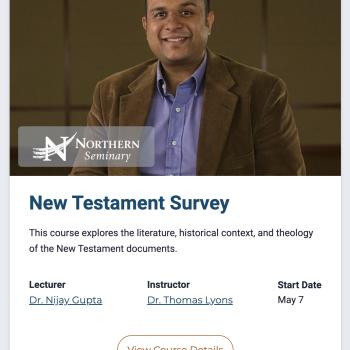
Get Seminary Credit through SeminaryNow Live Courses
Crux Sola: Formed by Scripture to Live like Christ
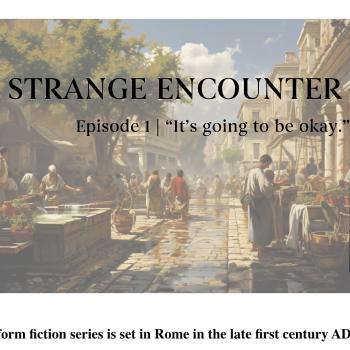
My New Fiction Series ("Strange Encounter")
Crux Sola: Formed by Scripture to Live like Christ

"Strange Religious Texts": Get the Bonus Essay FREE
Crux Sola: Formed by Scripture to Live like Christ
TRENDING AT PATHEOS Evangelical

In one sense walking into Westminster Abbey is like walking down the...

'Super Scam Me' Exposes AI Jon Bon Jovi...
Leslie Pickett believed she was in a relationship with Jon Bon Jovi....

The Brazilian Remake of Kendricks' 'Flywheel' Opens in...
“Flywheel,” the story that launched the Kendrick Brothers’ filmmaking career is getting...

The Dangers of Gradual Accommodation (Winking at Sin)
Recently, the “law of gradualness” resurfaced during the opening of a weeklong,...

The Iron Gates and the Lion of the...
Yesterday, I didn't finish my report about, well, yesterday. So I'll...

The Image: On the Horror of Capitalism and...
The Image Then went the Pharisees, and took counsel how they might...
view all Evangelical blogs
Ad-Free & Subscriber Log-In Subscription Support
- About Us
- 2026 Calendar
- Videos
- Podcasts
- Library of World Religions
- Faith In Media Tracker
- Advertise With Us
- Write for Us
- Privacy Policy
- Terms of Service
- Do Not Sell My Data
- Contact Us
- Radiant Digital
- Manage Newsletter Subscriptions
- Unsubscribe From Notifications
- Sitemap
Copyright 2008-2026, Patheos. All rights reserved.
Subscription Support Ad-Free & Subscriber Log-In
Follow Patheos