
BuddhistCatholicContemplativeEvangelicalGeneral ChristianHinduJewishLatter-day SaintMuslimNew VisionsProgressive Christian
Beliefs
- Buddhist
- Catholic
- Contemplative
- Evangelical
- General Christian
- Hindu
- Jewish
- Latter-day Saint
- More Voices
- Muslim
- New Visions
- Pagan
- Progressive Christian
Topics
- Religion News
- Food and Religion
- Sports and Religion
- Religious Art
- Religious Music and Entertainment
- Religious Events
- History and Religion
- Style and Religion
- Politics and Religion
- Women in Religion
- Recreation Outdoors and Religion
- Business Finance and Religion
- Careers Workplace and Religion
- Education and Religion
- Family Parenting and Religion
- Health Fitness and Religion
- Home and Religion
- Relationships and Religion
- Technology and Religion
- Travel and Religion
Columnists
- Buddhist Columnists
- Business Finance and Religion Columnists
- Careers Workplace and Religion Columnists
- Catholic Columnists
- Contemplative Columnists
- Education and Religion Columnists
- Evangelists Columnists
- Family Parenting and Religion Columnists
- General Christian Columnists
- Health Fitness and Religion Columnists
- Hindu Columnists
- History and Religion Columnists
- Home and Religion Columnists
- Jewish Columnists
- More Voices Columnists
- Latter Day Columnists
- Muslim Columnists
- New Visions Columnists
- Nonreligious Columnists
- Pagan Columnists
- Politics and Religion Columnists
- Progressive Columnists
- Recreation Outdoors and Religion Columnists
- Relationships and Religion Columnists
- Religion News Columnists
- Religious Art Columnists
- Religious Events Columnists
- Religious Music and Entertainment Columnists
- Sports and Religion Columnists
- Style and Religion Columnists
- Technology and Religion Columnists
- Travel and Religion Columnists
- Women in Religion Columnists
Resource Library
- 2026 Calendar
- Library of World Religions
- The 100 Most Holy Places on Earth
- Patheos Answers
- Podcasts
- Videos
- Faith Leaders Database
- Anglican Episcopalian
- Bahai
- Baptist
- Buddhism
- Christianity
- Confucianism
- Eastern Orthodoxy
- Hinduism
- Holiness and Pentecostal
- ISKCON
- Islam
- Judaism
- Lutheran
- Methodist
- The Church of Jesus Christ of Latter-day Saints
- New Age
- Paganism
- Presbytarian and Reformed
- Protestantism
- Religion Behind the Scenes
- Roman Catholic
- Scientology
- Shia Islam
- Sikhism
- Sufism
- Sunni Islam
- Taoism
- Zen
- See all religions
Research Tools
 Ad-Free & Subscriber Log-In Subscription Support
Ad-Free & Subscriber Log-In Subscription Support
Follow Patheos 

- Trending:
- Forgiveness
- |
- Marriage
- |
- Consciousness
- |
- Death Penalty
- |
- Election
- |
- Halloween
 Crux Sola: Formed by Scripture to Live like Christ
-
Blog Series
- Home
- Evangelical
- Why I Believe in Women in Ministry: Part 19 (Gupta)
Why I Believe in Women in Ministry: Part 19 (Gupta)
Last updated on: February 19, 2020 at 3:00 pm by Nijay Gupta
Why I Believe in Women in Ministry: Part 19 (Gupta) 2020-02-19T15:00:06-08:00 Nijay Gupta
Patheos Explore the world's faith through different perspectives on religion and spirituality! Patheos has the views of the prevalent religions and spiritualities of the world.
Does 1 Timothy 2:12 Prohibit Women from Leading and Preaching over Men in the Church?
For those who argue that women should not be preachers, elders, or leaders (over men) in the church, they often appeal to 1 Timothy 2:12 as their most direct and clear biblical foundation. Here are some questions I want to discuss:
-
Is Paul offering universal and general teaching in 1 Timothy 2:8-15?
-
Does this passage teach that women cannot have authority over men in the Church?
1 Timothy is an occasional letter, not a comprehensive church leadership manual
The “Pastoral Epistles” are situational letters, from Paul to a particular individual (here Timothy) in order to address certain circumstances. Now, all of Paul’s letters contain some general teaching. But, sometimes, his teaching is more limited to one situation. Only the literary/rhetorical and socio-historical context will tell us whether the teaching is “once and for all.”
Did Paul write 1 Timothy?
Scholars continue to debate whether Paul actually wrote 1 Timothy, or if perhaps it was written in a later era by someone else. My own view is that it probably has some historical connection to the apostle Paul. I admit its style of writing and argumentation don’t match letters like Philippians and Romans, but I don’t see any contradictions in theological teachings when 1 Timothy is compared against the so-called undisputed letters.
Looking at the Text in Context (1 Timothy 2:8-15)
8 Therefore I want the men everywhere to pray, lifting up holy hands without anger or disputing.9 I also want the women to dress modestly, with decency and propriety, adorning themselves, not with elaborate hairstyles or gold or pearls or expensive clothes,10 but with good deeds, appropriate for women who profess to worship God.
11 A woman should learn in quietness and full submission.12 I do not permit a woman to teach or to assume authority over a man; she must be quiet.13 For Adam was formed first, then Eve.14 And Adam was not the one deceived; it was the woman who was deceived and became a sinner.15 But women will be saved through childbearing– if they continue in faith, love and holiness with propriety. (NIV)
While Paul has some very firm commands to pass on to the Ephesian church through Timothy, one can’t help but notice that he argues in this manner:
-Do THIS, don’t do THIS
The prohibitions (2:8, 9, 12) included here lead me to believe there were serious problems going on in this church precisely on these matters. I think it is fair to assume men were disputing and creating a ruckus. Women were flaunting wealth. And, thus, I take 2:11-12 to be referring to clear misbehavior on the part of some of the Ephesian women.
If we take this as corrective teaching, we can better understand Paul’s harsh tone. Paul recognizes this church has been infected with many diseases of false teaching, in-fighting, and genderized furtive behavior—and he calls the theological physician, Timothy, to put the church on a very strict lifestyle and diet.
What Does “Assume Authority” (NIV) Mean?
This is where things get really tricky. When Paul normally talks about authority (power and leadership over another), he uses kyrieuo (rule over; w.g., Rom 7:1), or some form of exousia (e.g., Rom 13). These are relatively common word groups. But here in 1 Timothy 2:12 Paul uses an extremely rare and unusual Greek word authenteo. It occurs less than a dozen times in ancient Greek (first century AD and prior). Compare that to exousiazo (“to have authority over”) which occurs over 900 times in ancient Greek. We will get to what authenteo means in a minute, but just take a second to think about this: why would Paul choose such a rare word unless it fit a strange and rare situation?
So what does authenteo mean? Many English translations render it as “have/exercise authority” in a neutral/positive sense.
HCSB: “to have authority”
ESV: to exercise authority”
NET: “to exercise authority”
RSV: “to have authority”
Essentially, then, these translation treat authenteo as a synonym of exousiazo. But, again, if they are so close in meaning, why choose such a rare word?
Based on the meager evidence we have for how ancient Greek writers used authenteo (and other words based on the same root), another set of translators believe it has a more negative meaning of domineer (especially based on other forms of the root).
So the King James: “to usurp authority,” and the NIV seems to have moved in this direction: “to assume authority.” This kind of meaning is supported by the Latin Vulgate translation which reads dominari (from which we get the English word “dominate”).
To my mind, it would make all the sense in the world that Paul would choose this rare word authenteo if Paul wanted to tell women not to try and dominate over men with their teaching or power. In this kind of situation, Paul would not be rejecting women who want to be equal in the church. He would be demoting women who want to seize total control.
Chew on this #1: It is hard for lay people to fully understand just how rare the usage of authenteo was at Paul’s time. So think about it this way: have you ever used a word that (1) you will never use again, (2) you will never hear from another person ever, (3) and will never read anywhere ever again? That is how unusual it would have been for Paul to use authenteo. So why would he not have chosen a more common word if he was giving a direct and clear universal command through a third party (Timothy)?
Chew on this #2: authenteo does not occur (elsewhere) in the New Testament. It does not occur in the Septuagint (including the OT Apocrypha). It does not occur in the Greek OT Pseudepigrapha. It does not appear in any of the works of Josephus. Or Philo. Or any of the Apostolic Fathers. Isn’t that strange?
What about the Appeal to a Creation Story?
Some interpreters argue that women (universally) are taught here to be submissive to men because of the appeal to Adam and Eve in 2:13-14. Certainly when Paul points to key Old Testament stories, he has a broader point in mind. But the focus of this Scriptural appeal is not based on the inherent superiority of men due to privilege of the firstborn. After all, Paul elsewhere places the majority of blame on Adam, not (Rom 5; 1 Cor 15), not Eve. The mentioning of Eve’s deception by Paul is his way of humbling any arrogant Ephesian women who want to cause trouble for the men, believing they were wiser.
Chew on this #3: How could the same Paul who (supposedly) told women to be quiet in church and listen to the men teach also send Phoebe to deliver Romans and commend her as his patroness and deacon/minister? How could he maintain such a cordial relationship with Priscilla who certainly was not quiet in her leadership?
Conclusion
I understand this passage to be corrective of a disturbingly imbalanced situation in Ephesus where women were intentionally trying to domineer over men. Paul’s concern is not to force women into submission in the church under men, but to cultivate a healthy community by rebuking troublemakers. Everyone should learn peacefully and cooperatively.
Further Resources
This is a very complex discussion with many moving parts, so those with some Greek knowledge and training might want to read more. See below:
Cynthia Long Westfall (advanced article on authenteo)
Linda Belleville (more comprehensive discussion of 1 Timothy 2)
Previous Post

June 5, 2019
Why I Believe in Women in Ministry: Part 18 (Gupta)
Next Post
June 7, 2019 Why I Believe in Women in Ministry: Part 20 (Gupta)
Browse Our Archives
Select a Category (Mis)Understanding Philippians 10 Things I Can't Live Without 2023 New Books 30 OT HB Scholars to Read and Follow 5 Books Series 50-2-Follow Academia Christian Theologians to Read and Follow Cruciform Scripture: Contributor Reflections Crux Sola TV Editors Behind Great Books in NT Studies Education Gendering the Holy Spirit Gupta FB Live Lectures In Faith and Doubt In Their Own Words Living the King Jesus Gospel My Top 6 OT Commentaries New Testament Resource Guide New Word Biblical Themes Nijay's A Very Library Christmas Shopping Guide Notes from an Editor Notes on New Books NTRG OT in the NT Paul Seminary Now The Bible in God's World The Word Felt Among Us SPENCER Translating Philippians Uncategorized Why I Use Accordance Women in Ministry
Select a Month March 2024 February 2024 January 2024 December 2023 November 2023 October 2023 September 2023 August 2023 May 2023 March 2023 February 2023 January 2023 December 2022 November 2022 October 2022 September 2022 August 2022 July 2022 June 2022 May 2022 March 2022 February 2022 January 2022 December 2021 November 2021 October 2021 September 2021 August 2021 July 2021 June 2021 May 2021 April 2021 March 2021 February 2021 January 2021 December 2020 November 2020 October 2020 September 2020 August 2020 July 2020 June 2020 May 2020 April 2020 March 2020 February 2020 January 2020 December 2019 November 2019 October 2019 September 2019 August 2019 July 2019 June 2019 May 2019 April 2019 March 2019 February 2019 January 2019 October 2018 September 2018 August 2018 July 2018 June 2018 April 2018 March 2018 February 2018 January 2018 December 2017 October 2017 September 2017 August 2017 July 2017 June 2017 May 2017 April 2017 March 2017 February 2017 January 2017 December 2016 November 2016 October 2016 September 2016 August 2016 July 2016 June 2016 May 2016 April 2016 March 2016 February 2016 January 2016 December 2015 November 2015 October 2015 September 2015 August 2015 July 2015 June 2015 May 2015 April 2015 March 2015 February 2015 January 2015 December 2014 November 2014 October 2014 September 2014 August 2014 July 2014 June 2014 May 2014 April 2014 March 2014 February 2014 January 2014 December 2013 November 2013 October 2013 September 2013 August 2013 July 2013 June 2013 May 2013 April 2013 March 2013 February 2013 January 2013 December 2012 November 2012 October 2012 September 2012 August 2012 July 2012 June 2012 May 2012 April 2012 March 2012 February 2012 January 2012 December 2011 November 2011 October 2011 September 2011 August 2011 July 2011 June 2011 May 2011 April 2011 March 2011 February 2011 January 2011 December 2010 November 2010 October 2010 September 2010 August 2010 July 2010 June 2010 May 2010 April 2010 March 2010 February 2010 January 2010 December 2009 November 2009 October 2009 September 2009 August 2009 July 2009 June 2009 May 2009 April 2009 March 2009 February 2009 January 2009 December 2008 November 2008 October 2008 September 2008 August 2008 July 2008 June 2008 May 2008 April 2008 March 2008 February 2008 January 2008 December 2007 November 2007 October 2007 September 2007 August 2007 July 2007 April 2007 March 2007 February 2007 January 2007
Follow Us!
TAKE THE
Religious Wisdom Quiz
I asked, 'What must I do to be saved?' after an earthquake freed my prisoners. Who am I?
Select your answer to see how you score.
The Philippian jailer Cornelius A Roman centurion The Ethiopian eunuch
Related posts from Crux Sola: Formed by Scripture to Live like Christ
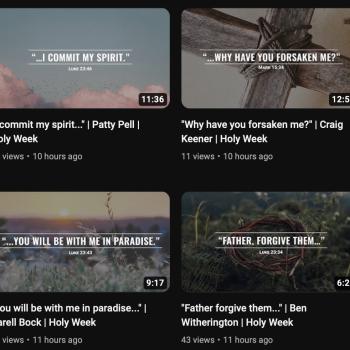
Check out the SeminaryNow Holy Week (2024) Video...
Crux Sola: Formed by Scripture to Live like Christ
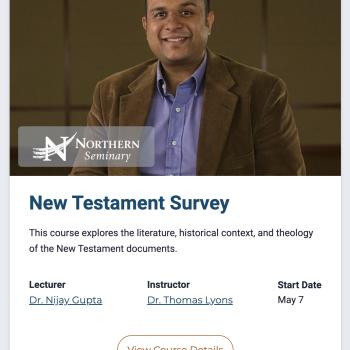
Get Seminary Credit through SeminaryNow Live Courses
Crux Sola: Formed by Scripture to Live like Christ

My New Fiction Series ("Strange Encounter")
Crux Sola: Formed by Scripture to Live like Christ
"Strange Religious Texts": Get the Bonus Essay FREE
Crux Sola: Formed by Scripture to Live like Christ
TRENDING AT PATHEOS Evangelical

The Problem with False Prophets
Miller’s Station UMC| 10/18/26| Anchor Verse: Jeremiah 23: 1, 9-23 I...

Emotion in Early Christianity by Andrew Crislip
Andrew Crislip’s Emotion in Early Christianity examines an often overlooked dimension of...

16 Spiritual Touchstones for a More Grounded Life
After decades of spiritual study, here are 16 principles I try...

Catholic Evangelization: Sharing Your Faith Every Day
Welcome back to the Graceful Awakening mini-series called, “From Faith to Mission.” ...

The Pillar of the Boatmen: the Ancient Monument...
The Pillar of the Boatmen is a Romano-Gaulish sculpture that dates from...

In one sense walking into Westminster Abbey is like walking down the...
view all Evangelical blogs
Ad-Free & Subscriber Log-In Subscription Support
- About Us
- 2026 Calendar
- Videos
- Podcasts
- Library of World Religions
- Faith In Media Tracker
- Advertise With Us
- Write for Us
- Privacy Policy
- Terms of Service
- Do Not Sell My Data
- Contact Us
- Radiant Digital
- Manage Newsletter Subscriptions
- Unsubscribe From Notifications
- Sitemap
Copyright 2008-2026, Patheos. All rights reserved.
Subscription Support Ad-Free & Subscriber Log-In
Follow Patheos