
BuddhistCatholicContemplativeEvangelicalGeneral ChristianHinduJewishLatter-day SaintMuslimNew VisionsProgressive Christian
Beliefs
- Buddhist
- Catholic
- Contemplative
- Evangelical
- General Christian
- Hindu
- Jewish
- Latter-day Saint
- More Voices
- Muslim
- New Visions
- Pagan
- Progressive Christian
Topics
- Religion News
- Food and Religion
- Sports and Religion
- Religious Art
- Religious Music and Entertainment
- Religious Events
- History and Religion
- Style and Religion
- Politics and Religion
- Women in Religion
- Recreation Outdoors and Religion
- Business Finance and Religion
- Careers Workplace and Religion
- Education and Religion
- Family Parenting and Religion
- Health Fitness and Religion
- Home and Religion
- Relationships and Religion
- Technology and Religion
- Travel and Religion
Columnists
- Buddhist Columnists
- Business Finance and Religion Columnists
- Careers Workplace and Religion Columnists
- Catholic Columnists
- Contemplative Columnists
- Education and Religion Columnists
- Evangelists Columnists
- Family Parenting and Religion Columnists
- General Christian Columnists
- Health Fitness and Religion Columnists
- Hindu Columnists
- History and Religion Columnists
- Home and Religion Columnists
- Jewish Columnists
- More Voices Columnists
- Latter Day Columnists
- Muslim Columnists
- New Visions Columnists
- Nonreligious Columnists
- Pagan Columnists
- Politics and Religion Columnists
- Progressive Columnists
- Recreation Outdoors and Religion Columnists
- Relationships and Religion Columnists
- Religion News Columnists
- Religious Art Columnists
- Religious Events Columnists
- Religious Music and Entertainment Columnists
- Sports and Religion Columnists
- Style and Religion Columnists
- Technology and Religion Columnists
- Travel and Religion Columnists
- Women in Religion Columnists
Resource Library
- 2026 Calendar
- Library of World Religions
- The 100 Most Holy Places on Earth
- Patheos Answers
- Podcasts
- Videos
- Faith Leaders Database
- Anglican Episcopalian
- Bahai
- Baptist
- Buddhism
- Christianity
- Confucianism
- Eastern Orthodoxy
- Hinduism
- Holiness and Pentecostal
- ISKCON
- Islam
- Judaism
- Lutheran
- Methodist
- The Church of Jesus Christ of Latter-day Saints
- New Age
- Paganism
- Presbytarian and Reformed
- Protestantism
- Religion Behind the Scenes
- Roman Catholic
- Scientology
- Shia Islam
- Sikhism
- Sufism
- Sunni Islam
- Taoism
- Zen
- See all religions
Research Tools
 Ad-Free & Subscriber Log-In Subscription Support
Ad-Free & Subscriber Log-In Subscription Support
Follow Patheos 

- Trending:
- Forgiveness
- |
- Marriage
- |
- Consciousness
- |
- Death Penalty
- |
- Election
- |
- Halloween
 Cross Examined
- Home
- Nonreligious
- Top 20 Most Damning Bible Contradictions (4 of 4)
Top 20 Most Damning Bible Contradictions (4 of 4)
Last updated on: April 8, 2025 at 8:11 am by Bob Seidensticker
Top 20 Most Damning Bible Contradictions (4 of 4) 2025-04-08T08:11:33-07:00 Bob Seidensticker
Patheos Explore the world's faith through different perspectives on religion and spirituality! Patheos has the views of the prevalent religions and spiritualities of the world.

|Image via Drew Saurus, CC license
We’ll conclude our look at Bible contradictions. Here are the final five (part 1 is here).
16. There are two incompatible Ten Commandments
You know the story: Moses got the Ten Commandments from God on Mt. Sinai in Exodus 20. The list of commandments had the familiar rules—no blaspheming, no murder, no lying, no stealing, and so on. Moses returns, only to find that the Israelites, impatient and anxious during his long absence, had made and were worshipping a golden calf, a familiar object of worship from Egypt.
Moses smashed the tablets in his rage, 3000 Israelites were killed in the opening round of punishment, and Moses eventually went back up for a duplicate set (Exodus 34), which was put in the Ark of the Covenant.
Except that it wasn’t a duplicate set. It’s a list that very few Christians are familiar with. For example, number 5 is “The first offspring from every womb belongs to me.” Number 7: Celebrate the Feast of Weeks. Number 10: “You shall not boil a young goat in its mother’s milk.” This set is referred to as the “Ten Commandments” in Exodus, not the other set.
We can debate which set fundamentalists should try to illegally place on government property, but despite God’s assurance, these are two very different sets of rules. (More here and here.)
17. There are two creation stories in Genesis
There are also two creation stories at the beginning of Genesis. First is the six-day creation story that enumerates the things God created day by day, after which God rested. Next is an older creation story, the one about the Garden of Eden.
Apologists try to harmonize these two, saying that the Garden of Eden story is just an in-depth look at the last day of creation, but details in the two stories disagree. The 6-day story says that humans can eat from every tree, while the Eden story says that one is forbidden. The 6-day story has plants and animals before humans, while the Eden story has the opposite. And so on (more).
18. There are even two Flood stories
You see the trend: the Old Testament often has two different, incompatible stories. Each was too precious for ancient editors to discard, so both were jammed together somehow. The two Ten Commandments stories are separated by over a dozen chapters, the two creation stories are back to back, and they’re interleaved in the Flood story.
In Flood story 1, the older story, Noah takes seven pairs of all clean animals plus one pair of all the others. Once on board with his family, it rained for forty days and forty nights, and everything outside the ark was killed. Noah sent out a dove to scout for dry land. On the second try, it returned with an olive leaf. Back on dry land, Noah sacrificed one of every clean animal to Yahweh, and Yahweh promised to never again destroy life on earth (with a flood, anyway).
In story #2, God is named, not Yahweh, but Elohim, and specifics about the design of the ark are given. With just one pair of each animal plus provisions, Noah (now 600 years old) and family go into the ark. This time, the water comes, not from rain, but from “the fountains of the great deep” and “the windows of the heavens.” Water had covered the earth for 150 days when Elohim made the water recede. This time it was a raven that helped scout for dry land, and they were back on dry land after a year in the ark. God told them to “be fruitful and multiply.”
A leading explanation of the Old Testament’s many story pairs is the Documentary Hypothesis. It answers a lot of questions and proposes four original documents that were merged to make the Pentateuch, the Bible’s first five books. Read more on the two Flood stories and the Documentary Hypothesis here.
19. Resurrection contradictions
Forty percent of the gospels focus on the last week of Jesus’s life, from the triumphant entry into Jerusalem on Palm Sunday to the crucifixion, resurrection, and final teachings, and they differ on many points.
A popular Christian response is to say that just because only Matthew wrote about the dead coming out of their graves and walking around Jerusalem doesn’t mean that it didn’t happen. (Yeah—the other gospel writers must not have thought that Jesus causing the dead to reanimate and walk around Jerusalem, seen by many, wasn’t worth writing about.)
Or that just because John says “Mary Magdalene went to the tomb,” that doesn’t mean that many other women weren’t also with her as Luke says (“Mary Magdalene, Joanna, Mary the mother of James, and the others with them”).
Or that just because only Matthew has Jesus riding on two donkeys, that doesn’t mean the other gospels’ reference to just one disagrees. (Yeah, it pretty much does.)
Or that Paul’s reference to 500 eyewitnesses to the risen Jesus might’ve been compelling to him, but it wasn’t worth writing about in any gospel (more).
From who Peter denied Jesus, to Jesus’s last words, to who the women saw at the tomb, to whether Mary Magdalene recognized Jesus or not, to how many days Jesus stayed after his resurrection, the various accounts differ. (More here.)
20. Jesus forgets the plot
At some point the three persons of the Trinity—Yahweh, Jesus, and the Holy Spirit—agreed that Jesus should live as a human on earth. Jesus was born as a divine being (except in Mark, where he becomes divine with his baptism) and lives out a life that ends with crucifixion. Just before that, he prayed with his disciples in the Garden of Gethsemane. To the few disciples with him, he said, “My soul is overwhelmed with sorrow to the point of death” (Matthew 26:38). Then he prays, “My Father, if it is possible, may this cup [he’s referring to the upcoming crucifixion] be taken from me.” He prays this three times. The story is the same in Mark, and in Luke, an angel strengthens Jesus.
Why did Jesus go off-script? He was part of the Trinity that decided this, so how could he be second-guessing the plan now?
We can look for a human comparison. It wouldn’t be surprising for an ordinary human to have second thoughts before a suicide mission, but in this story we’re talking about a god. Even if agony were a thing that he could perceive, why would an omniscient being question a plan that he knows is perfect?
The puzzle vanishes if we reinterpret the Jesus story as legend.
But wait! There’s more!
Religion is just superstition
which has been around long enough
to have become respectable.
— J. B. R. Yant
Previous Post

October 26, 2018
8 Lessons from New Age Thinking for Christians and Atheists
Next Post
October 31, 2018 Halloween Extra: An Atheist Horror Story
Browse Our Archives
Select a Category Abortion Apologetics Atheism Bible Christianity Cosmology Creationism/ID Debate Evolution History Homosexuality Humor Morality Other Religions Prophecy Religion Science Separation of Church and State Skepticism Social Issues Uncategorized Words
Select a Month December 2021 November 2021 October 2021 September 2021 August 2021 July 2021 June 2021 May 2021 April 2021 March 2021 February 2021 January 2021 December 2020 November 2020 October 2020 September 2020 August 2020 July 2020 June 2020 May 2020 April 2020 March 2020 February 2020 January 2020 December 2019 November 2019 October 2019 September 2019 August 2019 July 2019 June 2019 May 2019 April 2019 March 2019 February 2019 January 2019 December 2018 November 2018 October 2018 September 2018 August 2018 July 2018 June 2018 May 2018 April 2018 March 2018 February 2018 January 2018 December 2017 November 2017 October 2017 September 2017 August 2017 July 2017 June 2017 May 2017 April 2017 March 2017 February 2017 January 2017 December 2016 November 2016 October 2016 September 2016 August 2016 July 2016 June 2016 May 2016 April 2016 March 2016 February 2016 January 2016 December 2015 November 2015 October 2015 September 2015 August 2015 July 2015 June 2015 May 2015 April 2015 March 2015 February 2015 January 2015 December 2014 November 2014 October 2014 September 2014 August 2014 July 2014 June 2014 May 2014 April 2014 March 2014 February 2014 January 2014 December 2013 November 2013 October 2013 September 2013 August 2013 July 2013 June 2013 May 2013 April 2013 March 2013 February 2013 January 2013 December 2012 November 2012 October 2012 September 2012 August 2012 July 2012 June 2012 May 2012 April 2012 March 2012 February 2012 January 2012 December 2011 November 2011 October 2011 September 2011 August 2011
Follow Us!
TAKE THE
Religious Wisdom Quiz
What is the Christian teaching about caring for the poor?
Select your answer to see how you score.
Ignore the poor Seek only own wealth Never give Help those in need
Books by This Author Books by Bob Seidensticker
Related posts from Cross Examined
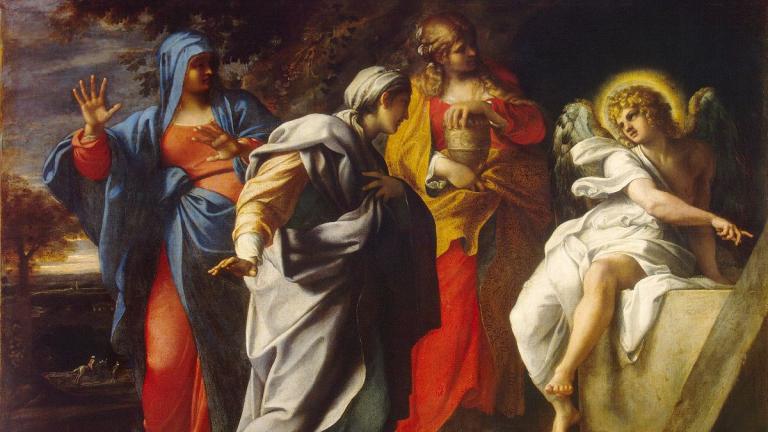
The Bible defeats its own Resurrection story

Guest post: The flat tire and the gospels

Bible Prophecies: Edom’s Barrenness, Deaths of Sons, and...
Bible Prophecies: Jerusalem Suburbs and Conquest
TRENDING AT PATHEOS Nonreligious

Dethroning Jesus and Enthroning Yourself
Jesus Never Asked to Be Worshipped. He Asked to Be Understood. Christianity...

Why Most Christians are Really Paulians and Jobians
I Don't Care, But It Matters Let's get this out of the...

Essential Tips to Successfully Navigate the Selling Process
Selling a house can feel overwhelming, but it doesn’t have to be....

To Make Remote Work Effective, Think About Others
The COVID-19 pandemic forced many companies to rapidly transition to remote work....

Flexibility Is Key to Solving Problems of Tomorrow
The world of work is undergoing a dramatic transformation. The COVID-19 pandemic...
view all Nonreligious blogs
Ad-Free & Subscriber Log-In Subscription Support
- About Us
- 2026 Calendar
- Videos
- Podcasts
- Library of World Religions
- Faith In Media Tracker
- Advertise With Us
- Write for Us
- Privacy Policy
- Terms of Service
- Do Not Sell My Data
- Contact Us
- Radiant Digital
- Manage Newsletter Subscriptions
- Unsubscribe From Notifications
- Sitemap
Copyright 2008-2026, Patheos. All rights reserved.
Subscription Support Ad-Free & Subscriber Log-In
Follow Patheos