
BuddhistCatholicContemplativeEvangelicalGeneral ChristianHinduJewishLatter-day SaintMuslimNew VisionsProgressive Christian
Beliefs
- Buddhist
- Catholic
- Contemplative
- Evangelical
- General Christian
- Hindu
- Jewish
- Latter-day Saint
- More Voices
- Muslim
- New Visions
- Pagan
- Progressive Christian
Topics
- Religion News
- Food and Religion
- Sports and Religion
- Religious Art
- Religious Music and Entertainment
- Religious Events
- History and Religion
- Style and Religion
- Politics and Religion
- Women in Religion
- Recreation Outdoors and Religion
- Business Finance and Religion
- Careers Workplace and Religion
- Education and Religion
- Family Parenting and Religion
- Health Fitness and Religion
- Home and Religion
- Relationships and Religion
- Technology and Religion
- Travel and Religion
Columnists
- Buddhist Columnists
- Business Finance and Religion Columnists
- Careers Workplace and Religion Columnists
- Catholic Columnists
- Contemplative Columnists
- Education and Religion Columnists
- Evangelists Columnists
- Family Parenting and Religion Columnists
- General Christian Columnists
- Health Fitness and Religion Columnists
- Hindu Columnists
- History and Religion Columnists
- Home and Religion Columnists
- Jewish Columnists
- More Voices Columnists
- Latter Day Columnists
- Muslim Columnists
- New Visions Columnists
- Nonreligious Columnists
- Pagan Columnists
- Politics and Religion Columnists
- Progressive Columnists
- Recreation Outdoors and Religion Columnists
- Relationships and Religion Columnists
- Religion News Columnists
- Religious Art Columnists
- Religious Events Columnists
- Religious Music and Entertainment Columnists
- Sports and Religion Columnists
- Style and Religion Columnists
- Technology and Religion Columnists
- Travel and Religion Columnists
- Women in Religion Columnists
Resource Library
- 2026 Calendar
- Library of World Religions
- The 100 Most Holy Places on Earth
- Patheos Answers
- Podcasts
- Videos
- Faith Leaders Database
- Anglican Episcopalian
- Bahai
- Baptist
- Buddhism
- Christianity
- Confucianism
- Eastern Orthodoxy
- Hinduism
- Holiness and Pentecostal
- ISKCON
- Islam
- Judaism
- Lutheran
- Methodist
- The Church of Jesus Christ of Latter-day Saints
- New Age
- Paganism
- Presbytarian and Reformed
- Protestantism
- Religion Behind the Scenes
- Roman Catholic
- Scientology
- Shia Islam
- Sikhism
- Sufism
- Sunni Islam
- Taoism
- Zen
- See all religions
Research Tools
 Ad-Free & Subscriber Log-In Subscription Support
Ad-Free & Subscriber Log-In Subscription Support
Follow Patheos 

- Trending:
- Forgiveness
- |
- Marriage
- |
- Consciousness
- |
- Death Penalty
- |
- Election
- |
- Halloween

- Home
- Jewish
- History and Religion
- Arabs Called 1927 Al-Aqsa Mosque Collapse God’s Punishment
Arabs Called 1927 Al-Aqsa Mosque Collapse God’s Punishment
Last updated on: February 23, 2026 at 9:15 am by Dr. Micah Ben David Naziri
Arabs Called 1927 Al-Aqsa Mosque Collapse God’s Punishment 2026-02-23T09:15:08-05:00 Dr. Micah Ben David Naziri
Patheos Explore the world's faith through different perspectives on religion and spirituality! Patheos has the views of the prevalent religions and spiritualities of the world.
Jews and Muslims alike saw the 1927 destruction of the Temple Mount Mosque as “The Hand of Heaven” and “From Allah.” This study reconstructs the architectural and theological history of al-Masjid al-Aqṣā and the Qubbat al-Ṣakhrah atop Jerusalem’s ancient Temple Mount (Har ha-Bayit; al-Ḥaram al-Sharīf), with particular emphasis on the catastrophic Jericho earthquake of July 11, 1927.
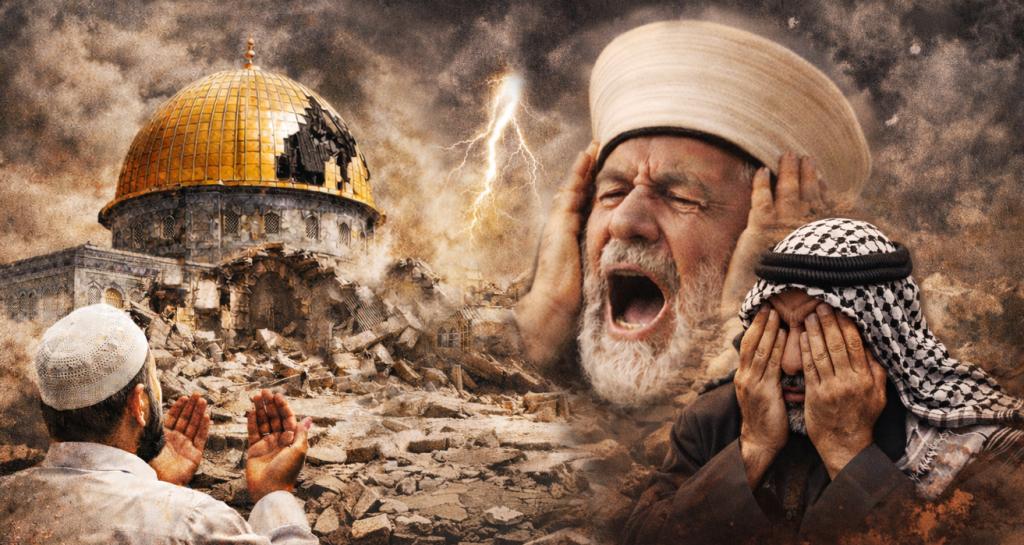
Image from the Tariqat Isawiyah. Used with permission.
The 1927 Temple Mount Earthquake Mosque Ruin ‘From God’ as ‘The Hand of Heaven’
Through a synthesis of Arabic chronicles, rabbinic and Hebrew-press testimonies, British administrative records, and modern seismological studies, it demonstrates how physical destruction at this locus repeatedly catalyzed rival yet parallel hermeneutics of divine communication. From the Umayyad program of imperial monotheism to the Fāṭimid and Ottoman reconstructions and finally the British-Mandate restoration under Grand Mufti Ḥājj Amīn al-Ḥusaynī, every earthquake not only altered stone and structure but also provoked renewed theological readings of legitimacy, chastisement, and grace.¹
The July 11, 1927 Jericho earthquake—the most destructive seismic event in modern regional history—nearly annihilated the mosque and fractured the Dome of the Rock. Al-Ḥusaynī proclaimed the devastation a trial from Allah (ibtilāʾ min Allāh, ابتلاء من الله), summoning Muslims to renew their covenant through reconstruction. At the same moment, Jewish residents of Jerusalem interpreted the same event through the idiom yad ha-shamayim—“the hand of Heaven”—finding providential meaning in the fact that the Western Wall stood unshaken while the structures above it collapsed. These twin interpretations—trial and mercy, punishment and preservation—reveal how a single geological convulsion became a mirror in which both communities discerned divine purpose.²
The History of Earthquakes Destroying the Temple Mount Mosques
The Temple Mount—Har ha-Bayit to Jews and al-Ḥaram al-Sharīf to Muslims—occupies not only Jerusalem’s highest ridge but the intersection of sacred memory, imperial ideology, and tectonic fault. For nearly fourteen centuries its sanctuaries have been destroyed and rebuilt by successive dynasties: Umayyad, ʿAbbāsid, Fāṭimid, Ayyūbid, Mamlūk, Ottoman, and British Mandate. Each epoch has left visible scars in masonry and invisible strata of meaning. The sanctuaries’ recurring collapse and renewal form a palimpsest of theology inscribed by the earth itself.³
From their construction in the late seventh century, al-Masjid al-Aqṣā and the Qubbat al-Ṣakhrah have stood upon the site of the destroyed Second Temple. Their Umayyad builders appropriated and re-signified that terrain as an emblem of Islam’s inheritance of prophetic monotheism. Yet the very ground upon which they built was seismically unstable. Every few centuries the fault lines of the Jordan Rift sent violent tremors through Jerusalem, toppling the structures that proclaimed continuity. Thus, the history of the Ḥaram is also a geological chronicle: 746 CE, 1033 CE, 1546 CE, 1837 CE, and 1927 CE mark not only earthquakes but theological aftershocks that reordered the city’s understanding of Heaven’s will.⁴
The earthquake of July 11, 1927, provides the most vivid modern example. Centered along the Jordan Rift Valley and registering approximately magnitude 6.3, it reduced the southern arcades of al-Masjid al-Aqṣā to ruin, cracked the Dome’s drum, and dislodged stones across the platform. The British Palestine Administration’s Annual Report for 1927 recorded: “Extensive structural damage … endangering the stability of the entire building.”⁵
The Grand Mufti, Ḥājj Amīn al-Ḥusaynī—then head of the Supreme Muslim Council—interpreted the destruction not as random catastrophe but as divine trial. Standing amid the debris, he declared before reporters of Filasṭīn on July 22, 1927:
The damage that has befallen al-Masjid al-Aqṣā and the Dome of the Rock is extensive and grievous. Their stones have been shaken, their arches split, and their domes cracked. This is a disaster that wounds the heart of every believer.
Ḍarar wāsiʿ wa-ʿaẓīm. Tazalzalat aḥjāruhā wa-inshaqqat aqwāsuhā wa-tashaqqaqqat qubābuhā. Hādhā muṣāb yunazzif qulūb kull muʾmin.
⁶ ضرر واسع وعظيم تزلزلت أحجارها وانشقت أقواسها وتشققـت قبابها هذا مصاب ينزف قلوب كل مؤمن
Ernest Tatham Richmond, the British architect appointed to direct the restoration, later confirmed in his official report:
The Grand Mufti’s characterization of the injuries to the buildings as “extensive” was entirely accurate. Several columns of al-Aqṣā had failed, and the drum of the dome showed dangerous fractures.⁷
Over the following eight years (1928–1936), the Supreme Muslim Council supervised the most ambitious renovation of the Ḥaram al-Sharīf since Ottoman times. Engineers dismantled compromised piers, replaced decayed cedar beams, installed steel tie-rods across the main arches, and re-sheeted the Dome of the Rock with new lead panels imported from England.
This restoration was framed publicly not merely as a technical necessity but as a religious obligation—evidence that the Muslim community had successfully endured a divine trial and renewed its covenant.⁸
While Muslim leadership interpreted the devastation as ibtilāʾ min Allāh (ابتلاء من الله), Jerusalem’s Jewish population read the same event through a sharply contrasting but equally providential idiom. Within days of the earthquake, the Hebrew-language press framed the tremor as an unmistakable act of divine communication.
On July 14, 1927, the daily Doʿar ha-Yom published an editorial under the headline Ha-Raʿash ha-Gadol (“The Great Tremor”), declaring:
This is the hand of Heaven that shakes the earth and makes our sanctuaries tremble.
Zot yad ha-shamayim ha-martitah et ha-aretz u-meriʿdah et heikhalenu.
⁹זאת יד השמים המרטיטה את הארץ ומרעידה את היכלינו
Two days later, on July 15, 1927, HaTzofeh, the organ of the religious Zionist Mizrachi movement, intensified this reading by introducing a crucial spatial contrast:
The hand of Heaven was made manifest; Jerusalem quaked, but the Western Wall did not move from its place.
Yad ha-shamayim nirʾetah be-galuy; Yerushalayim raʿadah, akh kir maʿarav lo zaʿ mi-mkomo.
¹⁰יד השמים נראתה בגלוי; ירושלים רעדה אך קיר מערב לא זע ממקומו
The emphasis on asymmetry—collapse above, stability below—quickly became central to Jewish theological reflection. One week later, on July 22, 1927, Ha-Hed printed a rabbinic commentary attributed to Rabbi Yehuda Leib Fishman (later Maimon):
From the earthquake we learn that the hand of Heaven acts to warn us to return in repentance.
Me-ha-raʿash nilmad ki yad ha-shamayim poʿelet le-hazhirenu la-shuv be-teshuvah.
¹¹מהרעש נלמד כי יד השמים פועלת להזהירנו לשוב בתשובה
These formulations—yad ha-shamayim, divine warning, repentance—circulated rapidly through synagogues, study houses, and private correspondence. The fact that the Western Wall, associated with the destroyed Temple, remained structurally intact while the Islamic sanctuaries above suffered catastrophic damage was repeatedly invoked as visible proof of enduring covenantal order.¹² To Jewish observers, geology itself appeared to have rendered a moral judgment.
Was This a Warning? Pogroms Before and After the 1927 Earthquake
The theological interpretations of the July 11, 1927 earthquake unfolded amid a documented pattern of escalating anti-Jewish violence in Mandatory Palestine. A comprehensive historical survey of pogrom-style attacks between 1830 and 1948 demonstrates that such violence was recurrent, often organized, and frequently justified through religious incitement—particularly during periods of political instability and disputes over sacred space.¹³
In the years preceding the earthquake, Jerusalem had already experienced repeated disturbances connected to the Western Wall controversy. Sermons, pamphlets, and Arabic press reports increasingly portrayed Jewish prayer at the Wall as a prelude to the seizure of Islamic holy sites, especially al-Masjid al-Aqṣā. These claims circulated widely despite repeated British denials, embedding sacred-space anxiety into popular politics well before the earthquake itself.¹⁴
The years following the earthquake proved catastrophic. In August 1929, riots erupted in Jerusalem and rapidly spread across the country, culminating in pogroms in Hebron and Safed. These attacks were not spontaneous clashes but sustained assaults on Jewish civilian populations, marked by extreme brutality and religious justification.¹⁵
In Hebron, on August 24, 1929, Arab mobs murdered sixty-seven Jews, frequently in their homes, employing knives, clubs, and axes. Bodies were mutilated, women were assaulted, and entire families were wiped out. British authorities evacuated the surviving Jewish population, effectively ending centuries of continuous Jewish presence in the city at that time.¹⁶
In Safed, during the same week, rioters looted and burned Jewish homes and synagogues, killing nearly two dozen Jewish residents and leaving hundreds homeless. The Jewish quarter was devastated, and British forces intervened only after significant loss of life.¹⁷
British commissions of inquiry later recorded that many attackers believed they were acting in defense of Islamic holy sites, particularly al-Masjid al-Aqṣā. Testimony gathered by the Shaw Commission noted that rumors of Jewish intentions to seize the Ḥaram al-Sharīf had circulated for months and were repeatedly invoked to justify violence.¹⁸
For Jewish interpreters, the pogroms of 1929 irrevocably reframed the memory of the earthquake. What had initially been read as yad ha-shamayim—a divine sign encoded in stone—was now understood as a warning not only of theological truth but of mortal vulnerability.
The destruction of al-Aqṣā in 1927 and the slaughter of Jewish communities in 1929 were increasingly read as linked moments in a single moral narrative: Heaven had spoken, but human actors had answered with bloodshed.¹²,¹³
Retrospective Judgment: Theology, Politics, and Moral Inversion
The events that followed the pogroms of August 1929 irrevocably altered how both communities retrospectively interpreted the July 11, 1927 earthquake. For Muslim leadership aligned with the Supreme Muslim Council, the earthquake had been framed as ibtilāʾ min Allāh (ابتلاء من الله), a divine trial that demanded unity, discipline, and renewed custodianship of the Ḥaram al-Sharīf. Reconstruction was thus presented as proof of spiritual endurance and legitimacy.¹⁹
For Jerusalem’s Jewish community, however, the sequence of events from 1927 to 1929 produced an inversion of meaning. What had initially been read as yad ha-shamayim—a providential sign inscribed into the Mount’s architecture—came to be understood not merely as reassurance but as warning. The same rhetoric of sacred defense that had framed Muslim interpretations of the earthquake was now operationalized as justification for mass violence. The theological register had crossed into bloodshed.²⁰
This inversion hardened further in the following decade. After fleeing Palestine in 1937, Ḥājj Amīn al-Ḥusaynī aligned himself openly with Nazi Germany and Fascist Italy. In November 1941, he met Adolf Hitler in Berlin and subsequently became a prominent voice in Arabic-language propaganda broadcast from Radio Berlin, urging resistance to Allied forces and explicitly calling for the extermination of Jews. German Foreign Office records document his praise for the “German solution to the Jewish problem” and his efforts to prevent Jewish refugees from escaping Europe.²¹
Al-Ḥusaynī also played a role in recruiting Muslim formations for the Waffen-SS, most notably the 13th Handschar Division and the 21st Skanderbeg Division in the Balkans. These units participated in anti-partisan operations and atrocities against civilian populations. Postwar historians have demonstrated that his wartime activity was not merely symbolic but materially supportive of Axis policy.²²
This later record profoundly reshaped Jewish memory of the 1927 earthquake. Sermons and essays written in the 1940s and 1950s increasingly treated the destruction of al-Masjid al-Aqṣā not only as a moment of divine signification but as a prefiguration of moral exposure. The man who had spoken of purification through trial in 1927 was now seen as having revealed the ethical emptiness of that claim through collaboration with genocidal ideology.²³
In this retrospective frame, the phrase yad ha-shamayim acquired a second resonance. It no longer referred solely to the hand that shakes the earth but also to the hand that unmasks false sanctity. The earthquake came to be read as a judgment not on Islam as a faith, but on the politicization of sacred space and the instrumentalization of theology for violence.²⁴
What Should We Conclude?
Across fourteen centuries of earthquakes—from 746 CE to 1033, from 1546 to 1927—the sanctuaries of the Temple Mount have never escaped impermanence. Each collapse has been followed by reconstruction, and each reconstruction by interpretation. The stones of the Mount have absorbed not only seismic shock but layers of theological meaning imposed by successive regimes that claimed to speak in Heaven’s name.
The July 11, 1927 earthquake brought this pattern into the modern era with unusual clarity. In purely geological terms, the catastrophe resulted from unstable fill and the periodic convulsions of the Jordan Rift Valley. In the eyes of believers, however, it was a revelation. To the Supreme Muslim Council and its supporters, it was ibtilāʾ min Allāh (ابتلاء من الله), a divine test that demanded faithful response and renewed custodianship. To Jerusalem’s Jews, it was yad ha-shamayim, the hand of Heaven, signaling that the ancient covenant beneath the Mount endured despite imperial overlays.
History layered a further irony onto this moment. The theological rhetoric that framed the earthquake as sacred trial soon gave way to sacralized violence, culminating in the pogroms of 1929 and later in open collaboration with genocidal regimes. In that light, the earthquake’s asymmetrical destruction—collapse above, endurance below—was reread as moral commentary rather than mere geological accident.
The physical history of al-Masjid al-Aqṣā and the Qubbat al-Ṣakhrah cannot be separated from the moral histories inscribed into their stones. Since the Umayyads first built atop the ruins of the Temple to proclaim imperial monotheism, the Mount has served as a canvas onto which claims of divine favor, legitimacy, and exclusion have been projected. Earthquakes have repeatedly erased those claims, reminding successive generations that no structure, however sanctified, is immune to judgment.
In the end, the competing interpretations of 1927 reveal less about geology than about theology under pressure. The earth shook once; meaning fractured many times. Jews and Muslims alike heard the same tremor as divine speech—but where one tradition heard reassurance, the other heard trial, and history would soon test which reading could survive the weight of bloodshed, memory, and moral reckoning.
Endnotes
- Andrew Marsham, The Umayyad Caliphate and the Formation of Islamic Imperial Ideology (Cambridge: Cambridge University Press, 2021), 214–17.
- Aziz al-Azmeh, The Emergence of Islam in Late Antiquity: Allah and His People (Cambridge: Cambridge University Press, 2014), 424–26.
- K. A. C. Creswell, Early Muslim Architecture, vol. 1 (Oxford: Clarendon Press, 1932), 130–33.
- Nicholas Ambraseys and C. P. Melville, The Seismicity of the Arabian Peninsula (Cambridge: Cambridge University Press, 1989), 28–30.
- Palestine Administration, Annual Report for 1927 (Jerusalem: Government Printer, 1928), 22–23.
- Filasṭīn (Jaffa), July 22, 1927.
- Ernest Tatham Richmond, Report on the Restoration of the Ḥaram al-Sharīf (Jerusalem: Supreme Muslim Council, 1936), 7–9.
- Robert Hamilton, The Structural History of the Aqsa Mosque (Oxford: Clarendon Press, 1949), 27–35.
- Doʿar ha-Yom (Jerusalem), July 14, 1927, p. 2.
- HaTzofeh (Tel Aviv), July 15, 1927.
- Ha-Hed (Jerusalem), July 22, 1927.
- Hillel Cohen, Year Zero of the Arab–Jewish Conflict, 1929 (Jerusalem: Magnes Press, Hebrew University, 2011), 54–55.
- Georges Bensoussan, Pogroms in Palestine before the Creation of the State of Israel (1830–1948) (Paris: Fondation pour l’Innovation Politique, 2024).
- Alex Winder, “The ‘Western Wall’ Riots of 1929: Religious Boundaries and Communal Violence in Palestine,” Journal of Palestine Studies 42, no. 1 (2012): 6–28.
- Great Britain, Report of the Commission on the Palestine Disturbances of August 1929 (Shaw Commission), Cmd. 3530 (London: His Majesty’s Stationery Office, 1930).
- Ibid., sections on Hebron.
- Ibid., sections on Safed.
- C. E. Richmond, Report on the Restoration of the Ḥaram al-Sharīf, 7.
- Philip Mattar, The Mufti of Jerusalem: Al-Hajj Amin al-Husayni and the Palestinian National Movement (New York: Columbia University Press, 1988), 131–60.
- Klaus Gensicke, Der Mufti von Jerusalem und die Nationalsozialisten (Darmstadt: Wissenschaftliche Buchgesellschaft, 2007), 88–97.
- Gilbert Achcar, The Arabs and the Holocaust: The Arab–Israeli War of Narratives (New York: Metropolitan Books, 2010), 66–73.
- Zvi Elpeleg, The Grand Mufti: Haj Amin al-Hussaini, Founder of the Palestinian National Movement (London: Frank Cass, 1993), 84–102.
- Jeffrey Herf, Nazi Propaganda for the Arab World (New Haven: Yale University Press, 2009), 145–76.
- Bernard Wasserstein, On the Eve: The Jews of Europe before the Second World War (New York: Simon & Schuster, 2012), 412–15.
Bibliography
Achcar, Gilbert. The Arabs and the Holocaust: The Arab–Israeli War of Narratives. New York: Metropolitan Books, 2010.
al-Azmeh, Aziz. The Emergence of Islam in Late Antiquity: Allah and His People. Cambridge: Cambridge University Press, 2014.
Ambraseys, Nicholas, and C. P. Melville. The Seismicity of the Arabian Peninsula. Cambridge: Cambridge University Press, 1989.
Bensoussan, Georges. Pogroms in Palestine before the Creation of the State of Israel (1830–1948). Paris: Fondation pour l’Innovation Politique, 2024.
Cohen, Hillel. Year Zero of the Arab–Jewish Conflict, 1929. Jerusalem: Magnes Press, Hebrew University, 2011.
Creswell, K. A. C. Early Muslim Architecture. Vol. 1. Oxford: Clarendon Press, 1932.
Elpeleg, Zvi. The Grand Mufti: Haj Amin al-Hussaini, Founder of the Palestinian National Movement. London: Frank Cass, 1993.
Gensicke, Klaus. Der Mufti von Jerusalem und die Nationalsozialisten. Darmstadt: Wissenschaftliche Buchgesellschaft, 2007.
Hamilton, Robert. The Structural History of the Aqsa Mosque. Oxford: Clarendon Press, 1949.
Herf, Jeffrey. Nazi Propaganda for the Arab World. New Haven: Yale University Press, 2009.
Marsham, Andrew. The Umayyad Caliphate and the Formation of Islamic Imperial Ideology. Cambridge: Cambridge University Press, 2021.
Mattar, Philip. The Mufti of Jerusalem: Al-Hajj Amin al-Husayni and the Palestinian National Movement. New York: Columbia University Press, 1988.
Palestine Administration. Annual Report for 1927. Jerusalem: Government Printer, 1928.
Richmond, Ernest Tatham. Report on the Restoration of the Ḥaram al-Sharīf. Jerusalem: Supreme Muslim Council, 1936.
Winder, Alex. “The ‘Western Wall’ Riots of 1929: Religious Boundaries and Communal Violence in Palestine.” Journal of Palestine Studies 42, no. 1 (2012): 6–28.
Wasserstein, Bernard. On the Eve: The Jews of Europe before the Second World War. New York: Simon & Schuster, 2012.
Muslim
Politics and Religion

About Dr. Micah Ben David Naziri
Dr. Micah Ben David Naziri is a scholar, author, and community activist whose work bridges Jewish and Muslim traditions through the Hashlamah Project Foundation, which he founded to foster grass-roots reconciliation between Jews and Palestinian Muslims. A specialist in Near Eastern languages, history and religions, he holds multiple graduate degrees in religious studies and conflict resolution and is training for Rabbinical s’mikhah ordination. Descended from Rabbi Nachman of Breslov, Naziri is also a lineage-holder and “Keeper of the Light” of the Tariqat ʿIsāwiyyah Judeo-Sufi order and is the sole teacher of the “Magen David” system of Krav Maga outside Israel. An instructor in multiple Asian martial arts systems and an award-winning educator, his interdisciplinary work explores the historical, linguistic, and spiritual connections uniting the peoples of the Near East and the diaspora. If you found this work edifying, clarifying, or constructive, please DONATE NOW to support it. Dr. Naziri’s research, writing, and reconciliation-centered activism—grounded in doctoral research on the persistence of Jewish–Muslim reconciliatory activism under conditions of threat and informed by my lineage as a direct descendant of Rabbi Nachman of Breslov—are produced ; reader support directly sustains independent scholarship and durable reconciliation work, and sharing, commenting on, and forwarding this piece also meaningfully helps. Learn more at https://aura.antioch.edu/etds/542/, https://hashlamah.com, and https://hashlamah.co.il Donation options: CashApp: $MicahNaziri Venmo: Micah-Naziri Zelle: 937-671-8334 PayPal: [email protected] You can read more about the author here.
Previous Post
February 3, 2026
The Messiah’s Mirror: Good Micah, Bad Micah
Next Post
February 10, 2026 The Jewish Talmud’s Four-Wife Rule Long Before the Qurʾān
Recent Comments
"Beautiful ❤️ 🙏🙏 This is so perfectly and accurately explained and articulated, it is a ..."
The Messiah’s Mirror: Good Micah, Bad ..."
"Many will regret destroying their skin with so many tattoos. It looks disgusting in my ..."
Are Tattoos Really Forbidden by the ..."
"Religion has become broken and corrupt. Our current belief systems only cause division and strife. ..."
The Jewish Origins of Ḥajj and ..."
"Excellent article! Nice to finally see the truth being exposed! Thank you again for the ..."
The Jewish Origins of Ḥajj and ..."
Browse Our Archives
Select a Category Uncategorized
Select a Month September 2026 August 2026 May 2026 February 2026 January 2026 December 2025 October 2025 September 2025 August 2025 June 2025 May 2025 April 2025 March 2025 October 2024
Follow Us!
TAKE THE
Religious Wisdom Quiz
Which Christian group is known for pacifism?
Select your answer to see how you score.
Pentecostals Quakers Baptists Methodists
Related posts from The Critical Historian of Religion As Detective
Circumcision, Indigeneity and Judeophobic Cultural Hypocrisy
The Critical Historian of Religion As Detective
Out-Crowleying Crowley: The Emptiness of the O9A
The Critical Historian of Religion As Detective
Does the Talmud Support Pedophilia? Debunking the Viral...
The Critical Historian of Religion As Detective

BAMBOOZLED: No People Rise by Blaming Another People
The Critical Historian of Religion As Detective
TRENDING AT PATHEOS Jewish

Building a Little Ark in a Frightening World
This past Shabbat, we read about Noah. I love this story. The...

Yom Kippur : Is There Always Room for...
Making Room for Forgiveness Every year as Yom Kippur approaches, I find...

This Rosh Hashanah: Can I Find New Meaning?
A Sunrise, a New Year, and a Question On our way to...

Killing Amalek: The Torah’s Most Misunderstood Commandment
Few passages of the Torah have provoked more confusion, polemic, and misuse...

I have never trusted a first draft. I don’t mean that...

Back to School, Back to Reality—and a New...
A New School Year Begins… Back to Reality A new school year...
view all Jewish blogs
What Are Your Thoughts?leave a comment
Ad-Free & Subscriber Log-In Subscription Support
- About Us
- 2026 Calendar
- Videos
- Podcasts
- Library of World Religions
- Faith In Media Tracker
- Advertise With Us
- Write for Us
- Privacy Policy
- Terms of Service
- Do Not Sell My Data
- Contact Us
- Radiant Digital
- Manage Newsletter Subscriptions
- Unsubscribe From Notifications
- Sitemap
Copyright 2008-2026, Patheos. All rights reserved.
Subscription Support Ad-Free & Subscriber Log-In
Follow Patheos