
BuddhistCatholicContemplativeEvangelicalGeneral ChristianHinduJewishLatter-day SaintMuslimNew VisionsProgressive Christian
Beliefs
- Buddhist
- Catholic
- Contemplative
- Evangelical
- General Christian
- Hindu
- Jewish
- Latter-day Saint
- More Voices
- Muslim
- New Visions
- Pagan
- Progressive Christian
Topics
- Religion News
- Food and Religion
- Sports and Religion
- Religious Art
- Religious Music and Entertainment
- Religious Events
- History and Religion
- Style and Religion
- Politics and Religion
- Women in Religion
- Recreation Outdoors and Religion
- Business Finance and Religion
- Careers Workplace and Religion
- Education and Religion
- Family Parenting and Religion
- Health Fitness and Religion
- Home and Religion
- Relationships and Religion
- Technology and Religion
- Travel and Religion
Columnists
- Buddhist Columnists
- Business Finance and Religion Columnists
- Careers Workplace and Religion Columnists
- Catholic Columnists
- Contemplative Columnists
- Education and Religion Columnists
- Evangelists Columnists
- Family Parenting and Religion Columnists
- General Christian Columnists
- Health Fitness and Religion Columnists
- Hindu Columnists
- History and Religion Columnists
- Home and Religion Columnists
- Jewish Columnists
- More Voices Columnists
- Latter Day Columnists
- Muslim Columnists
- New Visions Columnists
- Nonreligious Columnists
- Pagan Columnists
- Politics and Religion Columnists
- Progressive Columnists
- Recreation Outdoors and Religion Columnists
- Relationships and Religion Columnists
- Religion News Columnists
- Religious Art Columnists
- Religious Events Columnists
- Religious Music and Entertainment Columnists
- Sports and Religion Columnists
- Style and Religion Columnists
- Technology and Religion Columnists
- Travel and Religion Columnists
- Women in Religion Columnists
Resource Library
- 2026 Calendar
- Library of World Religions
- The 100 Most Holy Places on Earth
- Patheos Answers
- Podcasts
- Videos
- Faith Leaders Database
- Anglican Episcopalian
- Bahai
- Baptist
- Buddhism
- Christianity
- Confucianism
- Eastern Orthodoxy
- Hinduism
- Holiness and Pentecostal
- ISKCON
- Islam
- Judaism
- Lutheran
- Methodist
- The Church of Jesus Christ of Latter-day Saints
- New Age
- Paganism
- Presbytarian and Reformed
- Protestantism
- Religion Behind the Scenes
- Roman Catholic
- Scientology
- Shia Islam
- Sikhism
- Sufism
- Sunni Islam
- Taoism
- Zen
- See all religions
Research Tools
 Ad-Free & Subscriber Log-In Subscription Support
Ad-Free & Subscriber Log-In Subscription Support
Follow Patheos 

- Trending:
- Forgiveness
- |
- Marriage
- |
- Consciousness
- |
- Death Penalty
- |
- Election
- |
- Halloween
 Create Soul Space
- Home
- Catholic
- Relationships and Religion
- The USCCB on Abuse: Domestic Violence Awareness Month
The USCCB on Abuse: Domestic Violence Awareness Month
Last updated on: October 5, 2022 at 3:19 pm by Jenny duBay
The USCCB on Abuse: Domestic Violence Awareness Month 2022-10-05T15:19:39-04:00 Jenny duBay
Patheos Explore the world's faith through different perspectives on religion and spirituality! Patheos has the views of the prevalent religions and spiritualities of the world.
October is Domestic Violence Awareness Month—Which is the Perfect Time to Review Catholic Teaching on This Crucial Epidemic

(Jen Theodore / Unsplash)
Catholics are familiar with October as the month of the Holy Rosary as well as Respect Life month. However, it’s also important to remember that October is Domestic Violence Awareness month. This gives us the perfect opportunity to review what the United States Conference of Catholic Bishops (USCCB) teaches about violence within Catholic families.
One out of every three women are or will be victims of domestic violence. And the sad fact of the matter is, this appalling statistic remains the same across nearly all demographics.
Religion is no exception. Just because a family attends Mass every Sunday doesn’t mean, behind closed doors, their relationship is filled with the love of Christ.
Although it’s true that men can—and are—also victims, domestic violence “tends to harm women and children more,” as the USCCB points out. 85% of domestic violence targets are female victims of male partners, which is the reason this article focuses on female victims.
In 1992–with an update in 2002–the USCCB published an important document regarding the Catholic Church’s stance on domestic violence awareness. “When I Call for Help: A Pastoral Response to Domestic Violence Against Women” takes a clear, firm stance agains the evils of abuse within sacred marriages. Even so, the document hasn’t received the attention it deserves.
I’d like to help change that.

(engin / Unsplash)
What Does the Church Teach About Domestic Violence?
It’s not uncommon for Catholic women suffering in abusive marriages to feel confused, depressed, and stuck. Thy worry they have to live with abuse for the rest of their lives. After all, marriage is a sacrament, and the Church teaches that it’s indissoluble (CCC 1664-1645). Which obviously means they really are stuck, right?
But wait. Not so fast.
The statement in the Catechism of the Catholic Church about the indissolubility of marriage is clearly referring to valid unions that are a “partnership … ordered toward the good of the spouses” (CCC 1601). A sacramental marriage is supposed to be full of authentic love, which means equality, mutual self-giving, and empathetic compromise. An abusive marriage, on the other hand, is a relationship of coercive control, crazy-making, power-over and manipulation.
Love is patient and kind; love is not jealous or boastful; it is not arrogant or rude. Love does not insist on its own way; it is not irritable or resentful; it does not rejoice at wrong, but rejoices in the right.
(1 Cor 13:4-7)
In “When I Call for Help,” the U.S. bishops are very firm in clarifying Church teaching on abuse:
As pastors of the Catholic Church in the United States, we state as clearly and strongly as we can that violence against women, inside or outside the home, is never justified. Violence in any form—physical, sexual, psychological, or verbal—is sinful; often, it is a crime as well. We have called for a moral revolution to replace a culture of violence. We acknowledge that violence has many forms, many causes, and many victims—men as well as women.
A Catholic marriage is a call to help one’s partner become holy and grow in love. It should be a nurturing household, a faith-filled mini-community consisting of a close-knit family. Married couples are also called to be mutually self-giving to one another—which is the true meaning of Ephesians 5.
Sadly, Ephesians 5 is commonly corrupted by abusive individuals. They try to use the words as an excuse for their controlling behavior, but nothing could be further from the true interpretation. As the USCCB states:
As bishops, we condemn the use of the Bible to support abusive behavior in any form. A correct reading of Scripture leads people to an understanding of the equal dignity of men and women and to relationships based on mutuality and love. Beginning with Genesis, Scripture teaches that women and men are created in God’s image.
Jesus himself always respected the human dignity of women. Pope John Paul II reminds us that “Christ’s way of acting, the Gospel of his words and deeds, is a consistent protest against whatever offends the dignity of women.” Men who abuse often use Ephesians 5:22, taken out of context, to justify their behavior, but the passage (v. 21-33) refers to the mutual submission of husband and wife out of love for Christ. Husbands should love their wives as they love their own body, as Christ loves the Church.
Using any type of control and manipulation against another person “fails to treat that person as someone worthy of love.” This is clear Church teaching, even though it needs to be discussed more.
Domestic violence is any kind of behavior that a person uses to control an intimate partner through fear and intimidation. It includes physical, sexual, psychological, verbal, and economic abuse. Some examples of domestic abuse include battering, name-calling, and insults, threats to kill or harm one’s partner or children, destruction of property, marital rape, and forced sterilization or abortion.
This description of domestic violence is crucial to keep in mind, because it directly leads to the bishops’ next point.
No person is expected to stay in an abusive marriage. Some abused women believe that church teaching on the permanence of marriage requires them to stay in an abusive relationship. They may hesitate to seek a separation or divorce. They may fear that they cannot re-marry in the Church. Violence and abuse, not divorce, break up a marriage.
We encourage abused persons who have divorced to investigate the possibility of seeking an annulment. An annulment, which determines that the marriage bond is not valid, can frequently open the door to healing.
If you’re in an abusive marriage, please know that not only is it okay to seek help, but you should–for your own sake, and for the sake of your entire family. If you feel it’s safe and the right thing to do, domestic abuse is also a valid reason to leave a toxic relationship. The Catholic Church supports you.
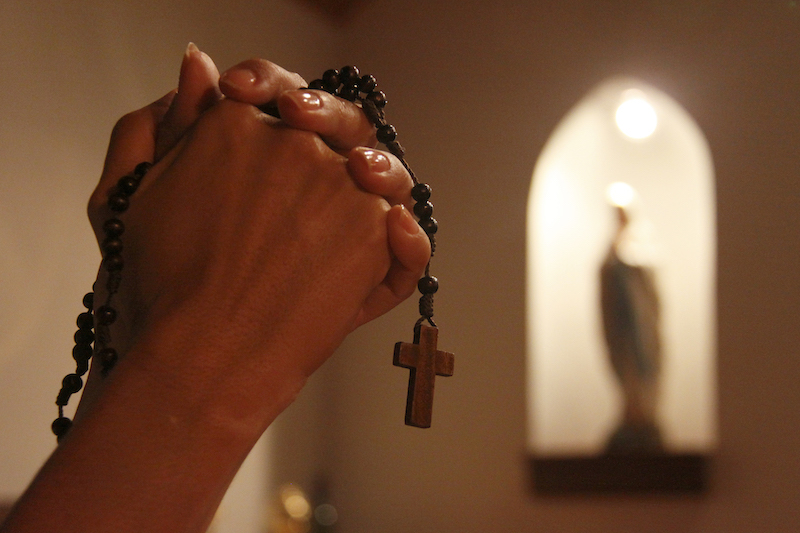
(Dante Di Natale / Cathopic)
However, please keep in mind that possessively jealous partners who are abusive can be also be physically dangerous, even if they’ve never before been physically abusive. If you feel you’re in danger in any way, seek help.
The National Domestic Violence Hotline provides crisis intervention and referrals to local service providers. Call 800-799-SAFE (7233) or 800-787-3224 (TTY). For more information, go to https://www.thehotline.org. Hotline Advocates are available to chat online, Monday to Friday, 9 AM – 7 PM CST.
“When I Call for Help” also attempts to help abusers who are willing to change. To assist individuals stop abusing and make positive changes in their lives, a bulleted list of pointers includes such crucial elements as:
- Admit that the abuse is your problem, not your partner’s, and have the manly courage to seek help. Begin to believe that you can change your behavior if you choose to do so.
- Be willing to reach out for help. Talk to someone you trust who can help you evaluate the situation. Contact Catholic Charities or other church or community agencies for the name of a program for abusers.
- Find alternative ways to act when you become frustrated or angry. Talk to other men who have overcome abusive behavior. Find out what they did and how they did it.
I believe it’s crucial to add a disclaimer here. Please be aware that if an abuser decides to contact his priest for help, it’s important to keep in mind that both clergy and lay ministers are often undereducated regarding domestic abuse. It often can do more harm than good to seek help from someone who has no idea how to help or minister in such a delicate and confusing situation.
Undereducated and non-suspecting people (those fooled by an abuser’s charm) tend to sympathize with an abuser, making the situation far worse and giving the abuser a further excuse to continue his behavior. Before seeking professional help of any kind, it’s necessary to ask questions. A lot of questions. A few possibilities include:
- What is their experience with domestic violence?
- What sort of training have they engaged in?
- Do they know the red flags of abuse, the covert methods that are used to gaslight and confuse not only the victim, but others around them?
- Are they aware of healing methods and are they in touch with local partner abuse intervention programs and domestic violence shelters?
To the USCCB’s list, I would add two other necessary components:
- The first non-negotiable step: An abuser needs to join a solid partner abuse intervention program (also called a batterer’s intervention program). He has to remain in the group and fully participate in all the meetings for the entire length of the course. Determining if a group program is trustworthy takes patience, research, education and discernment. Not all are created equal. It’d take another article to discuss all this, so if you want to know more, just contact me.
- Eucharistic Adoration. Without Christ, there is no true healing.
For priests and laity ministering in the Church–really, anyone who may encounter individuals seeking advice and assistance–the USCCB gives a few suggestions to increase domestic violence awareness. Primary in this endeavor is proper education.
As I said, the majority of well-intentioned ministers are undereducated or completely untrained in domestic violence awareness. Ignorance of the tactics employed by abusers, and the red flags to be aware of, are the main causes of inadequate and even damaging responses. This can cause a victim to be re-traumatized and needs to be avoided at all costs.
Education and awareness is the key to prevent such grave spiritual tragedy from happening.
Making people aware that documents such as “When I Call for Help” exist is of primary importance. I also suggest a program of thorough training for seminarians, clergy, and lay ministers to be instituted in every church and seminary.
- The best educational resource can be found at the Pax in Familia website, through Dr. Christauria Welland’s exceptional course, “Violence and Abuse in Catholic & Christian Families: Preparing an Effective and Compassionate Pastoral Response.”
- Catholics for Family Peace offers printable resources, including restroom flyers, bulletin announcements, and safety planning flyers.
We need to keep talking about this epidemic plaguing homes, and not only during Domestic Violence Awareness Month. Domestic violence happens every day, across the globe. The more we talk, the more we can help increase awareness and encourage positive change.

Religious Events
Home and Religion
Family, Parenting and Religion
healing after narcissistic abuse
United States Conference of Catholic Bishops

About Jenny duBay
As a domestic abuser survivor, advocate and author, Jenny duBay knows trauma--and the path toward healing. She founded "Create Soul Space: A Catholic Woman’s Guide to Domestic Abuse" (https://www.createsoulspace.net) to help cultivate awareness of domestic violence within a Catholic setting. Jenny is associated with Catholics for Family Peace, Pax in Familia, Missio Dei, and works with various dioceses to spiritually support victims and survivors of domestic violence. You can read more about the author here.
Previous Post

October 1, 2022
How to Talk About Your Abusive Relationship with Trusted Friends
Next Post

October 21, 2022 How to Attend Eucharistic Adoration When Adoration Isn't Possible
Browse Our Archives
Select a Category Conversion Difficult marriages Difficult Relationships Domestic Abuse Domestic Violence Eucharist Adoration Family Intimate Partner Violence Marriage & Relationships Marriage issues Patron Saints psychological abuse Self-Care Self-Change Self-Love Sexual Abuse
Select a Month April 2023 March 2023 November 2022 October 2022 September 2022 August 2022
Follow Us!
TAKE THE
Religious Wisdom Quiz
What does "Shalom" mean in Hebrew?
Select your answer to see how you score.
Love Peace Blessing Joy
Related posts from Create Soul Space

Catholic
Domestic Violence from a Personal Ministerial Perspective

Catholic
Pope Francis and Domestic Abuse Awareness: An Anniversary...
Catholic
Pope Francis on Equality: Putting Women in their...
Catholic
TRENDING AT PATHEOS Catholic

Creation, Preservation, and Teleology in Catholic Theology
As I write this, it is very early Monday morning. Like millions...

The Parable Of The Sower And The Word...
One of Christ’s most famous parables is that of the sower who...

Rejecting Doom: Christian Hope And Human Action
Christianity is a religion of hope. We are to have hope and...

Why I Choose the Eucharist Over the Sermon
Choose the Eucharist, Not the Sermon What are we supposed to get...

5 Design Elements Found in Spiritually Rooted Homes
Putting Spirituality Into Home Decor Our homes are more than our living...

Credo: A Story of God Told with the...
About 10 years ago, I began to imagine a personal "Credo" that...
view all Catholic blogs
Ad-Free & Subscriber Log-In Subscription Support
- About Us
- 2026 Calendar
- Videos
- Podcasts
- Library of World Religions
- Faith In Media Tracker
- Advertise With Us
- Write for Us
- Privacy Policy
- Terms of Service
- Do Not Sell My Data
- Contact Us
- Radiant Digital
- Manage Newsletter Subscriptions
- Unsubscribe From Notifications
- Sitemap
Copyright 2008-2026, Patheos. All rights reserved.
Subscription Support Ad-Free & Subscriber Log-In
Follow Patheos