
BuddhistCatholicContemplativeEvangelicalGeneral ChristianHinduJewishLatter-day SaintMuslimNew VisionsProgressive Christian
Beliefs
- Buddhist
- Catholic
- Contemplative
- Evangelical
- General Christian
- Hindu
- Jewish
- Latter-day Saint
- More Voices
- Muslim
- New Visions
- Pagan
- Progressive Christian
Topics
- Religion News
- Food and Religion
- Sports and Religion
- Religious Art
- Religious Music and Entertainment
- Religious Events
- History and Religion
- Style and Religion
- Politics and Religion
- Women in Religion
- Recreation Outdoors and Religion
- Business Finance and Religion
- Careers Workplace and Religion
- Education and Religion
- Family Parenting and Religion
- Health Fitness and Religion
- Home and Religion
- Relationships and Religion
- Technology and Religion
- Travel and Religion
Columnists
- Buddhist Columnists
- Business Finance and Religion Columnists
- Careers Workplace and Religion Columnists
- Catholic Columnists
- Contemplative Columnists
- Education and Religion Columnists
- Evangelists Columnists
- Family Parenting and Religion Columnists
- General Christian Columnists
- Health Fitness and Religion Columnists
- Hindu Columnists
- History and Religion Columnists
- Home and Religion Columnists
- Jewish Columnists
- More Voices Columnists
- Latter Day Columnists
- Muslim Columnists
- New Visions Columnists
- Nonreligious Columnists
- Pagan Columnists
- Politics and Religion Columnists
- Progressive Columnists
- Recreation Outdoors and Religion Columnists
- Relationships and Religion Columnists
- Religion News Columnists
- Religious Art Columnists
- Religious Events Columnists
- Religious Music and Entertainment Columnists
- Sports and Religion Columnists
- Style and Religion Columnists
- Technology and Religion Columnists
- Travel and Religion Columnists
- Women in Religion Columnists
Resource Library
- 2026 Calendar
- Library of World Religions
- The 100 Most Holy Places on Earth
- Patheos Answers
- Podcasts
- Videos
- Faith Leaders Database
- Anglican Episcopalian
- Bahai
- Baptist
- Buddhism
- Christianity
- Confucianism
- Eastern Orthodoxy
- Hinduism
- Holiness and Pentecostal
- ISKCON
- Islam
- Judaism
- Lutheran
- Methodist
- The Church of Jesus Christ of Latter-day Saints
- New Age
- Paganism
- Presbytarian and Reformed
- Protestantism
- Religion Behind the Scenes
- Roman Catholic
- Scientology
- Shia Islam
- Sikhism
- Sufism
- Sunni Islam
- Taoism
- Zen
- See all religions
Research Tools
 Ad-Free & Subscriber Log-In Subscription Support
Ad-Free & Subscriber Log-In Subscription Support
Follow Patheos 

- Trending:
- Forgiveness
- |
- Marriage
- |
- Consciousness
- |
- Death Penalty
- |
- Election
- |
- Halloween
 Cracks in Postmodernity
- Home
- Catholic
- Politics and Religion
- Sperging the Mass(es): more notes on neurodivergence and trad piety
Sperging the Mass(es): more notes on neurodivergence and trad piety
Last updated on: May 30, 2023 at 7:18 pm by Stephen G. Adubato
Sperging the Mass(es): more notes on neurodivergence and trad piety 2023-05-30T19:18:39+00:00 Stephen G. Adubato
Patheos Explore the world's faith through different perspectives on religion and spirituality! Patheos has the views of the prevalent religions and spiritualities of the world.
So I recently spent an extended period of time around a group of trads who are very likely to find themselves somewhere along the higher functioning end of the Spectrum. This experience was quite frustrating, to say the least: their cognitive dissonance deeply disturbed me—partially because it forced me (a post-trad in recovery) to confront my own cognitive dissonance.
A disclaimer: I’ve advocated for neurodivergent people who find the Tridentine Latin Mass and other forms of traditional theology, piety, and spirituality to be safe havens in a world where we often feel misunderstood, excluded, and our sensibilities belittled (see my piece in the National Catholic Reporter). Everyone—with all of their quirks or handicaps—has gifts to contribute to religious communities, which ought to be valued and taken seriously.
But part of what perturbed me so—while watching veiled women with long skirts drop loudly to their knees and stick out their tongue in order to receive communion, men in suspenders pounding their chests ostentatiously for each mea culpa, bowing every time the name of Christ or the Trinity is mentioned, and many other noticeable acts that distinguished them from the rest of the crowd—was the fact that these gestures seemed to be done as a way to perform one’s distinctness, one’s spiritual superiority, from the others…to draw attention to the fact that they are among an elect group who truly understands the faith and what it means to be reverent in a way that others don’t.
Sadly, I remembered the self-righteous zeal that drove me to do the same things as a new con/revert…the pride masking as piety, self-referentiality LARPing as devotion. I once remember visiting a parish on a Sunday where I balked at the choir for “liturgical abuse” (they were singing Gospel songs) and refused to grab the hand of the young girl with Downs Syndrome next to me during the Our Father (also liturgical abuse).
Over time I’ve come to see the error in my ways. Most of my griping about liturgical correctness—much like most politically correct fanatics and other virtue signalers—was a form of self-indulgent, masturbatory performance art. As Paul said in 1 Corinthians 12: “If I speak in human and angelic tongues but do not have charity, I am a resounding gong or a clashing cymbal. And if I have the gift of prophecy and comprehend all mysteries and all knowledge; if I have all faith so as to move mountains, but do not have charity, I am nothing.” The greatest gesture of charity, of unity with Christ and neighbor, is not to exalt the ideal of liturgical purity, but to adopt a “when in Rome” mentality—which would’ve meant holding that girl’s hand or singing (and clapping [!]) along to the Gospel version of “Hail Holy Queen” (a la Whoopi Goldberg).
I still stand by creating spaces for neurodivergent people to be themselves and not feel alienated from others. But the problem is (as Pope Francis seems to be hinting at in Traditionis Custodes) when trads (both neurotypical and divergent ones) are encouraged to think their proclivities are normative (or even superior) and seek to gain power and influence over the Church (as I’ve indicated here). I’ve come to see how closed-minded, narcissistic, and suffocating trad communities like these can be, and (as much as I think he can chill a little bit with the TLM restrictions) understand Francis’ recent concerns.
It’s worth noting that much of the trad-wave is a reaction to misinterpretations of the Second Vatican Council. Much of my own trad-sperimenting was a reaction to my experience at bourgeois, assimilated, WASP-y Catholic parishes (I also wrote about this in NCRep, CWR, NCReg and in various Substack posts like this one). But ultimately, I’ve come to see that the best interpreters of Vatican II are the lay movements (Neocats, CL, Focolare, Sant’Egidio, etc) and (some of) the religious orders—as they are the only entities that seem to be able to maintain the tension between individual and community, subjectivity and objectivity, tradition and progress, freedom of conscience and fidelity to dogma, sanctity and social justice, without compromising the one or the other…and that the best Masses to attend are ethnic ones, where there is a sense of tradition (without feeling artificial), community (without feeling sentimental), and beauty (without feeling overly decadent or self-indulgent).
I’ll close this rant with an excerpt from Luigi Giussani, as quoted by an Italian priest during a retreat, which encapsulates the lay movements’ nuanced and compelling reading of Vatican 2 as being primarily about Christocentricity, community, and mission:
“Once this companionship, or this road, had an imposing perimeter, imposing from the point of view of the strength of the walls and of its aesthetic grandeur. There is nothing finer and more fascinating, in ages long past, than the monasteries. The walls were defenses against the enemies, even physical enemies. The beauty of the architecture [just think what splendid things we have throughout Europe, and also in the rest of the world] had only one rival – the beauty of the song and the prayer that sounded within those walls and under those vaults. Now, things have become more spiritual; now, things have become more subtle, apparently more inconsistent; no more walls a yard thick, no more architectural spires, those spaces that were enough to draw the soul upward, no more that captivating suggestion of the chant and the regular prayer. There is a companionship, our companionship, our friendship, a companionship in which all depends on good will, on the will of those making it up. This companionship must substitute those walls, it must trace the echo of those chants, of those prayers; it has to be able to inspire a look that makes tangible, at least in some way, the physical attraction of God in His reality in the world, the attraction of the sign of Christ, that attraction which is the sign of Christ.”
Christian communities today “must trace the echo of those chants.” Prayer and singing are reminders of “the truer dimension of life, which replaces the thick walls of the Romanesque, or Gothic, or even certain Baroque beauties. That is why lay nature is not a path to conformism, but it is a path to making an impact on the world, and to mission wherever we are called. Memory, change in relationships, a radiant face – herein lies the whole origin of mission…Mission cannot help but come from this face [from the radiant face]. Not from what you do, but from the face that you have.”
PS: a random (but not totally irrelevant) thought: the Kiss of Peace presents us with an interesting conundrum. Most bourgeois assimilated Novus Ordo parishes reduce it to a sentimental formality emptied of any substance whatsoever. I’m most drawn to the Novus Ordo as celebrated in the Neocatechumenal Way, where before the Kiss, community members have the chance to air out grievances with each other and ask/give forgiveness (a la Matthew 5:23), and then actually give each and every community member a hug and dos besos kiss. …I’ll take that or the many traditional liturgies (TLM, Divine Liturgy of St. Chrysostom) that totally omit the Kiss of Peace altogether over the sentimentality of bougie white suburbanites waving peace signs around to whoever happens to be looking.
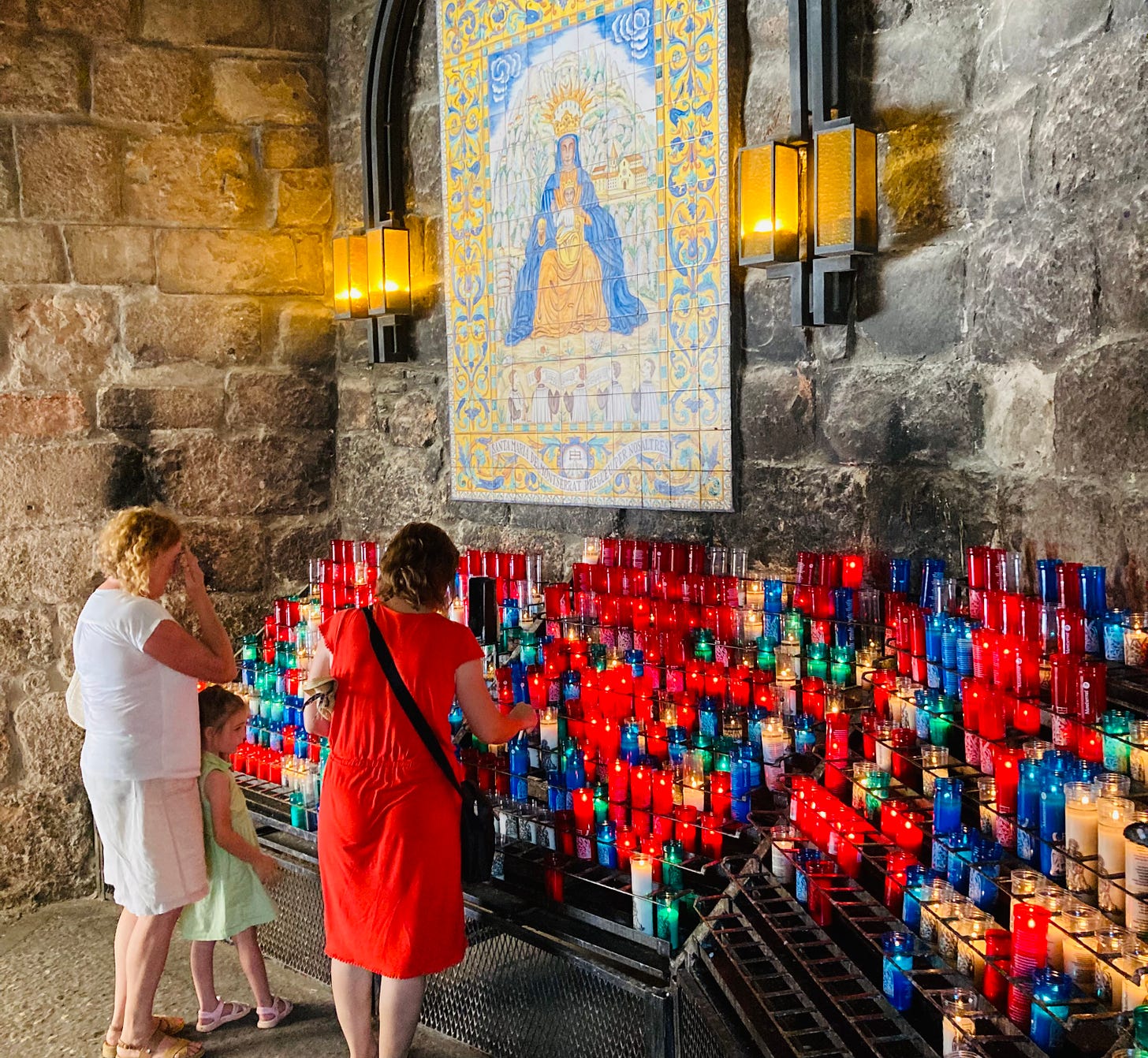
photo taken in Montserrat, Catalonia.
Email stephenadubato at gmail dot com to preorder a copy of cracks in pomo: the zine. $upport CracksInPomo by choosing a paid subscription of this page, or by offering a donation through Anchor. Check out my podcast on Anchor and YouTube and follow me on Instagram and Twitter.
Politics and Religion
Previous Post

April 25, 2023
Notes on Anti-Structure: sontagian musings on a taylorian idea

Recent Comments
"I have a friend who, having ancestry in the Nordic countries, identifies culturally more with ..."
"I can't think of a time in Western and Middle Eastern history in which religion ..."
The Sisters of Perpetual Indulgence and ..."
"As someone who indeed takes anti-Catholic discrimination in the US quite seriously, I take exception ..."
The Sisters of Perpetual Indulgence and ..."
"You've highlighted some of the differences between these two men, but even in the presence ..."
Why Ron DeSantis is Evil, and ..."
Browse Our Archives
Select a Category my mediterranean adventures Uncategorized
Select a Month July 2023 June 2023 May 2023 April 2023 March 2023 January 2023 November 2022 October 2022 September 2022 August 2022 May 2022 April 2022 March 2022 January 2022 December 2021 September 2021 April 2021 March 2021 February 2021 January 2021 December 2020 November 2020 October 2020 July 2020 June 2020 May 2020 April 2020 March 2020 February 2020 September 2019 August 2019 July 2019 June 2019 March 2019 January 2019 October 2018 August 2018 July 2018 June 2018 April 2018 March 2018 January 2018 December 2017 October 2017
Follow Us!
TAKE THE
Religious Wisdom Quiz
Which Roman centurion was the first Gentile baptized in Acts?
Select your answer to see how you score.
Julius Felix Cornelius Agrippa
Related posts from Cracks in Postmodernity
"Aspergers Me, Domine": neurodivergents in religious spaces
Notes on Trads: the latest in the trad...
Ok or not ok, that is (not) the...

Why I won't recommend Jordan Peterson to my...
TRENDING AT PATHEOS Catholic

The Parable Of The Sower And The Word...
One of Christ’s most famous parables is that of the sower who...

Rejecting Doom: Christian Hope And Human Action
Christianity is a religion of hope. We are to have hope and...

Why I Choose the Eucharist Over the Sermon
Choose the Eucharist, Not the Sermon What are we supposed to get...

5 Design Elements Found in Spiritually Rooted Homes
Putting Spirituality Into Home Decor Our homes are more than our living...

Credo: A Story of God Told with the...
About 10 years ago, I began to imagine a personal "Credo" that...

The Anatomy of Divine Revelation in Catholic Thought
The claim that God has made Himself known to human beings is...
view all Catholic blogs
Ad-Free & Subscriber Log-In Subscription Support
- About Us
- 2026 Calendar
- Videos
- Podcasts
- Library of World Religions
- Faith In Media Tracker
- Advertise With Us
- Write for Us
- Privacy Policy
- Terms of Service
- Do Not Sell My Data
- Contact Us
- Radiant Digital
- Manage Newsletter Subscriptions
- Unsubscribe From Notifications
- Sitemap
Copyright 2008-2026, Patheos. All rights reserved.
Subscription Support Ad-Free & Subscriber Log-In
Follow Patheos