
BuddhistCatholicContemplativeEvangelicalGeneral ChristianHinduJewishLatter-day SaintMuslimNew VisionsProgressive Christian
Beliefs
- Buddhist
- Catholic
- Contemplative
- Evangelical
- General Christian
- Hindu
- Jewish
- Latter-day Saint
- More Voices
- Muslim
- New Visions
- Pagan
- Progressive Christian
Topics
- Religion News
- Food and Religion
- Sports and Religion
- Religious Art
- Religious Music and Entertainment
- Religious Events
- History and Religion
- Style and Religion
- Politics and Religion
- Women in Religion
- Recreation Outdoors and Religion
- Business Finance and Religion
- Careers Workplace and Religion
- Education and Religion
- Family Parenting and Religion
- Health Fitness and Religion
- Home and Religion
- Relationships and Religion
- Technology and Religion
- Travel and Religion
Columnists
- Buddhist Columnists
- Business Finance and Religion Columnists
- Careers Workplace and Religion Columnists
- Catholic Columnists
- Contemplative Columnists
- Education and Religion Columnists
- Evangelists Columnists
- Family Parenting and Religion Columnists
- General Christian Columnists
- Health Fitness and Religion Columnists
- Hindu Columnists
- History and Religion Columnists
- Home and Religion Columnists
- Jewish Columnists
- More Voices Columnists
- Latter Day Columnists
- Muslim Columnists
- New Visions Columnists
- Nonreligious Columnists
- Pagan Columnists
- Politics and Religion Columnists
- Progressive Columnists
- Recreation Outdoors and Religion Columnists
- Relationships and Religion Columnists
- Religion News Columnists
- Religious Art Columnists
- Religious Events Columnists
- Religious Music and Entertainment Columnists
- Sports and Religion Columnists
- Style and Religion Columnists
- Technology and Religion Columnists
- Travel and Religion Columnists
- Women in Religion Columnists
Resource Library
- 2026 Calendar
- Library of World Religions
- The 100 Most Holy Places on Earth
- Patheos Answers
- Podcasts
- Videos
- Faith Leaders Database
- Anglican Episcopalian
- Bahai
- Baptist
- Buddhism
- Christianity
- Confucianism
- Eastern Orthodoxy
- Hinduism
- Holiness and Pentecostal
- ISKCON
- Islam
- Judaism
- Lutheran
- Methodist
- The Church of Jesus Christ of Latter-day Saints
- New Age
- Paganism
- Presbytarian and Reformed
- Protestantism
- Religion Behind the Scenes
- Roman Catholic
- Scientology
- Shia Islam
- Sikhism
- Sufism
- Sunni Islam
- Taoism
- Zen
- See all religions
Research Tools
 Ad-Free & Subscriber Log-In Subscription Support
Ad-Free & Subscriber Log-In Subscription Support
Follow Patheos 

- Trending:
- Forgiveness
- |
- Marriage
- |
- Consciousness
- |
- Death Penalty
- |
- Election
- |
- Halloween
 Cracks in Postmodernity
- Home
- Catholic
- Religion News
- Benedict: The Postmodern Pope
Benedict: The Postmodern Pope
Last updated on: January 24, 2023 at 4:30 pm by Stephen G. Adubato
Benedict: The Postmodern Pope 2023-01-24T16:30:01+00:00 Stephen G. Adubato
Patheos Explore the world's faith through different perspectives on religion and spirituality! Patheos has the views of the prevalent religions and spiritualities of the world.
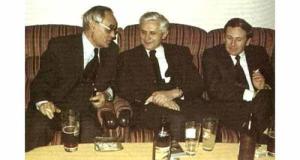
After long await, here are some excerpts from my essay on Benedict, the postmodern Pope:
For me, Benedict’s affect, style of thinking, and overall aesthetic was emblematic of Catholicism’s unique cultural vision. With his esteem for the arts, his affinity for engaging with intellectuals whom most would deem far from the Church’s tradition, and his campy flare, he was perhaps—despite his measured critiques of it—the pontiff most in tune with and capable of speaking to the postmodern tides that Western culture waded into. Far from being a philistine, intellectually arid, or a bigot, Benedict—more than his predecessor and successor—is par excellence the pope of the postmodern era.
…
Written off later in his career by the mainstream media as “God’s Rottweiler,” Joseph Ratzinger was widely considered a progressive during the Second Vatican Council because of his openness to engage with postmodernism. His 1968 tome, Introduction to Christianity, straddled the paradoxical line between theological traditionalism and the contemporary, anti-foundationalist air of doubt and skepticism, allowing him to dig into the foundations of Christian belief.
…
Benedict shared with skeptics, postmodernists, and existentialists the suspicion of the modern trust in the benevolence of the human will. He was ready to admit that humans are messy and the natural world unpredictable. His willingness to grapple with the darkness of existence has more in common with thinkers like Marquis de Sade and Sigmund Freud, Nietzsche, and Albert Camus—as much as his conclusions may have greatly differed from theirs—than with the likes of Jean-Jacques Rousseau and John Locke.
…
As literary critic Wayne C. Booth once observed, “postmodernist theories of the social self have not explicitly acknowledged the religious implications of what they are about. But if you read them closely, you will see that more and more of them are talking about the human mystery in terms that resemble those of the subtlest traditional theologies.”
Benedict’s theological legacy foreshadowed the recent “horseshoe” phenomenon that occurs when divergent forms of religious traditionalism and contemporary counterculture (almost) intersect. The conversion of “Red Scare” podcast host Dasha Nekrasova comes to mind. According to recent pieces in the New York Times and Vox, Catholicism’s artistic, spiritual, and liturgical tradition is drawing in bohemian, artsy types who typically are considered alien to the Church. As mainstream culture continues to head in a stiflingly bourgeois direction—between its unimaginative aesthetics, puritanical political correctness, and repetitive political deadlocks—so-called hipsters are finding that they have more in common with the Roman Catholic Church than they do with conventional progressivism.
Perhaps the most overlooked and misunderstood of Benedict’s “horseshoes” is between his comments on sexual morality and his surprising resonance with queer culture. During his lifetime, Benedict received vehement backlash for his decisive stance on the moral implications of same sex sexual relations and his blocking of men with “deep-seated homosexual inclinations” from the priesthood. In his infamous 1986 “Halloween Letter,” Ratzinger insisted that sodomy is an “intrinsically disordered” act. “To choose someone of the same sex for one’s sexual activity,” he wrote, “is to annul the rich symbolism and meaning, not to mention the goals, of the Creator’s sexual design. Unable “to transmit life,” sodomy is “essentially self-indulgent.”
…
Figures such as Wilde would likely (and ironically) have felt more at home, not with Francis, but with the theology and cultural sensibility of Benedict, whose affect—like Wilde’s—has an undeniably “campy” flavor. Camp, according to Susan Sontag, “is not a natural mode of sensibility, if there be any such. Indeed the essence of Camp is its love of the unnatural: of artifice and exaggeration.” That is why gay men like Wilde—caught perpetually between the “extremes” of supernatural chastity and unnatural debauchery—have been known to be drawn to camp.
In an essay on camp, literature scholar Fabio Cleto comments on how Benedict was “totally démodé, so alien to popular experience and the limelight as to retire from the throne in impenetrable, Garbo-like indifference, thereafter graciously considering his successor’s efforts from a distance. So viciously elegant, so unrelentingly medieval.” Benedict’s papacy, he says, made for an “ultra-camp story.” What with his flare for the baroque, his appreciation for aesthetic beauty and the arts, his taste for extravagant liturgical vestments and pageantry, his reputation for reading people’s logical fallacies and being outspoken without much concern for social conventions, his keen awareness of the tension between the finite and infinite, the sacred and profane, the natural and artificial, one might dare to call Benedict the real “gay-friendly” pope.
With a knack for stirring the pot, Benedict had little concern for sentimentality, refusing to pander to or appease the public’s sense of complacency. Take his letter on the resurgence of the Church sexual abuse scandal in 2018, which, while demonstrating humble respect and obedience to his successor, obliquely criticized those who deemed simplistic bureaucratic solutions would be enough to clean up the Church’s messes. Similarly, his “politically incorrect” comments about the reality (as much as it may have been expressed in an imprudent manner) of Islam’s history of violence was stated so glibly, as if to follow his caustic speech with the phrase “just saying…”
Benedict was the Christian equivalent of the Nietzschean Ubermensch. The antithesis to the bourgeois “last man,” he lived with gusto and a fervor for the finer things in life. He reveled in art, literature and music, and was a connoisseur of beer as well as indulging in the occasional Marlboro Red—unlike his party pooper-successor, who in 2017 banned the sale of tobacco in the Vatican as “the Holy See cannot contribute to an activity that clearly damages the health of people.”
Read the full essay at Hedgehog Review.
$upport CracksInPomo by choosing a paid subscription of this page, or by offering a donation through Anchor. Check out my podcast on Anchor and YouTube and follow me on Instagram and Twitter.
Religion News
Previous Post

January 2, 2023
2022 Wrap Up: The Best of Cracks in Pomo
Next Post

March 16, 2023 What exactly does one do with white people?
Recent Comments
"I have a friend who, having ancestry in the Nordic countries, identifies culturally more with ..."
"I can't think of a time in Western and Middle Eastern history in which religion ..."
The Sisters of Perpetual Indulgence and ..."
"As someone who indeed takes anti-Catholic discrimination in the US quite seriously, I take exception ..."
The Sisters of Perpetual Indulgence and ..."
"You've highlighted some of the differences between these two men, but even in the presence ..."
Why Ron DeSantis is Evil, and ..."
Browse Our Archives
Select a Category my mediterranean adventures Uncategorized
Select a Month July 2023 June 2023 May 2023 April 2023 March 2023 January 2023 November 2022 October 2022 September 2022 August 2022 May 2022 April 2022 March 2022 January 2022 December 2021 September 2021 April 2021 March 2021 February 2021 January 2021 December 2020 November 2020 October 2020 July 2020 June 2020 May 2020 April 2020 March 2020 February 2020 September 2019 August 2019 July 2019 June 2019 March 2019 January 2019 October 2018 August 2018 July 2018 June 2018 April 2018 March 2018 January 2018 December 2017 October 2017
Follow Us!
TAKE THE
Religious Wisdom Quiz
True or False: Peter raised Tabitha (Dorcas) from the dead in Lydda.
Select your answer to see how you score.
FALSE TRUE
Related posts from Cracks in Postmodernity


TRENDING AT PATHEOS Catholic

Rejecting Doom: Christian Hope And Human Action
Christianity is a religion of hope. We are to have hope and...

It’s What Comes From Within Which Matters
One of the most difficult things for us to understand is why...

Why I Choose the Eucharist Over the Sermon
Choose the Eucharist, Not the Sermon What are we supposed to get...

5 Design Elements Found in Spiritually Rooted Homes
Putting Spirituality Into Home Decor Our homes are more than our living...

Credo: A Story of God Told with the...
About 10 years ago, I began to imagine a personal "Credo" that...

The Anatomy of Divine Revelation in Catholic Thought
The claim that God has made Himself known to human beings is...
view all Catholic blogs
Ad-Free & Subscriber Log-In Subscription Support
- About Us
- 2026 Calendar
- Videos
- Podcasts
- Library of World Religions
- Faith In Media Tracker
- Advertise With Us
- Write for Us
- Privacy Policy
- Terms of Service
- Do Not Sell My Data
- Contact Us
- Radiant Digital
- Manage Newsletter Subscriptions
- Unsubscribe From Notifications
- Sitemap
Copyright 2008-2026, Patheos. All rights reserved.
Subscription Support Ad-Free & Subscriber Log-In
Follow Patheos