
BuddhistCatholicContemplativeEvangelicalGeneral ChristianHinduJewishLatter-day SaintMuslimNew VisionsProgressive Christian
Beliefs
- Buddhist
- Catholic
- Contemplative
- Evangelical
- General Christian
- Hindu
- Jewish
- Latter-day Saint
- More Voices
- Muslim
- New Visions
- Pagan
- Progressive Christian
Topics
- Religion News
- Food and Religion
- Sports and Religion
- Religious Art
- Religious Music and Entertainment
- Religious Events
- History and Religion
- Style and Religion
- Politics and Religion
- Women in Religion
- Recreation Outdoors and Religion
- Business Finance and Religion
- Careers Workplace and Religion
- Education and Religion
- Family Parenting and Religion
- Health Fitness and Religion
- Home and Religion
- Relationships and Religion
- Technology and Religion
- Travel and Religion
Columnists
- Buddhist Columnists
- Business Finance and Religion Columnists
- Careers Workplace and Religion Columnists
- Catholic Columnists
- Contemplative Columnists
- Education and Religion Columnists
- Evangelists Columnists
- Family Parenting and Religion Columnists
- General Christian Columnists
- Health Fitness and Religion Columnists
- Hindu Columnists
- History and Religion Columnists
- Home and Religion Columnists
- Jewish Columnists
- More Voices Columnists
- Latter Day Columnists
- Muslim Columnists
- New Visions Columnists
- Nonreligious Columnists
- Pagan Columnists
- Politics and Religion Columnists
- Progressive Columnists
- Recreation Outdoors and Religion Columnists
- Relationships and Religion Columnists
- Religion News Columnists
- Religious Art Columnists
- Religious Events Columnists
- Religious Music and Entertainment Columnists
- Sports and Religion Columnists
- Style and Religion Columnists
- Technology and Religion Columnists
- Travel and Religion Columnists
- Women in Religion Columnists
Resource Library
- 2026 Calendar
- Library of World Religions
- The 100 Most Holy Places on Earth
- Patheos Answers
- Podcasts
- Videos
- Faith Leaders Database
- Anglican Episcopalian
- Bahai
- Baptist
- Buddhism
- Christianity
- Confucianism
- Eastern Orthodoxy
- Hinduism
- Holiness and Pentecostal
- ISKCON
- Islam
- Judaism
- Lutheran
- Methodist
- The Church of Jesus Christ of Latter-day Saints
- New Age
- Paganism
- Presbytarian and Reformed
- Protestantism
- Religion Behind the Scenes
- Roman Catholic
- Scientology
- Shia Islam
- Sikhism
- Sufism
- Sunni Islam
- Taoism
- Zen
- See all religions
Research Tools
 Ad-Free & Subscriber Log-In Subscription Support
Ad-Free & Subscriber Log-In Subscription Support
Follow Patheos 

- Trending:
- Forgiveness
- |
- Marriage
- |
- Consciousness
- |
- Death Penalty
- |
- Election
- |
- Halloween
 Cracks in Postmodernity
- Home
- Catholic
- Reading into Reggaeton: Bad Bunny, Rauw Alejandro, Jowell y Randy
Reading into Reggaeton: Bad Bunny, Rauw Alejandro, Jowell y Randy
Last updated on: January 6, 2022 at 12:57 am by Stephen G. Adubato
Reading into Reggaeton: Bad Bunny, Rauw Alejandro, Jowell y Randy 2022-01-06T00:57:27+00:00 Stephen G. Adubato
Patheos Explore the world's faith through different perspectives on religion and spirituality! Patheos has the views of the prevalent religions and spiritualities of the world.
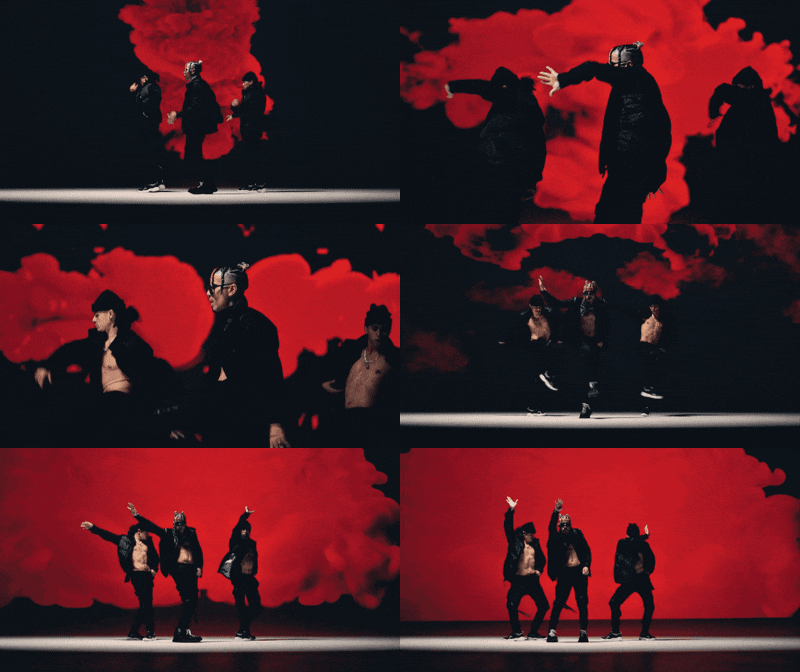
“Safaera,” Bad Bunny ft. Jowell y Randy and Nengo Flow
The intro to Bad Bunny’s “Safaera” is a sonic amalgam trudging from out of the chthonian…the dark, swamp-like underworld.
It speaks to the unpredictable Dionysian elements of human nature–what paganism celebrates, and what monotheism subjugates to the design of Natural Law and integrates into the pursuit of unity with the Creator.
Jowell y Randy groan out lyrics, as if dragging their bodies through an orgiastic swamp of bodies, where it’s not gravity but their instinctive desires that drag them down, and entraps them.
The song devolves into an absurdist, out-of-this world sexual fantasy…a most inhumane sexual encounter.
It draws out the animal nature in man which is the stuff of pagan earth and fertility cult. Sampling from Pliers and Chaka Demus’ “Santa Barbara,” an illusion to the Yoruba goddess Shango, the femme fatale who lures man in and destroys him,
they sing: “que falta de respeto, mami”…”how disrespectful, that you would dare to come here without panties.”
Bad Bunny declares ironically that tonight is a night of drinking, smoking weed, and spending–if God permits it, knowing full well that he has not intention of submitting his base inclination to the will of the Creator tonight, and proceeds to tell the girl to grab his genitals like a bong.
“Reloj,” Rauw Alejandro fr. Annuel AA
“Baby I would like to eat you all day long, what I would do to you if the clock gave us more time. Baby you’re mine…all the things I’d do to you, if the clock gave us more time.”
Rauw Alejandro speaks to the deep-seated yearning for total consummation with Being itself…for an experience of unity that reaches to eternity.
But in a neoliberal late-phase capitalist society, where eternity has been banished from our horizon of consciousness, we are left to accumulate an infinite amount of finite moments of pleasure. The yearning for a consummation with the eternal is reduced to perpetual consumption.
We aim in vain to resist the boundaries of time and space, asking for the finitude of our existence to transcend its boundaries and lead us to something lasting, but to no avail.
We must thus eat the object of our desire into oblivion, to the point that we forget the existential dread that this moment of pleasure is finite.
“Se Acabo la Cuarentena,” Jowell y Randy ft. Kiko el Crazy
“Se acabó la cuarentena, el cuerpo lo sabe, la calle está llena. The quarantine has ended, the body knows it and the street is full.”
Bourgeois suburban elites have no problem being cooped up in the house by their lonesome. Their disconnect from ethnic bonds, familial ties, and tradition has left them desensitized to atomization.
Thus why the “front row” coastal college educated elites had little difficulty quarantining themselves at the start of the pandemic, contrary to the experience of “back row America,” which consists of mostly ethnic and working class people.
Bourgeois comfort and complacency, total control and predictability, are the name of the game. They have no problem sacrificing basic human needs for the sake of not getting coronavirus.
This atomized norm represents the ultimate trajectory of the cartesian dualism between mind and body. The song represents the connection between mind and body for the back row, people with cultural and spiritual depth.
Music journalist GG Albuquerque indicates that Descartes’ separation between the mind and body privileged those whose pursuit of truth manifested intellectually, deeming more “rational” or “human” than those who engaged in manual labor or whose pursuit of truth was more embodied than purely rational. He cites the afroperspectivist philosophy of Renato Noguera, which aims to “decolonize” the body and relegitimize its ability to speak spiritual truths, thus creating what Albuquerque calls an “incorporated” or incarnational philosophy. This point of view “goes in the opposite direction of the [Western] philosophical tradition and its devaluation of the body, presenting the idea of the body as the mortal room of an immortal soul.”
He goes on to cite the writer Kyra Gaunt who highlights how the African drumming patterns used in funk demonstrates the body’s ability to speak truth: ”the body is a technology of black musical communication and identity…The social body as a tool or method of artistic composition and performance, however, continues to be overlooked in the study of music, just as the black vernacular body continues to be overlooked in dance history. Drums or any other forms of musical ‘technology’ are but extensions of things the body and voice can do. The striking of body parts and cavities, the resonating of the singing voice, and use of verbal and nonverbal language, manufactured codes, identifications, and ideas about music and life through the ‘systematic’ (re)production of an embodied phenomenology.”
“El cuerpo lo pide, la calle está llena.” The body knows it, the body asks for it. Now the street is full. The body speaks of the need for communion, for dynamic motion, for meaning…a desire which the front row is intent on silencing, subjugating to the demands of risk-free predictability and complacency.
Previous Post

January 3, 2022
Gyms: Temples of Neoliberal Atomization
Next Post

January 29, 2022 The Weeknd's Soulless R&B
Browse Our Archives
Select a Category my mediterranean adventures Uncategorized
Select a Month July 2023 June 2023 May 2023 April 2023 March 2023 January 2023 November 2022 October 2022 September 2022 August 2022 May 2022 April 2022 March 2022 January 2022 December 2021 September 2021 April 2021 March 2021 February 2021 January 2021 December 2020 November 2020 October 2020 July 2020 June 2020 May 2020 April 2020 March 2020 February 2020 September 2019 August 2019 July 2019 June 2019 March 2019 January 2019 October 2018 August 2018 July 2018 June 2018 April 2018 March 2018 January 2018 December 2017 October 2017
Follow Us!
TAKE THE
Religious Wisdom Quiz
On which sea did Jesus calm a storm and walk on water?
Select your answer to see how you score.
Dead Sea Sea of Galilee Red Sea Aegean Sea
Related posts from Cracks in Postmodernity

Bad Bunny’s Big Gay Kiss: The Banality of...
"Latinas Don't Twerk": Ivy Queen's loaded comments on...

Singing with a Childlike Heart: Ozuna's Odyssey

Healing from Addiction, Family Wounds in Nicky Jam's...
TRENDING AT PATHEOS Catholic

Creation, Preservation, and Teleology in Catholic Theology
As I write this, it is very early Monday morning. Like millions...

The Parable Of The Sower And The Word...
One of Christ’s most famous parables is that of the sower who...

Rejecting Doom: Christian Hope And Human Action
Christianity is a religion of hope. We are to have hope and...

Why I Choose the Eucharist Over the Sermon
Choose the Eucharist, Not the Sermon What are we supposed to get...

5 Design Elements Found in Spiritually Rooted Homes
Putting Spirituality Into Home Decor Our homes are more than our living...

Credo: A Story of God Told with the...
About 10 years ago, I began to imagine a personal "Credo" that...
view all Catholic blogs
Ad-Free & Subscriber Log-In Subscription Support
- About Us
- 2026 Calendar
- Videos
- Podcasts
- Library of World Religions
- Faith In Media Tracker
- Advertise With Us
- Write for Us
- Privacy Policy
- Terms of Service
- Do Not Sell My Data
- Contact Us
- Radiant Digital
- Manage Newsletter Subscriptions
- Unsubscribe From Notifications
- Sitemap
Copyright 2008-2026, Patheos. All rights reserved.
Subscription Support Ad-Free & Subscriber Log-In
Follow Patheos