
BuddhistCatholicContemplativeEvangelicalGeneral ChristianHinduJewishLatter-day SaintMuslimNew VisionsProgressive Christian
Beliefs
- Buddhist
- Catholic
- Contemplative
- Evangelical
- General Christian
- Hindu
- Jewish
- Latter-day Saint
- More Voices
- Muslim
- New Visions
- Pagan
- Progressive Christian
Topics
- Religion News
- Food and Religion
- Sports and Religion
- Religious Art
- Religious Music and Entertainment
- Religious Events
- History and Religion
- Style and Religion
- Politics and Religion
- Women in Religion
- Recreation Outdoors and Religion
- Business Finance and Religion
- Careers Workplace and Religion
- Education and Religion
- Family Parenting and Religion
- Health Fitness and Religion
- Home and Religion
- Relationships and Religion
- Technology and Religion
- Travel and Religion
Columnists
- Buddhist Columnists
- Business Finance and Religion Columnists
- Careers Workplace and Religion Columnists
- Catholic Columnists
- Contemplative Columnists
- Education and Religion Columnists
- Evangelists Columnists
- Family Parenting and Religion Columnists
- General Christian Columnists
- Health Fitness and Religion Columnists
- Hindu Columnists
- History and Religion Columnists
- Home and Religion Columnists
- Jewish Columnists
- More Voices Columnists
- Latter Day Columnists
- Muslim Columnists
- New Visions Columnists
- Nonreligious Columnists
- Pagan Columnists
- Politics and Religion Columnists
- Progressive Columnists
- Recreation Outdoors and Religion Columnists
- Relationships and Religion Columnists
- Religion News Columnists
- Religious Art Columnists
- Religious Events Columnists
- Religious Music and Entertainment Columnists
- Sports and Religion Columnists
- Style and Religion Columnists
- Technology and Religion Columnists
- Travel and Religion Columnists
- Women in Religion Columnists
Resource Library
- 2026 Calendar
- Library of World Religions
- The 100 Most Holy Places on Earth
- Patheos Answers
- Podcasts
- Videos
- Faith Leaders Database
- Anglican Episcopalian
- Bahai
- Baptist
- Buddhism
- Christianity
- Confucianism
- Eastern Orthodoxy
- Hinduism
- Holiness and Pentecostal
- ISKCON
- Islam
- Judaism
- Lutheran
- Methodist
- The Church of Jesus Christ of Latter-day Saints
- New Age
- Paganism
- Presbytarian and Reformed
- Protestantism
- Religion Behind the Scenes
- Roman Catholic
- Scientology
- Shia Islam
- Sikhism
- Sufism
- Sunni Islam
- Taoism
- Zen
- See all religions
Research Tools
 Ad-Free & Subscriber Log-In Subscription Support
Ad-Free & Subscriber Log-In Subscription Support
Follow Patheos 

- Trending:
- Forgiveness
- |
- Marriage
- |
- Consciousness
- |
- Death Penalty
- |
- Election
- |
- Halloween
 Cracks in Postmodernity
- Home
- Catholic
- Viva San Rocco!: Living Social Distance with the Saints
Viva San Rocco!: Living Social Distance with the Saints
Last updated on: April 17, 2020 at 3:52 am by Guest Contributor
Viva San Rocco!: Living Social Distance with the Saints 2020-04-17T03:52:48+00:00 Guest Contributor
Patheos Explore the world's faith through different perspectives on religion and spirituality! Patheos has the views of the prevalent religions and spiritualities of the world.
By Guest Contributor Ian Schaefer
It was a steamy August day in New York when I first saw the statue of St. Rocco. The rain fell in a hazy mist that soaked through everything and added to the mystical feel of the encounter. The statue was wrapped in plastic to protect him from the rain. Around his shoulders was draped a red ribbon with dozens of twenty-dollar bills pinned to it. I was probably fourteen- or fifteen-years-old at the time and had never seen anything like a procession before. My small-city American experience of Catholicism was not much different from other Christian denominations. I was profoundly struck by the dramatic devotion of these middle-aged men swaying achingly under the weight of an ancient statue.
In the years since, I have attended the St. Rocco festival almost annually, have become a member of the St. Rocco Society, and have images of the saint with his injured leg and his faithful dog throughout my home. I regularly ask for his intercession. I’m even sipping tea from a mug with “Viva San Rocco!” printed on it as I write this article. This encounter with a statue and the people who carry it shaped my spiritual development and brought me closer to the Church.
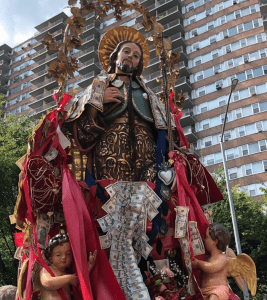
St. Rocco has been making more rounds on my social media timeline than usual in these days. As one of the patron saints of infectious diseases, I’ve seen everything from calls to resume processions (once the pandemic passes, of course) to anime-like comic books of St. Rocco’s life since the Coronavirus pandemic began its horrible spread. In a way, images of the saint have been making a sort of digital procession around the internet.

Tradition says that St. Rocco, born in France, was moved to make a pilgrimage to Rome during the plague of the fourteenth century. People suffering from the plague were miraculously cured by St. Rocco wherever he stopped along the way, until eventually he fell ill with the plague himself at Piacenza and was banished. He found shelter in a cave (self-isolation?), where a nobleman’s dog brought him scraps from his owner’s castle. Eventually, the nobleman found the suffering saint and brought him back to the castle to care for him. The plague left St. Rocco unrecognizable, so much so that he was jailed by his own uncle upon his return to France as a spy. Hagiographies differ as to how the truth of his identity became known – some involving angelic messages or miraculous birthmarks – but he quickly became a popular saint invoked against the plague, cholera, and other infectious diseases.
Today, we face a new infectious disease, one that humanity has never seen before and that we have been found unprepared to face. In an age when many find solace in the hope of technology’s capacity to save us, we resort to the same kind of preventative measures that humanity has relied on for hundreds of years: isolation, simple face masks, and most importantly, the love and generosity of others.
Among these “others” are the saints, especially those who our ancestors trusted to accompany them through times of epidemic. The people of Palermo have proposed parading the relics of St. Rosalia through their now-empty streets as was done four centuries ago. The Holy Father Pope Francis brought a crucifix that is credited with miraculously sparing Rome from a plague into homes across the globe during his outstanding Urbi et Orbi blessing. Does this turn to medieval spirituality – or “superstition,” as some might say – represent a sort of last resort desperation?
In a way, yes. In this territory that is unfamiliar to most of us, we are left bare in the face of our own fragility and filled with dread. Some desire to ignore this reality by hiding behind their youth, their belief that they understand the virus more than experts do, or even their faith (as seen in some churches that are still holding services and assuring congregants that God will protect them). But as the crisis becomes increasingly personal, the reality of our fragility will become undeniable.
Social isolation only further complicates this reality. In a time when Ways of the Cross normally fill streets and extended families fill dining rooms, we are confronted with a deafening emptiness. The inside of churches are only seen on livestreams. We must rely on our knowledge that the Church is the mystical Body of Christ, in which the saints also participate. We can ask saints to pray for us as we would ask friends and family, but why patron saints specifically?
St. Rocco suffered himself from an infectious disease. It damaged his body to the point that he was unrecognizable even to his own uncle. He knows the particular fear, the particular pain, and the particular hope in Christ that only someone who has had the concrete experience of such a horrible contagious disease. He understands the pain that we are going through as a society, having seen something similar himself first hand so many generations ago. He is able to relate to those suffering from the virus, those who fear the virus, and those who are fighting it. He prays for us in a deep and significant way, knowing from his experience our own needs, anxieties, and hopes.
This is the great value of having “patron saints.” The Church is universal and has spanned centuries. Her saints have come from every place and every people, and have experienced the deepest desolation and the highest ecstasy. They have been kings and beggars. There is someone who understands what you are going through in heaven because someone has gone through the same thing before. Trust in the prayers of the patron saint to lay your concerns at the feet of Christ.
Previous Post

April 7, 2020
Teaching in the Midst of Crisis
Next Post

May 19, 2020 Friendship that Surpasses Death: In Memory of Aris Aroutiounian
Browse Our Archives
Select a Category my mediterranean adventures Uncategorized
Select a Month July 2023 June 2023 May 2023 April 2023 March 2023 January 2023 November 2022 October 2022 September 2022 August 2022 May 2022 April 2022 March 2022 January 2022 December 2021 September 2021 April 2021 March 2021 February 2021 January 2021 December 2020 November 2020 October 2020 July 2020 June 2020 May 2020 April 2020 March 2020 February 2020 September 2019 August 2019 July 2019 June 2019 March 2019 January 2019 October 2018 August 2018 July 2018 June 2018 April 2018 March 2018 January 2018 December 2017 October 2017
Follow Us!
TAKE THE
Religious Wisdom Quiz
True or False: The feast of Purim commemorates the Jewish people's deliverance from Haman's plot.
Select your answer to see how you score.
TRUE FALSE
Related posts from Cracks in Postmodernity
Sperging the Mass(es): more notes on neurodivergence and...
Notes on Trads: the latest in the trad...
Ok or not ok, that is (not) the...
Confronting Suicide and Mental Health during COVID
TRENDING AT PATHEOS Catholic

Rejecting Doom: Christian Hope And Human Action
Christianity is a religion of hope. We are to have hope and...

It’s What Comes From Within Which Matters
One of the most difficult things for us to understand is why...

Why I Choose the Eucharist Over the Sermon
Choose the Eucharist, Not the Sermon What are we supposed to get...

5 Design Elements Found in Spiritually Rooted Homes
Putting Spirituality Into Home Decor Our homes are more than our living...

Credo: A Story of God Told with the...
About 10 years ago, I began to imagine a personal "Credo" that...

The Anatomy of Divine Revelation in Catholic Thought
The claim that God has made Himself known to human beings is...
view all Catholic blogs
Ad-Free & Subscriber Log-In Subscription Support
- About Us
- 2026 Calendar
- Videos
- Podcasts
- Library of World Religions
- Faith In Media Tracker
- Advertise With Us
- Write for Us
- Privacy Policy
- Terms of Service
- Do Not Sell My Data
- Contact Us
- Radiant Digital
- Manage Newsletter Subscriptions
- Unsubscribe From Notifications
- Sitemap
Copyright 2008-2026, Patheos. All rights reserved.
Subscription Support Ad-Free & Subscriber Log-In
Follow Patheos