
BuddhistCatholicContemplativeEvangelicalGeneral ChristianHinduJewishLatter-day SaintMuslimNew VisionsProgressive Christian
Beliefs
- Buddhist
- Catholic
- Contemplative
- Evangelical
- General Christian
- Hindu
- Jewish
- Latter-day Saint
- More Voices
- Muslim
- New Visions
- Pagan
- Progressive Christian
Topics
- Religion News
- Food and Religion
- Sports and Religion
- Religious Art
- Religious Music and Entertainment
- Religious Events
- History and Religion
- Style and Religion
- Politics and Religion
- Women in Religion
- Recreation Outdoors and Religion
- Business Finance and Religion
- Careers Workplace and Religion
- Education and Religion
- Family Parenting and Religion
- Health Fitness and Religion
- Home and Religion
- Relationships and Religion
- Technology and Religion
- Travel and Religion
Columnists
- Buddhist Columnists
- Business Finance and Religion Columnists
- Careers Workplace and Religion Columnists
- Catholic Columnists
- Contemplative Columnists
- Education and Religion Columnists
- Evangelists Columnists
- Family Parenting and Religion Columnists
- General Christian Columnists
- Health Fitness and Religion Columnists
- Hindu Columnists
- History and Religion Columnists
- Home and Religion Columnists
- Jewish Columnists
- More Voices Columnists
- Latter Day Columnists
- Muslim Columnists
- New Visions Columnists
- Nonreligious Columnists
- Pagan Columnists
- Politics and Religion Columnists
- Progressive Columnists
- Recreation Outdoors and Religion Columnists
- Relationships and Religion Columnists
- Religion News Columnists
- Religious Art Columnists
- Religious Events Columnists
- Religious Music and Entertainment Columnists
- Sports and Religion Columnists
- Style and Religion Columnists
- Technology and Religion Columnists
- Travel and Religion Columnists
- Women in Religion Columnists
Resource Library
- 2026 Calendar
- Library of World Religions
- The 100 Most Holy Places on Earth
- Patheos Answers
- Podcasts
- Videos
- Faith Leaders Database
- Anglican Episcopalian
- Bahai
- Baptist
- Buddhism
- Christianity
- Confucianism
- Eastern Orthodoxy
- Hinduism
- Holiness and Pentecostal
- ISKCON
- Islam
- Judaism
- Lutheran
- Methodist
- The Church of Jesus Christ of Latter-day Saints
- New Age
- Paganism
- Presbytarian and Reformed
- Protestantism
- Religion Behind the Scenes
- Roman Catholic
- Scientology
- Shia Islam
- Sikhism
- Sufism
- Sunni Islam
- Taoism
- Zen
- See all religions
Research Tools
 Ad-Free & Subscriber Log-In Subscription Support
Ad-Free & Subscriber Log-In Subscription Support
Follow Patheos 

- Trending:
- Forgiveness
- |
- Marriage
- |
- Consciousness
- |
- Death Penalty
- |
- Election
- |
- Halloween
 Cracks in Postmodernity
- Home
- Catholic
- “Touch my body, bro”: Sex, Death, and the Male Body
“Touch my body, bro”: Sex, Death, and the Male Body
Last updated on: August 6, 2018 at 1:33 am by Stephen G. Adubato
“Touch my body, bro”: Sex, Death, and the Male Body 2018-08-06T01:33:46+00:00 Stephen G. Adubato
Patheos Explore the world's faith through different perspectives on religion and spirituality! Patheos has the views of the prevalent religions and spiritualities of the world.
This is the third article in a series entitled “My Mediterranean Adventures”

I spent my first morning in Milan walking around the Cimitero Monumentale. Known for its elaborate headstones and mausolea, the Monumentale is the resting place of several well-known Milanesi and is frequented by locals and tourists. The juxtaposition of the morbid-yet-artistic ethos of the cemetery against the quickly modernizing city opened my eyes to some new postmodern *cracks*.

Among the most ornate of the headstones are dramatic sculptures of people in mourning. I was struck in particular by the statues that depicted scantily dressed figures. I’d guess that even the most liberated of Americans would get uncomfortable seeing a topless woman sitting upon the grave of a loved one. While Americans claim to be very open about sex and the human body, we seem to have a hard time recognizing their undeniable connection to death.

Our understanding of sexuality is informed by the consumerist mentality that our capitalistic culture has engendered, and the immanentistic worldview that underpins it all. It shouldn’t be surprising to Americans that our formerly Puritanical culture gave way to a consumer-capitalist one. Once the transcendent was divorced from the physical realm, it wasn’t long until belief in transcendence disappeared altogether. Now, sex is about feeling good and expressing yourself. Don’t think about the deeper and long term implications of entering into a sexual relationship, just have fun! And use protection.

Having been immersed in a sacramental worldview for several centuries, the interconnectedness of sexuality, death, and transcendent meaning is more apparent to Italians. Perhaps this is why it’s not so scandalous for them to see a nude body sitting on nonna’s grave.
I couldn’t help but reflect more specifically about the implications of these differing worldviews for the ways male beauty and sexuality are portrayed. In one of the most prominent sections of the cemetery were two nude men, posing pensively upon adjacent tombs.

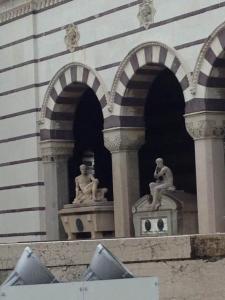
“That’s so gay,” would have been the reaction of most of my students upon seeing those two nude statues beside each other.
“That’s so unimaginative,” I would likely have responded. The idea that homoeroticism constitutes an expression of sexual love analogous to that of heterosexuality is unique to a post-puritanical, post-Enlightenment, immanentistic worldview.
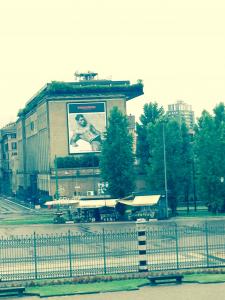
Across the way was a billboard for DSQUARED2 men’s underwear, with an underwear-clad model spreading his legs open for the viewers/consumers to gaze upon. In this moment, I was reminded how quickly that same immanentistic worldview of my own upbringing has been making its way across the Atlantic.
In a sacramental view, love between men was indeed valued and exalted, but as something totally distinct from opposite sex conjugal relations. Jesus, the God-man and origin of the sacraments, reveals himself as the divine Bridegroom…to both his female and male followers, who together make up his Bride, the Church. Christ’s nearly nude body, which is commemorated today on crucifixes around the world, presents itself to its Bride as her greatest object of affection.

Christian men (especially monks) throughout history have employed various channels to express their devotion to the body of their divine Spouse. Some examples that might shake the sensibilities of us postmoderns include John the Apostle, Bernard of Clairvaux, and John of the Cross, who demonstrated their affection to Christ through allusions to bodily gestures and embraces.

In those men’s respective cultures, bodily gestures of love for another man were not considered to be sexual. Sex happened in the context of marriage, where a man and a woman committed their lives to each other—to the point of death. The ethos of Christian marriage is centered upon the image of the Cross-in which two distinct and complementary elements unite themselves to each other in love, in a bodily way, pouring out their very beings for the sake of the other, and being open to the new life that is born of their union.
In a sacramental culture, same sex love and even sodomy itself were not considered “sexual” because of the type of “matter” involved in the exchange. The body—matter, played a role in giving meaning to the form—to the expression of love. The sacramental understanding of the relationship between form and matter is radically different from how Americans perceive the relationship between love, sex, and bodies. This is why what Americans call love is less explicitly connected to bodily self-gift and bearing fruit, and tends more toward an emotivist-capitalist ideal of gratification and acquiring of “goods” (ie “getting me some d*ck/p*ssy”).

“Add to Cart?”
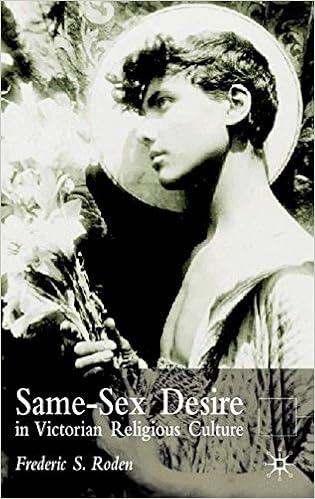
As I passed through the cemetery, I thought back to a book I read several summers ago about the way people with same sex attractions navigated the culture of Victorian England. The author (and my friend) Fred Roden asserts that Victorian queers flocked to the Catholic and Anglo-Catholic Churches because their sacramental worldview consisted of cultural and vocational spaces that were much more hospitable to queers/sexual deviants than were those offered in the lower church denominations. The valorization of flesh, art, and celibacy (itself a “queer” expression of sexuality to low-church Protestants) made the higher Churches a haven for those who experience SSA.
As I looked at that nearly nude model, I thought about everything he represents: a supreme reduction of what his body once signified. Intimacy has been reduced to consumption. The body has been reduced to a mechanism for gratification as well as an incentive to spend one’s money. And public spaces are reduced to room for advertising. Out go transcendence, sacrifice, nuance, and gratuitous spaces of beauty. The nude male is now the subject of consumption, whether by the mega corporation or by the homosexual groom.
As Italians attempts to shake off their sacramental heritage, I wonder if they’ll recognize the rich and comprehensive expressions of intimacy that their “archaic” tradition afforded them. If not, at least they’ll have good-looking underwear models to distract them from the flattening out of their culture.


Browse Our Archives
Select a Category my mediterranean adventures Uncategorized
Select a Month July 2023 June 2023 May 2023 April 2023 March 2023 January 2023 November 2022 October 2022 September 2022 August 2022 May 2022 April 2022 March 2022 January 2022 December 2021 September 2021 April 2021 March 2021 February 2021 January 2021 December 2020 November 2020 October 2020 July 2020 June 2020 May 2020 April 2020 March 2020 February 2020 September 2019 August 2019 July 2019 June 2019 March 2019 January 2019 October 2018 August 2018 July 2018 June 2018 April 2018 March 2018 January 2018 December 2017 October 2017
Follow Us!
TAKE THE
Religious Wisdom Quiz
What book of the Bible tells about Jesus’ birth?
Select your answer to see how you score.
Hebrews Luke Acts Revelation
Related posts from Cracks in Postmodernity

Quentin Crisp's Mystical Desire for the "Great Dark...
Divine Eroticism: Medieval Readings of the Song of...

Gender Theory and the Vatican: 1 Year Later

Friendship that Surpasses Death: In Memory of Aris...
TRENDING AT PATHEOS Catholic

Rejecting Doom: Christian Hope And Human Action
Christianity is a religion of hope. We are to have hope and...

It’s What Comes From Within Which Matters
One of the most difficult things for us to understand is why...

Why I Choose the Eucharist Over the Sermon
Choose the Eucharist, Not the Sermon What are we supposed to get...

5 Design Elements Found in Spiritually Rooted Homes
Putting Spirituality Into Home Decor Our homes are more than our living...

Credo: A Story of God Told with the...
About 10 years ago, I began to imagine a personal "Credo" that...

The Anatomy of Divine Revelation in Catholic Thought
The claim that God has made Himself known to human beings is...
view all Catholic blogs
Ad-Free & Subscriber Log-In Subscription Support
- About Us
- 2026 Calendar
- Videos
- Podcasts
- Library of World Religions
- Faith In Media Tracker
- Advertise With Us
- Write for Us
- Privacy Policy
- Terms of Service
- Do Not Sell My Data
- Contact Us
- Radiant Digital
- Manage Newsletter Subscriptions
- Unsubscribe From Notifications
- Sitemap
Copyright 2008-2026, Patheos. All rights reserved.
Subscription Support Ad-Free & Subscriber Log-In
Follow Patheos