
BuddhistCatholicContemplativeEvangelicalGeneral ChristianHinduJewishLatter-day SaintMuslimNew VisionsProgressive Christian
Beliefs
- Buddhist
- Catholic
- Contemplative
- Evangelical
- General Christian
- Hindu
- Jewish
- Latter-day Saint
- More Voices
- Muslim
- New Visions
- Pagan
- Progressive Christian
Topics
- Religion News
- Food and Religion
- Sports and Religion
- Religious Art
- Religious Music and Entertainment
- Religious Events
- History and Religion
- Style and Religion
- Politics and Religion
- Women in Religion
- Recreation Outdoors and Religion
- Business Finance and Religion
- Careers Workplace and Religion
- Education and Religion
- Family Parenting and Religion
- Health Fitness and Religion
- Home and Religion
- Relationships and Religion
- Technology and Religion
- Travel and Religion
Columnists
- Buddhist Columnists
- Business Finance and Religion Columnists
- Careers Workplace and Religion Columnists
- Catholic Columnists
- Contemplative Columnists
- Education and Religion Columnists
- Evangelists Columnists
- Family Parenting and Religion Columnists
- General Christian Columnists
- Health Fitness and Religion Columnists
- Hindu Columnists
- History and Religion Columnists
- Home and Religion Columnists
- Jewish Columnists
- More Voices Columnists
- Latter Day Columnists
- Muslim Columnists
- New Visions Columnists
- Nonreligious Columnists
- Pagan Columnists
- Politics and Religion Columnists
- Progressive Columnists
- Recreation Outdoors and Religion Columnists
- Relationships and Religion Columnists
- Religion News Columnists
- Religious Art Columnists
- Religious Events Columnists
- Religious Music and Entertainment Columnists
- Sports and Religion Columnists
- Style and Religion Columnists
- Technology and Religion Columnists
- Travel and Religion Columnists
- Women in Religion Columnists
Resource Library
- 2026 Calendar
- Library of World Religions
- The 100 Most Holy Places on Earth
- Patheos Answers
- Podcasts
- Videos
- Faith Leaders Database
- Anglican Episcopalian
- Bahai
- Baptist
- Buddhism
- Christianity
- Confucianism
- Eastern Orthodoxy
- Hinduism
- Holiness and Pentecostal
- ISKCON
- Islam
- Judaism
- Lutheran
- Methodist
- The Church of Jesus Christ of Latter-day Saints
- New Age
- Paganism
- Presbytarian and Reformed
- Protestantism
- Religion Behind the Scenes
- Roman Catholic
- Scientology
- Shia Islam
- Sikhism
- Sufism
- Sunni Islam
- Taoism
- Zen
- See all religions
Research Tools
 Ad-Free & Subscriber Log-In Subscription Support
Ad-Free & Subscriber Log-In Subscription Support
Follow Patheos 

- Trending:
- Forgiveness
- |
- Marriage
- |
- Consciousness
- |
- Death Penalty
- |
- Election
- |
- Halloween
 Cosmos The In Lost
- Home
- Catholic
- Pope Francis Quashes “Who am I to judge?” Speculation in Amoris Laetitia
Pope Francis Quashes “Who am I to judge?” Speculation in Amoris Laetitia
Last updated on: April 11, 2016 at 5:47 am by Artur Rosman
Pope Francis Quashes “Who am I to judge?” Speculation in Amoris Laetitia 2016-04-11T00:20:30-07:00 Artur Rosman
Patheos Explore the world's faith through different perspectives on religion and spirituality! Patheos has the views of the prevalent religions and spiritualities of the world.
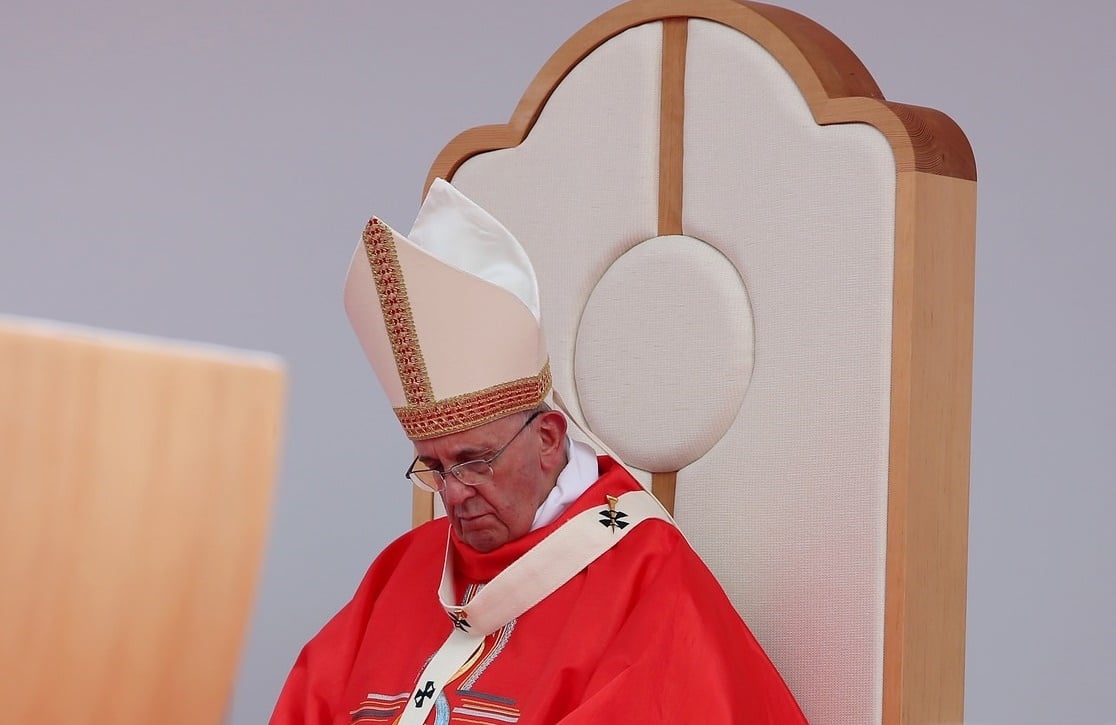
Pope Francis, man of hermeneutical sorrows (Source: Flickr, Republic of Korea, 2014 Pastoral Visit of Pope Francis to Korea, CC by 2.0).
The truncated statement, “Who am I to judge?,” caused a lot of consternation among certain kinds of Catholics. Some of them saw it as the prelude to a Church blessing of same-sex marriage. Others thought it was the prelude to the utter decline of Church into zeitgeist affirming irrelevance. Few read the statement in context. Let’s dive into it despite the fact that, as T.S. Eliot put it in The Four Quartets, “human kind / Cannot bear very much reality.”
Amoris Laetitia lays out the Church’s teaching clearly on same-sex unions:
In discussing the dignity and mission of the family, the Synod Fathers observed that, “as for proposals to place unions between homosexual persons on the same level as marriage, there are absolutely no grounds for considering homosexual unions to be in any way similar or even remotely analogous to God’s plan for marriage and family”. It is unacceptable “that local Churches should be subjected to pressure in this matter and that international bodies should make financial aid to poor countries dependent on the introduction of laws to establish ‘marriage’ between persons of the same sex.”
This comes as no surprise since in his recently released book-long interview, The Name of God is Mercy, Pope Francis already clarified how the “Who am I to judge?” statement was not a departure from traditional Catholic teaching:
On that occasion I said this: If a person is gay and seeks out the Lord and is willing, who am I to judge that person? I was paraphrasing by heart the Catechism of the Catholic Church where it says that these people should be treated with delicacy and not be marginalized.
I am glad that we are talking about ‘homosexual people’ because before all else comes the individual person, in his wholeness and dignity. And people should not be defined only by their sexual tendencies: let us not forget that God loves all his creatures and we are destined to receive his infinite love. I prefer that homosexuals come to confession, that they stay close to the Lord, and that we pray all together. You can advise them to pray, show goodwill, show them the way, and accompany them along it.
Here is the passage from the Catechism of the Catholic Church (#25338) paraphrased by the pope and also footnoted in the passage from Amoris Laetitia I quoted above:
The number of men and women who have deep-seated homosexual tendencies is not negligible. This inclination, which is objectively disordered, constitutes for most of them a trial. They must be accepted with respect, compassion, and sensitivity. Every sign of unjust discrimination in their regard should be avoided. These persons are called to fulfill God’s will in their lives and, if they are Christians, to unite to the sacrifice of the Lord’s Cross the difficulties they may encounter from their condition.
Finally, for those who are still doubtful, going on what they’ve read in the press, here is the full context of the “Who am I to judge statement?” from the press conference on a flight from Rio to Rome:
Ilze Scamparini
I would like permission to ask a delicate question: another image that has been going around the world is that of Monsignor Ricca and the news about his private life. I would like to know, Your Holiness, what you intend to do about this? How are you confronting this issue and how does Your Holiness intend to confront the whole question of the gay lobby?
Pope Francis
About Monsignor Ricca: I did what canon law calls for, that is a preliminary investigation. And from this investigation, there was nothing of what had been alleged. We did not find anything of that. This is the response. But I wish to add something else: I see that many times in the Church, over and above this case, but including this case, people search for “sins from youth”, for example, and then publish them. They are not crimes, right? Crimes are something different: the abuse of minors is a crime. No, sins. But if a person, whether it be a lay person, a priest or a religious sister, commits a sin and then converts, the Lord forgives, and when the Lord forgives, the Lord forgets and this is very important for our lives. When we confess our sins and we truly say, “I have sinned in this”, the Lord forgets, and so we have no right not to forget, because otherwise we would run the risk of the Lord not forgetting our sins. That is a danger. This is important: a theology of sin. Many times I think of Saint Peter. He committed one of the worst sins, that is he denied Christ, and even with this sin they made him Pope. We have to think a great deal about that. But, returning to your question more concretely. In this case, I conducted the preliminary investigation and we didn’t find anything. This is the first question. Then, you spoke about the gay lobby. So much is written about the gay lobby. I still haven’t found anyone with an identity card in the Vatican with “gay” on it. They say there are some there. I believe that when you are dealing with such a person, you must distinguish between the fact of a person being gay and the fact of someone forming a lobby, because not all lobbies are good. This one is not good. If someone is gay and is searching for the Lord and has good will, then who am I to judge him? The Catechism of the Catholic Church explains this in a beautiful way, saying … wait a moment, how does it say it … it says: “no one should marginalize these people for this, they must be integrated into society”. The problem is not having this tendency, no, we must be brothers and sisters to one another, and there is this one and there is that one. The problem is in making a lobby of this tendency: a lobby of misers, a lobby of politicians, a lobby of masons, so many lobbies. For me, this is the greater problem. Thank you so much for asking this question. Many thanks.
There you have it. There’s nothing jesuitical about saying this pope is Catholic. He wasn’t talking about same-sex marriage, instead he was talking about, in a tough but pastoral manner, the Vatican’s alleged “gay lobby.”
Reality is frequently different than appearance. This is the reason why we need philosophical hermeneutics.
* * * * * * * * * * * * * * * * * * * * * * * * * * * *
For something completely different, yet surprisingly similar, see Zizek: Straight Marriage is Daring When Ordained Transgression is the Norm!
* * * * * * * * * * * * * * * * * * * * * * * * * * * *
Please also consider making a donation to this blog through the donation button on the upper right side of its homepage.
Stay in touch! Like Cosmos the in Lost on Facebook:
Previous Post

April 6, 2016
Siskel & Ebert Give Protestants Two Thumbs Down, Way Down

Browse Our Archives
Select a Category #WhyRemainCatholic Abortion Advent Anti-Catholicism Arts Atheism Beauty Benedict XVI Bible Book Review Catholic Cinema Comedy Cosmos: A Space-Time Odyssey Czesław Miłosz Dariusz Karłowicz Devil Easter Eastern Orthodoxy Economics Environment Family Famous Atheists Who Weren't Atheists Guest Post Hans Urs von Balthasar HHS Mandate History Imagination Interview Islam Jean-Luc Marion John Paul II Judaism Just War Lent Literature Little Sisters of the Poor Liturgy Martyrdom Music News Paganism Patristics Phenomenology Philosophy Pierre Hadot Poetry Poland Pop Culture Pope Francis Poverty Prayer Protestantism Rabelais Race Remi Brague Rene Girard Russia Sam Rocha Science & Religion SCOTUS Secularization Sexual Abuse Sexuality Silence Solidarity Stratford Caldecott Synod14 Terrorism Top 10 Uncategorized Walker Percy War Weakened Edition World War II World Youth Day WYD Krakow
Select a Month July 2017 June 2017 May 2017 April 2017 March 2017 February 2017 January 2017 December 2016 October 2016 September 2016 August 2016 July 2016 June 2016 May 2016 April 2016 March 2016 February 2016 January 2016 December 2015 November 2015 October 2015 September 2015 August 2015 July 2015 June 2015 May 2015 April 2015 March 2015 February 2015 January 2015 December 2014 November 2014 October 2014 September 2014 August 2014 July 2014 May 2014 April 2014 March 2014 February 2014 January 2014 December 2013 November 2013 October 2013 September 2013 August 2013 July 2013 June 2013 May 2013
Follow Us!
TAKE THE
Religious Wisdom Quiz
Who said, "Though he slay me, yet will I hope in him"?
Select your answer to see how you score.
Peter Job David Isaiah
Related posts from Cosmos The In Lost

Post-Execution Church: Rise Up from the Electric Chair!

Leading Historian Made the Analogy Between the Refugee...
If You Hate Catholic SJW's, Especially on Earth...

2017: The Year Your Sperm Stopped Swimming and...
TRENDING AT PATHEOS Catholic

Rejecting Doom: Christian Hope And Human Action
Christianity is a religion of hope. We are to have hope and...

It’s What Comes From Within Which Matters
One of the most difficult things for us to understand is why...

Why I Choose the Eucharist Over the Sermon
Choose the Eucharist, Not the Sermon What are we supposed to get...

5 Design Elements Found in Spiritually Rooted Homes
Putting Spirituality Into Home Decor Our homes are more than our living...

Credo: A Story of God Told with the...
About 10 years ago, I began to imagine a personal "Credo" that...

The Anatomy of Divine Revelation in Catholic Thought
The claim that God has made Himself known to human beings is...
view all Catholic blogs
Ad-Free & Subscriber Log-In Subscription Support
- About Us
- 2026 Calendar
- Videos
- Podcasts
- Library of World Religions
- Faith In Media Tracker
- Advertise With Us
- Write for Us
- Privacy Policy
- Terms of Service
- Do Not Sell My Data
- Contact Us
- Radiant Digital
- Manage Newsletter Subscriptions
- Unsubscribe From Notifications
- Sitemap
Copyright 2008-2026, Patheos. All rights reserved.
Subscription Support Ad-Free & Subscriber Log-In
Follow Patheos