
BuddhistCatholicContemplativeEvangelicalGeneral ChristianHinduJewishLatter-day SaintMuslimNew VisionsProgressive Christian
Beliefs
- Buddhist
- Catholic
- Contemplative
- Evangelical
- General Christian
- Hindu
- Jewish
- Latter-day Saint
- More Voices
- Muslim
- New Visions
- Pagan
- Progressive Christian
Topics
- Religion News
- Food and Religion
- Sports and Religion
- Religious Art
- Religious Music and Entertainment
- Religious Events
- History and Religion
- Style and Religion
- Politics and Religion
- Women in Religion
- Recreation Outdoors and Religion
- Business Finance and Religion
- Careers Workplace and Religion
- Education and Religion
- Family Parenting and Religion
- Health Fitness and Religion
- Home and Religion
- Relationships and Religion
- Technology and Religion
- Travel and Religion
Columnists
- Buddhist Columnists
- Business Finance and Religion Columnists
- Careers Workplace and Religion Columnists
- Catholic Columnists
- Contemplative Columnists
- Education and Religion Columnists
- Evangelists Columnists
- Family Parenting and Religion Columnists
- General Christian Columnists
- Health Fitness and Religion Columnists
- Hindu Columnists
- History and Religion Columnists
- Home and Religion Columnists
- Jewish Columnists
- More Voices Columnists
- Latter Day Columnists
- Muslim Columnists
- New Visions Columnists
- Nonreligious Columnists
- Pagan Columnists
- Politics and Religion Columnists
- Progressive Columnists
- Recreation Outdoors and Religion Columnists
- Relationships and Religion Columnists
- Religion News Columnists
- Religious Art Columnists
- Religious Events Columnists
- Religious Music and Entertainment Columnists
- Sports and Religion Columnists
- Style and Religion Columnists
- Technology and Religion Columnists
- Travel and Religion Columnists
- Women in Religion Columnists
Resource Library
- 2026 Calendar
- Library of World Religions
- The 100 Most Holy Places on Earth
- Patheos Answers
- Podcasts
- Videos
- Faith Leaders Database
- Anglican Episcopalian
- Bahai
- Baptist
- Buddhism
- Christianity
- Confucianism
- Eastern Orthodoxy
- Hinduism
- Holiness and Pentecostal
- ISKCON
- Islam
- Judaism
- Lutheran
- Methodist
- The Church of Jesus Christ of Latter-day Saints
- New Age
- Paganism
- Presbytarian and Reformed
- Protestantism
- Religion Behind the Scenes
- Roman Catholic
- Scientology
- Shia Islam
- Sikhism
- Sufism
- Sunni Islam
- Taoism
- Zen
- See all religions
Research Tools
 Ad-Free & Subscriber Log-In Subscription Support
Ad-Free & Subscriber Log-In Subscription Support
Follow Patheos 

- Trending:
- Forgiveness
- |
- Marriage
- |
- Consciousness
- |
- Death Penalty
- |
- Election
- |
- Halloween
 Cosmos The In Lost
- Home
- Catholic
- Atheism’s Ancient Creation Myth
Atheism’s Ancient Creation Myth
Last updated on: March 18, 2015 at 2:44 pm by Artur Rosman
Atheism’s Ancient Creation Myth 2015-03-18T14:44:04-07:00 Artur Rosman
Patheos Explore the world's faith through different perspectives on religion and spirituality! Patheos has the views of the prevalent religions and spiritualities of the world.
The cardinal rule for writing a book is starting out strong with a memorable story, anecdote, or aphorism.
Frequently the promise of those first pages is enough to keep the readers glued to the rest of the book even if it doesn’t live up to the promise. Michel Foucault was a master at this, for example, when he began Discipline and Punish with the enthralling story of a regicide’s quartering. Tolstoy masterfully pulled his readers into the brick called Anna Karenina with a mere sentence pronouncing on the happiness of families. Augustine initiates his readers into the Confessions with an intense prayer. Finally, Italo Calvino’s novel If On a Winter’s Night a Traveler begins by telling its reader in details how they should kick back, relax, and read the book.
Nick Spencer’s well-received evolutionary account Atheists: The Origin of the Species does the same for the history of atheism. His hook is so good that I couldn’t help writing out the first page and a half of the book for you. What’s amazing is how the rest of the book keeps up the promise of the first pages (I’ll be writing about that soon enough).
Once upon a time there was a terrible monster that lived in the sky. No one had ever seen it because it lived a long way away, and because it was invisible, but everyone knew it was there because a long time ago it had shown itself to some clever men.
These very clever men explained how the monster had one head, three bodies and a thousand eyes, with which it could see into people’s souls. They told terrible tales of what the monster would do if it got angry but also of how kind it was if people would only worship it without thought or question. They explained how the monster had given them a powerful magic, which, if used rightly, would protect the world from evil.
Sometimes the monster would get angry and when it did the clever men would offer it sacrifices, dragging people into market squares where they would burn them alive, just to show the monster how much they loved it.
There’s a lot more here than the opening story. It’s actually a very sophisticated account of the origins of the many varieties of atheism.
The people listened to the very clever men and believed them. But they still yearned to be free of the monster.
And then, one day, a few brave men, who had only ever pretended to believe in the monster, unearthed a chest of strange metal. The chest had been hidden by earlier, wiser, freer people, who had lived in the land before the monster came, and had known a better way of life.
Ever so slowly, the men began to work the metal, which they called ‘reason,’ using it to forge a new weapon, which they called ‘science,’ and they used ‘science‘ to attack the monster, and the very clever men. They had to be very careful at first because if anyone was caught using ‘science,’ they would be dragged into market squares where they would be burned alive, and indeed this was how many lost their lives.
But these were brave men, not to be fooled by fables or cowed by threats. Their band multiplied and their weapons grew in number and power until one day, a brilliant, reclusive rebel invented a super-weapon, which he called ‘evolution,‘ which could punch clean through the monster’s armored scales.
After that the attacks increased in frequency and ferocity until one day the rebels were able to show the people what they had long known themselves. The monster had never actually existed. It was just a tale told by the very clever men to keep themselves in riches and power. Slowly the truth spread and although some very clever men still cling to riches and power, and some very stupid ones still believe them, gradually, wonderfully, the world is being set free.
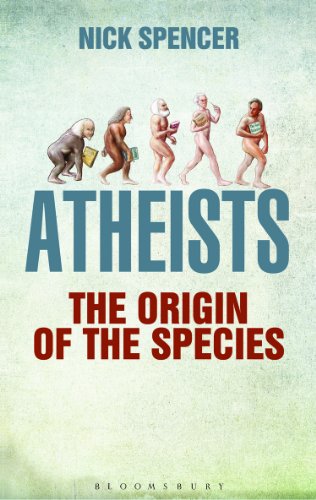
Spencer, a Catholic who is head of UK’s Theos Think Tank, concludes the opening myth of Atheists: The Origin of the Species with a dose of delicious skepticism:
Or so the story goes. Every culture has its ancient creation myth, and this is atheism’s, albeit one that is only about 150 years old. Atheism emerged in Europe through the services of reason, science, and evolution and in the teeth of often brutal religious opposition. In as far as the history of modern atheism is told, it is often a variant of this myth.
This book tries to tell a different story. This is not to say that atheism’s creation myth is wholly untrue. Creation myths are rarely wholly untrue. In this instance the tale is true enough to be believable, even if it’s not true enough to be true.
Previous Post

September 9, 2014
The Fourteen Foreskins of Christ and Mary's Hymen
Next Post

September 11, 2014 America's Post 9/11 Nihilism
Browse Our Archives
Select a Category #WhyRemainCatholic Abortion Advent Anti-Catholicism Arts Atheism Beauty Benedict XVI Bible Book Review Catholic Cinema Comedy Cosmos: A Space-Time Odyssey Czesław Miłosz Dariusz Karłowicz Devil Easter Eastern Orthodoxy Economics Environment Family Famous Atheists Who Weren't Atheists Guest Post Hans Urs von Balthasar HHS Mandate History Imagination Interview Islam Jean-Luc Marion John Paul II Judaism Just War Lent Literature Little Sisters of the Poor Liturgy Martyrdom Music News Paganism Patristics Phenomenology Philosophy Pierre Hadot Poetry Poland Pop Culture Pope Francis Poverty Prayer Protestantism Rabelais Race Remi Brague Rene Girard Russia Sam Rocha Science & Religion SCOTUS Secularization Sexual Abuse Sexuality Silence Solidarity Stratford Caldecott Synod14 Terrorism Top 10 Uncategorized Walker Percy War Weakened Edition World War II World Youth Day WYD Krakow
Select a Month July 2017 June 2017 May 2017 April 2017 March 2017 February 2017 January 2017 December 2016 October 2016 September 2016 August 2016 July 2016 June 2016 May 2016 April 2016 March 2016 February 2016 January 2016 December 2015 November 2015 October 2015 September 2015 August 2015 July 2015 June 2015 May 2015 April 2015 March 2015 February 2015 January 2015 December 2014 November 2014 October 2014 September 2014 August 2014 July 2014 May 2014 April 2014 March 2014 February 2014 January 2014 December 2013 November 2013 October 2013 September 2013 August 2013 July 2013 June 2013 May 2013
Follow Us!
TAKE THE
Religious Wisdom Quiz
True or False: In Luke's Gospel, the angels appeared to wealthy merchants to announce Jesus' birth.
Select your answer to see how you score.
FALSE TRUE
Related posts from Cosmos The In Lost

The Surprising Anti-Capitalist Logic Behind the Catholic Church's...

How is Classical Philosophy is Like War?

Why Does the World's Leading Philosopher Remain a...

Biblical Authority After Babel Cannot Be Built Upon...
TRENDING AT PATHEOS Catholic

Rejecting Doom: Christian Hope And Human Action
Christianity is a religion of hope. We are to have hope and...

It’s What Comes From Within Which Matters
One of the most difficult things for us to understand is why...

Why I Choose the Eucharist Over the Sermon
Choose the Eucharist, Not the Sermon What are we supposed to get...

5 Design Elements Found in Spiritually Rooted Homes
Putting Spirituality Into Home Decor Our homes are more than our living...

Credo: A Story of God Told with the...
About 10 years ago, I began to imagine a personal "Credo" that...

The Anatomy of Divine Revelation in Catholic Thought
The claim that God has made Himself known to human beings is...
view all Catholic blogs
Ad-Free & Subscriber Log-In Subscription Support
- About Us
- 2026 Calendar
- Videos
- Podcasts
- Library of World Religions
- Faith In Media Tracker
- Advertise With Us
- Write for Us
- Privacy Policy
- Terms of Service
- Do Not Sell My Data
- Contact Us
- Radiant Digital
- Manage Newsletter Subscriptions
- Unsubscribe From Notifications
- Sitemap
Copyright 2008-2026, Patheos. All rights reserved.
Subscription Support Ad-Free & Subscriber Log-In
Follow Patheos