
BuddhistCatholicContemplativeEvangelicalGeneral ChristianHinduJewishLatter-day SaintMuslimNew VisionsProgressive Christian
Beliefs
- Buddhist
- Catholic
- Contemplative
- Evangelical
- General Christian
- Hindu
- Jewish
- Latter-day Saint
- More Voices
- Muslim
- New Visions
- Pagan
- Progressive Christian
Topics
- Religion News
- Food and Religion
- Sports and Religion
- Religious Art
- Religious Music and Entertainment
- Religious Events
- History and Religion
- Style and Religion
- Politics and Religion
- Women in Religion
- Recreation Outdoors and Religion
- Business Finance and Religion
- Careers Workplace and Religion
- Education and Religion
- Family Parenting and Religion
- Health Fitness and Religion
- Home and Religion
- Relationships and Religion
- Technology and Religion
- Travel and Religion
Columnists
- Buddhist Columnists
- Business Finance and Religion Columnists
- Careers Workplace and Religion Columnists
- Catholic Columnists
- Contemplative Columnists
- Education and Religion Columnists
- Evangelists Columnists
- Family Parenting and Religion Columnists
- General Christian Columnists
- Health Fitness and Religion Columnists
- Hindu Columnists
- History and Religion Columnists
- Home and Religion Columnists
- Jewish Columnists
- More Voices Columnists
- Latter Day Columnists
- Muslim Columnists
- New Visions Columnists
- Nonreligious Columnists
- Pagan Columnists
- Politics and Religion Columnists
- Progressive Columnists
- Recreation Outdoors and Religion Columnists
- Relationships and Religion Columnists
- Religion News Columnists
- Religious Art Columnists
- Religious Events Columnists
- Religious Music and Entertainment Columnists
- Sports and Religion Columnists
- Style and Religion Columnists
- Technology and Religion Columnists
- Travel and Religion Columnists
- Women in Religion Columnists
Resource Library
- 2026 Calendar
- Library of World Religions
- The 100 Most Holy Places on Earth
- Patheos Answers
- Podcasts
- Videos
- Faith Leaders Database
- Anglican Episcopalian
- Bahai
- Baptist
- Buddhism
- Christianity
- Confucianism
- Eastern Orthodoxy
- Hinduism
- Holiness and Pentecostal
- ISKCON
- Islam
- Judaism
- Lutheran
- Methodist
- The Church of Jesus Christ of Latter-day Saints
- New Age
- Paganism
- Presbytarian and Reformed
- Protestantism
- Religion Behind the Scenes
- Roman Catholic
- Scientology
- Shia Islam
- Sikhism
- Sufism
- Sunni Islam
- Taoism
- Zen
- See all religions
Research Tools
 Ad-Free & Subscriber Log-In Subscription Support
Ad-Free & Subscriber Log-In Subscription Support
Follow Patheos 

- Trending:
- Forgiveness
- |
- Marriage
- |
- Consciousness
- |
- Death Penalty
- |
- Election
- |
- Halloween
 Cosmos The In Lost
- Home
- Catholic
- The Surprising Anti-Capitalist Logic Behind the Catholic Church’s Continued Ban of Gluten-Free Hosts
The Surprising Anti-Capitalist Logic Behind the Catholic Church’s Continued Ban of Gluten-Free Hosts
Last updated on: July 13, 2017 at 12:36 pm by Artur Rosman
The Surprising Anti-Capitalist Logic Behind the Catholic Church’s Continued Ban of Gluten-Free Hosts 2017-07-13T12:36:02-07:00 Artur Rosman
Patheos Explore the world's faith through different perspectives on religion and spirituality! Patheos has the views of the prevalent religions and spiritualities of the world.
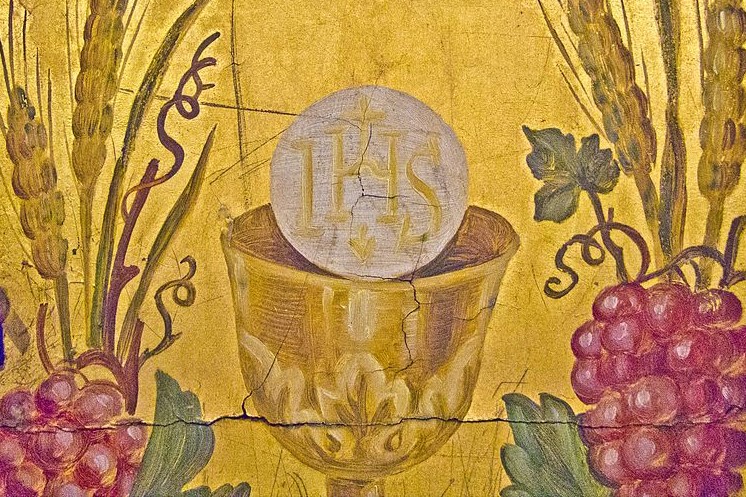
(Life macro detail in semiabandoned church in Ljubljana, 2011, Vid Gajšek; Wikimedia, Free Art License)

The continued ban of gluten-free hosts in the Catholic Church shows that the specificity of matter matters to the Catholic Church. It’s capitalism that’s spiritualistic.
I’m not an expert on the gluten-free host micro-debates. I’ve been trying my hardest to stay out of flame wars until now. What got me was the typically Catholic anti-capitalist logic (in the most positive sense) behind the continuation of present practice. Even the Washington Post is aware that it’s not a new ban, but a continuation:
The letter drew attention from media outlets around the globe, but it actually reaffirmed earlier guidelines saying that bread and wafers must have at least some gluten in them. The U.S. Conference of Catholic Bishops already has guidelines allowing churches to use low-gluten wafers and nothing will change in American Catholic churches, said Andrew Menke, executive director of the Secretariat of Divine Worship.
“Absolutely nothing has changed,” Menke said in a statement. “The ‘new guidance’ from the Vatican is simply a reminder to bishops that they need to be attentive to the bread and wine that is used for Mass, making sure that it’s consistent with the Church’s requirements.”
 The immediate logic behind the continuation is that the host must remain bread, which means the gluten has to stay. The following is from the Letter to Bishops on the bread and wine for the Eucharist issued by the Congregation for Divine Worship and the Discipline of the Sacraments (prefect: Cardinal Sarah). This statement even has my Protestant friends talking, mostly without having read it:
In its Circular Letter to the Presidents of the Episcopal Conferences regarding legitimate variations in the use of bread with a small quantity of gluten and the use of mustum as Eucharistic matter (24 July 2003, Prot. N. 89/78 – 17498), the Congregation for the Doctrine of the Faith published the norms for the celebration of the Eucharist by persons who, for varying and grave reasons, cannot consume bread made in the usual manner nor wine fermented in the normal manner:
“Hosts that are completely gluten-free are invalid matter for the celebration of the Eucharist. Low-gluten hosts (partially gluten-free) are valid matter, provided they contain a sufficient amount of gluten to obtain the confection of bread without the addition of foreign materials and without the use of procedures that would alter the nature of bread” (A. 1-2).
However, Christ remains fully present under both species, that is, wine too. The Vatican’s recent reiteration even makes provisions for those celiacs who might be alcoholics, or, former Methodists:
Mustum, which is grape juice that is either fresh or preserved by methods that suspend its fermentation without altering its nature (for example, freezing), is valid matter for the celebration of the Eucharist.
The Catholic Celiac Society notes that receiving solely wine, which is naturally gluten-free, has always been a valid option:
According to Catholic doctrine, the whole of Christ is contained in the Precious Blood alone. As such, the person who receives Communion this way is still receiving the whole sacrament. Since part of the rite of the Mass includes placing a small piece of bread into the wine, the person with celiac disease needs to arrange for a separate chalice into which no bread is put. The priest is required to do this, as each Catholic in good standing has a right to receive Communion. At churches where Communion is offered to the congregation under both species, this might not be a problem, as the chalices that are brought out to the congregation generally do not have bread in them. As this is not universal, each individual should become aware of the procedures in her own parish.
 I could keep offering more historical background on the gluten-free host debate. For example, the passage above is succeeded by a paragraph marked by a kind of “hostolatry,” which ignores the fact that the main end of the Eucharistic celebration is receiving the full Christ and that can be accomplished using wine and grape juice. The whole history of why the preference for one species developed in the West is a whole story unto itself, which I might come back to.
Let’s circle back to the title topic. Two infamous German theologians manqué once spoke of capitalism as a universal acid against tradition, because it melts traditional relations into infinitely exchangeable, spiritual in the sense of being anti-matter, capital:
Constant revolutionising of production, uninterrupted disturbance of all social conditions, everlasting uncertainty and agitation distinguish the bourgeois epoch from all earlier ones. All fixed, fast-frozen relations, with their train of ancient and venerable prejudices and opinions, are swept away, all new-formed ones become antiquated before they can ossify. All that is solid melts into air, all that is holy is profaned, and man is at last compelled to face with sober senses his real conditions of life, and his relations with his kind.
The most fascinating thing to me about this particular gluten-free host controversy is that the logic against non-gluten hosts in Letter to Bishops on the bread and wine for the Eucharist is so similar to the above anti-capitalist sentiments:
Until recently it was certain religious communities who took care of baking the bread and making the wine for the celebration of the Eucharist. Today, however, these materials are also sold in supermarkets and other stores and even over the internet. In order to remove any doubt about the validity of the matter for the Eucharist, this Dicastery suggests that Ordinaries should give guidance in this regard by, for example, guaranteeing the Eucharistic matter through special certification.
You don’t have to swallow the whole system of Marx and Engels in The Communist Manifesto to acknowledge that not only does matter matter to the bishops, but also how it’s handled.
I think it was Philip Goodchild in the Theology of Money who said that the capitalist economy, with its exclusive focus on exchange and accumulation of abstract wealth, is much more spiritualistic than theology. On the other hand, theology rests upon a real presence within the sometimes uncomfortable material particularities of grape and wheat.
That’s what makes the Incarnation absolutely unique, and creation participates in that uniqueness.
https://www.youtube.com/watch?v=_awAH-JJx1k
If you’re interested in how capitalism has eroded traditional bonds then see: Chesterton: Capitalism Killed the Family
If you’d like to carry a little of this blog’s burden, then make a donation through the button on the upper right side of this page.
Stay in touch! Like Cosmos the in Lost on Facebook:
Previous Post

July 7, 2017
What is the Source of Our Culture of Euphemism and Political Correctness?
Browse Our Archives
Select a Category #WhyRemainCatholic Abortion Advent Anti-Catholicism Arts Atheism Beauty Benedict XVI Bible Book Review Catholic Cinema Comedy Cosmos: A Space-Time Odyssey Czesław Miłosz Dariusz Karłowicz Devil Easter Eastern Orthodoxy Economics Environment Family Famous Atheists Who Weren't Atheists Guest Post Hans Urs von Balthasar HHS Mandate History Imagination Interview Islam Jean-Luc Marion John Paul II Judaism Just War Lent Literature Little Sisters of the Poor Liturgy Martyrdom Music News Paganism Patristics Phenomenology Philosophy Pierre Hadot Poetry Poland Pop Culture Pope Francis Poverty Prayer Protestantism Rabelais Race Remi Brague Rene Girard Russia Sam Rocha Science & Religion SCOTUS Secularization Sexual Abuse Sexuality Silence Solidarity Stratford Caldecott Synod14 Terrorism Top 10 Uncategorized Walker Percy War Weakened Edition World War II World Youth Day WYD Krakow
Select a Month July 2017 June 2017 May 2017 April 2017 March 2017 February 2017 January 2017 December 2016 October 2016 September 2016 August 2016 July 2016 June 2016 May 2016 April 2016 March 2016 February 2016 January 2016 December 2015 November 2015 October 2015 September 2015 August 2015 July 2015 June 2015 May 2015 April 2015 March 2015 February 2015 January 2015 December 2014 November 2014 October 2014 September 2014 August 2014 July 2014 May 2014 April 2014 March 2014 February 2014 January 2014 December 2013 November 2013 October 2013 September 2013 August 2013 July 2013 June 2013 May 2013
Follow Us!
TAKE THE
Religious Wisdom Quiz
True or False: The Thessalonians were told that the day of the Lord will come like a thief in the night.
Select your answer to see how you score.
TRUE FALSE
Related posts from Cosmos The In Lost
What is the Source of Our Culture of...


The Holy Family as an Icon of World...

Where Does the Body of Christ Go After...
TRENDING AT PATHEOS Catholic

Rejecting Doom: Christian Hope And Human Action
Christianity is a religion of hope. We are to have hope and...

It’s What Comes From Within Which Matters
One of the most difficult things for us to understand is why...

Why I Choose the Eucharist Over the Sermon
Choose the Eucharist, Not the Sermon What are we supposed to get...

5 Design Elements Found in Spiritually Rooted Homes
Putting Spirituality Into Home Decor Our homes are more than our living...

Credo: A Story of God Told with the...
About 10 years ago, I began to imagine a personal "Credo" that...

The Anatomy of Divine Revelation in Catholic Thought
The claim that God has made Himself known to human beings is...
view all Catholic blogs
Ad-Free & Subscriber Log-In Subscription Support
- About Us
- 2026 Calendar
- Videos
- Podcasts
- Library of World Religions
- Faith In Media Tracker
- Advertise With Us
- Write for Us
- Privacy Policy
- Terms of Service
- Do Not Sell My Data
- Contact Us
- Radiant Digital
- Manage Newsletter Subscriptions
- Unsubscribe From Notifications
- Sitemap
Copyright 2008-2026, Patheos. All rights reserved.
Subscription Support Ad-Free & Subscriber Log-In
Follow Patheos