
BuddhistCatholicContemplativeEvangelicalGeneral ChristianHinduJewishLatter-day SaintMuslimNew VisionsProgressive Christian
Beliefs
- Buddhist
- Catholic
- Contemplative
- Evangelical
- General Christian
- Hindu
- Jewish
- Latter-day Saint
- More Voices
- Muslim
- New Visions
- Pagan
- Progressive Christian
Topics
- Religion News
- Food and Religion
- Sports and Religion
- Religious Art
- Religious Music and Entertainment
- Religious Events
- History and Religion
- Style and Religion
- Politics and Religion
- Women in Religion
- Recreation Outdoors and Religion
- Business Finance and Religion
- Careers Workplace and Religion
- Education and Religion
- Family Parenting and Religion
- Health Fitness and Religion
- Home and Religion
- Relationships and Religion
- Technology and Religion
- Travel and Religion
Columnists
- Buddhist Columnists
- Business Finance and Religion Columnists
- Careers Workplace and Religion Columnists
- Catholic Columnists
- Contemplative Columnists
- Education and Religion Columnists
- Evangelists Columnists
- Family Parenting and Religion Columnists
- General Christian Columnists
- Health Fitness and Religion Columnists
- Hindu Columnists
- History and Religion Columnists
- Home and Religion Columnists
- Jewish Columnists
- More Voices Columnists
- Latter Day Columnists
- Muslim Columnists
- New Visions Columnists
- Nonreligious Columnists
- Pagan Columnists
- Politics and Religion Columnists
- Progressive Columnists
- Recreation Outdoors and Religion Columnists
- Relationships and Religion Columnists
- Religion News Columnists
- Religious Art Columnists
- Religious Events Columnists
- Religious Music and Entertainment Columnists
- Sports and Religion Columnists
- Style and Religion Columnists
- Technology and Religion Columnists
- Travel and Religion Columnists
- Women in Religion Columnists
Resource Library
- 2026 Calendar
- Library of World Religions
- The 100 Most Holy Places on Earth
- Patheos Answers
- Podcasts
- Videos
- Faith Leaders Database
- Anglican Episcopalian
- Bahai
- Baptist
- Buddhism
- Christianity
- Confucianism
- Eastern Orthodoxy
- Hinduism
- Holiness and Pentecostal
- ISKCON
- Islam
- Judaism
- Lutheran
- Methodist
- The Church of Jesus Christ of Latter-day Saints
- New Age
- Paganism
- Presbytarian and Reformed
- Protestantism
- Religion Behind the Scenes
- Roman Catholic
- Scientology
- Shia Islam
- Sikhism
- Sufism
- Sunni Islam
- Taoism
- Zen
- See all religions
Research Tools
 Ad-Free & Subscriber Log-In Subscription Support
Ad-Free & Subscriber Log-In Subscription Support
Follow Patheos 

- Trending:
- Forgiveness
- |
- Marriage
- |
- Consciousness
- |
- Death Penalty
- |
- Election
- |
- Halloween
 Cosmos The In Lost
- Home
- Catholic
- Charlie Gard Is Going to Die
Charlie Gard Is Going to Die
Last updated on: July 7, 2017 at 8:56 am by Guest Contributor
Charlie Gard Is Going to Die 2017-07-07T08:56:15-07:00 Guest Contributor
Patheos Explore the world's faith through different perspectives on religion and spirituality! Patheos has the views of the prevalent religions and spiritualities of the world.
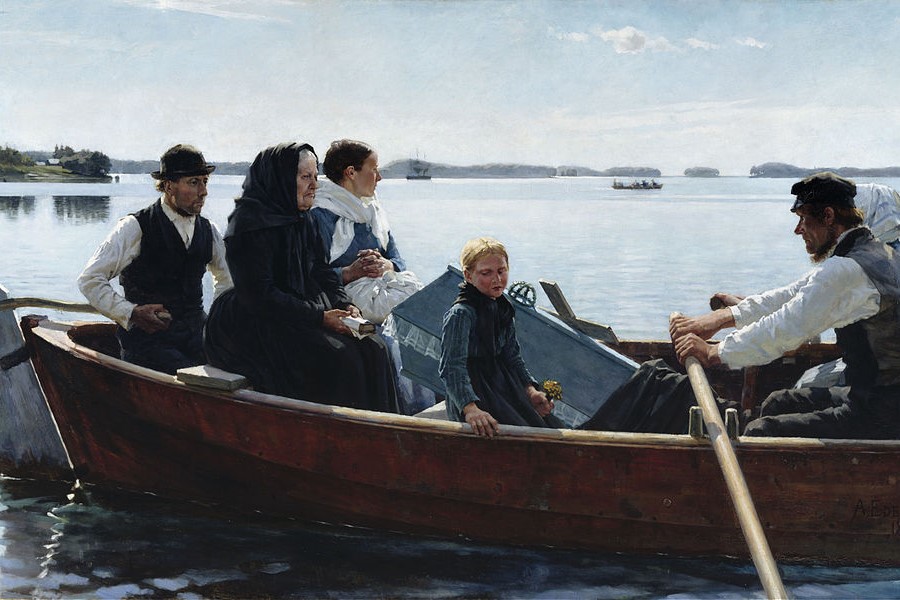
(Albert Edelfelt, Conveying the Child’s Coffin / A Child’s Funeral, 1879; Wikimedia Commons, PD-Old-100)
The position of the Great Ormond Street Hospital, and the attending physicians, arises out of and flows from their determination regarding the futility of (further) treatment.
Charlie Gard is going to die.
The attending physicians at GOSH hold the proposed treatment in the US so highly unlikely to produce any appreciable improvement in the patient’s condition, that they refuse to participate on the grounds that they would be uselessly inflicting harm – in the form of pain, at least – on their patient: in essence, that they would be violating their oath as healers.
That is a serious matter.
Their determination is deserving of deference at least on par with that of the parents to pursue treatment for their son.
The courts were asked to resolve the dispute arising from these competing claims.
How they have done so has been satisfactory to exactly no one.
On the one hand, there is the apparent subtraction of parents’ rights, which are prior to the state and rooted in the natural law.
Those rights, however, are not absolute, though they arise out of precisely that duty to care, which primarily resides in the parents of minors, and only by delegation and derivation in other parties, including the state.
Both the doctors into whose care the parents have entrusted their child, and the state, of which the patient is a member, do nevertheless have real duties, with which come the corresponding powers to discharge them.
 In the midst of all this, there is a crisis of confidence – one might even say a crisis of faith – in the medical profession, arising from the direction in which medical ethics throughout the West have turned.
Essentially, the medical profession – sometimes under the pressure of politicians and bureaucrats, sometimes more pro-actively – has distanced its practice from the core conviction that life is a basic and irreducible good, to which patients have an inherent and inalienable right, which right must be defended at all costs and against every usurper – even the one who possesses the good, hence the right to it.
Nota bene: the right deserves protection at all costs: the good itself is perishable, and when the good itself, from which the right arises, is in precinct of expiry, there are inevitably hard decisions to make, which for their right making depend on the clear and cloudless vision of the goods at stake and of the rights that arise from those goods.
This is why the turn in the medical profession has created such consternation in Charlie Gard’s case and in many others.
That turn away from such clear and cloudless vision has already done grave harm, and will prove disastrous – even lethal, in the strict biological sense of the term – if it is not arrested and reversed.
I am not sanguine.
In any case, it seems to me that neither the decriers of the hospital, the physicians, and the state that has sided with them as the enemies of life and of the natural order, the protection of which is – on paper at least – their very raison d’etre, nor those who defend the hospital, the physicians, and the state, by ridiculing those with concerns and adopting a facile, “nothing to see here” attitude, contribute anything useful either to Charlie’s cause or to the broader public and civilizational conversation, which presses on us with ever more palpable urgency.
This is a hard case.
There are legitimate concerns on all sides.
Helpful consideration of those concerns requires that we be extremely reluctant to attribute evil intent, especially when there does exist the possibility of attributing the actions of agents and the positions of interlocutors to something other than malice.
On the other hand, vigilance is not only the price of liberty, but the necessary and prudent posture of every person and any people truly jealous of their own rights and those of their neighbors.
We all have friends on both sides of the Charlie Gard case, whose opinions we generally respect – even when we disagree with them – and whose character we know to be unimpeachable.
As we pursue this necessary conversation, let us be mindful of that.
Chris Altieri is the co-founder and General Manager of Vocaris Media. He hosts the flagship program of the Vocaris production arm, Thinking with the Church. He lives in Rome, Italy, with his wife and two children.
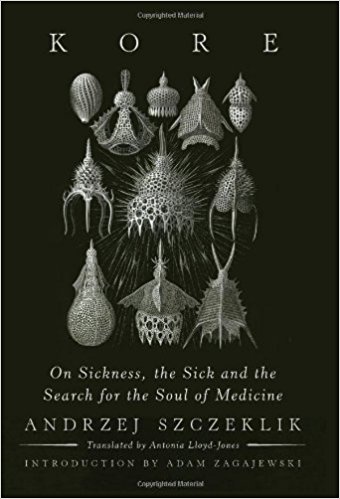
Suggested Reading: Kore: On Sickness, the Sick, and the Search for the Soul of Medicine
There is a grand tradition of physicians who are also great writers and philosophers. From Copernicus and Paracelsus, to Chekov, Osler and Frankl. And most recently Sherwin Nuland and Oliver Sacks have gained broad readerships and made huge contributions to the way we think and the way we live our lives. Andrzej Szczeklik is entirely worthy to join their company. When his first book, Catharsis, was published in English, critics from Seamus Heaney to Czeslaw Milosz stood to applaud. Now he has followed with an ever deeper and more accomplished book.
It has become unfortunately rare for a scientist or doctor to find his grounding in a broad understanding of literature and the humanities. But in Kore, the author insists that only with a curiosity thoroughly at home in both worlds can one expect to discover what we should mean about sickness and about the soul. No tedious academic, Szczeklik writes with the grace of a poet and the ease of a fine storyteller. Anecdotes drawn from a personal immersion in art, music, and literature are woven with reports on experimental medicine and daily clinical experience. From DNA and the re-creation of the Spanish Flu virus, to contemporary research in genetics, cancer, neurology, and the AIDS virus, from “Symptoms and Shadows,” to “Dying and Death,” to “Enchantment of Love,” every chapter of this book is alive and engaging. The result is a life-affirming work of science, philosophy, art, and spirituality.
If you like what you’ve read please make a donation to this blog through the button on the upper right side of this page to help keep it going.
Stay in touch! Like Cosmos the in Lost on Facebook:
Previous Post

June 21, 2017
The Holy Family as an Icon of World Refugee Day?
Next Post

July 7, 2017 What is the Source of Our Culture of Euphemism and Political Correctness?
Browse Our Archives
Select a Category #WhyRemainCatholic Abortion Advent Anti-Catholicism Arts Atheism Beauty Benedict XVI Bible Book Review Catholic Cinema Comedy Cosmos: A Space-Time Odyssey Czesław Miłosz Dariusz Karłowicz Devil Easter Eastern Orthodoxy Economics Environment Family Famous Atheists Who Weren't Atheists Guest Post Hans Urs von Balthasar HHS Mandate History Imagination Interview Islam Jean-Luc Marion John Paul II Judaism Just War Lent Literature Little Sisters of the Poor Liturgy Martyrdom Music News Paganism Patristics Phenomenology Philosophy Pierre Hadot Poetry Poland Pop Culture Pope Francis Poverty Prayer Protestantism Rabelais Race Remi Brague Rene Girard Russia Sam Rocha Science & Religion SCOTUS Secularization Sexual Abuse Sexuality Silence Solidarity Stratford Caldecott Synod14 Terrorism Top 10 Uncategorized Walker Percy War Weakened Edition World War II World Youth Day WYD Krakow
Select a Month July 2017 June 2017 May 2017 April 2017 March 2017 February 2017 January 2017 December 2016 October 2016 September 2016 August 2016 July 2016 June 2016 May 2016 April 2016 March 2016 February 2016 January 2016 December 2015 November 2015 October 2015 September 2015 August 2015 July 2015 June 2015 May 2015 April 2015 March 2015 February 2015 January 2015 December 2014 November 2014 October 2014 September 2014 August 2014 July 2014 May 2014 April 2014 March 2014 February 2014 January 2014 December 2013 November 2013 October 2013 September 2013 August 2013 July 2013 June 2013 May 2013
Follow Us!
TAKE THE
Religious Wisdom Quiz
What did God tell Moses from the burning bush?
Select your answer to see how you score.
That he would be king of Israel That he would lead Israel out of Egypt That he would become Pharaoh That he would build the temple
Related posts from Cosmos The In Lost

The Surprising Anti-Capitalist Logic Behind the Catholic Church's...
What is the Source of Our Culture of...
The Holy Family as an Icon of World...

Where Does the Body of Christ Go After...
TRENDING AT PATHEOS Catholic

Creation, Preservation, and Teleology in Catholic Theology
As I write this, it is very early Monday morning. Like millions...

The Parable Of The Sower And The Word...
One of Christ’s most famous parables is that of the sower who...

Rejecting Doom: Christian Hope And Human Action
Christianity is a religion of hope. We are to have hope and...

Why I Choose the Eucharist Over the Sermon
Choose the Eucharist, Not the Sermon What are we supposed to get...

5 Design Elements Found in Spiritually Rooted Homes
Putting Spirituality Into Home Decor Our homes are more than our living...

Credo: A Story of God Told with the...
About 10 years ago, I began to imagine a personal "Credo" that...
view all Catholic blogs
Ad-Free & Subscriber Log-In Subscription Support
- About Us
- 2026 Calendar
- Videos
- Podcasts
- Library of World Religions
- Faith In Media Tracker
- Advertise With Us
- Write for Us
- Privacy Policy
- Terms of Service
- Do Not Sell My Data
- Contact Us
- Radiant Digital
- Manage Newsletter Subscriptions
- Unsubscribe From Notifications
- Sitemap
Copyright 2008-2026, Patheos. All rights reserved.
Subscription Support Ad-Free & Subscriber Log-In
Follow Patheos