
BuddhistCatholicContemplativeEvangelicalGeneral ChristianHinduJewishLatter-day SaintMuslimNew VisionsProgressive Christian
Beliefs
- Buddhist
- Catholic
- Contemplative
- Evangelical
- General Christian
- Hindu
- Jewish
- Latter-day Saint
- More Voices
- Muslim
- New Visions
- Pagan
- Progressive Christian
Topics
- Religion News
- Food and Religion
- Sports and Religion
- Religious Art
- Religious Music and Entertainment
- Religious Events
- History and Religion
- Style and Religion
- Politics and Religion
- Women in Religion
- Recreation Outdoors and Religion
- Business Finance and Religion
- Careers Workplace and Religion
- Education and Religion
- Family Parenting and Religion
- Health Fitness and Religion
- Home and Religion
- Relationships and Religion
- Technology and Religion
- Travel and Religion
Columnists
- Buddhist Columnists
- Business Finance and Religion Columnists
- Careers Workplace and Religion Columnists
- Catholic Columnists
- Contemplative Columnists
- Education and Religion Columnists
- Evangelists Columnists
- Family Parenting and Religion Columnists
- General Christian Columnists
- Health Fitness and Religion Columnists
- Hindu Columnists
- History and Religion Columnists
- Home and Religion Columnists
- Jewish Columnists
- More Voices Columnists
- Latter Day Columnists
- Muslim Columnists
- New Visions Columnists
- Nonreligious Columnists
- Pagan Columnists
- Politics and Religion Columnists
- Progressive Columnists
- Recreation Outdoors and Religion Columnists
- Relationships and Religion Columnists
- Religion News Columnists
- Religious Art Columnists
- Religious Events Columnists
- Religious Music and Entertainment Columnists
- Sports and Religion Columnists
- Style and Religion Columnists
- Technology and Religion Columnists
- Travel and Religion Columnists
- Women in Religion Columnists
Resource Library
- 2026 Calendar
- Library of World Religions
- The 100 Most Holy Places on Earth
- Patheos Answers
- Podcasts
- Videos
- Faith Leaders Database
- Anglican Episcopalian
- Bahai
- Baptist
- Buddhism
- Christianity
- Confucianism
- Eastern Orthodoxy
- Hinduism
- Holiness and Pentecostal
- ISKCON
- Islam
- Judaism
- Lutheran
- Methodist
- The Church of Jesus Christ of Latter-day Saints
- New Age
- Paganism
- Presbytarian and Reformed
- Protestantism
- Religion Behind the Scenes
- Roman Catholic
- Scientology
- Shia Islam
- Sikhism
- Sufism
- Sunni Islam
- Taoism
- Zen
- See all religions
Research Tools
 Ad-Free & Subscriber Log-In Subscription Support
Ad-Free & Subscriber Log-In Subscription Support
Follow Patheos 

- Trending:
- Forgiveness
- |
- Marriage
- |
- Consciousness
- |
- Death Penalty
- |
- Election
- |
- Halloween
 Cosmos The In Lost
- Home
- Catholic
- The Holy Family as an Icon of World Refugee Day?
The Holy Family as an Icon of World Refugee Day?
Last updated on: June 24, 2017 at 10:30 pm by Artur Rosman
The Holy Family as an Icon of World Refugee Day? 2017-06-24T22:30:53-07:00 Artur Rosman
Patheos Explore the world's faith through different perspectives on religion and spirituality! Patheos has the views of the prevalent religions and spiritualities of the world.
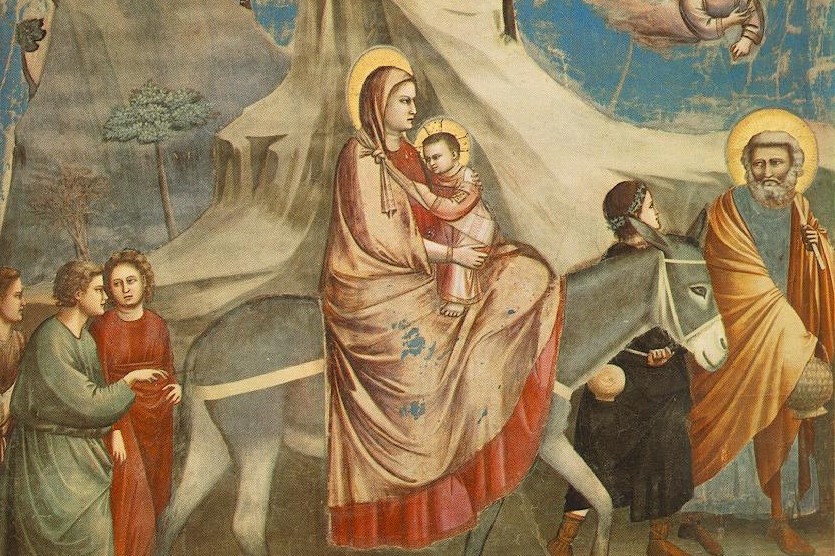
(Giotto, Scrovegni Chapel, Flight into Egypt, circa 13th c.; Source: Wikimedia, PD-Old-100)
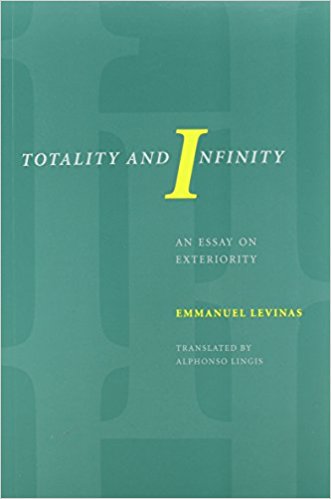
I haven’t had many opportunities to write lately because I am totally consumed translating Fr. Jozef Tischner’s (a.k.a. The Chaplain of Solidarity) The Philosophy of Drama (Polish edition, French Translation). Any translation is a process of learning a new philosophical language. Fr. Tischner’s phenomenology of the human drama develops Emmanuel Levinas’s biblically inspired philosophy of welcoming the Other set down in two groundbreaking volumes Totality and Infinity and Otherwise Than Being.
In Totality and Infinity Levinas, ever the personalist, insists that it is not our understanding of the totality of being (ontology) that primarily structures who we are, but rather the infinite demands–I don’t think I’d be going too far if I said unreasonable–of the person who comes to us in need:
I can recognize the gaze of the stranger, the widow, and the orphan only in giving or in refusing; I am free to give or to refuse, but my recognition passes necessarily through the interposition of things. Things are not, as in Heidegger, the foundation of the site, the quintessence of all the relations that constitute our presence on the earth ( and “under the heavens, in company with men, and in the expectation of the gods”). The relationship between the same [the I in itself] and the other, my welcoming of the other, is the ultimate fact, and in it the things figure not as what one builds but as what one gives.
The orphan, widow, and stranger could have been lifted straight out from any number of pages from Deuteronomy. For example, this comes from Deuteronomy 10:16-19:
16 Circumcise your heart then and be obstinate no longer;
17 for Yahweh your God is God of gods and Lord of lords, the great God, triumphant and terrible, free of favouritism, never to be bribed.
18 He it is who sees justice done for the orphan and the widow, who loves the stranger and gives him food and clothing.
19 (Love the stranger then, for you were once strangers in Egypt.)
Levinas’s Totality and Infinity also reminds us too that, unlike Odysseus, Abraham, the father of our faith, was called to abandon his homeland, never to return to his Ithaca-Ur.
 Yesterday was World Refugee Day. I feel obligated to speak on the matter since our family was welcomed in the summer of 1986 as refugees in Italy’s refugee camps. We were then granted political asylum by the United States a few weeks before the start of 1987. We too were once strangers making unreasonable demands upon the goodwill of people from lands strange to us who had no visible obligations to us other than their own memories of Egypts past.
Catholic hardline championing of refugees causes appears to have dropped out of the sky during the Francis papacy. He seems to be making irresponsible demands upon a First World already overtaxed by financial crises and floods of refugees. Those are the appearances, but reality involves much longer-term trends.
A Polish colleague of mine pointed to remarks made about refugees by Benedict XVI that seem just as foolish as anything you might have heard from Francis. The post was in Polish so I attempted to find the full Vatican document in English. I fell short by one year and found the wrong document. The document I found instead cited the following passage written by Pius XII less than a decade after World War II:
The family of Nazareth in exile, Jesus, Mary and Joseph, emigrants and taking refuge in Egypt to escape the fury of an evil king, are the model, the example and the support of all emigrants and pilgrims of every age and every country, of all refugees of any condition who, compelled by persecution and need, are forced to abandon their homeland, their beloved relatives, their neighbors, their dear friends, and move to a foreign land” (Exsul familia, AAS 44, 1952, 649).
Exsul familia stops short of calling the Holy Family an icon of the emigrant and refugee, but the phrase “the model, the example” sure does tend that way. I’ve seen plenty of resistance to such “liberalization” and “politicizing” of the Gospel, but there it is, over ten years before Vatican II (not to mention in the biblical record).
I couldn’t track down a translation of Exsul familia on the Vatican website. I instead found a downloadable .pdf copy on Georgetown’s Berkeley Center site. Now this, this is truly scandalous:
First, let us recall what the great St. Ambrose did and said when that illustrious Bishop of Milan succeeded in ransoming the wretched captives who had been taken after the defeat of the Emperor Valentine near Adrianopolis. He sacrificed the sacred vessels in order to protect the destitute ones from physical suffering and to relieve them of their pressing spiritual dangers which were even a greater hazard. “For who,” said Ambrose, “is so callous, unfeeling, herd-hearted and cruel that he does not want men saved from death and women from barbarous attacks worse than death? For who is not willing to rescue girls and boys or little children from the service of pagan idols, into which they have been forced under pain of death? We have not undertaken this work without reason; and we have done it openly to proclaim that it is far better to preserve souls for the Lord than to preserve gold.”
Sacrificing sacred vessels as ransom? Ambrose sounds like a guy you want to keep away from your elaborately ornamented parish church. Can you imagine the reaction to such a request from Pope Francis?
What would happen if Francis melted down the baldachin at St. Peter’s to ransom the Iraqi Christians who are currently being processed for deportation from the US? Let’s pretend bronze is very valuable. Let’s also omit the fact that the baldachin was made out of materials taken from pagan temples–a kind of theft (From thence comes the old Roman quip: quod non fecerunt barbari, fecerunt Barberini [what the barbarians did not do, the Barberini did]). We would still be left with the loss of an invaluable artefact of Western culture that is integral to the layout of the most important church in Christendom.
And yet, despite that, what could be more traditional than Ambrose’s response?
Remember, you too were once, or, will be, strangers.
To gauge the depths of the current refugee crisis and its parallels with the Holocaust give A New Springtime for Hitler? a read.
If you like what you’ve read please make a donation to this blog through the button on the upper right side of this page to help keep it going.
Stay in touch! Like Cosmos the in Lost on Facebook:
Previous Post

May 29, 2017
How is Classical Philosophy is Like War?
Next Post

July 6, 2017 Charlie Gard Is Going to Die
Browse Our Archives
Select a Category #WhyRemainCatholic Abortion Advent Anti-Catholicism Arts Atheism Beauty Benedict XVI Bible Book Review Catholic Cinema Comedy Cosmos: A Space-Time Odyssey Czesław Miłosz Dariusz Karłowicz Devil Easter Eastern Orthodoxy Economics Environment Family Famous Atheists Who Weren't Atheists Guest Post Hans Urs von Balthasar HHS Mandate History Imagination Interview Islam Jean-Luc Marion John Paul II Judaism Just War Lent Literature Little Sisters of the Poor Liturgy Martyrdom Music News Paganism Patristics Phenomenology Philosophy Pierre Hadot Poetry Poland Pop Culture Pope Francis Poverty Prayer Protestantism Rabelais Race Remi Brague Rene Girard Russia Sam Rocha Science & Religion SCOTUS Secularization Sexual Abuse Sexuality Silence Solidarity Stratford Caldecott Synod14 Terrorism Top 10 Uncategorized Walker Percy War Weakened Edition World War II World Youth Day WYD Krakow
Select a Month July 2017 June 2017 May 2017 April 2017 March 2017 February 2017 January 2017 December 2016 October 2016 September 2016 August 2016 July 2016 June 2016 May 2016 April 2016 March 2016 February 2016 January 2016 December 2015 November 2015 October 2015 September 2015 August 2015 July 2015 June 2015 May 2015 April 2015 March 2015 February 2015 January 2015 December 2014 November 2014 October 2014 September 2014 August 2014 July 2014 May 2014 April 2014 March 2014 February 2014 January 2014 December 2013 November 2013 October 2013 September 2013 August 2013 July 2013 June 2013 May 2013
Follow Us!
TAKE THE
Religious Wisdom Quiz
Who said, "What is impossible with man is possible with God"?
Select your answer to see how you score.
Peter Jesus Paul Moses
Related posts from Cosmos The In Lost

The Surprising Anti-Capitalist Logic Behind the Catholic Church's...

What is the Source of Our Culture of...

Where Does the Body of Christ Go After...
TRENDING AT PATHEOS Catholic

Rejecting Doom: Christian Hope And Human Action
Christianity is a religion of hope. We are to have hope and...

It’s What Comes From Within Which Matters
One of the most difficult things for us to understand is why...

Why I Choose the Eucharist Over the Sermon
Choose the Eucharist, Not the Sermon What are we supposed to get...

5 Design Elements Found in Spiritually Rooted Homes
Putting Spirituality Into Home Decor Our homes are more than our living...

Credo: A Story of God Told with the...
About 10 years ago, I began to imagine a personal "Credo" that...

The Anatomy of Divine Revelation in Catholic Thought
The claim that God has made Himself known to human beings is...
view all Catholic blogs
Ad-Free & Subscriber Log-In Subscription Support
- About Us
- 2026 Calendar
- Videos
- Podcasts
- Library of World Religions
- Faith In Media Tracker
- Advertise With Us
- Write for Us
- Privacy Policy
- Terms of Service
- Do Not Sell My Data
- Contact Us
- Radiant Digital
- Manage Newsletter Subscriptions
- Unsubscribe From Notifications
- Sitemap
Copyright 2008-2026, Patheos. All rights reserved.
Subscription Support Ad-Free & Subscriber Log-In
Follow Patheos