
BuddhistCatholicContemplativeEvangelicalGeneral ChristianHinduJewishLatter-day SaintMuslimNew VisionsProgressive Christian
Beliefs
- Buddhist
- Catholic
- Contemplative
- Evangelical
- General Christian
- Hindu
- Jewish
- Latter-day Saint
- More Voices
- Muslim
- New Visions
- Pagan
- Progressive Christian
Topics
- Religion News
- Food and Religion
- Sports and Religion
- Religious Art
- Religious Music and Entertainment
- Religious Events
- History and Religion
- Style and Religion
- Politics and Religion
- Women in Religion
- Recreation Outdoors and Religion
- Business Finance and Religion
- Careers Workplace and Religion
- Education and Religion
- Family Parenting and Religion
- Health Fitness and Religion
- Home and Religion
- Relationships and Religion
- Technology and Religion
- Travel and Religion
Columnists
- Buddhist Columnists
- Business Finance and Religion Columnists
- Careers Workplace and Religion Columnists
- Catholic Columnists
- Contemplative Columnists
- Education and Religion Columnists
- Evangelists Columnists
- Family Parenting and Religion Columnists
- General Christian Columnists
- Health Fitness and Religion Columnists
- Hindu Columnists
- History and Religion Columnists
- Home and Religion Columnists
- Jewish Columnists
- More Voices Columnists
- Latter Day Columnists
- Muslim Columnists
- New Visions Columnists
- Nonreligious Columnists
- Pagan Columnists
- Politics and Religion Columnists
- Progressive Columnists
- Recreation Outdoors and Religion Columnists
- Relationships and Religion Columnists
- Religion News Columnists
- Religious Art Columnists
- Religious Events Columnists
- Religious Music and Entertainment Columnists
- Sports and Religion Columnists
- Style and Religion Columnists
- Technology and Religion Columnists
- Travel and Religion Columnists
- Women in Religion Columnists
Resource Library
- 2026 Calendar
- Library of World Religions
- The 100 Most Holy Places on Earth
- Patheos Answers
- Podcasts
- Videos
- Faith Leaders Database
- Anglican Episcopalian
- Bahai
- Baptist
- Buddhism
- Christianity
- Confucianism
- Eastern Orthodoxy
- Hinduism
- Holiness and Pentecostal
- ISKCON
- Islam
- Judaism
- Lutheran
- Methodist
- The Church of Jesus Christ of Latter-day Saints
- New Age
- Paganism
- Presbytarian and Reformed
- Protestantism
- Religion Behind the Scenes
- Roman Catholic
- Scientology
- Shia Islam
- Sikhism
- Sufism
- Sunni Islam
- Taoism
- Zen
- See all religions
Research Tools
 Ad-Free & Subscriber Log-In Subscription Support
Ad-Free & Subscriber Log-In Subscription Support
Follow Patheos 

- Trending:
- Forgiveness
- |
- Marriage
- |
- Consciousness
- |
- Death Penalty
- |
- Election
- |
- Halloween
 Cosmos The In Lost
- Home
- Catholic
- Western Civ Doesn’t Need Tenured Radicals to Ruin Itself
Western Civ Doesn’t Need Tenured Radicals to Ruin Itself
Last updated on: May 4, 2017 at 12:11 am by Guest Contributor
Western Civ Doesn’t Need Tenured Radicals to Ruin Itself 2017-05-04T00:11:36-07:00 Guest Contributor
Patheos Explore the world's faith through different perspectives on religion and spirituality! Patheos has the views of the prevalent religions and spiritualities of the world.
. . . He refuses to fight fire with fire, to destroy the pagan edifice of Rome with triumphalist Christian apologetic. Instead, he very deftly, very affectionately, and finally, very damningly, teases out the deep causes of Rome’s greatest successes and ultimate failures. Romans, said Augustine, desired the glory of their city above all other goods. “They were passionately devoted to glory; it was for this that they desired to live, for this they did not hesitate to die.” (Bettenson, City of God V.12, p. 197). The love of glory was the source of Roman triumph; Romans were trained to discipline all their other desires, to tame them and put them in service of this one highest good. It was the passion for the glory of Rome that nurtured Romans’ love of liberty and encouraged them to build a republic of renown. But in time, and, paradoxically, because of their success, Roman love of glory became a libido dominandi, a lust for domination. “When liberty had been won, such a passion for glory took hold of them that liberty alone did not satisfy – they had to acquire dominion.” (V.12, p. 198) And it was this relentless ambition for domination that would, in time, weaken the very heart of Rome. The greatest strength of Rome carried within it the seeds of its own failure. Setting their hearts upon a glory in this mortal life, the Romans got exactly what they longed for, and, in the end, this reward itself brought them down from within. Quoting Jesus, Augustine says, “I tell you, they have received their reward in full.”
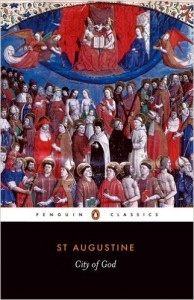 Perhaps it sounds like Christian triumphalism. But if Augustine is sure that “the bliss of a Christian emperor” is greater than his pagan predecessor because he is subject to God’s loving order, he is also quick to use the examples of Roman character to shame his Christian colleagues. If Romans could achieve so much in service of a worldly glory, why are we so slow to act in service of the eternal glory of the City of God? Augustine’s discussion of the cultural contradictions of Roman virtue is suffused with a deep love and tragic admiration, and he demonstrates again and again that, when we love a limited good as if it could last forever, we will fail. For Augustine, Christian Rome is no less subject to the same temptations and failings of its pagan ancestor. The only difference is that, in the light of providence, Christians (perhaps) have better tools to recognize the deep ambivalence in their loves and to work constantly to put them in service of the love that moves the sun and other stars.
In the face of the failure of a culture’s story, what is the best way to respond? David Brooks’ suspicion of universities is unfortunately predictable and short sighted, but he does have a point. Like Augustine’s disillusioned Romans, our intellectual leaders often have faced the collapse of the Western story with contempt and anger. It is certainly true that, in some corridors of our universities, we have torn down old institutions and demonized older values. But the politics of outrage have taken hold of both the left and the right. For every “tenured radical” on the left there is a Rush Limbaugh or Bill O’Reilly or Donald Trump on the right. Each side has its scapegoats; each side can claim certain victories. If the critical left is eager to tear down rather than repair, the reactionary right expends energy in the endless pursuit of “making America great again.” For all the noise, neither side can hear the voice of someone like Augustine, asking where our cultural contradictions lie, naming the good and the bad alike.
 If we made a mistake, in the wake of the internal collapse of the Western Civ story, it was a failure of the tragic imagination. Tragedy means more than “a story ending badly”; instead, it is a vision of life that holds together the beauty and the failure of all our “human, all too human” endeavor. Augustine took a properly tragic view of classical Roman culture when he recognized that their failure had the same cause as their success, and he deepened that tragic sensibility when he turned those same critical questions upon himself and his own Christian culture. Rowan Williams says that “[t]ragedy typically leaves questions painfully open…” but “the challenge is not only how we speak without false consolation in a world like this but how we keep our culture alive to the fact that it *is ‘*a world like this.” (Williams, The Tragic Imagination, 3) To deny our fundamental disease and disorder is to make our sickness worse. For example, could it be that our decade of denial in the “nifty Fifties” itself intensified the violent disruption and upheaval that followed in the Sixties? And the critical narrative of the Sixties could only imagine overcoming the failures of the past by tearing down the institutions that embodied those failures. But the tragic imagination refuses to deny the pain and failure, not in the service of defeatism, but in the trust that there is something there, something suffering its own failure, that is worth saving, for all its faults. It may be that we ceased to pass on a story that we no longer believed, but did we thereby eclipse the tainted beauty and goodness that abided within the failure?
The West lost its story, not at the hands of the university professoriate, but in being forced to confront the long, bloody trail of its failures. We compounded the failure by imagining that we could simply exorcise the demons of the past and place the blame on the national, the religious, the traditional. We imagined that wickedness could be removed simply by subtraction. And now we find that the evils we thought to subtract will not just disappear; they will return with a vengeance. We are tempted to repeat the cycle, to go to war with our neighbor. Until we can see, with a right sense of the tragic, that our virtues and our vices grow out of the same soil, we will succeed only in making for greater rootlessness for all of us. In this, David Brooks and I agree: We need to relearn the story of Western Civ, because, for better and for worse, it is our story. But we need to tell a tragic story, both the better and the worse.
Kevin L. Hughes is professor with a joint appointment to the Theology and Religious Studies and Humanities departments at Villanova University. He is the author of Constructing Antichrist and Church History: Faith Handed On, along with articles appearing in journals such as Modern Theology, Theological Studies, Franciscan Studies, and the Heythrop Journal. He lives in Media, PA with his wife Bridget, a ceramic artist, and their three daughters.
If you really insist on diving deeply into the gory details of how Western Civ ruined itself, then look no further than the 11 Most Important Critiques of Modernity According to Thomas Pfau.
You really should also take a look at The West Was Never Western.
Please also make a donation to this blog through the button on the upper right side of this page to help keep it going.
Stay in touch! Like Cosmos the in Lost on Facebook:
Previous Post

April 27, 2017
Post-Execution Church: Rise Up from the Electric Chair!
Next Post

May 4, 2017 Atheists Have "National Day of Reason," But American Atheism is Irrational
Browse Our Archives
Select a Category #WhyRemainCatholic Abortion Advent Anti-Catholicism Arts Atheism Beauty Benedict XVI Bible Book Review Catholic Cinema Comedy Cosmos: A Space-Time Odyssey Czesław Miłosz Dariusz Karłowicz Devil Easter Eastern Orthodoxy Economics Environment Family Famous Atheists Who Weren't Atheists Guest Post Hans Urs von Balthasar HHS Mandate History Imagination Interview Islam Jean-Luc Marion John Paul II Judaism Just War Lent Literature Little Sisters of the Poor Liturgy Martyrdom Music News Paganism Patristics Phenomenology Philosophy Pierre Hadot Poetry Poland Pop Culture Pope Francis Poverty Prayer Protestantism Rabelais Race Remi Brague Rene Girard Russia Sam Rocha Science & Religion SCOTUS Secularization Sexual Abuse Sexuality Silence Solidarity Stratford Caldecott Synod14 Terrorism Top 10 Uncategorized Walker Percy War Weakened Edition World War II World Youth Day WYD Krakow
Select a Month July 2017 June 2017 May 2017 April 2017 March 2017 February 2017 January 2017 December 2016 October 2016 September 2016 August 2016 July 2016 June 2016 May 2016 April 2016 March 2016 February 2016 January 2016 December 2015 November 2015 October 2015 September 2015 August 2015 July 2015 June 2015 May 2015 April 2015 March 2015 February 2015 January 2015 December 2014 November 2014 October 2014 September 2014 August 2014 July 2014 May 2014 April 2014 March 2014 February 2014 January 2014 December 2013 November 2013 October 2013 September 2013 August 2013 July 2013 June 2013 May 2013
Follow Us!
TAKE THE
Religious Wisdom Quiz
What did the Israelites have to gather twice as much of before Sabbath?
Select your answer to see how you score.
Manna Quail Barley Fish
Related posts from Cosmos The In Lost

The Surprising Anti-Capitalist Logic Behind the Catholic Church's...

What is the Source of Our Culture of...


The Holy Family as an Icon of World...
TRENDING AT PATHEOS Catholic

The Parable Of The Sower And The Word...
One of Christ’s most famous parables is that of the sower who...

Rejecting Doom: Christian Hope And Human Action
Christianity is a religion of hope. We are to have hope and...

Why I Choose the Eucharist Over the Sermon
Choose the Eucharist, Not the Sermon What are we supposed to get...

5 Design Elements Found in Spiritually Rooted Homes
Putting Spirituality Into Home Decor Our homes are more than our living...

Credo: A Story of God Told with the...
About 10 years ago, I began to imagine a personal "Credo" that...

The Anatomy of Divine Revelation in Catholic Thought
The claim that God has made Himself known to human beings is...
view all Catholic blogs
Ad-Free & Subscriber Log-In Subscription Support
- About Us
- 2026 Calendar
- Videos
- Podcasts
- Library of World Religions
- Faith In Media Tracker
- Advertise With Us
- Write for Us
- Privacy Policy
- Terms of Service
- Do Not Sell My Data
- Contact Us
- Radiant Digital
- Manage Newsletter Subscriptions
- Unsubscribe From Notifications
- Sitemap
Copyright 2008-2026, Patheos. All rights reserved.
Subscription Support Ad-Free & Subscriber Log-In
Follow Patheos