
BuddhistCatholicContemplativeEvangelicalGeneral ChristianHinduJewishLatter-day SaintMuslimNew VisionsProgressive Christian
Beliefs
- Buddhist
- Catholic
- Contemplative
- Evangelical
- General Christian
- Hindu
- Jewish
- Latter-day Saint
- More Voices
- Muslim
- New Visions
- Pagan
- Progressive Christian
Topics
- Religion News
- Food and Religion
- Sports and Religion
- Religious Art
- Religious Music and Entertainment
- Religious Events
- History and Religion
- Style and Religion
- Politics and Religion
- Women in Religion
- Recreation Outdoors and Religion
- Business Finance and Religion
- Careers Workplace and Religion
- Education and Religion
- Family Parenting and Religion
- Health Fitness and Religion
- Home and Religion
- Relationships and Religion
- Technology and Religion
- Travel and Religion
Columnists
- Buddhist Columnists
- Business Finance and Religion Columnists
- Careers Workplace and Religion Columnists
- Catholic Columnists
- Contemplative Columnists
- Education and Religion Columnists
- Evangelists Columnists
- Family Parenting and Religion Columnists
- General Christian Columnists
- Health Fitness and Religion Columnists
- Hindu Columnists
- History and Religion Columnists
- Home and Religion Columnists
- Jewish Columnists
- More Voices Columnists
- Latter Day Columnists
- Muslim Columnists
- New Visions Columnists
- Nonreligious Columnists
- Pagan Columnists
- Politics and Religion Columnists
- Progressive Columnists
- Recreation Outdoors and Religion Columnists
- Relationships and Religion Columnists
- Religion News Columnists
- Religious Art Columnists
- Religious Events Columnists
- Religious Music and Entertainment Columnists
- Sports and Religion Columnists
- Style and Religion Columnists
- Technology and Religion Columnists
- Travel and Religion Columnists
- Women in Religion Columnists
Resource Library
- 2026 Calendar
- Library of World Religions
- The 100 Most Holy Places on Earth
- Patheos Answers
- Podcasts
- Videos
- Faith Leaders Database
- Anglican Episcopalian
- Bahai
- Baptist
- Buddhism
- Christianity
- Confucianism
- Eastern Orthodoxy
- Hinduism
- Holiness and Pentecostal
- ISKCON
- Islam
- Judaism
- Lutheran
- Methodist
- The Church of Jesus Christ of Latter-day Saints
- New Age
- Paganism
- Presbytarian and Reformed
- Protestantism
- Religion Behind the Scenes
- Roman Catholic
- Scientology
- Shia Islam
- Sikhism
- Sufism
- Sunni Islam
- Taoism
- Zen
- See all religions
Research Tools
 Ad-Free & Subscriber Log-In Subscription Support
Ad-Free & Subscriber Log-In Subscription Support
Follow Patheos 

- Trending:
- Forgiveness
- |
- Marriage
- |
- Consciousness
- |
- Death Penalty
- |
- Election
- |
- Halloween
 Cosmos The In Lost
- Home
- Catholic
- Post-Execution Church: Rise Up from the Electric Chair!
Post-Execution Church: Rise Up from the Electric Chair!
Last updated on: April 27, 2017 at 4:35 am by Guest Contributor
Post-Execution Church: Rise Up from the Electric Chair! 2017-04-26T19:51:26-07:00 Guest Contributor
Patheos Explore the world's faith through different perspectives on religion and spirituality! Patheos has the views of the prevalent religions and spiritualities of the world.
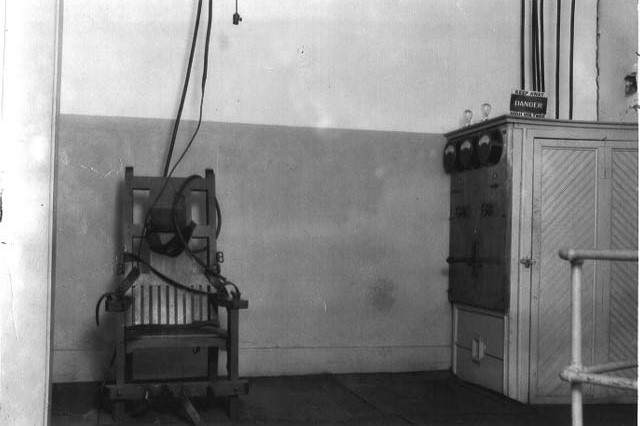
(1926-48 “Old Sparky” Electric Chair, 104 executions at the Tucker Unit in the state of Arkansas, USA; Wikimedia, PD)
I read this recent New York Times interview with people who have witnessed an act of capital punishment in the United States. Whatever your view of the death penalty, hearing those with actual experience of the act humanizes that opinion.
Those who enter the observation room bitter don’t often forgive, even after death. Staff are traumatized by it. Many just leave numb and knowing they witnessed something terrible, although not always certain how to even explain it. If this sounds eerily similar to the scenes at the end of the Gospels, then don’t forget that the apostles, too, witnessed a capital punishment carried out by an imperial authority by way of lawful trial, and with the support of both the police and religious figures of the time.
Part of the reason why I’m staunchly opposed to capital punishment, aside from many compelling pragmatic arguments against it, such as this recent article, which recounts the tragic story of the latest person who will likely join those exonerated after death. This is the case because essentially, what is happening here is the state is attempting to provide retribution for heinous crimes through its own (sterilized) form of violence. And people don’t typically leave that room feeling like they’ve forgiven their offender, and are now free to move on. Both parties are obscured from one another, not only physically by barriers, but also by the state. People aren’t allowed to reconcile with one another even if they want to. And the same is true for our courts, often. For a radically different approach, consider the video about the Truth and Reconciliation Commission in South Africa at the bottom of this post.
It is easy to just overlook all of the obvious problems within this country and impute the effects of our collective diseases to a scapegoat: criminals. And this category often falls conveniently alongside lines of profiling which benefit some more than others. But even leaving that aside, because universal statements about crime are not honest, many crimes in this country are fixed through things like better mental health resources (), a safer and fairer economic playing field, and so on.
Criminals are scapegoats. They are an easy target. They generally emerge from a life of poverty where they weren’t granted significant societal resources, nor social capital. As Elizabeth Bruenig pointed out recently on Twitter, they don’t have paid lobbyists at CNN and in the White House to explain their struggles to the powerful, and even if they did, it wouldn’t matter.
Injustice gives birth more injustice, and structural sins that “will be passed down for four generations.” Granting the state power to be Lord over our lives is a wager some have accepted, in light of the disorder we all see within our country, but it’s the most dangerous wager. Unfortunately, we’ve already allowed it.
Opinion has shifted on capital punishment a lot since the 90s, when Bill Clinton had to watch a mentally disabled African American man be put to death and praised the act, in order to prove he was “tough on crime.” If there was widespread opposition to capital punishment today, it is not idealistic to think the heinous practice could be done away with. Personally, I have encountered many individuals inside a maximum security prison who call their life sentences “death by incarceration,” and I think that also is a form of a death penalty, but we must begin somewhere. Another good starting point might be eliminating torture within US prisons.
I believe we are standing in the midst of a critical point in human history, and making the world better will be difficult, because that means we must restructure everything in a way that promotes peace, fairness, and all of those great words we have in our constitutions, or in enlightenment philosophies, and often, in our holy books. Our states have been lousy gods, and regaining control means demythologizing them; we have to learn to collectively become atheists of the lousy gods that we’ve previously given all the power to kill us, lock us up, manipulate our economies, and torture us in hopes of preserving the religious myths which legitimize them.
And we need to continue to become disenchanted with our own cultural and religious ways of thinking which have directly legitimized those lousy gods. I would argue that in the 20th century Mainline Protestants were experts at demytholigizing their own God, often too much and they were awful at demythologizing the religious myths of the United States itself.
Evangelicals and some conservative Catholics have fully embraced their cozy seat next to the emperor, but emperors are often fickle. Just because you’re not effected yet doesn’t mean you won’t be. This is the end of an epoch. I pray the God who is with us as we live in a world without Him, can give us strength.
Our God was executed, and, in a certain sense, we share in his execution, we also share his resurrection.
Executed church. Rise up!
Luke Pigott hails from the deep south, where he first began studying theology at the southern baptist college, William Carey University. He then moved to Philadelphia, where he completed an M.A. at Villanova University, worked as an adjunct professor for Villanova, Saint Joseph’s University, and most extensively, as a theology and philosophy professor for Villanova’s inner-prison B.A. program. He began a Ph.D. at the Lutheran Theological Seminary at Philadelphia, but that school no longer exists due to neoliberal austerity. He is currently back in Mississippi, asking himself whether he should be doing something more dangerous than finishing his Ph.D. elsewhere. Luke is also a professional coffee roaster and musician.
If you feel up to the task, you should also read Squishy New Atheist Pieties Miss Gospel Love’s Ruthless Demands.
Please also make a donation to this blog through the button on the upper right side of this page to help keep it going.
Stay in touch! Like Cosmos the in Lost on Facebook:


Next Post
May 3, 2017 Western Civ Doesn't Need Tenured Radicals to Ruin Itself
Browse Our Archives
Select a Category #WhyRemainCatholic Abortion Advent Anti-Catholicism Arts Atheism Beauty Benedict XVI Bible Book Review Catholic Cinema Comedy Cosmos: A Space-Time Odyssey Czesław Miłosz Dariusz Karłowicz Devil Easter Eastern Orthodoxy Economics Environment Family Famous Atheists Who Weren't Atheists Guest Post Hans Urs von Balthasar HHS Mandate History Imagination Interview Islam Jean-Luc Marion John Paul II Judaism Just War Lent Literature Little Sisters of the Poor Liturgy Martyrdom Music News Paganism Patristics Phenomenology Philosophy Pierre Hadot Poetry Poland Pop Culture Pope Francis Poverty Prayer Protestantism Rabelais Race Remi Brague Rene Girard Russia Sam Rocha Science & Religion SCOTUS Secularization Sexual Abuse Sexuality Silence Solidarity Stratford Caldecott Synod14 Terrorism Top 10 Uncategorized Walker Percy War Weakened Edition World War II World Youth Day WYD Krakow
Select a Month July 2017 June 2017 May 2017 April 2017 March 2017 February 2017 January 2017 December 2016 October 2016 September 2016 August 2016 July 2016 June 2016 May 2016 April 2016 March 2016 February 2016 January 2016 December 2015 November 2015 October 2015 September 2015 August 2015 July 2015 June 2015 May 2015 April 2015 March 2015 February 2015 January 2015 December 2014 November 2014 October 2014 September 2014 August 2014 July 2014 May 2014 April 2014 March 2014 February 2014 January 2014 December 2013 November 2013 October 2013 September 2013 August 2013 July 2013 June 2013 May 2013
Follow Us!
TAKE THE
Religious Wisdom Quiz
True or False: Balaam's donkey spoke to him.
Select your answer to see how you score.
FALSE TRUE
Related posts from Cosmos The In Lost

The Surprising Anti-Capitalist Logic Behind the Catholic Church's...

What is the Source of Our Culture of...


The Holy Family as an Icon of World...
TRENDING AT PATHEOS Catholic

Rejecting Doom: Christian Hope And Human Action
Christianity is a religion of hope. We are to have hope and...

It’s What Comes From Within Which Matters
One of the most difficult things for us to understand is why...

Why I Choose the Eucharist Over the Sermon
Choose the Eucharist, Not the Sermon What are we supposed to get...

5 Design Elements Found in Spiritually Rooted Homes
Putting Spirituality Into Home Decor Our homes are more than our living...

Credo: A Story of God Told with the...
About 10 years ago, I began to imagine a personal "Credo" that...

The Anatomy of Divine Revelation in Catholic Thought
The claim that God has made Himself known to human beings is...
view all Catholic blogs
Ad-Free & Subscriber Log-In Subscription Support
- About Us
- 2026 Calendar
- Videos
- Podcasts
- Library of World Religions
- Faith In Media Tracker
- Advertise With Us
- Write for Us
- Privacy Policy
- Terms of Service
- Do Not Sell My Data
- Contact Us
- Radiant Digital
- Manage Newsletter Subscriptions
- Unsubscribe From Notifications
- Sitemap
Copyright 2008-2026, Patheos. All rights reserved.
Subscription Support Ad-Free & Subscriber Log-In
Follow Patheos