
BuddhistCatholicContemplativeEvangelicalGeneral ChristianHinduJewishLatter-day SaintMuslimNew VisionsProgressive Christian
Beliefs
- Buddhist
- Catholic
- Contemplative
- Evangelical
- General Christian
- Hindu
- Jewish
- Latter-day Saint
- More Voices
- Muslim
- New Visions
- Pagan
- Progressive Christian
Topics
- Religion News
- Food and Religion
- Sports and Religion
- Religious Art
- Religious Music and Entertainment
- Religious Events
- History and Religion
- Style and Religion
- Politics and Religion
- Women in Religion
- Recreation Outdoors and Religion
- Business Finance and Religion
- Careers Workplace and Religion
- Education and Religion
- Family Parenting and Religion
- Health Fitness and Religion
- Home and Religion
- Relationships and Religion
- Technology and Religion
- Travel and Religion
Columnists
- Buddhist Columnists
- Business Finance and Religion Columnists
- Careers Workplace and Religion Columnists
- Catholic Columnists
- Contemplative Columnists
- Education and Religion Columnists
- Evangelists Columnists
- Family Parenting and Religion Columnists
- General Christian Columnists
- Health Fitness and Religion Columnists
- Hindu Columnists
- History and Religion Columnists
- Home and Religion Columnists
- Jewish Columnists
- More Voices Columnists
- Latter Day Columnists
- Muslim Columnists
- New Visions Columnists
- Nonreligious Columnists
- Pagan Columnists
- Politics and Religion Columnists
- Progressive Columnists
- Recreation Outdoors and Religion Columnists
- Relationships and Religion Columnists
- Religion News Columnists
- Religious Art Columnists
- Religious Events Columnists
- Religious Music and Entertainment Columnists
- Sports and Religion Columnists
- Style and Religion Columnists
- Technology and Religion Columnists
- Travel and Religion Columnists
- Women in Religion Columnists
Resource Library
- 2026 Calendar
- Library of World Religions
- The 100 Most Holy Places on Earth
- Patheos Answers
- Podcasts
- Videos
- Faith Leaders Database
- Anglican Episcopalian
- Bahai
- Baptist
- Buddhism
- Christianity
- Confucianism
- Eastern Orthodoxy
- Hinduism
- Holiness and Pentecostal
- ISKCON
- Islam
- Judaism
- Lutheran
- Methodist
- The Church of Jesus Christ of Latter-day Saints
- New Age
- Paganism
- Presbytarian and Reformed
- Protestantism
- Religion Behind the Scenes
- Roman Catholic
- Scientology
- Shia Islam
- Sikhism
- Sufism
- Sunni Islam
- Taoism
- Zen
- See all religions
Research Tools
 Ad-Free & Subscriber Log-In Subscription Support
Ad-Free & Subscriber Log-In Subscription Support
Follow Patheos 

- Trending:
- Forgiveness
- |
- Marriage
- |
- Consciousness
- |
- Death Penalty
- |
- Election
- |
- Halloween
 Cosmos The In Lost
- Home
- Catholic
- It’s a Good Friday to Leave Calypso’s Island
It’s a Good Friday to Leave Calypso’s Island
Last updated on: April 14, 2017 at 12:14 pm by Artur Rosman
It’s a Good Friday to Leave Calypso’s Island 2017-04-14T12:14:15-07:00 Artur Rosman
Patheos Explore the world's faith through different perspectives on religion and spirituality! Patheos has the views of the prevalent religions and spiritualities of the world.
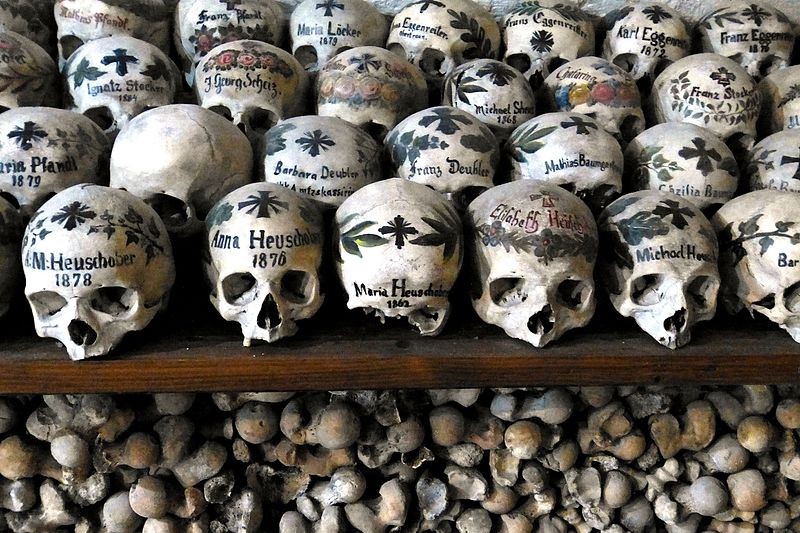
A subtle reminder for Good Friday (Wolfgand Sauber, Hallstatt Ossuary Painted skulls; Wikimedia, CC BY SA 4.0)
The specter of death haunts Western civilization at its roots like any other civilization. Greek and Roman popular religions saw death as ultimately defining what it means to be human. Mortality was so essential to being human for the ancients that Odysseus rejected the rare offer of immortality (essentially, to stop being human) by leaving Calypso’s island to return to Penelope in Ithaca.
 This gesture is incomprehensible to us, because posthumanist aspirations to overcome death define our post-Christian epoch. There was even a presidential candidate in the last election, Zoltan Istvan, who lured potential voters with a posthuman non-death like Calypso.
The Irish phenomenologist, Felix O Murchadha, captures the striking difference between Christian and ancient attitudes towards death in his A Phenomenology of Christian Life: Glory and Night:
The ancient gods—Greek and Semitic alike—abhorred death. In Homer the hero knew his death was imminent when he sensed the god or goddess who championed him fleeing from his presence. The destiny of death was that which not even Zeus, the father of the gods, could stop—nor could any god be present to it. Death separated the immortals from the mortals as that which the immortals could not know—neither of themselves nor of others. Knowledge of death separated the human from all other beings, including the gods.
The same sentiments, but filled with a dread of death mostly unfamiliar to the ancients, are what started me on reading Karl Ove Knausgaard’s remarkable My Struggle novels:
For the heart, life is simple: it beats for as long as it can. Then it stops. Sooner or later, one day, this pounding action will cease of its own accord, and the blood will begin to run towards the body’s lowest point, where it will collect in a small pool, visible from the outside as a dark, soft patch on ever whitening skin, as the temperature sinks, the limbs stiffen and the intestines drain. These changes in the first hours occur so slowly and take place with such inexorability that there is something almost ritualistic about them, as though life capitulates according to specific rules, a kind of gentleman’s agreement to which the representatives of death also adhere, inasmuch as they always wait until life has retreated before they launch their invasion of the new landscape.
You might object that, at the very least, Plato, Socrates, and their philosophical followers did not see death as the ultimate boundary of life. You might be partly right, even if not all philosophers thought immortality was our destiny. But it is important to remember, that no matter how central their texts and beliefs have become for the West thanks to their Christian appropriation, the philosophers were by no means the mainstream of ancient popular thinking.
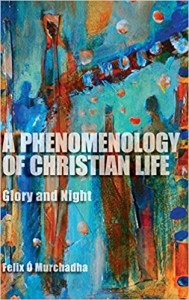 Socrates and Other Saints, a recently published book translation of mine, details how the Christian appropriation of philosophical ideas, especially about divinization, were finally democratized and made available to the masses–especially thanks to the witness of the martyrs (also an ancient philosophical, not mainstream, idea). A Phenomenology of Christian Life, in a discussion of Good Friday, reveals the incongruity between Socrates freely choosing death, even advocating practicing in preparation for death, with mainstream Greek beliefs, whose avoidance of death dictated even the structuring of cities:
“Dying he destroyed our death . . .” Those words of the Catholic liturgy depend for their resonance not on a belief in the afterlife—such a belief was not (and is not) peculiar to Christianity. Rather, they mean a bringing of death into the realm of the living, a living with death in an unprecedented manner. Death, which in the ancient world was kept beyond the walls of the city and far away from sacred space, is now placed at the center of the holy. The dead and the divine were reconciled in one and brought within the city. Christian churches are tombs: built around altars which contain relics, bodies between life and death—dead and yet making present the principle of life, the example of Christ. The Christian worships among the dead, walks the way of death and crucifixion in the church, and goes through death in entering the church. Death is no longer unclean, no longer accursed. Rather, death as a leaving of life becomes a way of living: no longer a preparation for death but to live now as if after death, as if death were destroyed.
It is usually in terms of an emotive mourning the death of a certain Constantinian Christian cultural hegemony that we hear about churches being called tombs. This is seen as a bad thing. Thinking this way forgets a much more important ancient Christian insight. Death is a good thing. Death is something that we should welcome. It is our door to our true homeland. However, Good Friday reminds us that death is not something we can leap over thanks to the get-out-jail-free card of the Resurrection (click below to continue): . . .

Next Post
April 15, 2017 Why Yes, The Vatican Museums Are Actually Taking Donations of Blood Money
Browse Our Archives
Select a Category #WhyRemainCatholic Abortion Advent Anti-Catholicism Arts Atheism Beauty Benedict XVI Bible Book Review Catholic Cinema Comedy Cosmos: A Space-Time Odyssey Czesław Miłosz Dariusz Karłowicz Devil Easter Eastern Orthodoxy Economics Environment Family Famous Atheists Who Weren't Atheists Guest Post Hans Urs von Balthasar HHS Mandate History Imagination Interview Islam Jean-Luc Marion John Paul II Judaism Just War Lent Literature Little Sisters of the Poor Liturgy Martyrdom Music News Paganism Patristics Phenomenology Philosophy Pierre Hadot Poetry Poland Pop Culture Pope Francis Poverty Prayer Protestantism Rabelais Race Remi Brague Rene Girard Russia Sam Rocha Science & Religion SCOTUS Secularization Sexual Abuse Sexuality Silence Solidarity Stratford Caldecott Synod14 Terrorism Top 10 Uncategorized Walker Percy War Weakened Edition World War II World Youth Day WYD Krakow
Select a Month July 2017 June 2017 May 2017 April 2017 March 2017 February 2017 January 2017 December 2016 October 2016 September 2016 August 2016 July 2016 June 2016 May 2016 April 2016 March 2016 February 2016 January 2016 December 2015 November 2015 October 2015 September 2015 August 2015 July 2015 June 2015 May 2015 April 2015 March 2015 February 2015 January 2015 December 2014 November 2014 October 2014 September 2014 August 2014 July 2014 May 2014 April 2014 March 2014 February 2014 January 2014 December 2013 November 2013 October 2013 September 2013 August 2013 July 2013 June 2013 May 2013
Follow Us!
TAKE THE
Religious Wisdom Quiz
The glory of this present house will be greater than the glory of the former house. What building is being reconstructed?
Select your answer to see how you score.
The palace The whole of Jerusalem The city wall The temple
Related posts from Cosmos The In Lost

The Surprising Anti-Capitalist Logic Behind the Catholic Church's...


Where Does the Body of Christ Go After...

How is Classical Philosophy is Like War?
TRENDING AT PATHEOS Catholic

Rejecting Doom: Christian Hope And Human Action
Christianity is a religion of hope. We are to have hope and...

It’s What Comes From Within Which Matters
One of the most difficult things for us to understand is why...

Why I Choose the Eucharist Over the Sermon
Choose the Eucharist, Not the Sermon What are we supposed to get...

5 Design Elements Found in Spiritually Rooted Homes
Putting Spirituality Into Home Decor Our homes are more than our living...

Credo: A Story of God Told with the...
About 10 years ago, I began to imagine a personal "Credo" that...

The Anatomy of Divine Revelation in Catholic Thought
The claim that God has made Himself known to human beings is...
view all Catholic blogs
Ad-Free & Subscriber Log-In Subscription Support
- About Us
- 2026 Calendar
- Videos
- Podcasts
- Library of World Religions
- Faith In Media Tracker
- Advertise With Us
- Write for Us
- Privacy Policy
- Terms of Service
- Do Not Sell My Data
- Contact Us
- Radiant Digital
- Manage Newsletter Subscriptions
- Unsubscribe From Notifications
- Sitemap
Copyright 2008-2026, Patheos. All rights reserved.
Subscription Support Ad-Free & Subscriber Log-In
Follow Patheos