
BuddhistCatholicContemplativeEvangelicalGeneral ChristianHinduJewishLatter-day SaintMuslimNew VisionsProgressive Christian
Beliefs
- Buddhist
- Catholic
- Contemplative
- Evangelical
- General Christian
- Hindu
- Jewish
- Latter-day Saint
- More Voices
- Muslim
- New Visions
- Pagan
- Progressive Christian
Topics
- Religion News
- Food and Religion
- Sports and Religion
- Religious Art
- Religious Music and Entertainment
- Religious Events
- History and Religion
- Style and Religion
- Politics and Religion
- Women in Religion
- Recreation Outdoors and Religion
- Business Finance and Religion
- Careers Workplace and Religion
- Education and Religion
- Family Parenting and Religion
- Health Fitness and Religion
- Home and Religion
- Relationships and Religion
- Technology and Religion
- Travel and Religion
Columnists
- Buddhist Columnists
- Business Finance and Religion Columnists
- Careers Workplace and Religion Columnists
- Catholic Columnists
- Contemplative Columnists
- Education and Religion Columnists
- Evangelists Columnists
- Family Parenting and Religion Columnists
- General Christian Columnists
- Health Fitness and Religion Columnists
- Hindu Columnists
- History and Religion Columnists
- Home and Religion Columnists
- Jewish Columnists
- More Voices Columnists
- Latter Day Columnists
- Muslim Columnists
- New Visions Columnists
- Nonreligious Columnists
- Pagan Columnists
- Politics and Religion Columnists
- Progressive Columnists
- Recreation Outdoors and Religion Columnists
- Relationships and Religion Columnists
- Religion News Columnists
- Religious Art Columnists
- Religious Events Columnists
- Religious Music and Entertainment Columnists
- Sports and Religion Columnists
- Style and Religion Columnists
- Technology and Religion Columnists
- Travel and Religion Columnists
- Women in Religion Columnists
Resource Library
- 2026 Calendar
- Library of World Religions
- The 100 Most Holy Places on Earth
- Patheos Answers
- Podcasts
- Videos
- Faith Leaders Database
- Anglican Episcopalian
- Bahai
- Baptist
- Buddhism
- Christianity
- Confucianism
- Eastern Orthodoxy
- Hinduism
- Holiness and Pentecostal
- ISKCON
- Islam
- Judaism
- Lutheran
- Methodist
- The Church of Jesus Christ of Latter-day Saints
- New Age
- Paganism
- Presbytarian and Reformed
- Protestantism
- Religion Behind the Scenes
- Roman Catholic
- Scientology
- Shia Islam
- Sikhism
- Sufism
- Sunni Islam
- Taoism
- Zen
- See all religions
Research Tools
 Ad-Free & Subscriber Log-In Subscription Support
Ad-Free & Subscriber Log-In Subscription Support
Follow Patheos 

- Trending:
- Forgiveness
- |
- Marriage
- |
- Consciousness
- |
- Death Penalty
- |
- Election
- |
- Halloween
 Cosmos The In Lost
- Home
- Catholic
- Is There a Way to Get Beyond Making the Best of a Bad Liturgy?
Is There a Way to Get Beyond Making the Best of a Bad Liturgy?
Last updated on: March 15, 2017 at 4:30 pm by Guest Contributor
Is There a Way to Get Beyond Making the Best of a Bad Liturgy? 2017-03-15T16:30:40-07:00 Guest Contributor
Patheos Explore the world's faith through different perspectives on religion and spirituality! Patheos has the views of the prevalent religions and spiritualities of the world.
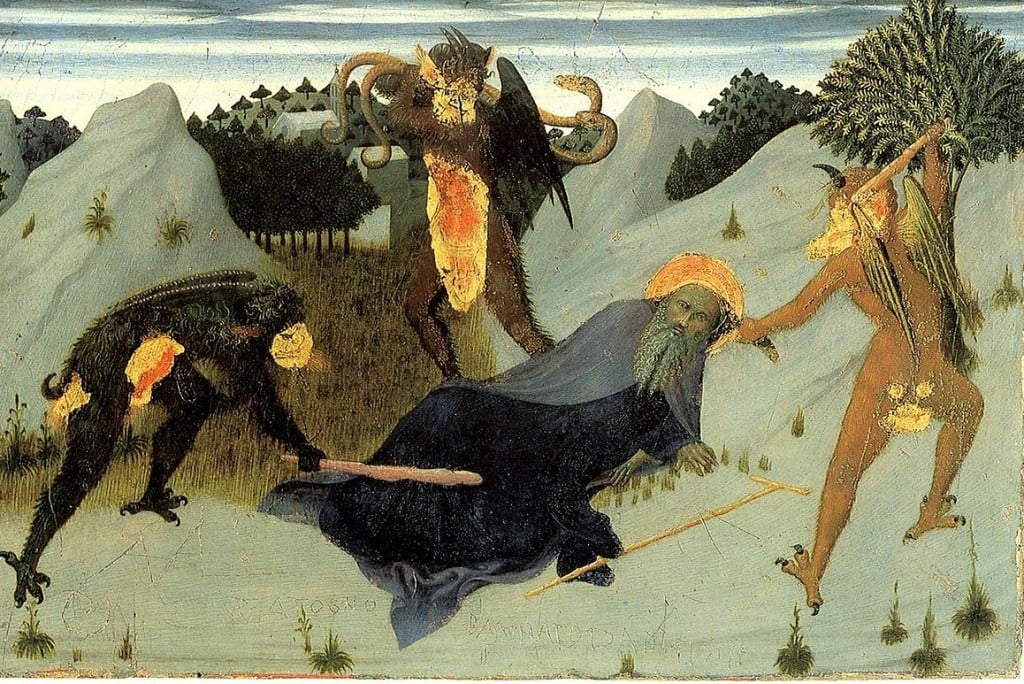
Bad liturgy frequently feels like… (Stefano di Giovanni, St. Anthony Beaten by the Devil, 1432; Wiki, PD-Old-100)
The following is an exchange I facilitated between Villanova theologian Kevin Hughes and Notre Dame liturgist Timothy O’Malley (I’ll resist the urge to say “Go Zags!”).
Their exchange grew out of a discussion I started with the statement, “Bad liturgy is a form of penance.”
 Kevin Hughes: You’ve written so beautifully about the relationship between liturgy and life, and I have learned so much. You’re following in a great tradition of writers like Romano Guardini, Alexander Schmemann, Joseph Ratzinger, and David Fagerberg. When I read all of these authors, I find myself torn. On the one hand, I am completely persuaded, in theory, but, at the same time, I cannot read this stuff without some sense of guilt or shame or disappointment. Almost every experience of liturgy I have on a regular basis simply cannot bear the weight that this theory seems to place on it. There are real limits on what our present liturgy seems to be capable of expressing, both aesthetically and theologically. My own spiritual strategy each Sunday is more like finding a way to make the best use of a bad liturgy than it is to delight in the “source and summit of our faith.” And when I talk to my fellow parishioners, I find that I am not alone. I have a good parish, so the good news is that we all are committed to make the best of it. But the bad news is that we have just make the best of it.
This sense of lack, of aesthetic, symbolic, and spiritual thinness, has led me from time to time to explore the Extraordinary Form liturgies. There, I have found that the form of the liturgy is richer, but too often it is surrounded by a self-satisfied chill in the air. “EF” communities in my experience are tempted to a kind of pride in being among the chosen few who are “doing it right,” and it’s as if the whole community is embodying Jesus’ Parable of the Pharisee and the Tax Collector. So I find it hard to pray there. So for better or for worse, I am in a “tax collector” community… limping along. It isn’t pretty, and we all know it, but I’m hoping we “walk away justified.” What can we do?
 Timothy O’Malley: I hear your cry of lament (and have to say that I’ve often thought the same thing). I’ve frequently read the claim of Alexander Schmemann that liturgy is prima theologia, first order theology, and I’ve thought to myself, “I hope not.” It would mean that first order theology is often poorly done, absent aesthetic splendor, and devoid of a moment of contemplation.
I fear that liturgical theology in attempting to elevate the liturgy to a place of privilege in theology has bypassed the particularity of liturgical celebrations. Liturgy, in general, may be the union of heaven and earth, the transfiguration of the polis according to the Eucharistic logic of the God-man. But, it is often difficult to perceive this claim in light of the actual, too often suburban, therapeutic celebrations that mark post-conciliar liturgy. Like Aidan Kavanagh, I hope that liturgical education is more than the making of really nice banners for worship. But, I also hope that liturgical education does not simply become a series of Platonic claims about the nature of a liturgy that rarely exists hic et nunc.
I do see the Extraordinary Form as a reaction against the therapeutic and verbose liturgical prayer that often marks celebrations of the Novus Ordo. But, as you note, I also find it disturbing that adherents of the Latin Mass can easily take up a posture that is almost Donatist. . .
Next Post

March 14, 2017 2017: The Year Your Sperm Stopped Swimming and Started Drowning
Browse Our Archives
Select a Category #WhyRemainCatholic Abortion Advent Anti-Catholicism Arts Atheism Beauty Benedict XVI Bible Book Review Catholic Cinema Comedy Cosmos: A Space-Time Odyssey Czesław Miłosz Dariusz Karłowicz Devil Easter Eastern Orthodoxy Economics Environment Family Famous Atheists Who Weren't Atheists Guest Post Hans Urs von Balthasar HHS Mandate History Imagination Interview Islam Jean-Luc Marion John Paul II Judaism Just War Lent Literature Little Sisters of the Poor Liturgy Martyrdom Music News Paganism Patristics Phenomenology Philosophy Pierre Hadot Poetry Poland Pop Culture Pope Francis Poverty Prayer Protestantism Rabelais Race Remi Brague Rene Girard Russia Sam Rocha Science & Religion SCOTUS Secularization Sexual Abuse Sexuality Silence Solidarity Stratford Caldecott Synod14 Terrorism Top 10 Uncategorized Walker Percy War Weakened Edition World War II World Youth Day WYD Krakow
Select a Month July 2017 June 2017 May 2017 April 2017 March 2017 February 2017 January 2017 December 2016 October 2016 September 2016 August 2016 July 2016 June 2016 May 2016 April 2016 March 2016 February 2016 January 2016 December 2015 November 2015 October 2015 September 2015 August 2015 July 2015 June 2015 May 2015 April 2015 March 2015 February 2015 January 2015 December 2014 November 2014 October 2014 September 2014 August 2014 July 2014 May 2014 April 2014 March 2014 February 2014 January 2014 December 2013 November 2013 October 2013 September 2013 August 2013 July 2013 June 2013 May 2013
Follow Us!
TAKE THE
Religious Wisdom Quiz
Which prophet was commanded to buy a field during a siege?
Select your answer to see how you score.
Isaiah Habakkuk Jeremiah Obadiah
Related posts from Cosmos The In Lost

The Surprising Anti-Capitalist Logic Behind the Catholic Church's...

Where Does the Body of Christ Go After...

How is Classical Philosophy is Like War?

Why Does the World's Leading Philosopher Remain a...
TRENDING AT PATHEOS Catholic

Rejecting Doom: Christian Hope And Human Action
Christianity is a religion of hope. We are to have hope and...

It’s What Comes From Within Which Matters
One of the most difficult things for us to understand is why...

Why I Choose the Eucharist Over the Sermon
Choose the Eucharist, Not the Sermon What are we supposed to get...

5 Design Elements Found in Spiritually Rooted Homes
Putting Spirituality Into Home Decor Our homes are more than our living...

Credo: A Story of God Told with the...
About 10 years ago, I began to imagine a personal "Credo" that...

The Anatomy of Divine Revelation in Catholic Thought
The claim that God has made Himself known to human beings is...
view all Catholic blogs
Ad-Free & Subscriber Log-In Subscription Support
- About Us
- 2026 Calendar
- Videos
- Podcasts
- Library of World Religions
- Faith In Media Tracker
- Advertise With Us
- Write for Us
- Privacy Policy
- Terms of Service
- Do Not Sell My Data
- Contact Us
- Radiant Digital
- Manage Newsletter Subscriptions
- Unsubscribe From Notifications
- Sitemap
Copyright 2008-2026, Patheos. All rights reserved.
Subscription Support Ad-Free & Subscriber Log-In
Follow Patheos