
BuddhistCatholicContemplativeEvangelicalGeneral ChristianHinduJewishLatter-day SaintMuslimNew VisionsProgressive Christian
Beliefs
- Buddhist
- Catholic
- Contemplative
- Evangelical
- General Christian
- Hindu
- Jewish
- Latter-day Saint
- More Voices
- Muslim
- New Visions
- Pagan
- Progressive Christian
Topics
- Religion News
- Food and Religion
- Sports and Religion
- Religious Art
- Religious Music and Entertainment
- Religious Events
- History and Religion
- Style and Religion
- Politics and Religion
- Women in Religion
- Recreation Outdoors and Religion
- Business Finance and Religion
- Careers Workplace and Religion
- Education and Religion
- Family Parenting and Religion
- Health Fitness and Religion
- Home and Religion
- Relationships and Religion
- Technology and Religion
- Travel and Religion
Columnists
- Buddhist Columnists
- Business Finance and Religion Columnists
- Careers Workplace and Religion Columnists
- Catholic Columnists
- Contemplative Columnists
- Education and Religion Columnists
- Evangelists Columnists
- Family Parenting and Religion Columnists
- General Christian Columnists
- Health Fitness and Religion Columnists
- Hindu Columnists
- History and Religion Columnists
- Home and Religion Columnists
- Jewish Columnists
- More Voices Columnists
- Latter Day Columnists
- Muslim Columnists
- New Visions Columnists
- Nonreligious Columnists
- Pagan Columnists
- Politics and Religion Columnists
- Progressive Columnists
- Recreation Outdoors and Religion Columnists
- Relationships and Religion Columnists
- Religion News Columnists
- Religious Art Columnists
- Religious Events Columnists
- Religious Music and Entertainment Columnists
- Sports and Religion Columnists
- Style and Religion Columnists
- Technology and Religion Columnists
- Travel and Religion Columnists
- Women in Religion Columnists
Resource Library
- 2026 Calendar
- Library of World Religions
- The 100 Most Holy Places on Earth
- Patheos Answers
- Podcasts
- Videos
- Faith Leaders Database
- Anglican Episcopalian
- Bahai
- Baptist
- Buddhism
- Christianity
- Confucianism
- Eastern Orthodoxy
- Hinduism
- Holiness and Pentecostal
- ISKCON
- Islam
- Judaism
- Lutheran
- Methodist
- The Church of Jesus Christ of Latter-day Saints
- New Age
- Paganism
- Presbytarian and Reformed
- Protestantism
- Religion Behind the Scenes
- Roman Catholic
- Scientology
- Shia Islam
- Sikhism
- Sufism
- Sunni Islam
- Taoism
- Zen
- See all religions
Research Tools
 Ad-Free & Subscriber Log-In Subscription Support
Ad-Free & Subscriber Log-In Subscription Support
Follow Patheos 

- Trending:
- Forgiveness
- |
- Marriage
- |
- Consciousness
- |
- Death Penalty
- |
- Election
- |
- Halloween
 Cosmos The In Lost
- Home
- Catholic
- Don’t Give Up For Lent
Don’t Give Up For Lent
Last updated on: March 1, 2017 at 3:10 pm by Artur Rosman
Don’t Give Up For Lent 2017-03-01T15:10:10-07:00 Artur Rosman
Patheos Explore the world's faith through different perspectives on religion and spirituality! Patheos has the views of the prevalent religions and spiritualities of the world.
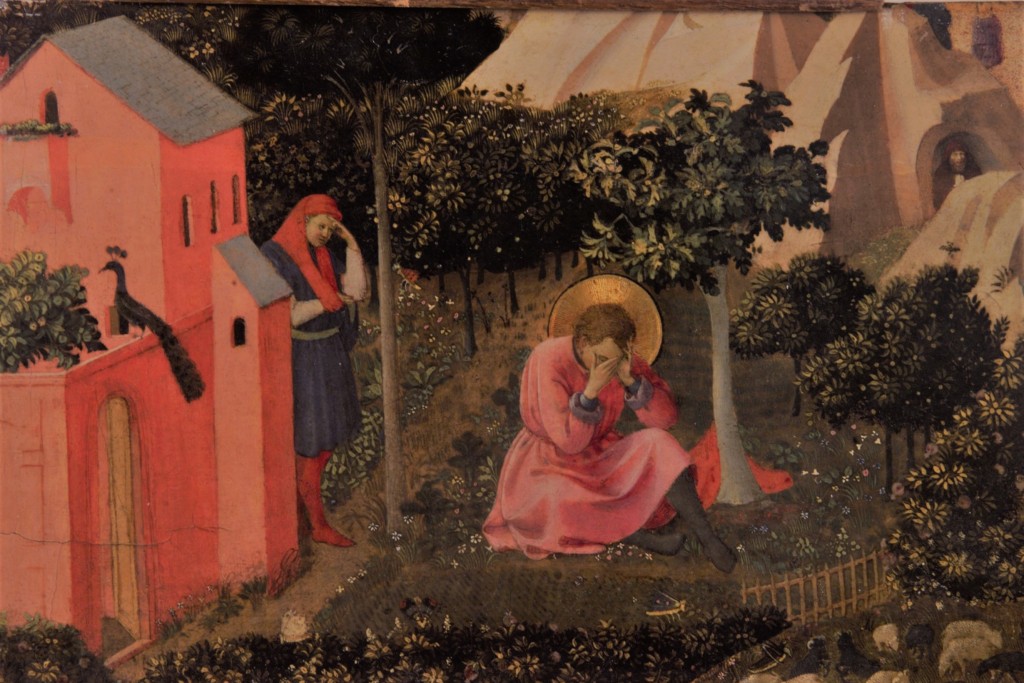
(Fra Angelico, Conversion of St. Augustine, 1435; Wiki Commons, PD-Old-100).
To the outsider the season of Lent might seem like an irrational outbreak of Pelagianism. Believers who come from the Catholic tradition, and the Protestant traditions which are rediscovering the ancient Catholic ascetic tradition, busy themselves with what they’re going to give up for Lent. It all sounds like an Olympiad of will-to-power. The responses run something like, “I can’t believe you’re giving up X for Lent. I couldn’t live without it for so long. You’re so brave!”
As I watch this spectacle from the sidelines I start fearing that there’s no way I could possible participate in all that. It makes me think of my longtime insomnia and how much effort I expend each night dreading my inability to surrender everything I failed to do during the day and feeling dread over everything the next morning will bring. This festival of vanity then translates itself into a Heideggerian general anxiety about our travail being nothing but a being-onto-death, but one I cannot willingly accept as my fate. It is beyond my powers.
Marvin C. Shaw’s The Paradox of Intention, a book I discovered while researching Christian practices of silence, speaks to this very point when one reaches the end of one’s rope:
Normally, we assume that goals are reached through the expenditure of mental and physical effort, and the so-called paradox of intention strikes us as perhaps intriguing, as some sort of mental puzzle, but finally as illogical and unavailaing. Now if this or any other difficulty arises, and the point of what you are reading escapes you, you have an opportunity to put into practice this paradoxical method we are attempting to understand. Simply take the advice of the medieval Christian mystic Suso, let go of the effort to grasp the meaning . . .
Just try not thinking about a bear. No BEAR!
Augustine’s Confessions further dramatizes both the paradox and salvation from it.
But the abyss of the human conscience lies naked to your eyes, O Lord, so would anything be secret even if I were unwilling to confess to you? I would be hiding you from myself, but not myself from you. But now that my groans bear witness that I find no pleasure in myself, you shed light upon me and give me joy, you offer yourself, lovable and longed for, that I may thrust myself away in disgust and choose you, and be pleasing no more either to you or to myself except in what I have from you . . . Let me, then, confess what I know about myself, and confess too what I do not know, because what I know of myself I know only because you shed light on me, and what I do not know I shall remain ignorant about until my darkness becomes like bright noon before your face.
Pope Gregory’s Moral Reflections on Job, working off of Isaiah, explain how the face of God appears to us as we go through this process of educating our desires.
I make good fortune and create calamity, because when we wrongly covet things which it was right for God to create, they are turned into scourges and we see them as evil. We have been alienated from God by sin, and it is fitting that we should be brought back to peace with him by the scourge. As every being, which was created good, turns to pain for us, the mind of the chastened man may, in its humbled state, be made new in peace with the Creator.
Everything that God creates is good since it draws its being from himself. However, we only see the world as evil, and alienate ourselves from God, if we use the things within it incorrectly (I believe Augustine’s On Christian Teaching was the first theologically systematic account of this). So in the end Lent is crowned not so much by giving up anything in particular, but clinging to the graces God freely gives us.
It is a time specifically designated for giving up on ourselves and our efforts, so that we can throw ourselves onto the heartbreaking mercy of God, so in the end we regain all that we have lost in the proper perspective, before God’s face, not in the deceiving reflections of our own willpower. If there was one thing that the Early Christians taught us, it’s that seeking the face of God should be our sole concern. In a more modern idiom, this involves what Jean-Luc Marion calls an inverse intentionality, or, in Dante’s idiom, “E ‘n la sua volontade è nostra pace.”
How to find God’s will and our pace? The Liturgy of Hours is one of the best places to start. Holy tears might also help to obscure our misguided view of ourselves.
May God shatter your heart this Lent, because your own self, like mine, might be such a good thing.
Don’t give up through your own will, cling to God’s will for you, because you’re never ultimately the one doing the giving.
You might also want to take a look at He Emptied Himself: A Kenosis Reading List, which has some great books that you might want to take up for Lent.
Please consider making a donation to this blog through the donation button on the upper right side of its homepage so that we can replace the bald tires on our car. You might miss me if I’m gone!
Stay in touch! Like Cosmos the in Lost on Facebook:

Browse Our Archives
Select a Category #WhyRemainCatholic Abortion Advent Anti-Catholicism Arts Atheism Beauty Benedict XVI Bible Book Review Catholic Cinema Comedy Cosmos: A Space-Time Odyssey Czesław Miłosz Dariusz Karłowicz Devil Easter Eastern Orthodoxy Economics Environment Family Famous Atheists Who Weren't Atheists Guest Post Hans Urs von Balthasar HHS Mandate History Imagination Interview Islam Jean-Luc Marion John Paul II Judaism Just War Lent Literature Little Sisters of the Poor Liturgy Martyrdom Music News Paganism Patristics Phenomenology Philosophy Pierre Hadot Poetry Poland Pop Culture Pope Francis Poverty Prayer Protestantism Rabelais Race Remi Brague Rene Girard Russia Sam Rocha Science & Religion SCOTUS Secularization Sexual Abuse Sexuality Silence Solidarity Stratford Caldecott Synod14 Terrorism Top 10 Uncategorized Walker Percy War Weakened Edition World War II World Youth Day WYD Krakow
Select a Month July 2017 June 2017 May 2017 April 2017 March 2017 February 2017 January 2017 December 2016 October 2016 September 2016 August 2016 July 2016 June 2016 May 2016 April 2016 March 2016 February 2016 January 2016 December 2015 November 2015 October 2015 September 2015 August 2015 July 2015 June 2015 May 2015 April 2015 March 2015 February 2015 January 2015 December 2014 November 2014 October 2014 September 2014 August 2014 July 2014 May 2014 April 2014 March 2014 February 2014 January 2014 December 2013 November 2013 October 2013 September 2013 August 2013 July 2013 June 2013 May 2013
Follow Us!
TAKE THE
Religious Wisdom Quiz
What Christian group is known for meeting in silence without formal clergy?
Select your answer to see how you score.
Catholic Lutheran Quakers (Friends) Presbyterian
Related posts from Cosmos The In Lost

Where Does the Body of Christ Go After...

Why Does the World's Leading Philosopher Remain a...
How Did the Resurrection Historically Affect Reason?

It's a Good Friday to Leave Calypso's Island
TRENDING AT PATHEOS Catholic

Rejecting Doom: Christian Hope And Human Action
Christianity is a religion of hope. We are to have hope and...

It’s What Comes From Within Which Matters
One of the most difficult things for us to understand is why...

Why I Choose the Eucharist Over the Sermon
Choose the Eucharist, Not the Sermon What are we supposed to get...

5 Design Elements Found in Spiritually Rooted Homes
Putting Spirituality Into Home Decor Our homes are more than our living...

Credo: A Story of God Told with the...
About 10 years ago, I began to imagine a personal "Credo" that...

The Anatomy of Divine Revelation in Catholic Thought
The claim that God has made Himself known to human beings is...
view all Catholic blogs
Ad-Free & Subscriber Log-In Subscription Support
- About Us
- 2026 Calendar
- Videos
- Podcasts
- Library of World Religions
- Faith In Media Tracker
- Advertise With Us
- Write for Us
- Privacy Policy
- Terms of Service
- Do Not Sell My Data
- Contact Us
- Radiant Digital
- Manage Newsletter Subscriptions
- Unsubscribe From Notifications
- Sitemap
Copyright 2008-2026, Patheos. All rights reserved.
Subscription Support Ad-Free & Subscriber Log-In
Follow Patheos