
BuddhistCatholicContemplativeEvangelicalGeneral ChristianHinduJewishLatter-day SaintMuslimNew VisionsProgressive Christian
Beliefs
- Buddhist
- Catholic
- Contemplative
- Evangelical
- General Christian
- Hindu
- Jewish
- Latter-day Saint
- More Voices
- Muslim
- New Visions
- Pagan
- Progressive Christian
Topics
- Religion News
- Food and Religion
- Sports and Religion
- Religious Art
- Religious Music and Entertainment
- Religious Events
- History and Religion
- Style and Religion
- Politics and Religion
- Women in Religion
- Recreation Outdoors and Religion
- Business Finance and Religion
- Careers Workplace and Religion
- Education and Religion
- Family Parenting and Religion
- Health Fitness and Religion
- Home and Religion
- Relationships and Religion
- Technology and Religion
- Travel and Religion
Columnists
- Buddhist Columnists
- Business Finance and Religion Columnists
- Careers Workplace and Religion Columnists
- Catholic Columnists
- Contemplative Columnists
- Education and Religion Columnists
- Evangelists Columnists
- Family Parenting and Religion Columnists
- General Christian Columnists
- Health Fitness and Religion Columnists
- Hindu Columnists
- History and Religion Columnists
- Home and Religion Columnists
- Jewish Columnists
- More Voices Columnists
- Latter Day Columnists
- Muslim Columnists
- New Visions Columnists
- Nonreligious Columnists
- Pagan Columnists
- Politics and Religion Columnists
- Progressive Columnists
- Recreation Outdoors and Religion Columnists
- Relationships and Religion Columnists
- Religion News Columnists
- Religious Art Columnists
- Religious Events Columnists
- Religious Music and Entertainment Columnists
- Sports and Religion Columnists
- Style and Religion Columnists
- Technology and Religion Columnists
- Travel and Religion Columnists
- Women in Religion Columnists
Resource Library
- 2026 Calendar
- Library of World Religions
- The 100 Most Holy Places on Earth
- Patheos Answers
- Podcasts
- Videos
- Faith Leaders Database
- Anglican Episcopalian
- Bahai
- Baptist
- Buddhism
- Christianity
- Confucianism
- Eastern Orthodoxy
- Hinduism
- Holiness and Pentecostal
- ISKCON
- Islam
- Judaism
- Lutheran
- Methodist
- The Church of Jesus Christ of Latter-day Saints
- New Age
- Paganism
- Presbytarian and Reformed
- Protestantism
- Religion Behind the Scenes
- Roman Catholic
- Scientology
- Shia Islam
- Sikhism
- Sufism
- Sunni Islam
- Taoism
- Zen
- See all religions
Research Tools
 Ad-Free & Subscriber Log-In Subscription Support
Ad-Free & Subscriber Log-In Subscription Support
Follow Patheos 

- Trending:
- Forgiveness
- |
- Marriage
- |
- Consciousness
- |
- Death Penalty
- |
- Election
- |
- Halloween
 Cosmos The In Lost
- Home
- Catholic
- Childlike Wonder in a Misbegotten World
Childlike Wonder in a Misbegotten World
Last updated on: February 21, 2017 at 5:41 am by Artur Rosman
Childlike Wonder in a Misbegotten World 2017-02-20T20:46:14-07:00 Artur Rosman
Patheos Explore the world's faith through different perspectives on religion and spirituality! Patheos has the views of the prevalent religions and spiritualities of the world.
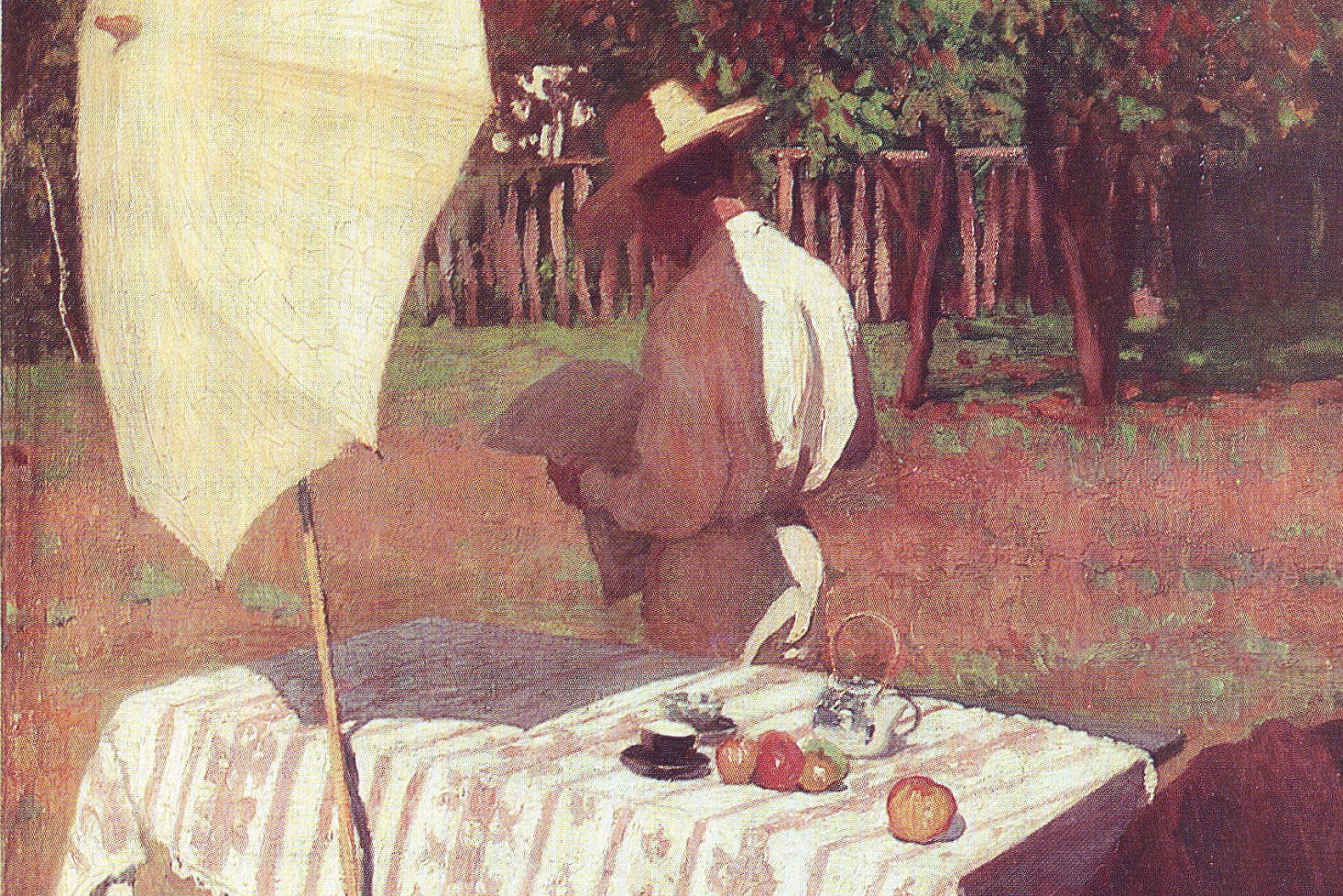
(Oscar Ferenczy, October, 1903; Source: Wiki Commons, PD-Old-100)
Things are picking up speed here on Cosmos. Books are pouring in for review. This means I’ll be lurching away from the sorts of pop culture posts that were trending last week on this blog. I’ll only say that what’s coming around the bend is something on theology and neuroscience.
The most noteworthy book to come in is the following long-awaited Czeslaw Milosz biography by Andrzej Franaszek, which has the authoritative title Milosz: A Biography:
Andrzej Franaszek’s award-winning biography of Czeslaw Milosz―the great Polish poet and winner of the Nobel Prize in Literature in 1980―offers a rich portrait of the writer and his troubled century, providing context for a larger appreciation of his work. This English-language edition, translated by Aleksandra Parker and Michael Parker, contains a new introduction by the translators, along with historical explanations, maps, and a chronology.
Franaszek recounts the poet’s personal odyssey through the events that convulsed twentieth-century Europe: World War I, the Bolshevik revolution, the Nazi invasion and occupation of Poland, and the Soviet Union’s postwar dominance of Eastern Europe. He follows the footsteps of a perpetual outsider who spent much of his unsettled life in Lithuania, Poland, and France, where he sought political asylum. From 1960 to 1999, Milosz lived in the United States before returning to Poland, where he died in 2004.
Franaszek traces Milosz’s changing, constantly questioning, often skeptical attitude toward organized religion. In the long term, he concluded that faith performed a positive role, not least as an antidote to the amoral, soulless materialism that afflicts contemporary civilization. Despite years of hardship, alienation, and neglect, Milosz retained a belief in the transformative power of poetry, particularly its capacity to serve as a source of moral resistance and a reservoir of collective hope. Seamus Heaney once said that Milosz’s poetry is irradiated by wisdom. Milosz reveals how that wisdom was tempered by experience even as the poet retained a childlike wonder in a misbegotten world.
This is a condensed 550-page, and slightly rewritten, version of the 950-page Polish book. What’s interesting is how much faith is rightfully highlighted in the blurb above, whereas it is not in the blurb for the Polish edition. Faith is just taken-for-granted in Poland for those familiar with his work, not so here.
By the way, if you’re not familiar with Milosz’s work, below you’ll find the poem, “Veni Creator.” It is taken from Milosz’s New and Collected Poems and will also give you an idea of what the blurb means by “misbegotten world”:
I did not expect to live in such an unusual moment.
When the God of thunders and of rocky heights,
The Lord of hosts, Kyrios Sabaoth,
Would humble people to the quick,
Allowing them to act whatever way they wished,
Leaving to them conclusions, saying nothing.
It was a spectacle that was indeed unlike
The age-long cycle of royal tragedies.
Roads on concrete pillars, cities of glass and cast iron,
Airfields larger than tribal dominions
Suddenly ran short of their essence and disintegrated
Not in a dream but really, for, subtracted from themselves,
They could only hold on as do things which should not last.
Out of trees, field stones, even lemons on the table,
Materiality escaped and their spectrum
Proved to be a void, a haze on a film.
Dispossessed of its objects, space was swarming.
Everywhere was nowhere and nowhere, everywhere.
Letters in books turned silver-pale, wobbled, and faded
The hand was not able to trace the palm sign, the river sign, or the sign of ibis.
A hullabaloo of many tongues proclaimed the mortality of the language.
A complaint was forbidden as it complained to itself.
People, afflicted with an incomprehensible distress,
Were throwing off their clothes on the piazzas so that nakedness might call
For judgment.
But in vain they were longing after horror, pity, and anger.
Neither work nor leisure
Was justified,
Nor the face, nor the hair nor the loins
Nor any existence.
This year promises a Milosz renaissance, because not only will we see the release of Milosz: A Biography, but also his posthumously published science-fiction novel The Mountains of Parnassus. Plus, the most important piece of Milosz literary criticism, Tischner’s Milosz and the Problem of Evil, is coming out in hardback so that you can order it for your library, while you can satisfy yourself with the paperback, which has been out for about a year (how could you not know?).
Reading a biography won’t be much a shift in gears, because I’m wrapping up Knausgaard’s biographical novel My Struggle, Book 2 (only four more 500 page books to go). Before I give you a rundown of what was trending on this blog last week…. here’s a wonder-ful passage from Knausgaard’s book about why one should read good literature, including biography:
What is a work of art if not the gaze of another person? Not directed above us, nor beneath us, but at the same height as our own gaze. Art cannot be experienced collectively, nothing can, art is something you are alone with. You meet its gaze alone.
- The Young Pope: The Second Coming of Brideshead Revisited?
- Lady Gaga: The Super Bowl’s Muse of Nationalist Catholicism
- Alt-Right Bête Noire Milo Yiannopoulos is an Aquinas-quoting Catholic
- February 14th is a Very Problematic Holiday For Many
- Just Another Atheist Jewish Catholic: An Interview With Damon Linker
- Postmodernist Lacan Proclaims the Triumph of the One, True, Catholic Religion
- Our Second Scientific Revolution. What Can Theology Expect?
- The Stanford Memorial Resolution for René Girard
- An Immigration Lawyer Explains the “Extreme Vetting” of the Current Refugee Process
- The Newest News on the Authenticity of the Shroud of Turin
I’m also looking forward to writing about the phenomenology of Andrew Bird’s music. He’s an artist (one of our finest) I rediscovered while watching The Young Pope:. The following song begins with a very Miloszian reversal, “I once was found, but now I’m lost,” of Amazing Grace?
For more on Milosz see: The Catholic Imagination and the Age of Czeslaw Milosz
Please consider making a donation to this blog through the donation button on the upper right side of its homepage so that we can replace the bald tires on our car. You might miss me if I’m gone!
Stay in touch! Like Cosmos the in Lost on Facebook:
Previous Post
February 15, 2017
The Young Pope: The Second Coming of Brideshead Revisited?
Browse Our Archives
Select a Category #WhyRemainCatholic Abortion Advent Anti-Catholicism Arts Atheism Beauty Benedict XVI Bible Book Review Catholic Cinema Comedy Cosmos: A Space-Time Odyssey Czesław Miłosz Dariusz Karłowicz Devil Easter Eastern Orthodoxy Economics Environment Family Famous Atheists Who Weren't Atheists Guest Post Hans Urs von Balthasar HHS Mandate History Imagination Interview Islam Jean-Luc Marion John Paul II Judaism Just War Lent Literature Little Sisters of the Poor Liturgy Martyrdom Music News Paganism Patristics Phenomenology Philosophy Pierre Hadot Poetry Poland Pop Culture Pope Francis Poverty Prayer Protestantism Rabelais Race Remi Brague Rene Girard Russia Sam Rocha Science & Religion SCOTUS Secularization Sexual Abuse Sexuality Silence Solidarity Stratford Caldecott Synod14 Terrorism Top 10 Uncategorized Walker Percy War Weakened Edition World War II World Youth Day WYD Krakow
Select a Month July 2017 June 2017 May 2017 April 2017 March 2017 February 2017 January 2017 December 2016 October 2016 September 2016 August 2016 July 2016 June 2016 May 2016 April 2016 March 2016 February 2016 January 2016 December 2015 November 2015 October 2015 September 2015 August 2015 July 2015 June 2015 May 2015 April 2015 March 2015 February 2015 January 2015 December 2014 November 2014 October 2014 September 2014 August 2014 July 2014 May 2014 April 2014 March 2014 February 2014 January 2014 December 2013 November 2013 October 2013 September 2013 August 2013 July 2013 June 2013 May 2013
Follow Us!
TAKE THE
Religious Wisdom Quiz
What was the first plague on Egypt?
Select your answer to see how you score.
Death of the Firstborn Lice Nile turned to Blood Hail
Related posts from Cosmos The In Lost
Wendell Berry and the Given Life
What Do Sex, Lent, UFO's, Evolution, and the...
Zygmunt Bauman Goes to Eternity from Liquid Modernity
TOP10 Booklist: What Theology, Science & Philosophy Should...
TRENDING AT PATHEOS Catholic

Rejecting Doom: Christian Hope And Human Action
Christianity is a religion of hope. We are to have hope and...

It’s What Comes From Within Which Matters
One of the most difficult things for us to understand is why...

Why I Choose the Eucharist Over the Sermon
Choose the Eucharist, Not the Sermon What are we supposed to get...

5 Design Elements Found in Spiritually Rooted Homes
Putting Spirituality Into Home Decor Our homes are more than our living...

Credo: A Story of God Told with the...
About 10 years ago, I began to imagine a personal "Credo" that...

The Anatomy of Divine Revelation in Catholic Thought
The claim that God has made Himself known to human beings is...
view all Catholic blogs
Ad-Free & Subscriber Log-In Subscription Support
- About Us
- 2026 Calendar
- Videos
- Podcasts
- Library of World Religions
- Faith In Media Tracker
- Advertise With Us
- Write for Us
- Privacy Policy
- Terms of Service
- Do Not Sell My Data
- Contact Us
- Radiant Digital
- Manage Newsletter Subscriptions
- Unsubscribe From Notifications
- Sitemap
Copyright 2008-2026, Patheos. All rights reserved.
Subscription Support Ad-Free & Subscriber Log-In
Follow Patheos