
BuddhistCatholicContemplativeEvangelicalGeneral ChristianHinduJewishLatter-day SaintMuslimNew VisionsProgressive Christian
Beliefs
- Buddhist
- Catholic
- Contemplative
- Evangelical
- General Christian
- Hindu
- Jewish
- Latter-day Saint
- More Voices
- Muslim
- New Visions
- Pagan
- Progressive Christian
Topics
- Religion News
- Food and Religion
- Sports and Religion
- Religious Art
- Religious Music and Entertainment
- Religious Events
- History and Religion
- Style and Religion
- Politics and Religion
- Women in Religion
- Recreation Outdoors and Religion
- Business Finance and Religion
- Careers Workplace and Religion
- Education and Religion
- Family Parenting and Religion
- Health Fitness and Religion
- Home and Religion
- Relationships and Religion
- Technology and Religion
- Travel and Religion
Columnists
- Buddhist Columnists
- Business Finance and Religion Columnists
- Careers Workplace and Religion Columnists
- Catholic Columnists
- Contemplative Columnists
- Education and Religion Columnists
- Evangelists Columnists
- Family Parenting and Religion Columnists
- General Christian Columnists
- Health Fitness and Religion Columnists
- Hindu Columnists
- History and Religion Columnists
- Home and Religion Columnists
- Jewish Columnists
- More Voices Columnists
- Latter Day Columnists
- Muslim Columnists
- New Visions Columnists
- Nonreligious Columnists
- Pagan Columnists
- Politics and Religion Columnists
- Progressive Columnists
- Recreation Outdoors and Religion Columnists
- Relationships and Religion Columnists
- Religion News Columnists
- Religious Art Columnists
- Religious Events Columnists
- Religious Music and Entertainment Columnists
- Sports and Religion Columnists
- Style and Religion Columnists
- Technology and Religion Columnists
- Travel and Religion Columnists
- Women in Religion Columnists
Resource Library
- 2026 Calendar
- Library of World Religions
- The 100 Most Holy Places on Earth
- Patheos Answers
- Podcasts
- Videos
- Faith Leaders Database
- Anglican Episcopalian
- Bahai
- Baptist
- Buddhism
- Christianity
- Confucianism
- Eastern Orthodoxy
- Hinduism
- Holiness and Pentecostal
- ISKCON
- Islam
- Judaism
- Lutheran
- Methodist
- The Church of Jesus Christ of Latter-day Saints
- New Age
- Paganism
- Presbytarian and Reformed
- Protestantism
- Religion Behind the Scenes
- Roman Catholic
- Scientology
- Shia Islam
- Sikhism
- Sufism
- Sunni Islam
- Taoism
- Zen
- See all religions
Research Tools
 Ad-Free & Subscriber Log-In Subscription Support
Ad-Free & Subscriber Log-In Subscription Support
Follow Patheos 

- Trending:
- Forgiveness
- |
- Marriage
- |
- Consciousness
- |
- Death Penalty
- |
- Election
- |
- Halloween
 Cosmos The In Lost
- Home
- Catholic
- February 14th is a Very Problematic Holiday For Many
February 14th is a Very Problematic Holiday For Many
Last updated on: February 14, 2017 at 4:48 am by Artur Rosman
February 14th is a Very Problematic Holiday For Many 2017-02-14T00:12:34-07:00 Artur Rosman
Patheos Explore the world's faith through different perspectives on religion and spirituality! Patheos has the views of the prevalent religions and spiritualities of the world.
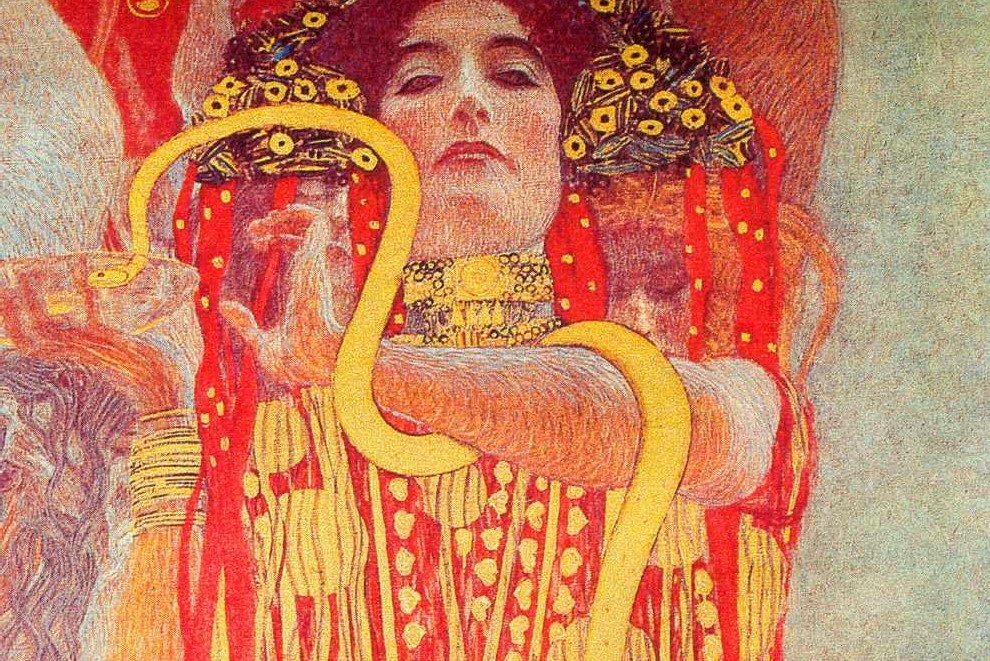
(Gustav Klimt, Medicine, c. 1890’s; Source: Wiki Commons, PD-Old-90).
Derrida liked to gleefully disseminate the news that the ancient Greek word for medicine (pharmakon) also means poison. Hearing that over and over in grad school got old quickly. It seemed like one of those nihilistic postmodernist word tricks (yay, you have a Greek dictionary!). But then I learned from Rene Girard that it can also be a scapegoat. Right about that same time, all unbeknownst to me (and you), the pharmaceutical industry was in the process of marketing an opiate epidemic to us.
Now I don’t laugh at Derrida so much anymore. And the industry around February 14th is no laughing matter either:
Today, February 14th, is a very problematic day for many.
For some, it is a day to celebrate a central aspect of their lives and their identity. For others, it highlights an unpleasant division between people and can inadvertently call to mind past wounds and contemporary discomforts.
So, as we collectively mark the Feast Day of Saints Cyril and Methodius – the brothers who developed the first Slavic alphabet, which while of remarkable benefit would also serve as an unfortunate mechanism to divide parts of the Slavic world from the Latin West – let us go about it in a spirit of charity and sympathy.
Note: there is also some sort of secular thing going on tomorrow that apparently involves confectionery, U.S. greeting card behemoth Hallmark, and dinner reservations. The entire thing seems needlessly costly and pointlessly exhausting, even more so on a work day.
I borrow the above from Bradley Jensen Murg who is a renaissance man, economist, political scientist, and chief (sole) writer for the best geopolitical blog on Patheos. He also likes to talk to me about economics. I frequently try not to listen.
Now, I agree with John Milbank that there is much to love about Eastern Christian theology, but the thread Bradley started is too much fun not to continue.
Therefore, I continue piling on with the following passage from Sarah Coakley’s God, Sexuality, and the Self: An Essay “On the Trinity”:
Secondly, one of the later manifestations of this same ‘East’–‘West’ contrast school of trinitarian theology was a certain self-flagellating tendency amongst its ‘Western’ exponents to adulate the ‘Eastern’ trinitarian alternative, as they saw it, and especially to hold it up as an imitable prototype for ecclesial and social relations. And thence was born what came to be called ‘social trinitarianism’. It was argued, for instance, that since the ‘Eastern’ model of the Trinity ‘started from the three and moved to the One’, it presented a vision of ‘persons’ in mutual ‘communion’ which could prove the ideal prototype for a political or church programme set on resisting the destructive individualism of the Enlightenment; whereas the ‘Western’, ‘Augustinian’ model of the Trinity was blamed for being nastily ‘proto-Cartesian’ in its implications in comparison. The ‘West’, it was argued, had already been seduced in Augustine well towards the modern solipsistic sense of selfhood which was later associated with Descartes’ philosophy, and had read it instead on to God in Godself, making God in the image of the modern, individual mind.
She continues, and I like this so much, because Anglicans, and Coakley is one, frequently like to project their theological utopias onto the East:
But this interpretative line of approach was as flawed as the first trend which had spawned it; it sought to project certain anti-‘Enlightenment’ agendas directly into the life of God, thereby unconsciously creating a new idolatrous project of social utopianism while also seriously misreading the Enlightenment figures who had become the new ‘whipping boys’ of this ‘Eastern’ trinitarian project. Ironically, the reading of the Cappadocian fathers which supposedly sustained this vision was itself strangely misleading exegetically.
All kidding aside, if you’d like the most balanced book on the topic of East-West relations then see John Panteleimon Manoussakis’ For the Unity of All: Contributions to the Theological Dialogue between East and West. While you’re at it take a look at my review of his latest book, a philosophy of time.
Stay in touch! Like Cosmos the in Lost on Facebook:
If you were looking for a Valentine’s Day post then see: The Catholic Valentine’s Creepier than 50 Shades
Consider making a donation to this blog through the donation button on the upper right side of its homepage so that we can replace the bald tires on our car.
Previous Post

February 10, 2017
The Stanford Memorial Resolution for René Girard
Next Post

February 15, 2017 The Young Pope: The Second Coming of Brideshead Revisited?
Browse Our Archives
Select a Category #WhyRemainCatholic Abortion Advent Anti-Catholicism Arts Atheism Beauty Benedict XVI Bible Book Review Catholic Cinema Comedy Cosmos: A Space-Time Odyssey Czesław Miłosz Dariusz Karłowicz Devil Easter Eastern Orthodoxy Economics Environment Family Famous Atheists Who Weren't Atheists Guest Post Hans Urs von Balthasar HHS Mandate History Imagination Interview Islam Jean-Luc Marion John Paul II Judaism Just War Lent Literature Little Sisters of the Poor Liturgy Martyrdom Music News Paganism Patristics Phenomenology Philosophy Pierre Hadot Poetry Poland Pop Culture Pope Francis Poverty Prayer Protestantism Rabelais Race Remi Brague Rene Girard Russia Sam Rocha Science & Religion SCOTUS Secularization Sexual Abuse Sexuality Silence Solidarity Stratford Caldecott Synod14 Terrorism Top 10 Uncategorized Walker Percy War Weakened Edition World War II World Youth Day WYD Krakow
Select a Month July 2017 June 2017 May 2017 April 2017 March 2017 February 2017 January 2017 December 2016 October 2016 September 2016 August 2016 July 2016 June 2016 May 2016 April 2016 March 2016 February 2016 January 2016 December 2015 November 2015 October 2015 September 2015 August 2015 July 2015 June 2015 May 2015 April 2015 March 2015 February 2015 January 2015 December 2014 November 2014 October 2014 September 2014 August 2014 July 2014 May 2014 April 2014 March 2014 February 2014 January 2014 December 2013 November 2013 October 2013 September 2013 August 2013 July 2013 June 2013 May 2013
Follow Us!
TAKE THE
Religious Wisdom Quiz
According to Philippians, what should we think about?
Select your answer to see how you score.
Whatever is true, noble, right, pure, lovely, and admirable The word of God day and night The needs of others The suffering of Christ
Related posts from Cosmos The In Lost

The Surprising Anti-Capitalist Logic Behind the Catholic Church's...

What is the Source of Our Culture of...


The Holy Family as an Icon of World...
TRENDING AT PATHEOS Catholic

Rejecting Doom: Christian Hope And Human Action
Christianity is a religion of hope. We are to have hope and...

It’s What Comes From Within Which Matters
One of the most difficult things for us to understand is why...

Why I Choose the Eucharist Over the Sermon
Choose the Eucharist, Not the Sermon What are we supposed to get...

5 Design Elements Found in Spiritually Rooted Homes
Putting Spirituality Into Home Decor Our homes are more than our living...

Credo: A Story of God Told with the...
About 10 years ago, I began to imagine a personal "Credo" that...

The Anatomy of Divine Revelation in Catholic Thought
The claim that God has made Himself known to human beings is...
view all Catholic blogs
Ad-Free & Subscriber Log-In Subscription Support
- About Us
- 2026 Calendar
- Videos
- Podcasts
- Library of World Religions
- Faith In Media Tracker
- Advertise With Us
- Write for Us
- Privacy Policy
- Terms of Service
- Do Not Sell My Data
- Contact Us
- Radiant Digital
- Manage Newsletter Subscriptions
- Unsubscribe From Notifications
- Sitemap
Copyright 2008-2026, Patheos. All rights reserved.
Subscription Support Ad-Free & Subscriber Log-In
Follow Patheos