
BuddhistCatholicContemplativeEvangelicalGeneral ChristianHinduJewishLatter-day SaintMuslimNew VisionsProgressive Christian
Beliefs
- Buddhist
- Catholic
- Contemplative
- Evangelical
- General Christian
- Hindu
- Jewish
- Latter-day Saint
- More Voices
- Muslim
- New Visions
- Pagan
- Progressive Christian
Topics
- Religion News
- Food and Religion
- Sports and Religion
- Religious Art
- Religious Music and Entertainment
- Religious Events
- History and Religion
- Style and Religion
- Politics and Religion
- Women in Religion
- Recreation Outdoors and Religion
- Business Finance and Religion
- Careers Workplace and Religion
- Education and Religion
- Family Parenting and Religion
- Health Fitness and Religion
- Home and Religion
- Relationships and Religion
- Technology and Religion
- Travel and Religion
Columnists
- Buddhist Columnists
- Business Finance and Religion Columnists
- Careers Workplace and Religion Columnists
- Catholic Columnists
- Contemplative Columnists
- Education and Religion Columnists
- Evangelists Columnists
- Family Parenting and Religion Columnists
- General Christian Columnists
- Health Fitness and Religion Columnists
- Hindu Columnists
- History and Religion Columnists
- Home and Religion Columnists
- Jewish Columnists
- More Voices Columnists
- Latter Day Columnists
- Muslim Columnists
- New Visions Columnists
- Nonreligious Columnists
- Pagan Columnists
- Politics and Religion Columnists
- Progressive Columnists
- Recreation Outdoors and Religion Columnists
- Relationships and Religion Columnists
- Religion News Columnists
- Religious Art Columnists
- Religious Events Columnists
- Religious Music and Entertainment Columnists
- Sports and Religion Columnists
- Style and Religion Columnists
- Technology and Religion Columnists
- Travel and Religion Columnists
- Women in Religion Columnists
Resource Library
- 2026 Calendar
- Library of World Religions
- The 100 Most Holy Places on Earth
- Patheos Answers
- Podcasts
- Videos
- Faith Leaders Database
- Anglican Episcopalian
- Bahai
- Baptist
- Buddhism
- Christianity
- Confucianism
- Eastern Orthodoxy
- Hinduism
- Holiness and Pentecostal
- ISKCON
- Islam
- Judaism
- Lutheran
- Methodist
- The Church of Jesus Christ of Latter-day Saints
- New Age
- Paganism
- Presbytarian and Reformed
- Protestantism
- Religion Behind the Scenes
- Roman Catholic
- Scientology
- Shia Islam
- Sikhism
- Sufism
- Sunni Islam
- Taoism
- Zen
- See all religions
Research Tools
 Ad-Free & Subscriber Log-In Subscription Support
Ad-Free & Subscriber Log-In Subscription Support
Follow Patheos 

- Trending:
- Forgiveness
- |
- Marriage
- |
- Consciousness
- |
- Death Penalty
- |
- Election
- |
- Halloween
 Cosmos The In Lost
- Home
- Catholic
- The Stanford Memorial Resolution for René Girard
The Stanford Memorial Resolution for René Girard
Last updated on: February 10, 2017 at 9:57 pm by Artur Rosman
The Stanford Memorial Resolution for René Girard 2017-02-10T21:57:09-07:00 Artur Rosman
Patheos Explore the world's faith through different perspectives on religion and spirituality! Patheos has the views of the prevalent religions and spiritualities of the world.
. . . Before coming to Stanford in 1981, Girard had also been on the faculties at Bryn Mawr, Duke and the State University of New York at Buffalo. He was the James M. Beall Professor of French and Humanities at Johns Hopkins when he accepted an appointment at Stanford.
 Girard’s first book, Deceit, Desire and the Novel (1961 in French; 1965 in English), used Cervantes, Stendhal, Proust and Dostoevsky as case studies to develop his theory of mimesis.
In 1972, his landmark Violence and the Sacred (1977 in English) explored the role of archaic religions in suppressing social violence through scapegoating and sacrifice. The provocative book was awarded by the Académie Française. Things Hidden Since the Foundation of the World (1978 in French; 1987 in English), was the fullest summation of Girard’s ideas. He offered Christianity as a solution to mimetic rivalry, and challenged Freud’s Totem and Taboo.
“I hold that truth is not an empty word, or a mere ‘effect’ as people say nowadays,” he wrote in the final pages of Things Hidden Since the Foundation of the World. “I hold that everything capable of diverting us from madness and death, from now on, is inextricably linked with this truth. But I do not know how to speak about these matters. I can only approach texts and institutions, and relating them to one another seems to me to throw light in every direction.”
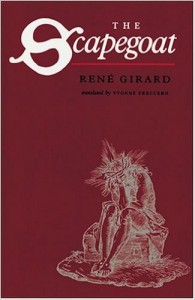
He was the author of nearly 30 books, which have been widely translated, including The Scapegoat, I Saw Satan Fall Like Lightning, To Double Business Bound, Oedipus Unbound and A Theater of Envy: William Shakespeare, which was awarded France’s Prix Médicis in 1990.
His last major work was 2007’s Achever Clausewitz (published in English as Battling to the End: Politics, War, and Apocalypse), ignited a firestorm of controversy. French President Nicolas Sarkozy cited his words, and reporters trekked to Girard’s Paris doorstep daily. The book, which takes as its point of departure the Prussian military historian and theorist Carl von Clausewitz, had implications that placed Girard firmly in the 21st century.
At Stanford, he organized several symposia at Stanford, including 1987’s “Understanding Origin” and 1981’s “Disorder and Order,” which explored a broad changing ideas of orders and disorder in the humanities and sciences from a broad interdisciplinary perspective, and then considered the implications for contemporary culture. Participants included Nobel laureate Ilya Prigogine (chemistry), public intellectual Michel Serres, who would eventually join him at Stanford, Jacques Attali, economist and theorist of culture, and critic Edward Said, and Stanford Prof. Kenneth Arrow, a Nobel laureate in economics, Ian Watt, then-director of the Stanford Humanities Center, and Stanford Prof. John Freccero, a leading Dante scholar. Girard also founded a program of interdisciplinary studies.
He was a fellow of the American Academy of Arts and Sciences and twice a Guggenheim Fellow. He received a lifetime achievement award from the Modern Language Association in 2009. In 2013, King Juan Carlos of Spain awarded him the Order of Isabella the Catholic, a Spanish civil order bestowed for his “profound attachment” to “Spanish culture as a whole.” He was also a Chevalier de la Légion d’honneur and Commandeur des Arts et des Lettres. He was awarded the Dr. Leopold Lucas Prize by the University of Tübingen in 2006. He received honorary degrees from: the Free University of Amsterdam (1985); University Faculties Saint Ignatius Antwerp in Antwerp (1995), the Università degli Studi di Padova (2001); the faculty of theology at the University of Innsbruck, the Université de Montréal (2004), and Scotland’s University of St Andrews (2008).
The achievement and renown, however, fail to catch the measure of the man, who is remembered for his courtesy as much as his ferocity in argument, for his humility as much as his bold, sweeping vision of human nature, human history, and human destiny.
Girard is survived by his wife of nearly 65 years, Martha, of Stanford; two sons, Daniel, of Hillsborough, California, and Martin, of Seattle; a daughter, Mary Girard Brown, of Newark, California; and nine grandchildren.
For more on René Girard see: Lux Aeterna: RIP René Girard (December 25, 1923 – Nov 4, 2015); René Girard: Is Christianity a Myth?; and TOP10 Books: The Girard Option of Interdisciplinary Influence.
Consider making a donation to this blog through the donation button on the upper right side of its homepage so that we can replace the bald tires on our car.
Stay in touch! Like Cosmos the in Lost on Facebook:
Previous Post

February 9, 2017
Lady Gaga: The Super Bowl's Muse of Nationalist Catholicism
Next Post
February 14, 2017 February 14th is a Very Problematic Holiday For Many
Browse Our Archives
Select a Category #WhyRemainCatholic Abortion Advent Anti-Catholicism Arts Atheism Beauty Benedict XVI Bible Book Review Catholic Cinema Comedy Cosmos: A Space-Time Odyssey Czesław Miłosz Dariusz Karłowicz Devil Easter Eastern Orthodoxy Economics Environment Family Famous Atheists Who Weren't Atheists Guest Post Hans Urs von Balthasar HHS Mandate History Imagination Interview Islam Jean-Luc Marion John Paul II Judaism Just War Lent Literature Little Sisters of the Poor Liturgy Martyrdom Music News Paganism Patristics Phenomenology Philosophy Pierre Hadot Poetry Poland Pop Culture Pope Francis Poverty Prayer Protestantism Rabelais Race Remi Brague Rene Girard Russia Sam Rocha Science & Religion SCOTUS Secularization Sexual Abuse Sexuality Silence Solidarity Stratford Caldecott Synod14 Terrorism Top 10 Uncategorized Walker Percy War Weakened Edition World War II World Youth Day WYD Krakow
Select a Month July 2017 June 2017 May 2017 April 2017 March 2017 February 2017 January 2017 December 2016 October 2016 September 2016 August 2016 July 2016 June 2016 May 2016 April 2016 March 2016 February 2016 January 2016 December 2015 November 2015 October 2015 September 2015 August 2015 July 2015 June 2015 May 2015 April 2015 March 2015 February 2015 January 2015 December 2014 November 2014 October 2014 September 2014 August 2014 July 2014 May 2014 April 2014 March 2014 February 2014 January 2014 December 2013 November 2013 October 2013 September 2013 August 2013 July 2013 June 2013 May 2013
Follow Us!
TAKE THE
Religious Wisdom Quiz
What body of water did Peter walk on at Jesus' invitation?
Select your answer to see how you score.
Dead Sea Sea of Galilee Red Sea Mediterranean Sea
Related posts from Cosmos The In Lost

The Surprising Anti-Capitalist Logic Behind the Catholic Church's...

What is the Source of Our Culture of...


The Holy Family as an Icon of World...
TRENDING AT PATHEOS Catholic

The Parable Of The Sower And The Word...
One of Christ’s most famous parables is that of the sower who...

Rejecting Doom: Christian Hope And Human Action
Christianity is a religion of hope. We are to have hope and...

Why I Choose the Eucharist Over the Sermon
Choose the Eucharist, Not the Sermon What are we supposed to get...

5 Design Elements Found in Spiritually Rooted Homes
Putting Spirituality Into Home Decor Our homes are more than our living...

Credo: A Story of God Told with the...
About 10 years ago, I began to imagine a personal "Credo" that...

The Anatomy of Divine Revelation in Catholic Thought
The claim that God has made Himself known to human beings is...
view all Catholic blogs
Ad-Free & Subscriber Log-In Subscription Support
- About Us
- 2026 Calendar
- Videos
- Podcasts
- Library of World Religions
- Faith In Media Tracker
- Advertise With Us
- Write for Us
- Privacy Policy
- Terms of Service
- Do Not Sell My Data
- Contact Us
- Radiant Digital
- Manage Newsletter Subscriptions
- Unsubscribe From Notifications
- Sitemap
Copyright 2008-2026, Patheos. All rights reserved.
Subscription Support Ad-Free & Subscriber Log-In
Follow Patheos