
BuddhistCatholicContemplativeEvangelicalGeneral ChristianHinduJewishLatter-day SaintMuslimNew VisionsProgressive Christian
Beliefs
- Buddhist
- Catholic
- Contemplative
- Evangelical
- General Christian
- Hindu
- Jewish
- Latter-day Saint
- More Voices
- Muslim
- New Visions
- Pagan
- Progressive Christian
Topics
- Religion News
- Food and Religion
- Sports and Religion
- Religious Art
- Religious Music and Entertainment
- Religious Events
- History and Religion
- Style and Religion
- Politics and Religion
- Women in Religion
- Recreation Outdoors and Religion
- Business Finance and Religion
- Careers Workplace and Religion
- Education and Religion
- Family Parenting and Religion
- Health Fitness and Religion
- Home and Religion
- Relationships and Religion
- Technology and Religion
- Travel and Religion
Columnists
- Buddhist Columnists
- Business Finance and Religion Columnists
- Careers Workplace and Religion Columnists
- Catholic Columnists
- Contemplative Columnists
- Education and Religion Columnists
- Evangelists Columnists
- Family Parenting and Religion Columnists
- General Christian Columnists
- Health Fitness and Religion Columnists
- Hindu Columnists
- History and Religion Columnists
- Home and Religion Columnists
- Jewish Columnists
- More Voices Columnists
- Latter Day Columnists
- Muslim Columnists
- New Visions Columnists
- Nonreligious Columnists
- Pagan Columnists
- Politics and Religion Columnists
- Progressive Columnists
- Recreation Outdoors and Religion Columnists
- Relationships and Religion Columnists
- Religion News Columnists
- Religious Art Columnists
- Religious Events Columnists
- Religious Music and Entertainment Columnists
- Sports and Religion Columnists
- Style and Religion Columnists
- Technology and Religion Columnists
- Travel and Religion Columnists
- Women in Religion Columnists
Resource Library
- 2026 Calendar
- Library of World Religions
- The 100 Most Holy Places on Earth
- Patheos Answers
- Podcasts
- Videos
- Faith Leaders Database
- Anglican Episcopalian
- Bahai
- Baptist
- Buddhism
- Christianity
- Confucianism
- Eastern Orthodoxy
- Hinduism
- Holiness and Pentecostal
- ISKCON
- Islam
- Judaism
- Lutheran
- Methodist
- The Church of Jesus Christ of Latter-day Saints
- New Age
- Paganism
- Presbytarian and Reformed
- Protestantism
- Religion Behind the Scenes
- Roman Catholic
- Scientology
- Shia Islam
- Sikhism
- Sufism
- Sunni Islam
- Taoism
- Zen
- See all religions
Research Tools
 Ad-Free & Subscriber Log-In Subscription Support
Ad-Free & Subscriber Log-In Subscription Support
Follow Patheos 

- Trending:
- Forgiveness
- |
- Marriage
- |
- Consciousness
- |
- Death Penalty
- |
- Election
- |
- Halloween
 Cosmos The In Lost
- Home
- Catholic
- What Does Greek Philosopher Socrates Have to do with the Christian Saints?
What Does Greek Philosopher Socrates Have to do with the Christian Saints?
Last updated on: February 8, 2017 at 1:54 am by Artur Rosman
What Does Greek Philosopher Socrates Have to do with the Christian Saints? 2017-02-08T01:54:32-07:00 Artur Rosman
Patheos Explore the world's faith through different perspectives on religion and spirituality! Patheos has the views of the prevalent religions and spiritualities of the world.
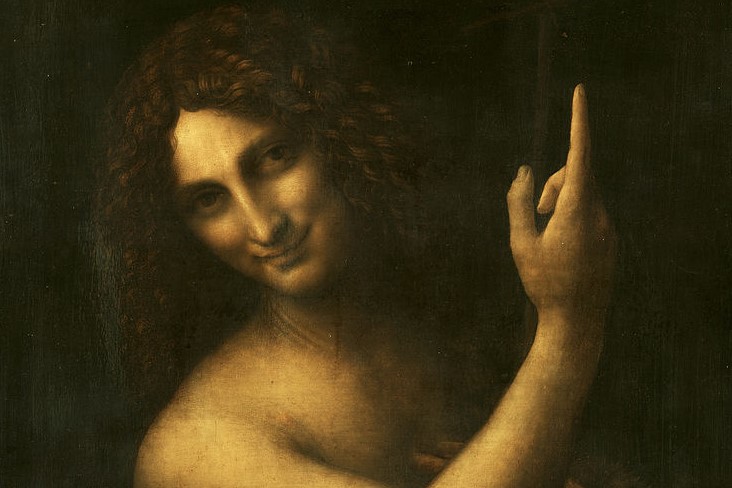
(Leonardo da Vinci, Saint John the Baptist, 1516; Source: Wiki Commons, PD-Old-100).
The old question from Tertullian’s Prescription Against the Heretics is “What does Athens have to do with Jerusalem?” Tertullian’s full formulation is even more stark in drawing the battle lines:
What indeed has Athens to do with Jerusalem? What concord is there between the Academy and the Church? what between heretics and Christians? Our instruction comes from “the porch of Solomon,” who had himself taught that “the Lord should be sought in simplicity of heart.” Away with all attempts to produce a mottled Christianity of Stoic, Platonic, and dialectic composition! We want no curious disputation after possessing Christ Jesus, no inquisition after enjoying the gospel! With our faith, we desire no further belief.
The recently released translation (by yours truly) of Socrates and Other Saints: Early Christian Understandings of Reason and Philosophy argues that Athens has plenty to do with Jerusalem:
Many contemporary writers misunderstand early Christian views on philosophy because they identify the critical stances of the ante-Nicene fathers toward specific pagan philosophical schools with a general negative stance toward reason itself. Dariusz Karłowicz’s Socrates and Other Saints demonstrates why this identification is false.
The question of the extent of humanity’s natural knowledge cannot be reduced to the question of faith’s relationship to the historical manifestations of philosophy among the Ancients. Karłowicz closely reads the writings of Justin Martyr, Tertullian, Clement of Alexandria, and others to demonstrate this point. He also builds upon Pierre Hadot’s thesis that ancient philosophy is not primarily theory but a “way of life” taught by sages, which aimed at happiness through participation in the divine.
The fact that pagan philosophers falsely described humanity’s telos did not mean that the spiritual practices they developed could not be helpful in the Christian pilgrimage. As it turns out, the ancient Christian writers traditionally considered to be enemies of philosophy actually borrowed from her much more than we think–and perhaps more than they admitted.
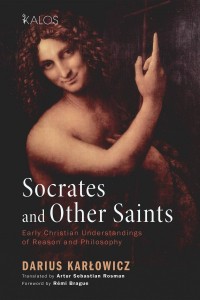 The book features the following ringing endorsement from John Milbank, author of Theology and Social Theory: Beyond Secular Reason:
This significant new book amply demonstrates that the relationship of Christianity to pagan teaching did not really correspond to what we today take to be the distinction between faith and reason. Instead it was a matter of complex continuities as well as discontinuities in terms of practice and spiritual stance as much as theoretical affirmation. A very important corrective.”
It is also graced by a foreword written by Cosmos favorite Remi Brague whose work has been covered here, here, and here (in relation to Endo’s Silence). Here’s an excerpt from his intro that gives you a pretty good idea of what’s going on between Athens and Jerusalem in Socrates and Other Saints :
It might be the case that the real intellectual fight in Late Antiquity was fought not between dogmas, but between worldviews and the ways of life that they fostered in response to them. Hans Urs von Balthasar once observed, en passant, probably in the wake of Nietzsche, that the real adversary of Christian salvation is not Greek philosophy, but the vision of life and being that comes to the fore in Greek tragedy. Very much in an analogous way, Dariusz Karłowicz points out that philosophy was, for pagans as well as for Christians, for its practitioners as well as for as for its enemies, less a set of dogmas (although the word is philosophic in origin) as a way of life. He thereby takes advantage of the works of Pierre Hadot who highlighted this dimension of ancient philosophy.
Here’s one last teaser from Socrates and Other Saints that puts Tertullian’s statement in proper perspective:
It is difficult to doubt that some of Tertullian’s statements play into this assumption. Tertullian’s well-known statements forcefully contrast philosophy and Christianity as two mutually exclusive realities. In the famous phrases from the Apology he denies all similarities and any commingling between the philosopher and Christian, the pupil of Greece and the student of heaven, the friend of error and his enemy. In the Prescription Against the Heretics these antinomies are filled out with two more, Athens versus Jerusalem and the Academy versus the church. The stereotyping of Tertullian as a Christian who tends toward annihilating reason by stressing the paradoxicality of revelation is also borne out by a popular fragment from De carne Christi, where the Carthaginian derives the authenticity of the Son of God’s death through its absurdity and the certainty of the resurrection through its impossibility. Yet, one needs the blindness of a Shestov to not notice that philosophy, Greece, attachment to error, Athens, and the Academy need not be (and they are not!) synonyms for natural reason, but rather historical examples of its compromise. Being anti-philosophical is not the same as being anti-rational. Tertullian, with all of his considerable conviction, merely says that philosophy, only up to his day, represents falsehood. That emphatically does not mean that reason cannot even touch a sliver of the truth. Furthermore, he adds in The Soul’s Testimony that positive historical philosophy does not represent nature at all. In the mind of Tertullian there is no quarrel between revelation and nature. If there is any quarrel proclaimed by Tertullian, it is the conflict between nature and positive historical philosophy. Tertullian makes war against a philosophy that falsifies nature; he makes war in the name of both reason, nature, and revelation.
For more from Dariusz Karlowicz, including other excerpts from this book, look here. Expect to see more about Socrates and Other Saints in the upcoming weeks, including, hopefully, and interview with the author.
As for Socrates (the representative of philosophy) and the saints (representatives of Christianity), well, you’ll have to read the book. But I suspect you have a pretty good idea of where it’s going (hint: a “way of life“).
Remember to also take a look at my translation of the expanded version of Karlowicz’s Socrates and Other Saints entitled, The Archparadox of Death: Martyrdom as a Philosophical Category.
Consider making a donation to this blog through the donation button on the upper right side of its homepage. Many thanks to all the souls who have already done so and those who plan to do so in the future.
While you’re at it: Check out my review, The Good = Evil + Time, of a new book on the philosophy of time.
Stay in touch! Like Cosmos the in Lost on Facebook:
Previous Post

February 2, 2017
Alt-Right Bête Noire Milo Yiannopoulos is an Aquinas-quoting Catholic
Next Post

February 9, 2017 Lady Gaga: The Super Bowl's Muse of Nationalist Catholicism
Browse Our Archives
Select a Category #WhyRemainCatholic Abortion Advent Anti-Catholicism Arts Atheism Beauty Benedict XVI Bible Book Review Catholic Cinema Comedy Cosmos: A Space-Time Odyssey Czesław Miłosz Dariusz Karłowicz Devil Easter Eastern Orthodoxy Economics Environment Family Famous Atheists Who Weren't Atheists Guest Post Hans Urs von Balthasar HHS Mandate History Imagination Interview Islam Jean-Luc Marion John Paul II Judaism Just War Lent Literature Little Sisters of the Poor Liturgy Martyrdom Music News Paganism Patristics Phenomenology Philosophy Pierre Hadot Poetry Poland Pop Culture Pope Francis Poverty Prayer Protestantism Rabelais Race Remi Brague Rene Girard Russia Sam Rocha Science & Religion SCOTUS Secularization Sexual Abuse Sexuality Silence Solidarity Stratford Caldecott Synod14 Terrorism Top 10 Uncategorized Walker Percy War Weakened Edition World War II World Youth Day WYD Krakow
Select a Month July 2017 June 2017 May 2017 April 2017 March 2017 February 2017 January 2017 December 2016 October 2016 September 2016 August 2016 July 2016 June 2016 May 2016 April 2016 March 2016 February 2016 January 2016 December 2015 November 2015 October 2015 September 2015 August 2015 July 2015 June 2015 May 2015 April 2015 March 2015 February 2015 January 2015 December 2014 November 2014 October 2014 September 2014 August 2014 July 2014 May 2014 April 2014 March 2014 February 2014 January 2014 December 2013 November 2013 October 2013 September 2013 August 2013 July 2013 June 2013 May 2013
Follow Us!
TAKE THE
Religious Wisdom Quiz
According to Colossians, in whom are hidden all the treasures of wisdom and knowledge?
Select your answer to see how you score.
Christ The Scriptures The Holy Spirit God the Father
Related posts from Cosmos The In Lost

The Surprising Anti-Capitalist Logic Behind the Catholic Church's...

How is Classical Philosophy is Like War?

Why Does the World's Leading Philosopher Remain a...

Biblical Authority After Babel Cannot Be Built Upon...
TRENDING AT PATHEOS Catholic

Creation, Preservation, and Teleology in Catholic Theology
As I write this, it is very early Monday morning. Like millions...

The Parable Of The Sower And The Word...
One of Christ’s most famous parables is that of the sower who...

Rejecting Doom: Christian Hope And Human Action
Christianity is a religion of hope. We are to have hope and...

Why I Choose the Eucharist Over the Sermon
Choose the Eucharist, Not the Sermon What are we supposed to get...

5 Design Elements Found in Spiritually Rooted Homes
Putting Spirituality Into Home Decor Our homes are more than our living...

Credo: A Story of God Told with the...
About 10 years ago, I began to imagine a personal "Credo" that...
view all Catholic blogs
Ad-Free & Subscriber Log-In Subscription Support
- About Us
- 2026 Calendar
- Videos
- Podcasts
- Library of World Religions
- Faith In Media Tracker
- Advertise With Us
- Write for Us
- Privacy Policy
- Terms of Service
- Do Not Sell My Data
- Contact Us
- Radiant Digital
- Manage Newsletter Subscriptions
- Unsubscribe From Notifications
- Sitemap
Copyright 2008-2026, Patheos. All rights reserved.
Subscription Support Ad-Free & Subscriber Log-In
Follow Patheos