
BuddhistCatholicContemplativeEvangelicalGeneral ChristianHinduJewishLatter-day SaintMuslimNew VisionsProgressive Christian
Beliefs
- Buddhist
- Catholic
- Contemplative
- Evangelical
- General Christian
- Hindu
- Jewish
- Latter-day Saint
- More Voices
- Muslim
- New Visions
- Pagan
- Progressive Christian
Topics
- Religion News
- Food and Religion
- Sports and Religion
- Religious Art
- Religious Music and Entertainment
- Religious Events
- History and Religion
- Style and Religion
- Politics and Religion
- Women in Religion
- Recreation Outdoors and Religion
- Business Finance and Religion
- Careers Workplace and Religion
- Education and Religion
- Family Parenting and Religion
- Health Fitness and Religion
- Home and Religion
- Relationships and Religion
- Technology and Religion
- Travel and Religion
Columnists
- Buddhist Columnists
- Business Finance and Religion Columnists
- Careers Workplace and Religion Columnists
- Catholic Columnists
- Contemplative Columnists
- Education and Religion Columnists
- Evangelists Columnists
- Family Parenting and Religion Columnists
- General Christian Columnists
- Health Fitness and Religion Columnists
- Hindu Columnists
- History and Religion Columnists
- Home and Religion Columnists
- Jewish Columnists
- More Voices Columnists
- Latter Day Columnists
- Muslim Columnists
- New Visions Columnists
- Nonreligious Columnists
- Pagan Columnists
- Politics and Religion Columnists
- Progressive Columnists
- Recreation Outdoors and Religion Columnists
- Relationships and Religion Columnists
- Religion News Columnists
- Religious Art Columnists
- Religious Events Columnists
- Religious Music and Entertainment Columnists
- Sports and Religion Columnists
- Style and Religion Columnists
- Technology and Religion Columnists
- Travel and Religion Columnists
- Women in Religion Columnists
Resource Library
- 2026 Calendar
- Library of World Religions
- The 100 Most Holy Places on Earth
- Patheos Answers
- Podcasts
- Videos
- Faith Leaders Database
- Anglican Episcopalian
- Bahai
- Baptist
- Buddhism
- Christianity
- Confucianism
- Eastern Orthodoxy
- Hinduism
- Holiness and Pentecostal
- ISKCON
- Islam
- Judaism
- Lutheran
- Methodist
- The Church of Jesus Christ of Latter-day Saints
- New Age
- Paganism
- Presbytarian and Reformed
- Protestantism
- Religion Behind the Scenes
- Roman Catholic
- Scientology
- Shia Islam
- Sikhism
- Sufism
- Sunni Islam
- Taoism
- Zen
- See all religions
Research Tools
 Ad-Free & Subscriber Log-In Subscription Support
Ad-Free & Subscriber Log-In Subscription Support
Follow Patheos 

- Trending:
- Forgiveness
- |
- Marriage
- |
- Consciousness
- |
- Death Penalty
- |
- Election
- |
- Halloween
 Cosmos The In Lost
- Home
- Catholic
- The Reformation is Not Done with You
The Reformation is Not Done with You
Last updated on: November 1, 2016 at 3:07 pm by Artur Rosman
The Reformation is Not Done with You 2016-11-01T15:07:06-07:00 Artur Rosman
Patheos Explore the world's faith through different perspectives on religion and spirituality! Patheos has the views of the prevalent religions and spiritualities of the world.
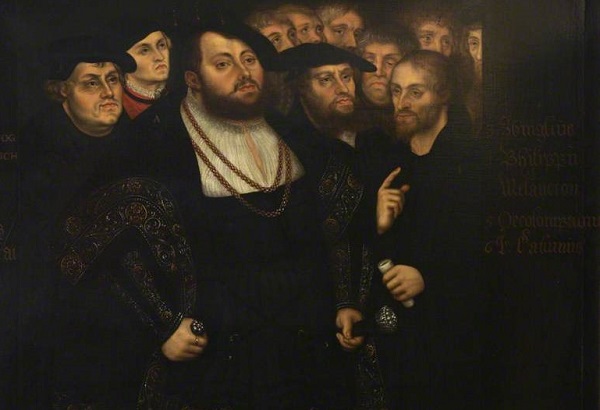
(After Lucas Cranach the Younger, Elector Johann Friederich of Saxony and the Reformers, 17th c; Source: Wikimedia, PD-Old-100)
“The past is never dead. It’s not even past.”
–William Faulkner, Requiem for a Nun
Reformation Day is an appropriate occasion to trot out a quote from America’s greatest (Protestant, what else?) novelist from his otherwise mediocre novel about a “nun.”
Something like this sentiment is behind one of the most discussed history and theology books of recent years, Brad Gregory’s The Unintended Reformation . Its subtitle telegraphs its rather unusually grandiose ambitions for an age that is weary of metanarratives: How a Religious Revolution Secularized Society.
The book revolves around the following continuity thesis about the Reformation:
The place of the Reformation in European history seems clear. It falls between the Middle Ages and modernity as something long gone, over and done with. It seems distant from the political realities and global capitalism of the early twenty-first century, far removed from present- day moral debates and social problems. This book argues otherwise. What transpired five centuries ago continues today profoundly to influence the lives of everyone not only in Europe and North America but all around the world, whether or not they are Christians or indeed religious believers of any kind. William Faulkner famously said, “The past is never dead. It’s not even past.” He spoke more truly than he perhaps knew, yet in ways I doubt that he suspected.
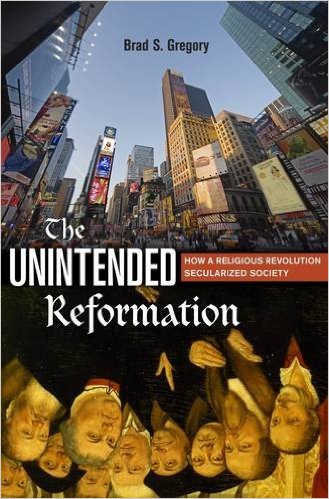 Its conclusion about the Reformation heritage is richly pessimistic:
[This book] analyzes the Protestant Reformation and modern philosophy as the two most important (and related) means by which attempts were made to ground truth claims by those who rejected medieval Christianity as embodied in the Roman church, which led in divergent ways to unintended pluralisms based respectively on the Bible and reason. Doctrinal impasses in the Reformation era helped to foster a renaissance of ancient epistemological skepticism and to inspire modern philosophical foundationalism. But historically and empirically, “reason alone” since Descartes has proved no more capable than “scripture alone” since Luther of providing a basis for reaching shared answers to questions about what is true, how people should live, or what they should care about. The long- term result is the open- ended multiplication of truth claims about such issues that proliferate within modern, liberal states today and that collectively contribute to Western hyperpluralism.
Criticisms of The Unintended Reformation frequently overlook how much blame Gregory puts on medieval Catholicism and its inability to found a lasting synthesis in great part because of ecclesiastical corruption.
I’ve omitted that part of the book for the sake of brevity and because it would be too charitable an observation on Reformation Day, a day when Catholics and Protestants exchange unfair barbs, thereby continuing the unintended consequences of the Reformation.
For good measure Gregory also lays contemporary American political culture, le Grand-Guignol you constantly see in your social media feeds, its hyperpluralism at the feet of the Reformers.
His description of our situation is truly bracing and worth the price of admission for its unblinking honesty:
First, along with quite a few other Americans, I am concerned about the degree to which people in the United States appear to be growing evermore politically and culturally polarized, since at least the 1980s, whether or not one thinks the phenomenon merits the designation of a “culture war.” Daniel Bell referred in 1996 to “a confused, angry, uneasy, and insecure America,” and if anything his characterization seems even more applicable now. Americans are deeply divided on many matters with major implications for their national life, including U.S. military interventions abroad, the place of religion in the public square, school vouchers and public education, abortion, race and affirmative action, gun control, the relationship between environmental protection and economic development, and the tolerability of sexually explicit and graphically violent popular culture. Whatever the issue, American national political culture as manifest in the media is lacking in rigor and loaded with rancor. Often “our own poisoned public sphere,” as Anthony Grafton has recently called it, seems little more than a shouting match of distorted and distorting slogans and propagandistic one- liners. The realities of a bumper- sticker political life seem distant from idealizations of the well- informed, fair- minded, reasonable citizens theorized by champions of deliberative democracy, whether in a Rawlsian, Habermasian, or some other form.
The scary thing, this is Halloween after all, is that our problems don’t go back a couple of decades. They go back half a millennium. Even scarier? It might be too late to fix them. The silver lining resides in the knowledge that this long enduring crisis of European life hasn’t totally destroyed everything, yet.
So, if you’re tired of the election cycle, you know who to scapegoat for it today. I, for one, am leaving the country on the 7th of November. The downside is that I’ll spend way too much time explaining the post-election chaos to foreigners. Oh well… when you can’t blame Canada, you can always blame the Reformation (and the Middle Ages).
Finally, in light of all this, my favorite Jesuit joke of all time takes on an even darker tone than usual:
What is similar about the Jesuit and Dominican Orders?
Well, they were both founded by Spaniards, St. Dominic for the Dominicans, and St. Ignatius of Loyola for the Jesuits.
They were also both founded to combat heresy: the Dominicans to fight the Albigensians, and the Jesuits to fight the Protestants.
What is different about the Jesuit and Dominican Orders?
Well, have you met any Albigensians lately?
For more Reformation Day tomfoolery see: Reformation Day Joke Polka
Consider making a donation to this blog through the donation button on the upper right side of its homepage. Times are tough.
Stay in touch! Like Cosmos the in Lost on Facebook:

Next Post

December 5, 2016 Religion: Either Everything, or Nothing
Browse Our Archives
Select a Category #WhyRemainCatholic Abortion Advent Anti-Catholicism Arts Atheism Beauty Benedict XVI Bible Book Review Catholic Cinema Comedy Cosmos: A Space-Time Odyssey Czesław Miłosz Dariusz Karłowicz Devil Easter Eastern Orthodoxy Economics Environment Family Famous Atheists Who Weren't Atheists Guest Post Hans Urs von Balthasar HHS Mandate History Imagination Interview Islam Jean-Luc Marion John Paul II Judaism Just War Lent Literature Little Sisters of the Poor Liturgy Martyrdom Music News Paganism Patristics Phenomenology Philosophy Pierre Hadot Poetry Poland Pop Culture Pope Francis Poverty Prayer Protestantism Rabelais Race Remi Brague Rene Girard Russia Sam Rocha Science & Religion SCOTUS Secularization Sexual Abuse Sexuality Silence Solidarity Stratford Caldecott Synod14 Terrorism Top 10 Uncategorized Walker Percy War Weakened Edition World War II World Youth Day WYD Krakow
Select a Month July 2017 June 2017 May 2017 April 2017 March 2017 February 2017 January 2017 December 2016 October 2016 September 2016 August 2016 July 2016 June 2016 May 2016 April 2016 March 2016 February 2016 January 2016 December 2015 November 2015 October 2015 September 2015 August 2015 July 2015 June 2015 May 2015 April 2015 March 2015 February 2015 January 2015 December 2014 November 2014 October 2014 September 2014 August 2014 July 2014 May 2014 April 2014 March 2014 February 2014 January 2014 December 2013 November 2013 October 2013 September 2013 August 2013 July 2013 June 2013 May 2013
Follow Us!
TAKE THE
Religious Wisdom Quiz
I am a large sheet that came down from heaven, filled with animals both clean and unclean. I changed Peter's understanding forever. What am I?
Select your answer to see how you score.
Peter's vision A heavenly message A sign from God A dream
Related posts from Cosmos The In Lost

The Surprising Anti-Capitalist Logic Behind the Catholic Church's...

The Holy Family as an Icon of World...

Biblical Authority After Babel Cannot Be Built Upon...

Western Civ Doesn't Need Tenured Radicals to Ruin...
TRENDING AT PATHEOS Catholic

Rejecting Doom: Christian Hope And Human Action
Christianity is a religion of hope. We are to have hope and...

It’s What Comes From Within Which Matters
One of the most difficult things for us to understand is why...

Why I Choose the Eucharist Over the Sermon
Choose the Eucharist, Not the Sermon What are we supposed to get...

5 Design Elements Found in Spiritually Rooted Homes
Putting Spirituality Into Home Decor Our homes are more than our living...

Credo: A Story of God Told with the...
About 10 years ago, I began to imagine a personal "Credo" that...

The Anatomy of Divine Revelation in Catholic Thought
The claim that God has made Himself known to human beings is...
view all Catholic blogs
Ad-Free & Subscriber Log-In Subscription Support
- About Us
- 2026 Calendar
- Videos
- Podcasts
- Library of World Religions
- Faith In Media Tracker
- Advertise With Us
- Write for Us
- Privacy Policy
- Terms of Service
- Do Not Sell My Data
- Contact Us
- Radiant Digital
- Manage Newsletter Subscriptions
- Unsubscribe From Notifications
- Sitemap
Copyright 2008-2026, Patheos. All rights reserved.
Subscription Support Ad-Free & Subscriber Log-In
Follow Patheos