
BuddhistCatholicContemplativeEvangelicalGeneral ChristianHinduJewishLatter-day SaintMuslimNew VisionsProgressive Christian
Beliefs
- Buddhist
- Catholic
- Contemplative
- Evangelical
- General Christian
- Hindu
- Jewish
- Latter-day Saint
- More Voices
- Muslim
- New Visions
- Pagan
- Progressive Christian
Topics
- Religion News
- Food and Religion
- Sports and Religion
- Religious Art
- Religious Music and Entertainment
- Religious Events
- History and Religion
- Style and Religion
- Politics and Religion
- Women in Religion
- Recreation Outdoors and Religion
- Business Finance and Religion
- Careers Workplace and Religion
- Education and Religion
- Family Parenting and Religion
- Health Fitness and Religion
- Home and Religion
- Relationships and Religion
- Technology and Religion
- Travel and Religion
Columnists
- Buddhist Columnists
- Business Finance and Religion Columnists
- Careers Workplace and Religion Columnists
- Catholic Columnists
- Contemplative Columnists
- Education and Religion Columnists
- Evangelists Columnists
- Family Parenting and Religion Columnists
- General Christian Columnists
- Health Fitness and Religion Columnists
- Hindu Columnists
- History and Religion Columnists
- Home and Religion Columnists
- Jewish Columnists
- More Voices Columnists
- Latter Day Columnists
- Muslim Columnists
- New Visions Columnists
- Nonreligious Columnists
- Pagan Columnists
- Politics and Religion Columnists
- Progressive Columnists
- Recreation Outdoors and Religion Columnists
- Relationships and Religion Columnists
- Religion News Columnists
- Religious Art Columnists
- Religious Events Columnists
- Religious Music and Entertainment Columnists
- Sports and Religion Columnists
- Style and Religion Columnists
- Technology and Religion Columnists
- Travel and Religion Columnists
- Women in Religion Columnists
Resource Library
- 2026 Calendar
- Library of World Religions
- The 100 Most Holy Places on Earth
- Patheos Answers
- Podcasts
- Videos
- Faith Leaders Database
- Anglican Episcopalian
- Bahai
- Baptist
- Buddhism
- Christianity
- Confucianism
- Eastern Orthodoxy
- Hinduism
- Holiness and Pentecostal
- ISKCON
- Islam
- Judaism
- Lutheran
- Methodist
- The Church of Jesus Christ of Latter-day Saints
- New Age
- Paganism
- Presbytarian and Reformed
- Protestantism
- Religion Behind the Scenes
- Roman Catholic
- Scientology
- Shia Islam
- Sikhism
- Sufism
- Sunni Islam
- Taoism
- Zen
- See all religions
Research Tools
 Ad-Free & Subscriber Log-In Subscription Support
Ad-Free & Subscriber Log-In Subscription Support
Follow Patheos 

- Trending:
- Forgiveness
- |
- Marriage
- |
- Consciousness
- |
- Death Penalty
- |
- Election
- |
- Halloween
 Cosmos The In Lost
- Home
- Catholic
- Pope Francis Wasn’t Silent About Auschwitz; He Deconstructed It Instead
Pope Francis Wasn’t Silent About Auschwitz; He Deconstructed It Instead
Last updated on: August 1, 2016 at 3:55 am by Artur Rosman
Pope Francis Wasn’t Silent About Auschwitz; He Deconstructed It Instead 2016-07-31T22:52:11-07:00 Artur Rosman
Patheos Explore the world's faith through different perspectives on religion and spirituality! Patheos has the views of the prevalent religions and spiritualities of the world.
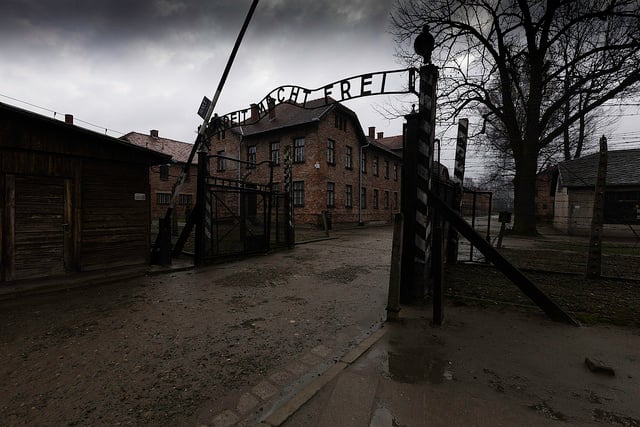
(Rodrigo Paredes, Auschwitz; Flickr, CC By 2.0)
There’s plenty of talk about Francis’s silence during his visit to Auschwitz last week.
This picture of the silent pope is reinforced by the video footage of his visit where he is seen walking quietly through the camp, mutely but generously greeting camp survivors, and spending some time in contemplation in St. Maximillian Kolbe’s starvation cell.
Even though the pope did not make a speech in the Auschwitz death camp, which he gets credit for from some corners, he did not remain totally silent.
He actually spoke about Auschwitz in Krakow from the now famous papal window at the Bishop’s Palace, right across the street from the Franciscan church were I got married. This is where it gets interesting, because nobody seems to have noticed how much he deconstructed our common understanding of Auschwitz.
The following statements on this topic are taken from a CNA report on it:
Speaking form the balcony of the bishop’s palace in Krakow, Pope Francis told youth gathered below that the horror lived by prisoners in the Auschwitz extermination camp isn’t over, but still continues in those who suffer various forms of cruelty today.
“I don’t want to make you bitter, but I have to tell the truth. The cruelty of Auschwitz and Birkenau has not ended. Even today many people are tortured,” the Pope said July 29.
Many prisoners, he said, “are tortured immediately, in order to make them talk. Today there are men and women in overcrowded prisons. They live like animals. This cruelty is there today.”
He spoke at the close of his second full day in Poland, where he is spending July 27-31 for World Youth Day. He’s appearing on the balcony of the archbishop’s palace each night after he returns in order to address the crowd of youth gathered below.
Such a reading of Auschwitz and the Holocaust departs from the current intellectual orthodoxy, which sees both the camp and the historical murder of Jews as unique and incomparable.
Yet, this view of Auschwitz is comparably recent. The final chapter of Tony Judt’s final book, Postwar: A History of Europe Since 1945, notes that the uniqueness thesis only became the prevailing view toward the mid 1980’s. Before that Western Europe was largely indifferent to the plight of the Jews in Nazi concentration camps and did not see their plight as either unique or universal.
However, the pope’s reading of the Holocaust goes outside the intellectually orthodox readings of Auschwitz by leaning heavily upon Christology:
In his speech to youth at the balcony window, Pope Francis noted how they are closed the day uniting to the suffering Jesus. However, Jesus didn’t just suffer 2,000 years ago, but “he suffers today,” the Pope said.
There are many people who suffer, including “the sick the homeless, the hungry, those who are doubtful in life, who don’t feel happiness or salvation, or who feel the weight of their own sin,” he said, noting that Jesus also suffers in the sick children he visited at the hospital earlier in the day.
“Jesus also suffers there, in many children…and that question always comes to mind: why do children suffer? There are no answers for these things.”
Francis then reflected on his visit to Auschwitz and Birkenau, where there was so much pain and “cruelty,” asking “is it possible that us men, created in God’s image, are capable of doing these things?”
The same cruelty exists today, he said, explaining that this can be seen wherever there is war. “In many places in the world, where there is war the same thing happens,” he said.
This might be seen as Christian theological colonialism by some, although Francis, luckily, gets a free pass on many controversial statements.
The most productive reading of these words from Francis would see them in light of the common Christian and Jewish hope for the coming Messiah. For example, take a look at the following anecdote about Martin Buber from Elie Wiesel’s All Rivers Run to the Sea . . .
Previous Post
July 31, 2016
Why Are Muslims Filling Up France's Traditionally Empty Churches Today?
Next Post

August 6, 2016 Truman Lied, Hiroshima Fried: An Atomic Transfiguration
Browse Our Archives
Select a Category #WhyRemainCatholic Abortion Advent Anti-Catholicism Arts Atheism Beauty Benedict XVI Bible Book Review Catholic Cinema Comedy Cosmos: A Space-Time Odyssey Czesław Miłosz Dariusz Karłowicz Devil Easter Eastern Orthodoxy Economics Environment Family Famous Atheists Who Weren't Atheists Guest Post Hans Urs von Balthasar HHS Mandate History Imagination Interview Islam Jean-Luc Marion John Paul II Judaism Just War Lent Literature Little Sisters of the Poor Liturgy Martyrdom Music News Paganism Patristics Phenomenology Philosophy Pierre Hadot Poetry Poland Pop Culture Pope Francis Poverty Prayer Protestantism Rabelais Race Remi Brague Rene Girard Russia Sam Rocha Science & Religion SCOTUS Secularization Sexual Abuse Sexuality Silence Solidarity Stratford Caldecott Synod14 Terrorism Top 10 Uncategorized Walker Percy War Weakened Edition World War II World Youth Day WYD Krakow
Select a Month July 2017 June 2017 May 2017 April 2017 March 2017 February 2017 January 2017 December 2016 October 2016 September 2016 August 2016 July 2016 June 2016 May 2016 April 2016 March 2016 February 2016 January 2016 December 2015 November 2015 October 2015 September 2015 August 2015 July 2015 June 2015 May 2015 April 2015 March 2015 February 2015 January 2015 December 2014 November 2014 October 2014 September 2014 August 2014 July 2014 May 2014 April 2014 March 2014 February 2014 January 2014 December 2013 November 2013 October 2013 September 2013 August 2013 July 2013 June 2013 May 2013
Follow Us!
TAKE THE
Religious Wisdom Quiz
Which Christian denomination was founded by John and Charles Wesley?
Select your answer to see how you score.
Baptist Presbyterian Methodist Catholic
Related posts from Cosmos The In Lost

The Surprising Anti-Capitalist Logic Behind the Catholic Church's...

The Holy Family as an Icon of World...

Biblical Authority After Babel Cannot Be Built Upon...
Western Civ Doesn't Need Tenured Radicals to Ruin...
TRENDING AT PATHEOS Catholic

Creation, Preservation, and Teleology in Catholic Theology
As I write this, it is very early Monday morning. Like millions...

The Parable Of The Sower And The Word...
One of Christ’s most famous parables is that of the sower who...

Rejecting Doom: Christian Hope And Human Action
Christianity is a religion of hope. We are to have hope and...

Why I Choose the Eucharist Over the Sermon
Choose the Eucharist, Not the Sermon What are we supposed to get...

5 Design Elements Found in Spiritually Rooted Homes
Putting Spirituality Into Home Decor Our homes are more than our living...

Credo: A Story of God Told with the...
About 10 years ago, I began to imagine a personal "Credo" that...
view all Catholic blogs
Ad-Free & Subscriber Log-In Subscription Support
- About Us
- 2026 Calendar
- Videos
- Podcasts
- Library of World Religions
- Faith In Media Tracker
- Advertise With Us
- Write for Us
- Privacy Policy
- Terms of Service
- Do Not Sell My Data
- Contact Us
- Radiant Digital
- Manage Newsletter Subscriptions
- Unsubscribe From Notifications
- Sitemap
Copyright 2008-2026, Patheos. All rights reserved.
Subscription Support Ad-Free & Subscriber Log-In
Follow Patheos