
BuddhistCatholicContemplativeEvangelicalGeneral ChristianHinduJewishLatter-day SaintMuslimNew VisionsProgressive Christian
Beliefs
- Buddhist
- Catholic
- Contemplative
- Evangelical
- General Christian
- Hindu
- Jewish
- Latter-day Saint
- More Voices
- Muslim
- New Visions
- Pagan
- Progressive Christian
Topics
- Religion News
- Food and Religion
- Sports and Religion
- Religious Art
- Religious Music and Entertainment
- Religious Events
- History and Religion
- Style and Religion
- Politics and Religion
- Women in Religion
- Recreation Outdoors and Religion
- Business Finance and Religion
- Careers Workplace and Religion
- Education and Religion
- Family Parenting and Religion
- Health Fitness and Religion
- Home and Religion
- Relationships and Religion
- Technology and Religion
- Travel and Religion
Columnists
- Buddhist Columnists
- Business Finance and Religion Columnists
- Careers Workplace and Religion Columnists
- Catholic Columnists
- Contemplative Columnists
- Education and Religion Columnists
- Evangelists Columnists
- Family Parenting and Religion Columnists
- General Christian Columnists
- Health Fitness and Religion Columnists
- Hindu Columnists
- History and Religion Columnists
- Home and Religion Columnists
- Jewish Columnists
- More Voices Columnists
- Latter Day Columnists
- Muslim Columnists
- New Visions Columnists
- Nonreligious Columnists
- Pagan Columnists
- Politics and Religion Columnists
- Progressive Columnists
- Recreation Outdoors and Religion Columnists
- Relationships and Religion Columnists
- Religion News Columnists
- Religious Art Columnists
- Religious Events Columnists
- Religious Music and Entertainment Columnists
- Sports and Religion Columnists
- Style and Religion Columnists
- Technology and Religion Columnists
- Travel and Religion Columnists
- Women in Religion Columnists
Resource Library
- 2026 Calendar
- Library of World Religions
- The 100 Most Holy Places on Earth
- Patheos Answers
- Podcasts
- Videos
- Faith Leaders Database
- Anglican Episcopalian
- Bahai
- Baptist
- Buddhism
- Christianity
- Confucianism
- Eastern Orthodoxy
- Hinduism
- Holiness and Pentecostal
- ISKCON
- Islam
- Judaism
- Lutheran
- Methodist
- The Church of Jesus Christ of Latter-day Saints
- New Age
- Paganism
- Presbytarian and Reformed
- Protestantism
- Religion Behind the Scenes
- Roman Catholic
- Scientology
- Shia Islam
- Sikhism
- Sufism
- Sunni Islam
- Taoism
- Zen
- See all religions
Research Tools
 Ad-Free & Subscriber Log-In Subscription Support
Ad-Free & Subscriber Log-In Subscription Support
Follow Patheos 

- Trending:
- Forgiveness
- |
- Marriage
- |
- Consciousness
- |
- Death Penalty
- |
- Election
- |
- Halloween
 Cosmos The In Lost
- Home
- Catholic
- Rene Girard: No, Christianity is Not a Religion of Peace!
Rene Girard: No, Christianity is Not a Religion of Peace!
Last updated on: June 16, 2016 at 3:00 pm by Artur Rosman
Rene Girard: No, Christianity is Not a Religion of Peace! 2016-06-16T15:00:32-07:00 Artur Rosman
Patheos Explore the world's faith through different perspectives on religion and spirituality! Patheos has the views of the prevalent religions and spiritualities of the world.
![(Queen Mary Apocalypse, The Rider on a White Horse [Christ with Sword in Mouth], early 14th C.; Wikimedia, CC0 1.0)](https://commons.wikimedia.org/wiki/File:The_Rider_on_a_White_Horse_-_Queen_Mary_Apocalypse_%28early_14th_C%29,_f.37_-_BL_Royal_MS_19_B_XV.jpg)
(Queen Mary Apocalypse, The Rider on a White Horse [Christ with Sword in Mouth, detail], early 14th C.; Wikimedia, CC0 1.0)
Think not that I am come to send peace on earth: I came not to send peace, but a sword. For I am come to set a man at variance against his father, and the daughter against her mother, and the daughter in law against her mother in law. And a man’s foes shall be they of his own household.
–Jesus, Matthew 10:34, in his native KJV dialect
The latest round of gun violence has relaunched the never ending debate on whether Islam is a violent religion. The combox crusaders are probably unveiling their profoundest gun control, hate crime, and theology arguments ever as I type this.
No doubt they will come to earth-shattering conclusions that will blind their opponents with their obviousness, but humanity’s inherent stupidity will prevent their recommendations from finding universal application.
Everybody will get their $0.02 in, but pretty much nobody will change their minds.
What I’m trying to say is that I knew I shouldn’t have looked into social media where everybody is now putting their PhD’s in geopolitics, gender studies, theology, American history, and anthropology to kickass use.
Change, traditional values. and progress are no doubt only a couple status updates and tweets away.
The most cringe-worthy of these debates revolves around definitively answering the question “Is Islam a violent religion? The social media crusaders like to resolve that complex problem with the simple binary of “Islam is a religion of violence” vs. “Christianity is a religion of peace.”
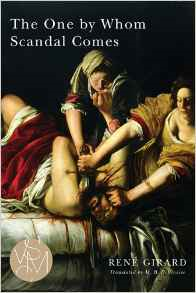 But what if the biblical evidence doesn’t support this?
Rene Girard’s The One by Whom Scandal Comes brings my ongoing discussion of terrorism and violence back to the theological ambit I started on in my posts about Jesus not calling God the Father “Daddy” and the bizarre, but moving, biblical practice of collecting tears in flasks (Is that where the insult about drinking someone’s tears originates?) with the following:
Those who claim there is no apocalyptic element in John are mistaken. It’s true that it lacks an apocalyptic chapter in the manner of the synoptic Gospels, as well as certain sayings ascribed to Jesus in those books, such as “Do not think that I have come to bring peace upon the earth” (Mat 10:34).
But there are striking continuities according to Girard:
But the idea that Christ came to bring war is also found in John, Chapter 9, where Jesus’s healing of the man who was blind from birth creates discord among the Jews. Thus, John says, “a division occurred in the crowd because of him” (7:43). The outlook for the world in the wake of Christ’s revelation is therefore exceedingly blea. But the affairs of this world no longer matter. Union with God takes precedence.
He then ties his explanation of this violence inherent in the Christian system to his theory of scapegoating:
The paradox of the Cross is that it reproduces the archaic structure of sacrifice in order to stand it on its head. But this inversion is a matter of putting right side up what had been wrong side up since the beginning of the world: since the victim is not guilty, he no longer has the power to absorb violence. In social terms, the Cross is the revelation of a destabilizing truth. One thing that is particularly striking, even thought the structure of divine revelation remains unchanged from teh archaic structure of sacrifice, revelation in the Gospels is granted only to a small dissident minority, not to the persecuting majority. It is reserved to those who see, and this unraveling of unanimity prevents the other froms of religion, the archaic, from establishing itself. We see this at the conclusion of the Gospel According to John, which ends on a discordant note. Christ provoked dissension among his listeners wherever he went, and particularly whenever a miracle occurred.
Here’s Girard recapitulating these ideas in the fifth part of the CBC Series on his thought entitled “The Scapegoat“:
If I may explicate a bit . . . According to Girard, archaic religion, and ultimately all of human culture, is based upon the release of pent up violence built up by the resentment created by our innately imitative desires. Scapegoating is a release of these energies, their projection onto a single victim, that reunites a divided society around killing a person or group, who is retroactively divinized. The scapegoat(s) is/are both evil (because he or she is blamed for the divisions) and ultimately good, even divine (because he or she unites a society in releasing their antagonisms upon a single victim).
 The Crucifixion exposes this process as a lie. Therefore, it robs culture of its main avenue for dealing with its competitive aggression. In this way, if its hearers chose the old violence over love, Christianity does not bring peace, it brings the sword. Our judgment, and effectively the judgments people will have of the Christian God, is immanent within that decision to accept or reject the grace of the King of Peace, the Lamb of God. I know of few other commentaries upon these passages that make this much sense of them.
I know this is a lot to process from three passages followed by two paragraphs of commentary, especially for an intricate theory developed in detail over three rather large books Deceit, Desire, and the Novel (desire), Violence and the Sacred (scapegoat), Things Hidden Since the Foundation of the World (theological reading of the other two concepts). I See Satan Fall Like Lightning is Girard’s most readable late synthesis of these three concepts. .
For a more detailed account you might also want to see the post René Girard: Is Christianity a Myth?, my Girard obituary, and my list of thinkers in a variety of fields influenced by his work.
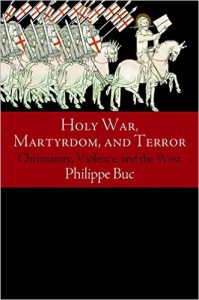
This ambivalence toward violence played itself out in many strange ways in Christian history, especially during the Crusades. If you want a mostly enthusiastic account of this look to Rodney Stark’s God’s Battalions. For a more sophisticated account of the Crusades see Philippe Buc’s (as in buc emissaire, scapegoat!) Holy War, Martyrdom, and Terror. One of the things Buc highlights toward the end of his Entitled Opinions “Religion and Violence” interview, which he gave while writing the book in question, is how much the idea of fighting humanitarian wars, rather than wars for one’s national interest, is a mostly overlooked, more or less positive, phenomenon that grows out of the Christian tradition.
There, I’ve made a mess of it all, but Christianity has never been exclusively for the weak in mind and heart, even though it is that too. The violent bear it away, they say.
Here’s the full episode of CBC’s Ideas on Girard’s take on Christianity if you’re really curious:
For breaking news on the Orlando Shooting and its connections to Girard’s notion of the scapegoat see: Sources Close to Orlando Shooter Confirm Omar Mateen Was Gay
Please consider making a donation to this blog through the donation button on the upper right side of its homepage.
Stay in touch! Like Cosmos the in Lost on Facebook:
Previous Post
June 13, 2016
Terrorism Has an Altruistic Logic
Next Post
June 15, 2016 A Prayer for Omar Mateen
Browse Our Archives
Select a Category #WhyRemainCatholic Abortion Advent Anti-Catholicism Arts Atheism Beauty Benedict XVI Bible Book Review Catholic Cinema Comedy Cosmos: A Space-Time Odyssey Czesław Miłosz Dariusz Karłowicz Devil Easter Eastern Orthodoxy Economics Environment Family Famous Atheists Who Weren't Atheists Guest Post Hans Urs von Balthasar HHS Mandate History Imagination Interview Islam Jean-Luc Marion John Paul II Judaism Just War Lent Literature Little Sisters of the Poor Liturgy Martyrdom Music News Paganism Patristics Phenomenology Philosophy Pierre Hadot Poetry Poland Pop Culture Pope Francis Poverty Prayer Protestantism Rabelais Race Remi Brague Rene Girard Russia Sam Rocha Science & Religion SCOTUS Secularization Sexual Abuse Sexuality Silence Solidarity Stratford Caldecott Synod14 Terrorism Top 10 Uncategorized Walker Percy War Weakened Edition World War II World Youth Day WYD Krakow
Select a Month July 2017 June 2017 May 2017 April 2017 March 2017 February 2017 January 2017 December 2016 October 2016 September 2016 August 2016 July 2016 June 2016 May 2016 April 2016 March 2016 February 2016 January 2016 December 2015 November 2015 October 2015 September 2015 August 2015 July 2015 June 2015 May 2015 April 2015 March 2015 February 2015 January 2015 December 2014 November 2014 October 2014 September 2014 August 2014 July 2014 May 2014 April 2014 March 2014 February 2014 January 2014 December 2013 November 2013 October 2013 September 2013 August 2013 July 2013 June 2013 May 2013
Follow Us!
TAKE THE
Religious Wisdom Quiz
Who is the "chosen lady" addressed in a New Testament letter?
Select your answer to see how you score.
Phoebe Mary Unspecified church Lydia
Related posts from Cosmos The In Lost

Biblical Authority After Babel Cannot Be Built Upon...

Post-Execution Church: Rise Up from the Electric Chair!

2 Reasons Why the March for Science is...
What is the History of the Coptic Christian...
TRENDING AT PATHEOS Catholic

Creation, Preservation, and Teleology in Catholic Theology
As I write this, it is very early Monday morning. Like millions...

The Parable Of The Sower And The Word...
One of Christ’s most famous parables is that of the sower who...

Rejecting Doom: Christian Hope And Human Action
Christianity is a religion of hope. We are to have hope and...

Why I Choose the Eucharist Over the Sermon
Choose the Eucharist, Not the Sermon What are we supposed to get...

5 Design Elements Found in Spiritually Rooted Homes
Putting Spirituality Into Home Decor Our homes are more than our living...

Credo: A Story of God Told with the...
About 10 years ago, I began to imagine a personal "Credo" that...
view all Catholic blogs
Ad-Free & Subscriber Log-In Subscription Support
- About Us
- 2026 Calendar
- Videos
- Podcasts
- Library of World Religions
- Faith In Media Tracker
- Advertise With Us
- Write for Us
- Privacy Policy
- Terms of Service
- Do Not Sell My Data
- Contact Us
- Radiant Digital
- Manage Newsletter Subscriptions
- Unsubscribe From Notifications
- Sitemap
Copyright 2008-2026, Patheos. All rights reserved.
Subscription Support Ad-Free & Subscriber Log-In
Follow Patheos