
BuddhistCatholicContemplativeEvangelicalGeneral ChristianHinduJewishLatter-day SaintMuslimNew VisionsProgressive Christian
Beliefs
- Buddhist
- Catholic
- Contemplative
- Evangelical
- General Christian
- Hindu
- Jewish
- Latter-day Saint
- More Voices
- Muslim
- New Visions
- Pagan
- Progressive Christian
Topics
- Religion News
- Food and Religion
- Sports and Religion
- Religious Art
- Religious Music and Entertainment
- Religious Events
- History and Religion
- Style and Religion
- Politics and Religion
- Women in Religion
- Recreation Outdoors and Religion
- Business Finance and Religion
- Careers Workplace and Religion
- Education and Religion
- Family Parenting and Religion
- Health Fitness and Religion
- Home and Religion
- Relationships and Religion
- Technology and Religion
- Travel and Religion
Columnists
- Buddhist Columnists
- Business Finance and Religion Columnists
- Careers Workplace and Religion Columnists
- Catholic Columnists
- Contemplative Columnists
- Education and Religion Columnists
- Evangelists Columnists
- Family Parenting and Religion Columnists
- General Christian Columnists
- Health Fitness and Religion Columnists
- Hindu Columnists
- History and Religion Columnists
- Home and Religion Columnists
- Jewish Columnists
- More Voices Columnists
- Latter Day Columnists
- Muslim Columnists
- New Visions Columnists
- Nonreligious Columnists
- Pagan Columnists
- Politics and Religion Columnists
- Progressive Columnists
- Recreation Outdoors and Religion Columnists
- Relationships and Religion Columnists
- Religion News Columnists
- Religious Art Columnists
- Religious Events Columnists
- Religious Music and Entertainment Columnists
- Sports and Religion Columnists
- Style and Religion Columnists
- Technology and Religion Columnists
- Travel and Religion Columnists
- Women in Religion Columnists
Resource Library
- 2026 Calendar
- Library of World Religions
- The 100 Most Holy Places on Earth
- Patheos Answers
- Podcasts
- Videos
- Faith Leaders Database
- Anglican Episcopalian
- Bahai
- Baptist
- Buddhism
- Christianity
- Confucianism
- Eastern Orthodoxy
- Hinduism
- Holiness and Pentecostal
- ISKCON
- Islam
- Judaism
- Lutheran
- Methodist
- The Church of Jesus Christ of Latter-day Saints
- New Age
- Paganism
- Presbytarian and Reformed
- Protestantism
- Religion Behind the Scenes
- Roman Catholic
- Scientology
- Shia Islam
- Sikhism
- Sufism
- Sunni Islam
- Taoism
- Zen
- See all religions
Research Tools
 Ad-Free & Subscriber Log-In Subscription Support
Ad-Free & Subscriber Log-In Subscription Support
Follow Patheos 

- Trending:
- Forgiveness
- |
- Marriage
- |
- Consciousness
- |
- Death Penalty
- |
- Election
- |
- Halloween
 Cosmos The In Lost
- Home
- Catholic
- Did God Rape the Prophet Jeremiah?
Did God Rape the Prophet Jeremiah?
Last updated on: June 10, 2016 at 11:37 am by Artur Rosman
Did God Rape the Prophet Jeremiah? 2016-06-10T11:37:33-07:00 Artur Rosman
Patheos Explore the world's faith through different perspectives on religion and spirituality! Patheos has the views of the prevalent religions and spiritualities of the world.
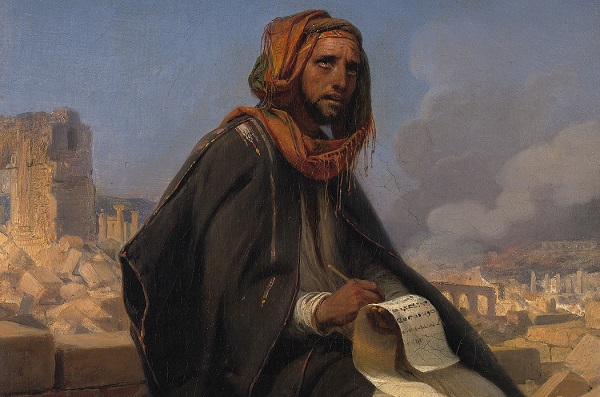
You’d look confused too if you were him (Horace Vernet, Jeremiah on the ruins of Jerusalem, 1844; Wikimedia, PD-Old-100).
Jeremiah seemed to think so and that’s more interesting than a thousand vapid “current events” articles on gorillas.
Modern Christians have talked about the strange new world within the Bible at least since the time of Karl Barth. Actually, this trope goes back all the way back to one of Barth’s sources, Albert Schweitzer and his The Quest of the Historical Jesus. In that book the good humanist doctor “discovered” in Jesus an apocalyptic prophet-figure that didn’t play nice with the liberal-bourgeois Jesus of Troeltsch’s The Social Teaching of the Christian Churches.
But boy, if you look at the Old Testament then you realize how disturbing God could be for the prophets. The prophets were strange figures who demanded a fundamental transformation from their audiences. Perhaps none of them was as radical as Jeremiah. He would not have been a popular figure in any age. Jeremiah prophesied nothing less than the total destruction of Jerusalem as divine punishment for Israel’s unfaithfulness to God. Predicting famine, plundering by conquerors, and foreign exile doesn’t win too many popularity contests. Move over Westboro, there’s an old game in town.
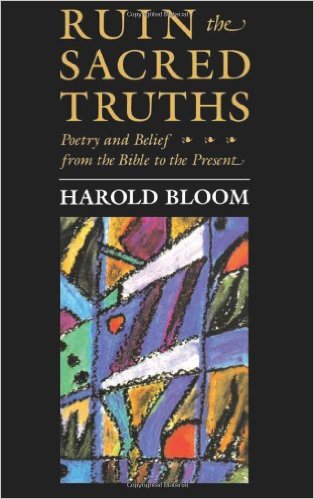 Thanks to Harold Bloom’s Ruin the Sacred Truths: Poetry and Belief from the Bible to the Present I suspect God probably wasn’t one of Jeremiah’s greatest fans either.
I’d like to draw some attention to Harold Bloom before we move onto Jeremiah. Bloom is one of the few critics in the secular academe who defiantly champions religious literature. A surprising number of the figures in my TOP10 Religious Novelists and Poets came to literary prominence thanks to Bloom’s criticism, because of his penchant for promoting overtly religious literature. You can glean some of the reasons for his habit from the following passage in Ruin the Sacred Truths:
I myself do not believe that secularization is itself a literary process. The scandal is the stubborn resistance of imaginative literature to the categories of sacred and secular. If you wish, you can insist that all high literature is secular, or, if you should desire it so, then all strong poetry is sacred. What I find incoherent is the judgment that some authentic literary art is more sacred or more secular than some other.
His unwillingness to separate the sacred from the secular has much in common with what recent scholarship notes as the hallmarks of a uniquely Catholic imagination. In this he is only perhaps equally by George Steiner, whose Real Presences brashly argues for the presence of God as the key for understanding all human efforts at meaning.
But let’s get back to the meaning of some really strange things said by Jeremiah. The standard translation of Jeremiah 20:7 hints at something odd:
You seduced me,* LORD, and I let myself be seduced; you were too strong for me, and you prevailed. All day long I am an object of laughter; everyone mocks me.
The explanatory note for “seduced me” reads, “Jeremiah accuses the Lord of having deceived him,” which is rather disappointing, because it doesn’t pick up on the violence of the rest of the verse. Ruin the Sacred Truths instead goes further, much further:
Starting with Chapter 2, Jeremiah’s oracles place a heavy emphasis upon the trope of Jerusalem as Yahweh’s unfaithful bride, his first wife as it were, to be replaced by the more reliable Jeremiah as second bride. I was to examine this trope more fully in a moment, but only after looking at the most extravagant and memorable passage in this extravagant and memorable interpreter of Yahweh, from the seventh verse of Chapter 20 on ward. Here the Hebrew needs to be read very slowly and thoroughly, because Jeremiah accuses Yahweh of sexual violence towards him, and accusation too serious and too original to be set aside as easily as many might wish.
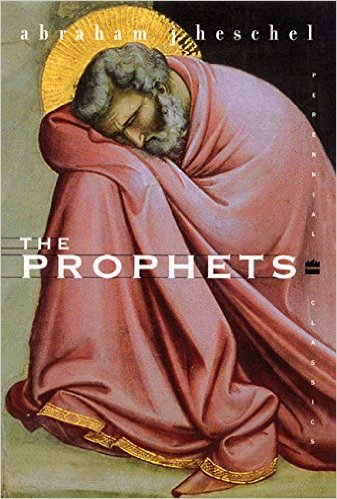 Here Bloom is relying on work previously done by the venerable Abraham Joshua Heschel in his widely-read book The Prophets:
The words used by Jeremiah to describe the impact of God upon his life are identical with the terms for seduction and rape in the legal terminology of the Bible.
The words in question, according to Bloom, are as follows:
The crucial verbs are patah and chasack. In Exodus 22:16 patah refers to seducing “a maid that is not betrothed” before or without marriage. In Deuteronomy 22:15 chasack refers to sexual violence, and elsewhere to adulterous rape.
Therefore Bloom renders Jeremiah 20:7 in Ruin the Sacred Truths as:
Yahweh, you seduced me unlawfully, and I consented to being seduced; you raped me, and you were too strong for my resistance to prevail. All day long I have become an object of derision, everyone mocks me.
This is clearly a metaphor, since the prophets, more than the authors of the previous sections of the Hebrew Bible, criticized anthropomorphism.
Yet, even if it is “only” a metaphor, it is an especially pungent one that gives Jeremiah’s words a properly Rabelaisian Catholic punch, a punch bigger than any gorilla. “My ways are not your ways,” the prophet Isaiah quotes God.
That’s how strange the world of the Bible really is. I should add that all of this is predicated upon the fundamental nuptial metaphor (as already suggested by Bloom above) for the relationship between God and his people.
I will deign to explain why this is important for understanding why a Church that worships a celibate Messiah places so much emphasis upon marriage.
By the way, if you find all this offensive, all I can say is that it is in the Bible, just as the fact that Jesus was an anatomically correct male. Deal with it.
UPDATE: These are my own first reactions to this particular reading of Jeremiah. I refused to be bullied into making moralizing, but ultimately flaky, conclusions about it. I trust my readers, and maybe this is a fault of mine, to explore (or not!) the issues brought up here for themselves rather than ramming a “relevant” takeaway down their throats.
By the way, did you know that Jesus Didn’t Call God Daddy, or that Difference, Disharmony, and Drama Are the Essence of Marriage? Or, did you ever wonder . . Does Catholic Monasticism Have a Sexual Orientation?
Please consider making a donation to this blog through the donation button on the upper right side of its homepage.
Stay in touch! Like Cosmos the in Lost on Facebook:
Previous Post

June 6, 2016
Ever Wonder Why Saint Paul Went to Arabia?
Next Post

June 9, 2016 Palestinians Are the Living Key to "Tear Flasks" & the Bible's Strange World
Browse Our Archives
Select a Category #WhyRemainCatholic Abortion Advent Anti-Catholicism Arts Atheism Beauty Benedict XVI Bible Book Review Catholic Cinema Comedy Cosmos: A Space-Time Odyssey Czesław Miłosz Dariusz Karłowicz Devil Easter Eastern Orthodoxy Economics Environment Family Famous Atheists Who Weren't Atheists Guest Post Hans Urs von Balthasar HHS Mandate History Imagination Interview Islam Jean-Luc Marion John Paul II Judaism Just War Lent Literature Little Sisters of the Poor Liturgy Martyrdom Music News Paganism Patristics Phenomenology Philosophy Pierre Hadot Poetry Poland Pop Culture Pope Francis Poverty Prayer Protestantism Rabelais Race Remi Brague Rene Girard Russia Sam Rocha Science & Religion SCOTUS Secularization Sexual Abuse Sexuality Silence Solidarity Stratford Caldecott Synod14 Terrorism Top 10 Uncategorized Walker Percy War Weakened Edition World War II World Youth Day WYD Krakow
Select a Month July 2017 June 2017 May 2017 April 2017 March 2017 February 2017 January 2017 December 2016 October 2016 September 2016 August 2016 July 2016 June 2016 May 2016 April 2016 March 2016 February 2016 January 2016 December 2015 November 2015 October 2015 September 2015 August 2015 July 2015 June 2015 May 2015 April 2015 March 2015 February 2015 January 2015 December 2014 November 2014 October 2014 September 2014 August 2014 July 2014 May 2014 April 2014 March 2014 February 2014 January 2014 December 2013 November 2013 October 2013 September 2013 August 2013 July 2013 June 2013 May 2013
Follow Us!
TAKE THE
Religious Wisdom Quiz
What Christian group follows the "Three Self Principle" in church governance?
Select your answer to see how you score.
Seventh-day Adventists Chinese Protestant Churches Quakers Orthodox Christians
Related posts from Cosmos The In Lost

Biblical Authority After Babel Cannot Be Built Upon...
Why Yes, The Vatican Museums Are Actually Taking...

Who Knew Sex Helps You to Experience God's...
TRENDING AT PATHEOS Catholic

Rejecting Doom: Christian Hope And Human Action
Christianity is a religion of hope. We are to have hope and...

It’s What Comes From Within Which Matters
One of the most difficult things for us to understand is why...

Why I Choose the Eucharist Over the Sermon
Choose the Eucharist, Not the Sermon What are we supposed to get...

5 Design Elements Found in Spiritually Rooted Homes
Putting Spirituality Into Home Decor Our homes are more than our living...

Credo: A Story of God Told with the...
About 10 years ago, I began to imagine a personal "Credo" that...

The Anatomy of Divine Revelation in Catholic Thought
The claim that God has made Himself known to human beings is...
view all Catholic blogs
Ad-Free & Subscriber Log-In Subscription Support
- About Us
- 2026 Calendar
- Videos
- Podcasts
- Library of World Religions
- Faith In Media Tracker
- Advertise With Us
- Write for Us
- Privacy Policy
- Terms of Service
- Do Not Sell My Data
- Contact Us
- Radiant Digital
- Manage Newsletter Subscriptions
- Unsubscribe From Notifications
- Sitemap
Copyright 2008-2026, Patheos. All rights reserved.
Subscription Support Ad-Free & Subscriber Log-In
Follow Patheos