
BuddhistCatholicContemplativeEvangelicalGeneral ChristianHinduJewishLatter-day SaintMuslimNew VisionsProgressive Christian
Beliefs
- Buddhist
- Catholic
- Contemplative
- Evangelical
- General Christian
- Hindu
- Jewish
- Latter-day Saint
- More Voices
- Muslim
- New Visions
- Pagan
- Progressive Christian
Topics
- Religion News
- Food and Religion
- Sports and Religion
- Religious Art
- Religious Music and Entertainment
- Religious Events
- History and Religion
- Style and Religion
- Politics and Religion
- Women in Religion
- Recreation Outdoors and Religion
- Business Finance and Religion
- Careers Workplace and Religion
- Education and Religion
- Family Parenting and Religion
- Health Fitness and Religion
- Home and Religion
- Relationships and Religion
- Technology and Religion
- Travel and Religion
Columnists
- Buddhist Columnists
- Business Finance and Religion Columnists
- Careers Workplace and Religion Columnists
- Catholic Columnists
- Contemplative Columnists
- Education and Religion Columnists
- Evangelists Columnists
- Family Parenting and Religion Columnists
- General Christian Columnists
- Health Fitness and Religion Columnists
- Hindu Columnists
- History and Religion Columnists
- Home and Religion Columnists
- Jewish Columnists
- More Voices Columnists
- Latter Day Columnists
- Muslim Columnists
- New Visions Columnists
- Nonreligious Columnists
- Pagan Columnists
- Politics and Religion Columnists
- Progressive Columnists
- Recreation Outdoors and Religion Columnists
- Relationships and Religion Columnists
- Religion News Columnists
- Religious Art Columnists
- Religious Events Columnists
- Religious Music and Entertainment Columnists
- Sports and Religion Columnists
- Style and Religion Columnists
- Technology and Religion Columnists
- Travel and Religion Columnists
- Women in Religion Columnists
Resource Library
- 2026 Calendar
- Library of World Religions
- The 100 Most Holy Places on Earth
- Patheos Answers
- Podcasts
- Videos
- Faith Leaders Database
- Anglican Episcopalian
- Bahai
- Baptist
- Buddhism
- Christianity
- Confucianism
- Eastern Orthodoxy
- Hinduism
- Holiness and Pentecostal
- ISKCON
- Islam
- Judaism
- Lutheran
- Methodist
- The Church of Jesus Christ of Latter-day Saints
- New Age
- Paganism
- Presbytarian and Reformed
- Protestantism
- Religion Behind the Scenes
- Roman Catholic
- Scientology
- Shia Islam
- Sikhism
- Sufism
- Sunni Islam
- Taoism
- Zen
- See all religions
Research Tools
 Ad-Free & Subscriber Log-In Subscription Support
Ad-Free & Subscriber Log-In Subscription Support
Follow Patheos 

- Trending:
- Forgiveness
- |
- Marriage
- |
- Consciousness
- |
- Death Penalty
- |
- Election
- |
- Halloween
 Cosmos The In Lost
- Home
- Catholic
- Ever Wonder Why Saint Paul Went to Arabia?
Ever Wonder Why Saint Paul Went to Arabia?
Last updated on: June 6, 2016 at 7:06 am by Artur Rosman
Ever Wonder Why Saint Paul Went to Arabia? 2016-06-06T07:06:55-07:00 Artur Rosman
Patheos Explore the world's faith through different perspectives on religion and spirituality! Patheos has the views of the prevalent religions and spiritualities of the world.
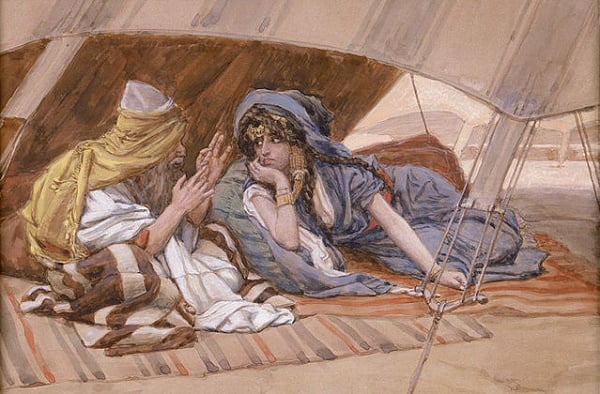
Inquiring minds want to know (James Tissot, Abram’s Counsel to Sarai, 1902; Source: Wikimedia Commons, PD-Old-100)
Arabia is a geographical entity familiar and vexing to the contemporary Westerners, but what could it have meant to Paul?
The place to start when you have questions about Holy Writ.
There’s no indication in Galatians 1 the future saint went there to combat ISIS, or to fight for Israel in the hope of igniting Armageddon:
But when God, who from my mother’s womb had set me apart
was pleased to reveal his Son to me,
so that I might proclaim him to the Gentiles,
I went into Arabia and then returned to Damascus.
This curious reference was passed over by our Irish priest in today’s sermon in favor of talking about miracles and the Mariners. He prayed for a miracle to Leonie Martin right before Leonys Martin had a walk off two-run blast on a two out, two strike, pitch a couple of weeks ago to give the home team an improbably victory. It worked, see video at the bottom of this post.
Surprise summer reading hit for Mariners fans.
Fair enough, I had to scramble to a more reliable source, McKenzie’s Dictionary of the Bible. Alas, the Jesuit let me down a bit–the cynical might say that’s as expected from the Jesuits. He only mentioned that the Arabian peninsula is the original home of the Semitic peoples, the place where the father of our faith (Abraham) left, and that Mt. Sinai might be located there. If we take these three clues together then we might come to the conclusion that St. Paul might have been going back to the roots of the faith.
I was perplexed there was nothing about St. Paul in Arabia in Barbara M. Bowen’s little classic Strange Scriptures that Perplex the Western Mind. I looked there because she based many of her explanations of difficult biblical passages upon the habits of Arab nomads whose behaviors have not changed since before biblical times. I’m sure I’ll return to this book in the coming weeks. It’s a real treasure trove.
After these failed efforts I reached for Margaret Barker’s King of the Jews: Temple Theology in John’s Gospel, which makes explicit reference to today’s reading:
Barker tracks down lots of obscure references in this book.
Justin, a native of Palestine writing in the mid-second century, said the magi came from Arabia, but his voice has been largely unheard, and the magi are invariably linked to Persia. . . . Exactly what Justin meant by ‘Arabia’, however, is not known. Herod was an Arabian but he came from Edom, and Josephus said that Petra was the capital of Arabia. It was not today’s Arabia. After his conversion, Paul went to Arabia (Gal. 1.17), and his visit may help to identify the magi. He came back better informed about his new faith and able to explain that Christianity was rooted in something older than the law of Moses. Who instructed him? Paul went on to teach that Christianity antedated the Sinai covenant, and was based on righteousness through faith. Abraham was the great example, and his true heirs were righteous through faith. The righteous have proved to be a significant group in the nativity story (Luke 1.17, 75; Matt. 1.19), and Abraham and his heirs were important for Zechariah and his son John (Luke 1.73; Matt. 3.9).
It appears Paul was not after Saudi air conditioning and oil. He was hunting down an ancient tradition of the First Temple that was essential for understanding Christianity. But is this tradition a figment of Justin Martyr’s imagination, or something actually documented in other places? Barker’s The Great High Priest: The Temple Roots of Christian Liturgy offers solid clues from an ancient Jewish primary source:

More clues about Paul and the ancient Hebrew roots of Christianity.
It was Josiah, not Nebuchadnezzar, who finally destroyed the old temple, and there were long memories about the work of Josiah. Essential items from the temple were ‘hidden’ in his time – the anointing oil, the ark, the manna and Aaron’s rod (b. Horayoth 12a), and in the time of the Messiah the lamp, the ark, the Spirit, the fire and the cherubim would be restored to the temple (Num. R. XV. 10), the implication being that these were absent from the second temple but had been in the first. It was also remembered that eighty thousand priests fled to the army of Nebuchadnezzar, and then settled among the Ishmaelites (/. Ta’anit 4.5, The Jerusalem Talmud, often known as Yerushalmi). Not everyone was grieving when Josiah’s ‘reformed’ temple fell. The Jerusalem Talmud continues with lines from Isaiah 21.13-14, and interprets them as a reference to the departed priests. ‘The oracle concerning Arabia: In the thickets of Arabia you will lodge …’ was said to mean ‘A great burden is on Arabia’ (Hebrew masa’ can mean oracle or burden), ‘for those who had been in the Forest of Lebanon [the temple, 1 Kgs 7.2] are now in the thickets of Arabia’. From this we may conclude two things: the priests with the older ways and therefore with knowledge of the traditions of the holy of holies, were known to have gone to Arabia, so we should expect to find remnants of the first temple among the sons of Ishmael; and second, that this was still remembered when the Jerusalem Talmud was compiled in Palestine about 400 CE.
So we started with St. Paul, but he was going all the way back to Abraham. (You didn’t think I picked the feature image for this post randomly, did you?).
There we learn how the First Temple reproduced the seven days of Creation. The High Priest was responsible for keeping Creation in harmony through elaborate rites that culminated with a scapegoat ritual. When you think of Jesus as both the scapegoat/victim and priest, as in the Letter to the Hebrews, then you can glimpse how the pieces begin fall into place. Therefore, McKenzie’s Dictionary of the Bible gave us all the right basic threads, but the carpet Barker weaves in Temple Theology ties them all together.
Maybe there’s way, way more to the biblical worldview than what’s contained in the Bible? Margaret Barker thinks so.
Jewish tradition remembered and recorded that many priests of the original temple had fled to Arabia after the time of Josiah’s purge. They must have taken with them the faith of the older temple. Paul also spent time in ‘Arabia’ (Gal. 1:17) before returning and arguing that the roots of Christianity lay in the faith of Abraham.
Traditions associated with the origin of Islam knew that there had been another ancient faith that was neither Christianity nor Judaism. There earliest account of the life of Muhammad was written by Ibn Ishaq in the middle of the 8th century CE and so only about 100 years after the time of Muhammad. Before the prophet appeared, he wrote, four good men set out to seek the religion of their father Abraham, which they believed their people had corrupted. ‘They went their several ways in the lands, seeking the Hanifiya, the religion of Abraham.’ One of them eventually met a Christian monk in Syria who told him there was nobody left who could guide him to the religion of Abraham, but that a new prophet would soon appear. The Qur’an too distinguished between the religion of Abraham and the religion of Moses… Much of the Temple lore re-emerged in Islam; the traditional dimensions of the holy of holies are also those of the Kaaba.
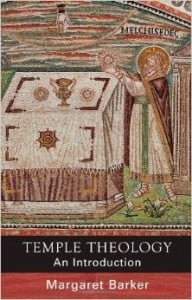
You weren’t expecting the connection Islam, were you? Well, should you want to explore this admittedly speculative line of investigation, then Barker’s Temple Theology is your best entryway into her vast publications. BUT, BE WARNED–once you pop open one of her works, you can’t stop…
https://www.youtube.com/watch?v=B2wXhB-ydKU
You might also want to know How Did Disappearing Middle Eastern Religions Survive in the First Place?, or Rene Girard: Is Christianity a Myth?
Please consider making a donation to this blog through the donation button on the upper right side of its homepage.
Stay in touch! Like Cosmos the in Lost on Facebook:
Previous Post
May 28, 2016
Obama Used Original Sin to Explain Hiroshima
Next Post

June 7, 2016 Did God Rape the Prophet Jeremiah?
Browse Our Archives
Select a Category #WhyRemainCatholic Abortion Advent Anti-Catholicism Arts Atheism Beauty Benedict XVI Bible Book Review Catholic Cinema Comedy Cosmos: A Space-Time Odyssey Czesław Miłosz Dariusz Karłowicz Devil Easter Eastern Orthodoxy Economics Environment Family Famous Atheists Who Weren't Atheists Guest Post Hans Urs von Balthasar HHS Mandate History Imagination Interview Islam Jean-Luc Marion John Paul II Judaism Just War Lent Literature Little Sisters of the Poor Liturgy Martyrdom Music News Paganism Patristics Phenomenology Philosophy Pierre Hadot Poetry Poland Pop Culture Pope Francis Poverty Prayer Protestantism Rabelais Race Remi Brague Rene Girard Russia Sam Rocha Science & Religion SCOTUS Secularization Sexual Abuse Sexuality Silence Solidarity Stratford Caldecott Synod14 Terrorism Top 10 Uncategorized Walker Percy War Weakened Edition World War II World Youth Day WYD Krakow
Select a Month July 2017 June 2017 May 2017 April 2017 March 2017 February 2017 January 2017 December 2016 October 2016 September 2016 August 2016 July 2016 June 2016 May 2016 April 2016 March 2016 February 2016 January 2016 December 2015 November 2015 October 2015 September 2015 August 2015 July 2015 June 2015 May 2015 April 2015 March 2015 February 2015 January 2015 December 2014 November 2014 October 2014 September 2014 August 2014 July 2014 May 2014 April 2014 March 2014 February 2014 January 2014 December 2013 November 2013 October 2013 September 2013 August 2013 July 2013 June 2013 May 2013
Follow Us!
TAKE THE
Religious Wisdom Quiz
Which prophet's visions include "Gog and Magog"?
Select your answer to see how you score.
Micah Daniel Ezekiel Amos
Related posts from Cosmos The In Lost

The Surprising Anti-Capitalist Logic Behind the Catholic Church's...

The Holy Family as an Icon of World...

Biblical Authority After Babel Cannot Be Built Upon...
Western Civ Doesn't Need Tenured Radicals to Ruin...
TRENDING AT PATHEOS Catholic

Rejecting Doom: Christian Hope And Human Action
Christianity is a religion of hope. We are to have hope and...

It’s What Comes From Within Which Matters
One of the most difficult things for us to understand is why...

Why I Choose the Eucharist Over the Sermon
Choose the Eucharist, Not the Sermon What are we supposed to get...

5 Design Elements Found in Spiritually Rooted Homes
Putting Spirituality Into Home Decor Our homes are more than our living...

Credo: A Story of God Told with the...
About 10 years ago, I began to imagine a personal "Credo" that...

The Anatomy of Divine Revelation in Catholic Thought
The claim that God has made Himself known to human beings is...
view all Catholic blogs
Ad-Free & Subscriber Log-In Subscription Support
- About Us
- 2026 Calendar
- Videos
- Podcasts
- Library of World Religions
- Faith In Media Tracker
- Advertise With Us
- Write for Us
- Privacy Policy
- Terms of Service
- Do Not Sell My Data
- Contact Us
- Radiant Digital
- Manage Newsletter Subscriptions
- Unsubscribe From Notifications
- Sitemap
Copyright 2008-2026, Patheos. All rights reserved.
Subscription Support Ad-Free & Subscriber Log-In
Follow Patheos