
BuddhistCatholicContemplativeEvangelicalGeneral ChristianHinduJewishLatter-day SaintMuslimNew VisionsProgressive Christian
Beliefs
- Buddhist
- Catholic
- Contemplative
- Evangelical
- General Christian
- Hindu
- Jewish
- Latter-day Saint
- More Voices
- Muslim
- New Visions
- Pagan
- Progressive Christian
Topics
- Religion News
- Food and Religion
- Sports and Religion
- Religious Art
- Religious Music and Entertainment
- Religious Events
- History and Religion
- Style and Religion
- Politics and Religion
- Women in Religion
- Recreation Outdoors and Religion
- Business Finance and Religion
- Careers Workplace and Religion
- Education and Religion
- Family Parenting and Religion
- Health Fitness and Religion
- Home and Religion
- Relationships and Religion
- Technology and Religion
- Travel and Religion
Columnists
- Buddhist Columnists
- Business Finance and Religion Columnists
- Careers Workplace and Religion Columnists
- Catholic Columnists
- Contemplative Columnists
- Education and Religion Columnists
- Evangelists Columnists
- Family Parenting and Religion Columnists
- General Christian Columnists
- Health Fitness and Religion Columnists
- Hindu Columnists
- History and Religion Columnists
- Home and Religion Columnists
- Jewish Columnists
- More Voices Columnists
- Latter Day Columnists
- Muslim Columnists
- New Visions Columnists
- Nonreligious Columnists
- Pagan Columnists
- Politics and Religion Columnists
- Progressive Columnists
- Recreation Outdoors and Religion Columnists
- Relationships and Religion Columnists
- Religion News Columnists
- Religious Art Columnists
- Religious Events Columnists
- Religious Music and Entertainment Columnists
- Sports and Religion Columnists
- Style and Religion Columnists
- Technology and Religion Columnists
- Travel and Religion Columnists
- Women in Religion Columnists
Resource Library
- 2026 Calendar
- Library of World Religions
- The 100 Most Holy Places on Earth
- Patheos Answers
- Podcasts
- Videos
- Faith Leaders Database
- Anglican Episcopalian
- Bahai
- Baptist
- Buddhism
- Christianity
- Confucianism
- Eastern Orthodoxy
- Hinduism
- Holiness and Pentecostal
- ISKCON
- Islam
- Judaism
- Lutheran
- Methodist
- The Church of Jesus Christ of Latter-day Saints
- New Age
- Paganism
- Presbytarian and Reformed
- Protestantism
- Religion Behind the Scenes
- Roman Catholic
- Scientology
- Shia Islam
- Sikhism
- Sufism
- Sunni Islam
- Taoism
- Zen
- See all religions
Research Tools
 Ad-Free & Subscriber Log-In Subscription Support
Ad-Free & Subscriber Log-In Subscription Support
Follow Patheos 

- Trending:
- Forgiveness
- |
- Marriage
- |
- Consciousness
- |
- Death Penalty
- |
- Election
- |
- Halloween
 Cosmos The In Lost
- Home
- Catholic
- Obama Used Original Sin to Explain Hiroshima
Obama Used Original Sin to Explain Hiroshima
Last updated on: May 28, 2016 at 7:45 pm by Artur Rosman
Obama Used Original Sin to Explain Hiroshima 2016-05-28T19:45:08-07:00 Artur Rosman
Patheos Explore the world's faith through different perspectives on religion and spirituality! Patheos has the views of the prevalent religions and spiritualities of the world.
![(Titian, Cain and Abel [detail], 1490; Source: Wikimedia, PD-Old-100)](https://wp-media.patheos.com/blogs/sites/455/2016/05/Titian_-_Cain_and_Abel.jpg)
(Titian, Cain and Abel [detail], 1490; Source: Wikimedia, PD-Old-100)
If one bothers to scratch even a little below the surface then it becomes clear as day that the doctrine of Original Sin was the primary trope of President Obama’s speech at the Hiroshima Peace Park.
But that’s only one part of a larger biblical story that should also include apology, forgiveness, and reconciliation.
What follows is a reading of the text following the interpretive hints dropped by The Irony of Barack Obama: Barack Obama, Reinhold Niebuhr and the Problem of Christian Statecraft:
Drawing on the political theology of Reinhold Niebuhr, described by Barack Obama as ‘one of my favourite philosophers’, this book assesses the challenges facing the President during his first term. It evaluates his success in adhering to Niebuhr’s path of ‘Christian realism’ when faced with the pragmatic demands of domestic and foreign affairs. In 2008 Candidate Obama used the ideas of ‘Hope’ and ‘Change’ to inspire voters and secure the presidency. Obama promised change not only regarding America’s policies, but even more fundamentally in the nation’s political culture. Holder and Josephson describe the foundations of President Obama’s Christian faith and the extent to which it has shaped his approach to politics. Their book explores Obama’s journey of faith in the context of a broadly Augustinian understanding of faith and politics, examines the tensions between Christian realism and pragmatic progressivism, explains why a Christian realist interpretation is essential to understanding Obama’s presidency, and applies this model of understanding to considerations of foreign and domestic policy. By combining this theological and political analysis the book offers a special opportunity to reflect on the relationship between Christian faith and statesmanship, reflections that are missing from current popular discussions of the Obama presidency.
[I should also mention the influence of my friend Justin Tse and my dissertation committee member Jim Wellman in encouraging a Niebuhrian reading of Obama.]
The following are the things hidden since the foundation of the world according to Barack Obama:
It is not the fact of war that sets Hiroshima apart. Artifacts tell us that violent conflict appeared with the very first man. Our early ancestors having learned to make blades from flint and spears from wood used these tools not just for hunting but against their own kind. On every continent, the history of civilization is filled with war, whether driven by scarcity of grain or hunger for gold, compelled by nationalist fervor or religious zeal. Empires have risen and fallen. Peoples have been subjugated and liberated. And at each juncture, innocents have suffered, a countless toll, their names forgotten by time.
The Girardian and biblical theme of the foundational nature of violence for civilization continues in the next paragraph:
The world war that reached its brutal end in Hiroshima and Nagasaki was fought among the wealthiest and most powerful of nations. Their civilizations had given the world great cities and magnificent art. Their thinkers had advanced ideas of justice and harmony and truth. And yet the war grew out of the same base instinct for domination or conquest that had caused conflicts among the simplest tribes, an old pattern amplified by new capabilities and without new constraints.
If you will remember, in the Bible the founding of cities, and therefore civilization, directly follows upon the consequences of Original Sin (Genesis 3), which leads to the Original Murder and then to the Curse of Cain (Genesis 4). Here is the biblical critique of the dangers of civilization:
Cain said to the LORD: “My punishment is too great to bear. Look, you have now banished me from the ground. I must avoid you and be a constant wanderer on the earth. Anyone may kill me at sight.” Not so! the LORD said to him. If anyone kills Cain, Cain shall be avenged seven times. So the LORD put a mark* on Cain, so that no one would kill him at sight. Cain then left the LORD’s presence and settled in the land of Nod, east of Eden.
Cain had intercourse with his wife, and she conceived and bore Enoch. Cain also became the founder of a city, which he named after his son Enoch.
There’s also an implicit critique of progressive views of history (discredited in the trenches of WWI and buried in the bombing of Hiroshima) in Obama’s Hiroshima speech. It utilizes Niebuhr’s so-called “Christian realism,” one possible reading of Original Sin, as it talks about how the old patterns of the most primitive tribal behavior remain, amplified by the unchecked power technology makes available to humankind despite all the historical changes:
Yet in the image of a mushroom cloud that rose into these skies, we are most starkly reminded of humanity’s core contradiction. How the very spark that marks us as a species, our thoughts, our imagination, our language, our toolmaking, our ability to set ourselves apart from nature and bend it to our will — those very things also give us the capacity for unmatched destruction.
How often does material advancement or social innovation blind us to this truth? How easily we learn to justify violence in the name of some higher cause.
It’s not certain whether Niebuhr believed in the Resurrection (nor his close friend W.H. Auden), but we was absolutely certain of Original Sin. This firm quasi-Augustinian belief is later extended in the Hiroshima speech to a critique of scientism:
Science allows us to communicate across the seas and fly above the clouds, to cure disease and understand the cosmos, but those same discoveries can be turned into ever more efficient killing machines.
The wars of the modern age teach us this truth. Hiroshima teaches this truth. Technological progress without an equivalent progress in human institutions can doom us. The scientific revolution that led to the splitting of an atom requires a moral revolution as well.
I say “quasi-Augustinian,” because the writers of Genesis didn’t have something like Original Sin in mind when they wrote chapters 3 and 4. But more importantly, it was only in light of the Resurrection that St. Paul–a prime example of how Christians read backwards the only scriptures they had available, namely, the Hebrew Bible–came to understand implicitly as such (Augustine made it explicit) in 1 Corinthians 15 20-28 and Romans 5:12-21. Original Sin only makes sense along with the Resurrection as you can see from those texts.
Something like doubt about the possibility of Resurrection subtly creeps in right before the telegraphed hopeful closing of the Hiroshima speech:
Still, every act of aggression between nations, every act of terror and corruption and cruelty and oppression that we see around the world shows our work is never done. We may not be able to eliminate man’s capacity to do evil, so nations and the alliances that we form must possess the means to defend ourselves. But among those nations like my own that hold nuclear stockpiles, we must have the courage to escape the logic of fear and pursue a world without them.
We may not realize this goal in my lifetime, but persistent effort can roll back the possibility of catastrophe. We can chart a course that leads to the destruction of these stockpiles. We can stop the spread to new nations and secure deadly materials from fanatics.
There is much backpedaling here. There’s hope for peace, but peace does not seem to feasible, therefore there a need to (and this is a prime Girardian theme too) battle to the end with good violence to combat bad violence, which is what stopping the spread of deadly materials to “fanatics” actually means. It is also indicative that there was plenty of sympathy for the victims in the speech, but no explicit and formal apology. An apology would have bound Obama’s gesture to a radically orthodox process of forgiveness and reconciliation as John Paul II’s numerous apologies did. The omission is even more puzzling given that the President is an African-American. His own group has long sought apology and redress for grievous past historical wrongs.
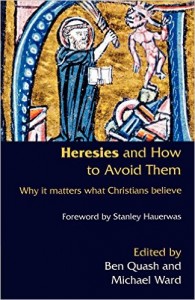 Of course, the exclusion of one doctrine in favor of another is what Christians have called “heresy” from time immemorial; it is the very root definition of the word [See especially: Heresies and How to Avoid Them: Why It Matters What Christians Believe]. The Christian grammar only makes sense when all of its parts are used correctly within their proper context instead of being proof-texted.
All the above factors are the reason why I think it is important to read Obama through a theological lens. That lens helps us to understand the strengths of what he is saying, but also its limitations.
==================
UPDATE: A reader made the following astute objection to my stress upon Obama needing to apologize:
How about the Japanese apologizing for the Rape of Nanking and their treatment of British and Commonwealth and American POWs?
My answer:
How about Cain apologizing to Abel?
What I mean by this is that the process of reconciliation needs to be set into motion by someone gratuitously, that is, with the help of grace. The chain of grievances extends over the whole of human history, because in real life, like in Battlestar Galactica, nobody is totally innocent. That last point is yet another important insight of Original Sin.
Jean Vanier’s wonderful Becoming Human most recently reminded me that it is only by sticking one’s neck out, as one does in the gesture of prayer, that one provides an example for others. The Girardian theologian James Allison calls the working out of this process “the joy of being wrong.”
Therefore, if one lets justice totally trump mercy (a heresy), then the end result is no justice. An Obama apology could have triggered apologies from the Japanese, but now we’ll never know.
==================
For a more solidly philosophically and theologically grounded understanding of the continuing nuclear threat hanging over the world read The Jonah Paradox: Is Humanity Living on Borrowed Time?
==================
Speaking of Love and Theft and the Land of Nod:
https://www.youtube.com/watch?v=afp_kTaksMg
Please consider making a donation to this blog through the donation button on the upper right side of its homepage.
Stay in touch! Like Cosmos the in Lost on Facebook:
Previous Post

May 26, 2016
Jesus Didn't Call God Daddy
Next Post

June 6, 2016 Ever Wonder Why Saint Paul Went to Arabia?
Browse Our Archives
Select a Category #WhyRemainCatholic Abortion Advent Anti-Catholicism Arts Atheism Beauty Benedict XVI Bible Book Review Catholic Cinema Comedy Cosmos: A Space-Time Odyssey Czesław Miłosz Dariusz Karłowicz Devil Easter Eastern Orthodoxy Economics Environment Family Famous Atheists Who Weren't Atheists Guest Post Hans Urs von Balthasar HHS Mandate History Imagination Interview Islam Jean-Luc Marion John Paul II Judaism Just War Lent Literature Little Sisters of the Poor Liturgy Martyrdom Music News Paganism Patristics Phenomenology Philosophy Pierre Hadot Poetry Poland Pop Culture Pope Francis Poverty Prayer Protestantism Rabelais Race Remi Brague Rene Girard Russia Sam Rocha Science & Religion SCOTUS Secularization Sexual Abuse Sexuality Silence Solidarity Stratford Caldecott Synod14 Terrorism Top 10 Uncategorized Walker Percy War Weakened Edition World War II World Youth Day WYD Krakow
Select a Month July 2017 June 2017 May 2017 April 2017 March 2017 February 2017 January 2017 December 2016 October 2016 September 2016 August 2016 July 2016 June 2016 May 2016 April 2016 March 2016 February 2016 January 2016 December 2015 November 2015 October 2015 September 2015 August 2015 July 2015 June 2015 May 2015 April 2015 March 2015 February 2015 January 2015 December 2014 November 2014 October 2014 September 2014 August 2014 July 2014 May 2014 April 2014 March 2014 February 2014 January 2014 December 2013 November 2013 October 2013 September 2013 August 2013 July 2013 June 2013 May 2013
Follow Us!
TAKE THE
Religious Wisdom Quiz
What Christian group is known for singing acapella during worship?
Select your answer to see how you score.
Catholics Churches of Christ Methodists Baptists
Related posts from Cosmos The In Lost

The Surprising Anti-Capitalist Logic Behind the Catholic Church's...

What is the Source of Our Culture of...


The Holy Family as an Icon of World...
TRENDING AT PATHEOS Catholic

Creation, Preservation, and Teleology in Catholic Theology
As I write this, it is very early Monday morning. Like millions...

The Parable Of The Sower And The Word...
One of Christ’s most famous parables is that of the sower who...

Rejecting Doom: Christian Hope And Human Action
Christianity is a religion of hope. We are to have hope and...

Why I Choose the Eucharist Over the Sermon
Choose the Eucharist, Not the Sermon What are we supposed to get...

5 Design Elements Found in Spiritually Rooted Homes
Putting Spirituality Into Home Decor Our homes are more than our living...

Credo: A Story of God Told with the...
About 10 years ago, I began to imagine a personal "Credo" that...
view all Catholic blogs
Ad-Free & Subscriber Log-In Subscription Support
- About Us
- 2026 Calendar
- Videos
- Podcasts
- Library of World Religions
- Faith In Media Tracker
- Advertise With Us
- Write for Us
- Privacy Policy
- Terms of Service
- Do Not Sell My Data
- Contact Us
- Radiant Digital
- Manage Newsletter Subscriptions
- Unsubscribe From Notifications
- Sitemap
Copyright 2008-2026, Patheos. All rights reserved.
Subscription Support Ad-Free & Subscriber Log-In
Follow Patheos