
BuddhistCatholicContemplativeEvangelicalGeneral ChristianHinduJewishLatter-day SaintMuslimNew VisionsProgressive Christian
Beliefs
- Buddhist
- Catholic
- Contemplative
- Evangelical
- General Christian
- Hindu
- Jewish
- Latter-day Saint
- More Voices
- Muslim
- New Visions
- Pagan
- Progressive Christian
Topics
- Religion News
- Food and Religion
- Sports and Religion
- Religious Art
- Religious Music and Entertainment
- Religious Events
- History and Religion
- Style and Religion
- Politics and Religion
- Women in Religion
- Recreation Outdoors and Religion
- Business Finance and Religion
- Careers Workplace and Religion
- Education and Religion
- Family Parenting and Religion
- Health Fitness and Religion
- Home and Religion
- Relationships and Religion
- Technology and Religion
- Travel and Religion
Columnists
- Buddhist Columnists
- Business Finance and Religion Columnists
- Careers Workplace and Religion Columnists
- Catholic Columnists
- Contemplative Columnists
- Education and Religion Columnists
- Evangelists Columnists
- Family Parenting and Religion Columnists
- General Christian Columnists
- Health Fitness and Religion Columnists
- Hindu Columnists
- History and Religion Columnists
- Home and Religion Columnists
- Jewish Columnists
- More Voices Columnists
- Latter Day Columnists
- Muslim Columnists
- New Visions Columnists
- Nonreligious Columnists
- Pagan Columnists
- Politics and Religion Columnists
- Progressive Columnists
- Recreation Outdoors and Religion Columnists
- Relationships and Religion Columnists
- Religion News Columnists
- Religious Art Columnists
- Religious Events Columnists
- Religious Music and Entertainment Columnists
- Sports and Religion Columnists
- Style and Religion Columnists
- Technology and Religion Columnists
- Travel and Religion Columnists
- Women in Religion Columnists
Resource Library
- 2026 Calendar
- Library of World Religions
- The 100 Most Holy Places on Earth
- Patheos Answers
- Podcasts
- Videos
- Faith Leaders Database
- Anglican Episcopalian
- Bahai
- Baptist
- Buddhism
- Christianity
- Confucianism
- Eastern Orthodoxy
- Hinduism
- Holiness and Pentecostal
- ISKCON
- Islam
- Judaism
- Lutheran
- Methodist
- The Church of Jesus Christ of Latter-day Saints
- New Age
- Paganism
- Presbytarian and Reformed
- Protestantism
- Religion Behind the Scenes
- Roman Catholic
- Scientology
- Shia Islam
- Sikhism
- Sufism
- Sunni Islam
- Taoism
- Zen
- See all religions
Research Tools
 Ad-Free & Subscriber Log-In Subscription Support
Ad-Free & Subscriber Log-In Subscription Support
Follow Patheos 

- Trending:
- Forgiveness
- |
- Marriage
- |
- Consciousness
- |
- Death Penalty
- |
- Election
- |
- Halloween
 Cosmos The In Lost
- Home
- Catholic
- Freedom of Religion Isn’t Free
Freedom of Religion Isn’t Free
Last updated on: May 24, 2016 at 5:14 pm by Artur Rosman
Freedom of Religion Isn’t Free 2016-05-24T17:14:26-07:00 Artur Rosman
Patheos Explore the world's faith through different perspectives on religion and spirituality! Patheos has the views of the prevalent religions and spiritualities of the world.

(Goya, Friar Pedro shoots El Maragato as his horse runs off, 1806; Wikimedia, PD-Old-100).
You might think this post will be about how great a price Catholics will have to pay in order to gain back their God-given American “religious freedom.” Instead it is about how great a price there is to pay in being granted “religious freedom” in the way it is understood in modern-day America.
Freedom of religion isn’t free.
The conclusions I draw here grow out of some incisive questions Anne Carpenter of The Rule and the Raven posed to me after reading the post Big Win for Little Sisters is a Huge Loss for Catholicism.
First of all, she wanted to know what Cavanaugh means by religion and why he seems to reject it. He means several things by it. The word “religion” is a homonym, an Aristotelian concept I first encountered in Alexandre Leupin’s Fiction And Incarnation: Rhetoric, Theology, and Literature in the Middle Ages where he defines it as a situation where “a single word designates different ideas and things in a conceptual reapportionment.”
In other words, one word identical word with at least two wildly different meanings. In practice: conceptual (and therefore practical) confusion.
Let’s start with what “religion” has meant in the United States courts since WW2 and increasingly for public debate shortly thereafter.
I will use Cavanaugh’s The Myth of Religious Violence: Secular Ideology and the Roots of Modern Conflict to put these local developments in the understanding of religion in a longer, much longer, historical trajectory. It turns out the American problems with “religious freedom” are a tiny blip on a much bigger radar screen:
In the medieval application of the term, religio was primarily used to differentiate clergy who were members of orders from diocesan clergy. Secondarily, religio named one relatively minor virtue in a complex of other practices that assumed the particular context of the Christian church and the Christian social order. With the dawn of modernity, however, a new concept with a much wider and different significance came to operate under the term religion. Religion in modernity indicates a universal genus of which the various religions are species; each religion comes to be demarcated by a system of propositions; religion is identified with an essentially interior, private impulse; and religion comes to be seen as essentially distinct from secular pursuits such as politics, economics, and the like. The rise of the concept of religion the myth of religious violence thus establishes Christianity’s proper sphere as the interior life, without direct access to the political. As Cantwell Smith remarks in The Meaning and End of Religion, “the rise of the concept of ‘religion’ is in some ways correlated with a decline in the practice of religion itself.” What he means is that the invention of the modern concept of religion accompanies the decline of the church as the public, communal practice of the virtue of religio. The rise of religion is accompanied by the rise of its twin, the secular realm, a pairing which will gradually remove the practice of Christian religio from a central place in the social order of the West.
Think of “essentially interior, private impulse . . .” as you read the following passage from Dignitatis Humanae. It is an exercise indirectly suggested to me by Anne as she asked me whether Cavanaugh rejects the teaching of the Council:
This Vatican Council declares that the human person has a right to religious freedom. This freedom means that all men are to be immune from coercion on the part of individuals or of social groups and of any human power, in such wise that no one is to be forced to act in a manner contrary to his own beliefs, whether privately or publicly, whether alone or in association with others, within due limits.
The council further declares that the right to religious freedom has its foundation in the very dignity of the human person as this dignity is known through the revealed word of God and by reason itself. This right of the human person to religious freedom is to be recognized in the constitutional law whereby society is governed and thus it is to become a civil right.
These pronouncements, if taken without any context whatsoever, sound like what the American courts and lawmakers mean by religion, don’t they?
However, let’s continue reading:
It is in accordance with their dignity as persons-that is, beings endowed with reason and free will and therefore privileged to bear personal responsibility-that all men should be at once impelled by nature and also bound by a moral obligation to seek the truth, especially religious truth. They are also bound to adhere to the truth, once it is known, and to order their whole lives in accord with the demands of truth. However, men cannot discharge these obligations in a manner in keeping with their own nature unless they enjoy immunity from external coercion as well as psychological freedom. Therefore the right to religious freedom has its foundation not in the subjective disposition of the person, but in his very nature.
Not subjective? In keeping with nature? The demands of truth and moral obligations? Religious truth?
What could Catholicism have to do with the essentially irrational interior and private impulses of what the Americans usually define as religion?
Very little.
The contrast between the papist talk about freedom of religion and American freedom of religion sounds very much like we’re dealing with homonyms here.
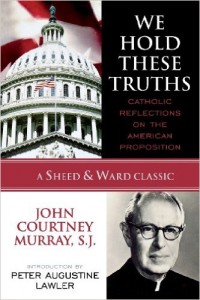
The religion of Vatican II is different than the religion of the HHS Mandate and the Supreme Court (why does SCOTUS sounds so annoying an nominalist?). Unfortunately, identifying the Catholic and the American understandings of religion was the major, one wishes it wasn’t so influential, mistake of John Courtney Murray’s project [See especially: We Hold These Truths: Catholic Reflections on the American Proposition].
By now I hope it is clear that Vatican II was talking about something drastically different than what religion means in the American public square. This is why Cavanaugh makes the following appeal in Field Hospital: The Church’s Engagement with a Wounded World:
To resist the confinement of Christianity to concern with the otherworldly, we need a robust defense of the idea that our God is the God of all creation, and that the gospel is concerned with caring for the flourishing of the whole human person, body and soul. We need more than an appeal to freedom of belief and freedom of conscience; we need to question the modern terms under which Christianity is consigned to one side of the religious/secular dichotomy that has been constructed in liberal society. We need to ask, as Robert Shedinger puts it, “whether the concern so often expressed over the politicization of Islam in the contemporary world ought to be replaced by concern with the ‘religionization’ of Christianity.”
Freedom of religion isn’t free because even if it is granted to Catholicism (God forbid!) it will turn Catholicism into something that it isn’t. There is a price to pay for making Catholicism a private American religious affair.
===============
I recognize there are still many threads to pick up, but I have to get up in the morning and drive nearly two hours to work. Among the hanging threads: a) the social nature of Catholicism b) how the state monopolizes (good) violence because it claims to save its citizens from (bad) religious violence c) how The Myth of American Religious Freedom was frequently used against Catholics d) any further questions, observations, and concerns from you, the reader.
All of this has to wait as I leave you with a well-known clip from The Princess Bride, because it is also about conceptual rigor:
Make sure you also take a look at the post that got me thinking about religion: Big Win for Little Sisters is a Huge Loss for Catholicism.
Stay in touch! Like Cosmos the in Lost on Facebook:
Please consider making a donation to this blog through the donation button on the upper right side of its homepage.
Previous Post
May 22, 2016
TOP10 Books to Build Upon Trinity Sunday
Next Post

May 25, 2016 3 Easy Steps for Beating Amazon.com's Fluctuating Prices
Browse Our Archives
Select a Category #WhyRemainCatholic Abortion Advent Anti-Catholicism Arts Atheism Beauty Benedict XVI Bible Book Review Catholic Cinema Comedy Cosmos: A Space-Time Odyssey Czesław Miłosz Dariusz Karłowicz Devil Easter Eastern Orthodoxy Economics Environment Family Famous Atheists Who Weren't Atheists Guest Post Hans Urs von Balthasar HHS Mandate History Imagination Interview Islam Jean-Luc Marion John Paul II Judaism Just War Lent Literature Little Sisters of the Poor Liturgy Martyrdom Music News Paganism Patristics Phenomenology Philosophy Pierre Hadot Poetry Poland Pop Culture Pope Francis Poverty Prayer Protestantism Rabelais Race Remi Brague Rene Girard Russia Sam Rocha Science & Religion SCOTUS Secularization Sexual Abuse Sexuality Silence Solidarity Stratford Caldecott Synod14 Terrorism Top 10 Uncategorized Walker Percy War Weakened Edition World War II World Youth Day WYD Krakow
Select a Month July 2017 June 2017 May 2017 April 2017 March 2017 February 2017 January 2017 December 2016 October 2016 September 2016 August 2016 July 2016 June 2016 May 2016 April 2016 March 2016 February 2016 January 2016 December 2015 November 2015 October 2015 September 2015 August 2015 July 2015 June 2015 May 2015 April 2015 March 2015 February 2015 January 2015 December 2014 November 2014 October 2014 September 2014 August 2014 July 2014 May 2014 April 2014 March 2014 February 2014 January 2014 December 2013 November 2013 October 2013 September 2013 August 2013 July 2013 June 2013 May 2013
Follow Us!
TAKE THE
Religious Wisdom Quiz
Which empire conquered the Northern Kingdom of Israel?
Select your answer to see how you score.
Egyptian Babylonian Persian Assyrian
Related posts from Cosmos The In Lost

The Surprising Anti-Capitalist Logic Behind the Catholic Church's...

The Holy Family as an Icon of World...

How is Classical Philosophy is Like War?

Why Does the World's Leading Philosopher Remain a...
TRENDING AT PATHEOS Catholic

Creation, Preservation, and Teleology in Catholic Theology
As I write this, it is very early Monday morning. Like millions...

The Parable Of The Sower And The Word...
One of Christ’s most famous parables is that of the sower who...

Rejecting Doom: Christian Hope And Human Action
Christianity is a religion of hope. We are to have hope and...

Why I Choose the Eucharist Over the Sermon
Choose the Eucharist, Not the Sermon What are we supposed to get...

5 Design Elements Found in Spiritually Rooted Homes
Putting Spirituality Into Home Decor Our homes are more than our living...

Credo: A Story of God Told with the...
About 10 years ago, I began to imagine a personal "Credo" that...
view all Catholic blogs
Ad-Free & Subscriber Log-In Subscription Support
- About Us
- 2026 Calendar
- Videos
- Podcasts
- Library of World Religions
- Faith In Media Tracker
- Advertise With Us
- Write for Us
- Privacy Policy
- Terms of Service
- Do Not Sell My Data
- Contact Us
- Radiant Digital
- Manage Newsletter Subscriptions
- Unsubscribe From Notifications
- Sitemap
Copyright 2008-2026, Patheos. All rights reserved.
Subscription Support Ad-Free & Subscriber Log-In
Follow Patheos