
BuddhistCatholicContemplativeEvangelicalGeneral ChristianHinduJewishLatter-day SaintMuslimNew VisionsProgressive Christian
Beliefs
- Buddhist
- Catholic
- Contemplative
- Evangelical
- General Christian
- Hindu
- Jewish
- Latter-day Saint
- More Voices
- Muslim
- New Visions
- Pagan
- Progressive Christian
Topics
- Religion News
- Food and Religion
- Sports and Religion
- Religious Art
- Religious Music and Entertainment
- Religious Events
- History and Religion
- Style and Religion
- Politics and Religion
- Women in Religion
- Recreation Outdoors and Religion
- Business Finance and Religion
- Careers Workplace and Religion
- Education and Religion
- Family Parenting and Religion
- Health Fitness and Religion
- Home and Religion
- Relationships and Religion
- Technology and Religion
- Travel and Religion
Columnists
- Buddhist Columnists
- Business Finance and Religion Columnists
- Careers Workplace and Religion Columnists
- Catholic Columnists
- Contemplative Columnists
- Education and Religion Columnists
- Evangelists Columnists
- Family Parenting and Religion Columnists
- General Christian Columnists
- Health Fitness and Religion Columnists
- Hindu Columnists
- History and Religion Columnists
- Home and Religion Columnists
- Jewish Columnists
- More Voices Columnists
- Latter Day Columnists
- Muslim Columnists
- New Visions Columnists
- Nonreligious Columnists
- Pagan Columnists
- Politics and Religion Columnists
- Progressive Columnists
- Recreation Outdoors and Religion Columnists
- Relationships and Religion Columnists
- Religion News Columnists
- Religious Art Columnists
- Religious Events Columnists
- Religious Music and Entertainment Columnists
- Sports and Religion Columnists
- Style and Religion Columnists
- Technology and Religion Columnists
- Travel and Religion Columnists
- Women in Religion Columnists
Resource Library
- 2026 Calendar
- Library of World Religions
- The 100 Most Holy Places on Earth
- Patheos Answers
- Podcasts
- Videos
- Faith Leaders Database
- Anglican Episcopalian
- Bahai
- Baptist
- Buddhism
- Christianity
- Confucianism
- Eastern Orthodoxy
- Hinduism
- Holiness and Pentecostal
- ISKCON
- Islam
- Judaism
- Lutheran
- Methodist
- The Church of Jesus Christ of Latter-day Saints
- New Age
- Paganism
- Presbytarian and Reformed
- Protestantism
- Religion Behind the Scenes
- Roman Catholic
- Scientology
- Shia Islam
- Sikhism
- Sufism
- Sunni Islam
- Taoism
- Zen
- See all religions
Research Tools
 Ad-Free & Subscriber Log-In Subscription Support
Ad-Free & Subscriber Log-In Subscription Support
Follow Patheos 

- Trending:
- Forgiveness
- |
- Marriage
- |
- Consciousness
- |
- Death Penalty
- |
- Election
- |
- Halloween
 Cosmos The In Lost
- Home
- Catholic
- TOP10 Books to Build Upon Trinity Sunday
TOP10 Books to Build Upon Trinity Sunday
Last updated on: May 24, 2016 at 5:04 pm by Artur Rosman
TOP10 Books to Build Upon Trinity Sunday 2016-05-24T17:04:35-07:00 Artur Rosman
Patheos Explore the world's faith through different perspectives on religion and spirituality! Patheos has the views of the prevalent religions and spiritualities of the world.
![(Andrei Rublev, Old Testament Trinity [detail], 1410; Wikimedia, PD-Old-100).](https://commons.wikimedia.org/wiki/File:Angelsatmamre-trinity-rublev-1410.jpg)
(Andrei Rublev, Old Testament Trinity [detail], 1410; Wikimedia, PD-Old-100).
We must be willing to admit that, should the doctrine of the Trinity have to be dropped as false, the major part of religious literature could well remain virtually unchanged.
–Karl Rahner, The Trinity
I remember being shocked while reading Karl Rahner’s short and dense book on the Trinity as an undergraduate at the University of Washington. Rahner still seemed to be right about the main thrust of Western Christian theology. However, I later came to discover that his critique had trickled down into at least the academic theology of our time. This means that practical changes in emphasis will reach the laity, and perhaps the liturgy, in about fifty years from now.
Those of you reading this post are probably on your way back from a Mass where a sermon on the Trinity was mostly bungled with heavy recourse to the notion of a “unapproachable mystery.” Or you’re reading it a day or two after Trinity Sunday and wondering what the doctrine of the Trinity has to do with your Christian life.
The language of mystery is fine, however, it is mostly translated by postmodern ears as meaning “gibberish that can’t be explained and has no practical bearing on life.” The older notion of mystery is of something that cannot be theoretically explained, yet, it can be inhabited through participation in the Divine Life.
With this in mind I compiled the following booklist for you. I did an informal crowdsourcing survey that confirmed these books should be relatively new to most of you.
Here is how the list is structured:
It starts out with some introductory surveys, moves onto the historical roots of the Trinity, delves into the appropriation of the doctrine into contemporary spirituality, then it bends toward the fruitful contemporary dialogue between the East and West on this topic.
I pray these tomes help you build on Trinity Sunday and deepen your Christian life. I welcome further recommendations in the comments section at the bottom of this post.
I should add that I couldn’t fit in, given the artificial restraints of a TOP10 list, some really interesting sources like Lash’s Believing Three Ways in One God: A Reading of the Apostles’ Creed, Kasper’s The God of Jesus Christ, Congar’s I Believe in the Holy Spirit, Barth’s Church Dogmatics, Vol. 1.1, Sections 8-12: The Doctrine of the Word of God, and LaCugna’s God for Us: The Trinity and Christian Life.
I haven’t read the last three, so at least that’s partially justified.
Enjoy!
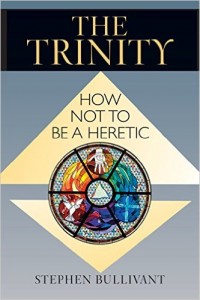 0. The Trinity: How Not to Be a Heretic by Stephen Bullivant
The central idea of this book is that, contrary to popular assumption, the Trinity is a very simple doctrine. It consists of just three short, deeply scriptural convictions: i) There is only one God; ii) Father, Son, and Holy Spirit are all God; and iii) Father, Son, and Holy Spirit are not the same. The Trinity: How Not to Be a Heretic explains how the earliest Christians came to be convinced by each statement, why they matter, and how slowly, over a period of several centuries it found a way of saying all three at once. Its sole purpose is to help Christians of all kinds better understand the Trinity so that they can then help others Christians, non-Christians, and maybe even some not-yet-Christians better understand it too.
 1. The Trinity and the Paschal Mystery: A Development in Recent Catholic Theology by Anne Hunt
Something quite extraordinary has happened in Catholic trinitarian theology in the last thirty years or so: the mystery of the Trinity is being approached by reflection on the paschal mystery of Jesus’ death and resurrection. Astonishing though it may seem, the traditional Augustinian-Thomistic treatment of the trinity made no such direct reference to those Easter events, even though it was through them that Jesus’ disciples came to proclaim that Jesus is Lord and that God is Father, Son, and Holy Spirit. The redemptive significance of Jesus’ death and resurrection was clearly recognized, but not its revelatory significance.
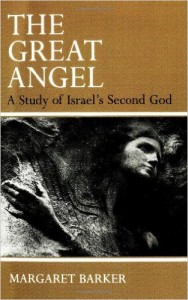 2. The Great Angel: A Study of Israel’s Second God by Margaret Barker
What did “Son of God,” “Messiah,” and “Lord,” mean to the first Christians when they used these words to describe their beliefs about Jesus? In this book Margaret Barker explores the possibility that, in the expectations and traditions of first-century Palestine, these titles belonged together, and that the first Christians fit Jesus’ identity into an existing pattern of belief. She claims that pre-Christian Judaism was not monotheistic and that the roots of Christian Trinitarian theology lie in a pre-Christian Palestinian belief about angels–a belief derived from the ancient religion of Israel, in which there was a “High God” and several “Sons of God.” Yahweh was a son of God, manifested on earth in human form as an angel or in the Davidic King. Jesus was a manifestation of Yahweh, and was acknowledged as Son of God, Messiah, and Lord. Barker relies on canonical and deutero-canonical works and literature from Qumran and rabbinic sources to present her thoughtful investigation.
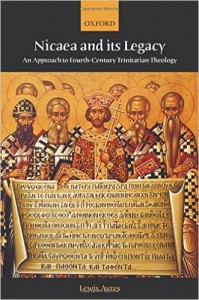 3. Nicaea and Its Legacy: An Approach to Fourth-Century Trinitarian Theology by Lewis Ayres
The first part of the book offers a new narrative of the fourth-century Trinitarian controversies. It takes forward modern revisionary scholarship, showing the slow emergence of the theologies that came to constitute pro-Nicene orthodoxy. Ancient heresiological categories, such as ‘Arian’ and ‘Neo-Arian’, are avoided while the unity of ‘Nicene’ theologies is not assumed. The second part offers a new account of the unity in diversity of late fourth-century pro-Nicene theologies. In particular it is argued that the Nicene-Constantinopolitan creed and the statements of unity and plurality in the Trinity, to be found in all pro-Nicene theologians and in Theodosius’ anti-heretical legislation, were intended to be understood in the context of a broad set of theological practices and assumptions. An account of the basic strategies that ground pro-Nicene theology is offered, focusing on common epistemological concerns, a common notion of purification and sanctification, and a common aesthetics of faith. Instructions are provided detailing the Trinitarian theology of Basil of Caesarea, Gregory of Nyssa, and Augustine of Hippo. Throughout the first two parts of the book, a constant concern is to show that the common acceptance of a basic division between Eastern and Western Trinitarian theologies is unsustainable. Finally, the failure of modern Trinitarian theology to engage pro-Nicene theology in a substantial manner is considered.
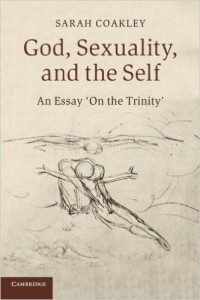 4. God, Sexuality, and the Self: An Essay ‘On the Trinity’ by Sarah Coakley
God, Sexuality and the Self is a new venture in systematic theology. Sarah Coakley invites the reader to re-conceive the relation of sexual desire and the desire for God and – through the lens of prayer practice – to chart the intrinsic connection of this relation to a theology of the Trinity. The goal is to integrate the demanding ascetical undertaking of prayer with the recovery of lost and neglected materials from the tradition and thus to reanimate doctrinal reflection both imaginatively and spiritually. What emerges is a vision of human longing for the triune God which is both edgy and compelling: Coakley’s théologie totale questions standard shibboleths on ‘sexuality’ and ‘gender’ and thereby suggests a way beyond current destructive impasses in the churches. The book is clearly and accessibly written and will be of great interest to all scholars and students of theology.
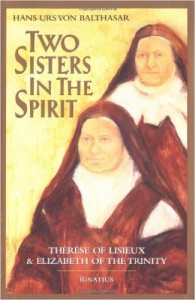 5. Two Sisters in the Spirit by Hans Urs von Balthasar
Balthasar’s unique volume on Thérèse of Lisieux and Elizabeth of the Trinity presents a theological biography of each of these holy Carmelite sisters which gives profound insights into their spirituality, showing that their differences actually complement one another. Balthasar probes the depths of the contemplative mission of each of these young Carmelites who both died in their twenties, and gave powerful witness to the critical importance of contemplation as a means to holiness. Each woman is clearly shown as a daughter of her Carmelite heritage with her own emphasis: Thérèse’s discovery of the “little way of love” and Elizabeth’s focus on the indwelling of God in the soul. He proposes their spiritualities as the only valid answers to Nietzsche’s proclamation of God’s death.
 6. Being as Communion by John Zizioulas
The voice of John Zizioulas may turn out to be the fresh voice for which theology and especially ecclesiology have long been waiting. In the context of a complete theology, which includes extended consideration of the major theological topics the Trinity, Christology, eschatology, ministry, and sacrament, but above all, the Eucharist the author propounds a fresh understanding, based on the early Fathers and the Orthodox tradition, of the concept of person, and so of the Church itself. His consideration of the local church as ‘catholic’ in the literal sense, and the need to understand the universal Church not as a superstructure but as the communion of all Churches, provides the program for the ecclesiology of the future. Yves Congar has written that he considers the author to be ‘one of the most original and profound theologians of our epoch’ and that he ‘presents a penetrating and coherent reading of the tradition of the Greek .”
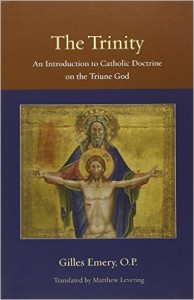 7. The Trinity: An Introduction to Catholic Doctrine on the Triune God by Giles Emery
Representing the highest quality of scholarship, Gilles Emery offers a much-anticipated introduction to Catholic doctrine on the Trinity. His extensive research combined with lucid prose provides readers a resource to better understand the foundations of Trinitarian reflection. The book is addressed to all who wish to benefit from an initiation to Trinitarian doctrine.
The path proposed by this introductory work comprises six steps. First the book indicates some liturgical and biblical ways for entering into Trinitarian faith. It then presents the revelation of the Father, Son, and Holy Spirit in the New Testament, by inviting the reader to reflect upon the signification of the word “God.” Next it explores the confessions of Trinitarian faith, from the New Testament itself to the Creed of Constantinople, on which it offers a commentary. By emphasizing the Christian culture inherited from the fourth-century Fathers of the Church, the book presents the fundamental principles of Trinitarian doctrine, which find their summit in the Christian notion of “person.”
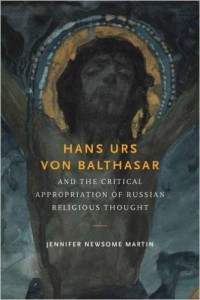 8. Hans Urs von Balthasar and the Critical Appropriation of Russian Religious Thought by Jenny Martin
In Hans Urs von Balthasar and the Critical Appropriation of Russian Religious Thought, Jennifer Newsome Martin offers the first systematic treatment and evaluation of the Swiss Catholic theologian’s complex relation to modern speculative Russian religious philosophy. Her constructive analysis proceeds through Balthasar’s critical reception of Vladimir Soloviev, Nicholai Berdyaev, and Sergei Bulgakov with respect to theological aesthetics, myth, eschatology, and Trinitarian discourse and examines how Balthasar adjudicates both the possibilities and the limits of theological appropriation, especially considering the degree to which these Russian thinkers have been influenced by German Idealism and Romanticism.
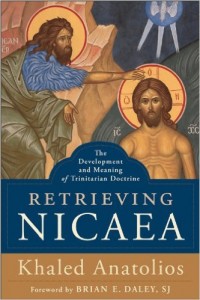 9. Retrieving Nicaea: The Development and Meaning of Trinitarian Doctrine by Khaled Anatolios
Khaled Anatolios, a noted expert on the development of Nicene theology, offers a historically informed theological study of the development of the doctrine of the Trinity, showing its relevance to Christian life and thought today. According to Anatolios, the development of trinitarian doctrine involved a global interpretation of Christian faith as a whole. Consequently, the meaning of trinitarian doctrine is to be found in a reappropriation of the process of this development, such that the entirety of Christian existence is interpreted in a trinitarian manner.
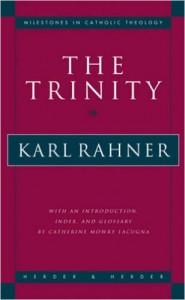 10. The Trinity by Karl Rahner
The ground-breaking treatment of the doctrine of the Trinity by one of the most important theologians of the century is here reprinted on the 30th anniversary of its orginal publication. In this treatise, Karl Rahner analyzes the place of the doctrine of the Trinity within Catholic theology and develops his own highly original and innovative reading of the doctrine, including his now-famous dictum, “the economic Trinity is the immanent Trinity.”
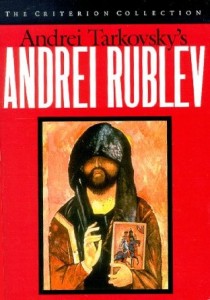 FILM BONUS: Andrei Rublev by Andrei Tarkovsky
Immediately suppressed by the Soviets in 1966, Andrei Tarkovsky’s epic masterpiece is a sweeping medieval tale of Russia’s greatest icon painter. Too experimental, too frightening, too violent, and too politically complicated to be released officially, Andrei Rublev has existed only in shortened, censored versions until the Criterion Collection created this complete 205-minute director’s cut special edition.
It runs three hours in black and white and then culminates in the following scene (not a spoiler!):
You should also take at Top 10 Theology Books of the Last 10 Years (That I’ve Read).
Stay in touch! Like Cosmos the in Lost on Facebook:
Please consider making a donation to this blog through the donation button on the upper right side of its homepage.
Previous Post
May 21, 2016
The Democratic Clown Bus Parks Alongside the GOP Clown Bus . . .
Next Post

May 24, 2016 Freedom of Religion Isn't Free
Browse Our Archives
Select a Category #WhyRemainCatholic Abortion Advent Anti-Catholicism Arts Atheism Beauty Benedict XVI Bible Book Review Catholic Cinema Comedy Cosmos: A Space-Time Odyssey Czesław Miłosz Dariusz Karłowicz Devil Easter Eastern Orthodoxy Economics Environment Family Famous Atheists Who Weren't Atheists Guest Post Hans Urs von Balthasar HHS Mandate History Imagination Interview Islam Jean-Luc Marion John Paul II Judaism Just War Lent Literature Little Sisters of the Poor Liturgy Martyrdom Music News Paganism Patristics Phenomenology Philosophy Pierre Hadot Poetry Poland Pop Culture Pope Francis Poverty Prayer Protestantism Rabelais Race Remi Brague Rene Girard Russia Sam Rocha Science & Religion SCOTUS Secularization Sexual Abuse Sexuality Silence Solidarity Stratford Caldecott Synod14 Terrorism Top 10 Uncategorized Walker Percy War Weakened Edition World War II World Youth Day WYD Krakow
Select a Month July 2017 June 2017 May 2017 April 2017 March 2017 February 2017 January 2017 December 2016 October 2016 September 2016 August 2016 July 2016 June 2016 May 2016 April 2016 March 2016 February 2016 January 2016 December 2015 November 2015 October 2015 September 2015 August 2015 July 2015 June 2015 May 2015 April 2015 March 2015 February 2015 January 2015 December 2014 November 2014 October 2014 September 2014 August 2014 July 2014 May 2014 April 2014 March 2014 February 2014 January 2014 December 2013 November 2013 October 2013 September 2013 August 2013 July 2013 June 2013 May 2013
Follow Us!
TAKE THE
Religious Wisdom Quiz
What does "Gad" mean in Hebrew?
Select your answer to see how you score.
Fortune Warrior Joyful Chosen One
Related posts from Cosmos The In Lost

The Surprising Anti-Capitalist Logic Behind the Catholic Church's...

How is Classical Philosophy is Like War?

Why Does the World's Leading Philosopher Remain a...

Biblical Authority After Babel Cannot Be Built Upon...
TRENDING AT PATHEOS Catholic

The Parable Of The Sower And The Word...
One of Christ’s most famous parables is that of the sower who...

Rejecting Doom: Christian Hope And Human Action
Christianity is a religion of hope. We are to have hope and...

Why I Choose the Eucharist Over the Sermon
Choose the Eucharist, Not the Sermon What are we supposed to get...

5 Design Elements Found in Spiritually Rooted Homes
Putting Spirituality Into Home Decor Our homes are more than our living...

Credo: A Story of God Told with the...
About 10 years ago, I began to imagine a personal "Credo" that...

The Anatomy of Divine Revelation in Catholic Thought
The claim that God has made Himself known to human beings is...
view all Catholic blogs
Ad-Free & Subscriber Log-In Subscription Support
- About Us
- 2026 Calendar
- Videos
- Podcasts
- Library of World Religions
- Faith In Media Tracker
- Advertise With Us
- Write for Us
- Privacy Policy
- Terms of Service
- Do Not Sell My Data
- Contact Us
- Radiant Digital
- Manage Newsletter Subscriptions
- Unsubscribe From Notifications
- Sitemap
Copyright 2008-2026, Patheos. All rights reserved.
Subscription Support Ad-Free & Subscriber Log-In
Follow Patheos