
BuddhistCatholicContemplativeEvangelicalGeneral ChristianHinduJewishLatter-day SaintMuslimNew VisionsProgressive Christian
Beliefs
- Buddhist
- Catholic
- Contemplative
- Evangelical
- General Christian
- Hindu
- Jewish
- Latter-day Saint
- More Voices
- Muslim
- New Visions
- Pagan
- Progressive Christian
Topics
- Religion News
- Food and Religion
- Sports and Religion
- Religious Art
- Religious Music and Entertainment
- Religious Events
- History and Religion
- Style and Religion
- Politics and Religion
- Women in Religion
- Recreation Outdoors and Religion
- Business Finance and Religion
- Careers Workplace and Religion
- Education and Religion
- Family Parenting and Religion
- Health Fitness and Religion
- Home and Religion
- Relationships and Religion
- Technology and Religion
- Travel and Religion
Columnists
- Buddhist Columnists
- Business Finance and Religion Columnists
- Careers Workplace and Religion Columnists
- Catholic Columnists
- Contemplative Columnists
- Education and Religion Columnists
- Evangelists Columnists
- Family Parenting and Religion Columnists
- General Christian Columnists
- Health Fitness and Religion Columnists
- Hindu Columnists
- History and Religion Columnists
- Home and Religion Columnists
- Jewish Columnists
- More Voices Columnists
- Latter Day Columnists
- Muslim Columnists
- New Visions Columnists
- Nonreligious Columnists
- Pagan Columnists
- Politics and Religion Columnists
- Progressive Columnists
- Recreation Outdoors and Religion Columnists
- Relationships and Religion Columnists
- Religion News Columnists
- Religious Art Columnists
- Religious Events Columnists
- Religious Music and Entertainment Columnists
- Sports and Religion Columnists
- Style and Religion Columnists
- Technology and Religion Columnists
- Travel and Religion Columnists
- Women in Religion Columnists
Resource Library
- 2026 Calendar
- Library of World Religions
- The 100 Most Holy Places on Earth
- Patheos Answers
- Podcasts
- Videos
- Faith Leaders Database
- Anglican Episcopalian
- Bahai
- Baptist
- Buddhism
- Christianity
- Confucianism
- Eastern Orthodoxy
- Hinduism
- Holiness and Pentecostal
- ISKCON
- Islam
- Judaism
- Lutheran
- Methodist
- The Church of Jesus Christ of Latter-day Saints
- New Age
- Paganism
- Presbytarian and Reformed
- Protestantism
- Religion Behind the Scenes
- Roman Catholic
- Scientology
- Shia Islam
- Sikhism
- Sufism
- Sunni Islam
- Taoism
- Zen
- See all religions
Research Tools
 Ad-Free & Subscriber Log-In Subscription Support
Ad-Free & Subscriber Log-In Subscription Support
Follow Patheos 

- Trending:
- Forgiveness
- |
- Marriage
- |
- Consciousness
- |
- Death Penalty
- |
- Election
- |
- Halloween
 Cosmos The In Lost
- Home
- Catholic
- The Secular Addiction to the Endtimes (& Scapegoating)
The Secular Addiction to the Endtimes (& Scapegoating)
Last updated on: May 6, 2016 at 8:03 pm by Artur Rosman
The Secular Addiction to the Endtimes (& Scapegoating) 2016-05-06T20:03:31-07:00 Artur Rosman
Patheos Explore the world's faith through different perspectives on religion and spirituality! Patheos has the views of the prevalent religions and spiritualities of the world.
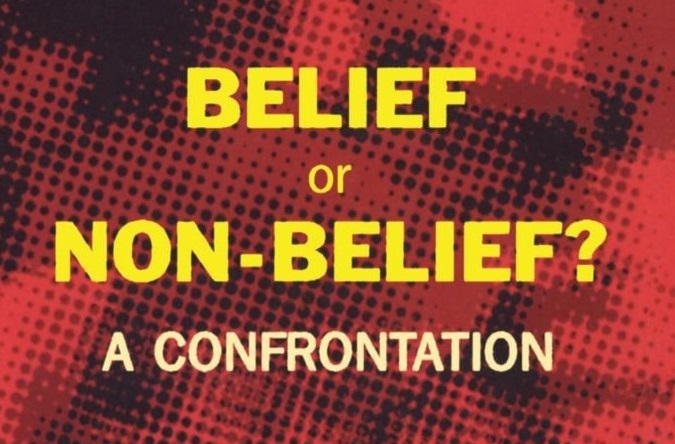
In our case, it is surely obvious that the sudden intensification of our capacity to pick up the eschatological undertones and overtones of the New Testamnt must have something to do with the emerging crisis of European civilization. Since the turn of the [20th] century human minds have been increasingly aware of a decline and fall, like the premonition of some imminent earthquake in world history. The First World War gave this sense its earliest tragic confirmation, undermining as it did so the then dominant theological Liberalism with its optimistic assessement of a purely cultural Christianity. –Joseph Ratzinger, Eschatology: Death and Eternal Life
Our 7 year-old seems to have mixed up the Gospel reading with the readings from the book of Revelation. A couple of Sundays ago after Mass he explained to his sister, “Then Jesus went up on a fiery cross . . . and died.”
You’d think such apocalyptic mixups would be the sole provenance of believers if you only read books such as Cohn’s classic The Pursuit of the Millennium: Revolutionary Millenarians and Mystical Anarchists of the Middle Ages. You might be tempted to say millenarian and apocalyptic thinking is a trap only believers fall into, but, you’d be wrong.
[SIDEBAR: Did you know that Muslims await for Jesus, not Mohammed, to inaugurate the endtimes? That’s just something I learned from a lecture by the author of Islam’s Jesus. One more thing, because of this very eschatological reason there are plenty of Muslims who await the imminent return of Jesus like some off the grid conservative Southern Baptists.]
How wrong would you be? Take a look at any number of atheist blogs (the ones here on Patheos are fuelled by a the run-of-the-mill sensationalism that appeals only to the choir). Or take a look at the increasingly unfunny Stephen Fry as he totally butchers the Enlightenment by a) claiming it exclusively for the non-religious b) naming Kant and Voltaire (believers) as his main Enlightenment heroes c) then does his best to drum up anti-religious paranoia:
Thank Goodness the Enlightenment was much more pluralistic, even Catholic, than this. Granted, it would be difficult to drum up support for one’s weak community without a scapegoat. So I understand Stephen. It is an effective mobilizing tool, even if it appeals to a small group of like-minded people. Religious communities interpret the apocalyptic parts of their Scriptures in this way all the time. That symmetry only goes to underscore, as with the case of “religious” violence, the fact that no group owns this way of thinking and the actions that flow from it–it’s just human.
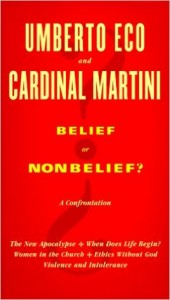
There, I’ve shown you a little bit of how the internet sausage is made. This is how ditto-heads on all the sides get hits: by scapegoating (here I partially return to the topic of yesterday’s post: Rene Girard). I hope you won’t mind if I pull back now and give you something more nourishing to bite into. I have in mind the public exchange of letters between the recently deceased novelist (and agnostic) Umberto Eco and Milan’s Cardinal Martini of blessed memory. In Belief or Nonbelief? Eco discusses the omnipresence of apocalyptic thinking and secularism’s appropriation of it:
No more the seven trumpets, the hailstorm, the sea turned to blood, stars falling from the sky, horses rising in a cloud of smoke from the deepest abyss… In their place: the uncontrolled and uncontrollable proliferation of nuclear waste; acid rain; the disappearing Amazon; the hole in the ozone; the migrating disinherited masses knocking, often with violence, at the door of prosperity; the hunger of entire continents; new, incurable pestilence; the selfish destruction of the soil; global warming; melting glaciers; the construction of our own clones through genetic engineering; and, according to mystical principles of ecology, the necessary suicide of humanity itself, which must perish in order to rescue those species it has already almost obliterated–Mother Earth, denatured and suffocating.
 From this Eco surprisingly comes to this conclusion about apocalyptic thinking:
I’d be willing to bet that the notion of the end of time is more common today in the secular world than in the Christian. The Christian world makes it the object of meditation, but acts as if it may be projected into a dimension not measure by calendars. The secular world pretends to ignore the end of time, but is fundamentally obessed by it. This is not a paradox by a repetition of what transpired in the first thousand years of history.
It’s not that the threats listed above aren’t real, but what matters is humanity’s response to them. As both Martini and Eco point out there is the possibility of responding in hope without being paralyzed for the Christian. However, Eco believes that secularists tend to get stuck in a vicious cycle of denial, because they think they have no recourse to a transcendence that might lessen their burden as they grapple with such immense problems:
One could say even that we live our fear in the spirit of eart, drink, for tomorrow we die, celebrating the end of ideology and solidarity in a whirlwind of irresponsible consumerism. In this way, each one of us flirts with the specter of the apocalypse, exorcising it; the more one unconsciouslyfears it the more one exorcises, projecting it onto the screen in the for of bloody spectacle, hoping in this way to render it unreal. But the power of specter lies precisely in its unreality.
As you can see, the addiction to apocalyptic thinking is not solely religious, but it takes on a unique form of projecting outwards, very much in line with the mechanism of scapegoating, for secular thinking.
On the other hand, the Christian has the possibility of such a turning against the world in despair, or putting their faith in a transcendence that helps to affirm even the tragedies of history meaningful. But I had a further revelation about atheist thinking while reading the collection of conversations with Richard Kearney entitled, Reimagining the Sacred. The conversation with atheist Simone Critchley, author of The Faith of the Faithless (unexpectedly on sale), especially opened up my eyes because he says, “even those who cannot believe still require religious truth and a framework of ritual in which they can believe.” Now that’s going to take a little bit of unpacking in a future post.
I do suspect that maybe his position is closer to what Kearney calls anatheism–a space of conversation where atheists and theists can meet without scapegoating each other, without becoming addicted to violent interpretations of apocalypticism (the default human position, not uniquely religious), but instead putting their faith in a hopeful form of apocalypticism oriented toward self-transcendence and goodwill.
Granted, the differences cannot be papered over either, as they were not in Belief or Nonbelief?, but neither should they hinder conversations like this between believers from vastly different traditions:
You will also want to read through: Anatheism: The Hospitality Before Theism and Atheism
Stay in touch! Like Cosmos the in Lost on Facebook:
Do also take a look at my interview with Charlie Camosy. It will really open your eyes and give you hope: The Anti-Abortion Supermajority: Beyond the Abortion Wars
Please also consider making a donation to this blog through the donation button on the upper right side of its homepage.
Previous Post

May 5, 2016
Cinco de Mayo Especial: The Legacy of Rene Girard
Next Post

May 7, 2016 Trump Sounds Like Derrida When Talking to Woodward about Lincoln & Nixon
Browse Our Archives
Select a Category #WhyRemainCatholic Abortion Advent Anti-Catholicism Arts Atheism Beauty Benedict XVI Bible Book Review Catholic Cinema Comedy Cosmos: A Space-Time Odyssey Czesław Miłosz Dariusz Karłowicz Devil Easter Eastern Orthodoxy Economics Environment Family Famous Atheists Who Weren't Atheists Guest Post Hans Urs von Balthasar HHS Mandate History Imagination Interview Islam Jean-Luc Marion John Paul II Judaism Just War Lent Literature Little Sisters of the Poor Liturgy Martyrdom Music News Paganism Patristics Phenomenology Philosophy Pierre Hadot Poetry Poland Pop Culture Pope Francis Poverty Prayer Protestantism Rabelais Race Remi Brague Rene Girard Russia Sam Rocha Science & Religion SCOTUS Secularization Sexual Abuse Sexuality Silence Solidarity Stratford Caldecott Synod14 Terrorism Top 10 Uncategorized Walker Percy War Weakened Edition World War II World Youth Day WYD Krakow
Select a Month July 2017 June 2017 May 2017 April 2017 March 2017 February 2017 January 2017 December 2016 October 2016 September 2016 August 2016 July 2016 June 2016 May 2016 April 2016 March 2016 February 2016 January 2016 December 2015 November 2015 October 2015 September 2015 August 2015 July 2015 June 2015 May 2015 April 2015 March 2015 February 2015 January 2015 December 2014 November 2014 October 2014 September 2014 August 2014 July 2014 May 2014 April 2014 March 2014 February 2014 January 2014 December 2013 November 2013 October 2013 September 2013 August 2013 July 2013 June 2013 May 2013
Follow Us!
TAKE THE
Religious Wisdom Quiz
Who prepared Jesus' body for burial?
Select your answer to see how you score.
Mary the Mother of Jesus Peter, James, and John Roman Centurions Joseph of Arimathea
Related posts from Cosmos The In Lost

The Surprising Anti-Capitalist Logic Behind the Catholic Church's...

How is Classical Philosophy is Like War?

Why Does the World's Leading Philosopher Remain a...

Atheists Have "National Day of Reason," But American...
TRENDING AT PATHEOS Catholic

Rejecting Doom: Christian Hope And Human Action
Christianity is a religion of hope. We are to have hope and...

It’s What Comes From Within Which Matters
One of the most difficult things for us to understand is why...

Why I Choose the Eucharist Over the Sermon
Choose the Eucharist, Not the Sermon What are we supposed to get...

5 Design Elements Found in Spiritually Rooted Homes
Putting Spirituality Into Home Decor Our homes are more than our living...

Credo: A Story of God Told with the...
About 10 years ago, I began to imagine a personal "Credo" that...

The Anatomy of Divine Revelation in Catholic Thought
The claim that God has made Himself known to human beings is...
view all Catholic blogs
Ad-Free & Subscriber Log-In Subscription Support
- About Us
- 2026 Calendar
- Videos
- Podcasts
- Library of World Religions
- Faith In Media Tracker
- Advertise With Us
- Write for Us
- Privacy Policy
- Terms of Service
- Do Not Sell My Data
- Contact Us
- Radiant Digital
- Manage Newsletter Subscriptions
- Unsubscribe From Notifications
- Sitemap
Copyright 2008-2026, Patheos. All rights reserved.
Subscription Support Ad-Free & Subscriber Log-In
Follow Patheos